Guest Post! Monotheism & D&D (2 of 2)

In the first part of this thought experiment, I focused on how the setting’s true God would function within a monotheistic campaign setting. In this second part, I will focus on what to do about the other gods and goddesses mistakenly worshiped by ignorant PCs and NPCs.

Step #3: The Other Gods and Goddesses

What about the lesser beings mistakenly worshiped as gods and goddesses in your monotheistic campaign setting? In keeping with real-world history, the existence of a true God in your campaign setting doesn’t mean that other religions in the setting suddenly cease to exist. As is the case with other D&D settings, you can still have your monotheistic campaign setting be set in an otherwise predominantly classical pagan world.

Since clerics of other faiths would need to get their divine spells from somewhere (this is a rule that has been present in all the published editions of D&D), it makes sense that these “lesser gods and goddesses” would still exist in the campaign setting. That perhaps could be one of the religious mysteries centered around the true God of your monotheistic campaign: “Why does the true God permit the existence and worship of other gods and goddesses by the ignorant?”

The classical Jewish and Christian understanding of the pagan gods was that, if they actually did exist and simply weren’t made up, they were perhaps higher angelic spirits who rebelled against God and left their assigned posts in the celestial hierarchy. So, perhaps in your monotheistic campaign, the other gods and goddesses were originally high-ranking Celestials assigned to protect individual groups of mortals, but something happened in the mythic past that caused these high-ranking Celestials to be worshiped mistakenly as deities and demigods. Whether it was intentionally done by the Celestials themselves or done first by the mortals can be left up to the GM’s prerogative.

In AD&D’s first and second published editions, a deity’s divine rank (greater, lesser, et cetera) set a limit on the adherent cleric’s granted spells (which before 3rd Edition was limited to the 7th spell level). In an old school style game, perhaps the GM can use this mechanic to differentiate the setting’s true God from the other gods and goddesses. Thus, the true God would be the only available deity who is at the divine rank of “greater deity”. According to the 1st Edition Deities and Demigods handbook, the following information is how cleric spells and patron deities normally operate:

1. All 1st and 2nd level cleric spells are gained through the cleric’s knowledge and faith. 3rd and higher level cleric spells are gained through the act of prayer.

2. 3rd through 5th level cleric spells are granted by the supernatural servants or minions of the cleric’s patron deity. For example, a cleric of a lawful good deity would, after praying, receive his 3rd through 5th level cleric spells through a Celestial creature appointed as the deity’s intermediary to the cleric. These appointed supernatural servants and minions range from creatures to demigods.

3. A cleric whose patron deity is of the demigod rank (and not the lesser god or greater god rank) receives his 3rd through 5th level spells directly from their patron deity. In 1st Edition, a demigod could not grant cleric spells above 5th level.

4. 6th and 7th level spells are granted to clerics directly from their patron deities (in this case being lesser gods and greater gods). In 1st Edition, a lesser god could not grant cleric spells above 6th level; only a greater god could grant 7th level cleric spells.

    In terms of keeping the setting’s true God as the only deity at the divine rank of greater god, the GM could simply downgrade the other gods and goddesses by one divine rank so that none of them rank higher than lesser god. Not only will this make potential clerics of the true God notably stand out when they inevitably appear in the campaign, but the ability to receive 6th level cleric spells from the other gods and goddesses can serve as an in-game incentive for many PCs and NPCs to persist in their ignorance of the setting’s true God being the only deity worthy of worship.

    I now come to the end of my article for this gaming blog. I hope it proves useful to anyone reading it that pondered how to do a monotheistic campaign setting at their gaming table.

    March 24th, 2026  in RPG No Comments »

    Guest Post! Monotheism & D&D (1 of 2)

    (Today’s post is not me, Mark L. Chance, getting back into writing for this site. Rather, it’s Christopher “Giant Boy” Chance stepping in as a guest poster. Huzzah.)

    How One Could Do A Monotheistic Campaign (Part I)

    Greetings, readers of Spes Magna Games. This is Christopher Chance (aka Giant Boy) writing this feature blog post. I have been giving thought to how one could do a monotheistic campaign setting for a D&D campaign, mainly because I wish to encourage fellow Christians to not be afraid of participating in table-top, pencil-and-paper roleplaying games. Here is how I think it could work if you come across players who are either uncomfortable with or don’t want to play in a polytheistic campaign setting.

    Step #1: The GM Gets to Have the Final Say

    This one should be a no-brainer. Yes, healthy gaming groups have a GM who is willing to listen to advice and feedback from his or her players when the situation warrants it, but the players should know and be willing to accept that the GM ultimately has the final say. If the GM does not wish to do a monotheistic campaign, then the players should be willing to accept this. But, if the GM is willing to try their hand at something that seems rare at D&D tables, we should proceed to the next steps.

    Step #2: The One True God

    In a monotheistic campaign setting, the true God (or “High God” if you want to take a henotheistic variant on this idea) needs to clearly stand out from the lesser beings that the ignorant PCs and NPCs in your campaign setting mistakenly worship as gods or goddesses. The true God in a monotheistic campaign not only needs to be a purely spiritual being but also the “Uncreated Creator” of the campaign setting in general. According to classical positions among philosophers, the following would be traits you would need to give your setting’s true God:

    1. Aseity: The setting’s true God does not depend on any cause other than himself for his existence, realization, and end, and has within himself his own reason of existence.

    2. Immutability: The setting’s true God is unchanging in his character, will, and covenant promises.

    3. Impassibility: The setting’s true God does not experience pain or pleasure from the actions of another being.

    4. Ineffability: The setting’s true God surpasses the ability of language to fully express his nature, attributes, motives, et cetera.

    5. Omnibenevolence: The setting’s true God possesses maximum goodness and permits the existence of evil in order to bring a greater good out of it.

    6. Omnipotence: The setting’s true God possesses maximum power and can do all things that are logically possible that do not contradict his other attributes.

    7. Omniscience: The setting’s true God possesses maximum knowledge of all things that are logically possible.

    8. Simplicity: The setting’s true God is a single, unified entity with no distinction between his attributes. He has no parts.

    9. Transcendence: The setting’s true God is completely independent of the material world (e.g., all of Creation itself) and is beyond all physical laws.

      The GM should decide if and when the true God decides to make himself known to the residents of the campaign setting for the purpose of starting an organized religion around him. To make the campaign setting “nice and messy” about which religion is true (as most inhabitants would be ignorant that the true God is the only being worthy of receiving divine worship), the lesser gods and goddesses should have organized religions and cults built up around them as well.

      This brings us to the end of the first part of this thought experiment. In the second part, I will give thoughts on how to handle the lesser gods and goddesses in a monotheistic campaign setting.

      March 12th, 2026  in RPG No Comments »

      Defending Oxonia Nova

      Monday afternoon, I drove over to a friend’s house with my son Christopher and ran a post-apoc game that combines 1978’s Gamma World (GW) with elements from Kevin Crawford’s Ashes without Number (Aw/oN) and Wolves of God (WoG). My friends Mike and his son Peter plus Christopher gave me three players.

      We made up characters, taking note of places where Aw/oN and WoG mentioned rules that required some interpretation to fit into GW‘s framework. All three PCs live and work in Oxonia Nova, a thriving village of about 800 souls. After the Great Event that turned the world into a post-apocalyptic patchwork of isolated communities, demon-haunted urban ruins, and dangerous wilderness full of mutant creatures and magical menaces, the Founders of Oxonia Nova rebuilt civilization along the lines of 8th-century Anglo-Saxon England. Oxonia Nova falls under the jurisdiction of a bishop and includes an Augustinian priory. Able-bodied adult citizens of Oxonia Nova are all part of a sort of reserve guard who regularly take shifts in various ways to protect the town.

      Christopher, Mike, and Peter made up Albertus Magus, a mutant human Galdorman with the priest background; Raedulf, a mutant rat Warrior with the scavenger background; and Robin, a pure strain human Saint with the outcast background. The trio were pulling night guard in the forest covering the steep hillside that flanks one side of Oxonia Nova. During his shift, Raedulf’s acute rat senses caught of whiff of wet fur and leather wafting on the breeze. Raedulf woke up his two comrades, and then the trio moved out as stealthily as possible to investigate.

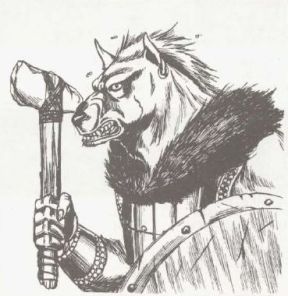
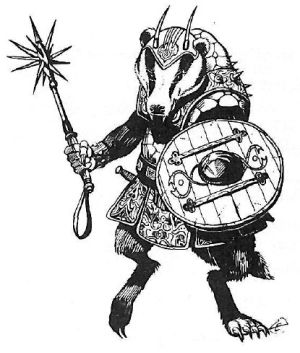
      Raedulf took the lead, getting ahead of two badders and two arks moving cautiously downhill toward the town. Raedulf noted that it is unusual for arks and badders to work together. Albertus and Robin brought up the rear with less stealth than Raedulf, but the pair saw the four mutant animals slip behind cover. From his position, Raedulf saw them ready ranged weapons, thinking to ambush Albertus and Robin.

      The fight that followed was quick and brutal. Raedulf’s razor sharp incisors drew first blood. Albertus summoned a swarm of bees to attack the ark that was barking orders to the other three. Robin threatened divine judgement while promising divine forgiveness should the badders repent of their alliance with the arks. The second ark, seeing the leader swarmed by bees and the badders hesitating to act, used his life leech mutation to kill the bees and the badders while damaging everyone – friend or foe – in a 30 meter radius. Bolstered with more than 40 extra hit points, the ark then fled. Albertus took wing (because he has functional, bat-like wings) and set the fleeing ark ablaze.

      Having captured the ark leader, the PCs discovered a large concentrated damage pack (a type of bomb) on the leader’s person. Interrogation revealed some troubling information:

      1. The mutant animals were heading to a tower close to town that is part of the aqueduct system that channels rain from the hill to cisterns in town.
      2. A traitor in the tower was supposed to let the mutant animals in to plant the concentrated damage pack.
      3. The mutant animals belong to the Ranks of the Fit, a neo-Nazi mutant animal supremacist group.

      With all that accomplished, we called the game session to a close and made plans to meet again to continue the adventure.

      November 25th, 2025  in RPG No Comments »

      Giant Mutant Sea Snails!

      So, I’m just going to pretend that I haven’t posted anything since July 2025. That’s easier than making excuses.

      Ludi Fabularum, the game club I facilitate where I teach, continues to grow. I’ve got more than 20 middle school boys playing Castles & Crusades in a shared campaign world. The boys are divided into four groups. After Thanksgiving break, these groups branch out from Junnmiv, the campaign’s central community, ready to investigate various problems ranging from livestock-stealing stealth humanoids to a city in the mountains that is said to have appeared from nowhere. Three 8th graders help with the GMing.

      At home, my Storm Clouds Gather and Heroes of Tejas City campaigns have run into issues. The former is down to two players as our third has had to drop out due to Real Life. The latter has gone into suspended animation because I kept running into a lack of time to prep for the sessions. The heroes did manage to defeat the machinations of Pulcinella and his cabal of villains, but Pulcinella escaped capture.

      Since I’m off work this week, tomorrow I’m heading over to a friend’s house with my son Christopher to run a post-apoc game that combines 1978’s Gamma World with elements from Kevin Crawford’s Ashes without Number and Wolves of God. Everything Kevin Crawford writes is RPG gold. If I had few hundred extra dollars just laying around, I’d likely spend it on Sine Nomine Publishing print-on-demand books.

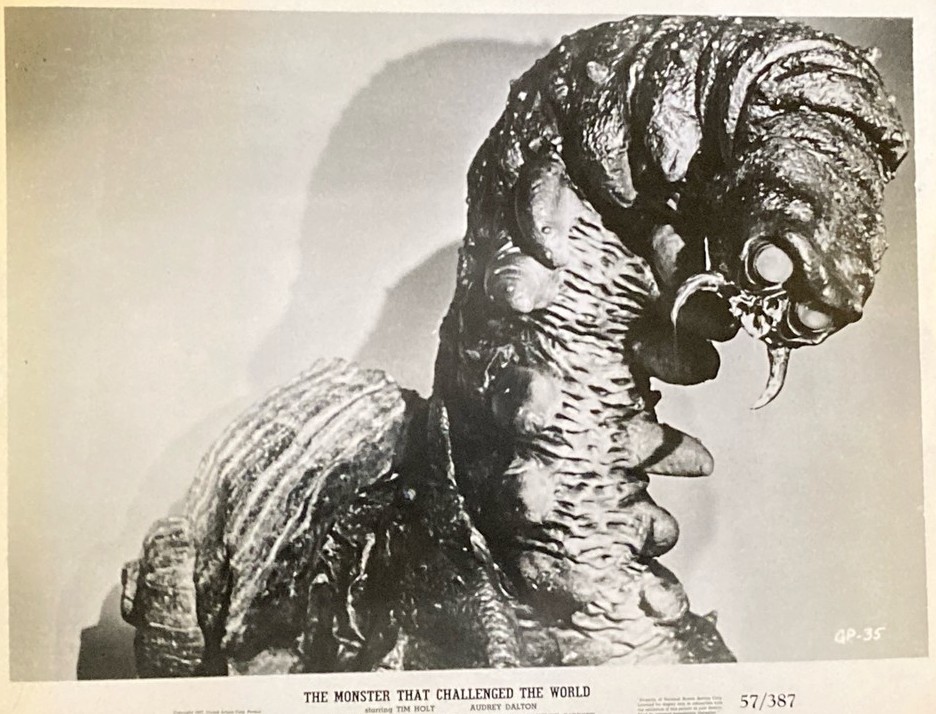
      And, since it’s been a few years since I posted anything B-movie related, here’s a new mutant animal inspired by 1957’s classic The Monster That Challenged the World. If you’ve not seen this one, you own it to yourself and all your friends to host a viewing to thrill at the only movie ever made with both giant, flesh-eating sea snails and Chekov’s thermostat.

      Syrinx
      No. Appearing: 1-10
      Armor Class: 2 or 6
      Movement: 3/6 swimming
      Hit Dice: 12

      The syrinx is an enormous sea snail. Fully grown, its shell is about 2 meters across. Attacks against the shell are versus AC 2 and only inflict half damage. The syrinx’s body is slimy and caterpillar-like, capable of extending 3 meters from its shell. The body’s rugged hide is AC 6, and attacks against it inflict normal damage. The syrinx has ultravision. Its powerful mandibles bite for 1-12 points of damage. The mucus that covers its body is an intensity 12 poison that kills by asphyxiation. Each syrinx is a hermaphrodite, capable of fertilizing itself. A syrinx lays a clutch of several hundred eggs over a period of several days in the late summer months.

      November 23rd, 2025  in RPG No Comments »

      Bayou of Feathers 6: What’s Where?

      Earlier this week, I whipped out Atelier Clandestin‘s Sandbox Generator and went hex-by-hex to determine the main feature in each hex. (Nota Bene: That product link is still an affiliate link. If you click and purchase, I get a small bit of pocket change.) The results are shown below.

      I only tweaked two of the randomly generated features. In Hex 19, there was a repeat of a feature having something to with upcoming weather. Since Hex 8 ended up with a randomly generated “Mycelial Proliferation”, I decided to repeat that result in Hex 19. The second tweaked location is Hex 6, since that’s where I put Unvary-by-Water.

      Recall that each hex is 2 miles across. That’s about 10.4 square miles per hex, which might seem small. To get some perspective, imagine that someone stole a vehicle and put it somewhere in 10.4 squares miles of forest. It can take a search party a few hours to cover just one square mile of terrain. If you can’t follow the vehicle tracks leading in, you’re facing a potentially lengthy search.

      So, what noteworthy features did I randomly generate?

      1. There’s only one other settlement in the region: Nisme-on-the-Hill, a hamlet notable for its tourney grounds. This tells me a couple of things. The were-alligators are not refugees from Nisme. Also, there must be larger communities that include knights somewhere outside the center group of hexes. Nisme could be a stopping point on a commonly traveled road.

      2. There are several features both artificial and natural that contain hints about other things. Two of them have clues about a magic weapon. If both are about the same weapon, perhaps these clues are there because adventurers seeking the weapon met some grim fate in Hexes 3 and 13?

      3. Three of the results deal with fungus. Hexes 8 and 18 have proliferations of mycelium. Hex 12 has a hallucinogenic spore hazard. These hexes are not that close to each other. Is there a sort of fungus that proliferates when a certain sort of weather is imminent? Does this fungus mature and release hallucinogenic spores?

      4. There is a group of orcs camped in Hex 19. Are they responsible for the heads on spikes in Hex 2?

      5. A wolf pack hunts near a wooden fence in Hex 4. Why is there a wooden fence?

      6. Who excavated the quarry in Hex 10?

      7. Bandits and beastmen lair in Hexes 15 and 17, respectively. The bandits are close to both Nisme and Unvary. Do they prey on travelers passing through Nisme to points beyond?

      8. There are five dungeons in the region: The Chambers of Twilight (Hex 5), The Haunted Tombs (Hex 7), The Infernal Burrows (Hex 11), The Haunted Pits (Hex 14), and The Crumbling Chambers (Hex 16).

        Whew! That’s a lot potential plot hooks in about 200 square miles of territory, and this is only one cluster of hexes. There are six other clusters, yielding about 1,100 square miles of territory.

        July 3rd, 2025  in RPG No Comments »