Posts Tagged ‘ Bayou of Feathers ’

Bayou of Feathers 6: What’s Where?

Earlier this week, I whipped out Atelier Clandestin‘s Sandbox Generator and went hex-by-hex to determine the main feature in each hex. (Nota Bene: That product link is still an affiliate link. If you click and purchase, I get a small bit of pocket change.) The results are shown below.

I only tweaked two of the randomly generated features. In Hex 19, there was a repeat of a feature having something to with upcoming weather. Since Hex 8 ended up with a randomly generated “Mycelial Proliferation”, I decided to repeat that result in Hex 19. The second tweaked location is Hex 6, since that’s where I put Unvary-by-Water.

Recall that each hex is 2 miles across. That’s about 10.4 square miles per hex, which might seem small. To get some perspective, imagine that someone stole a vehicle and put it somewhere in 10.4 squares miles of forest. It can take a search party a few hours to cover just one square mile of terrain. If you can’t follow the vehicle tracks leading in, you’re facing a potentially lengthy search.

So, what noteworthy features did I randomly generate?

1. There’s only one other settlement in the region: Nisme-on-the-Hill, a hamlet notable for its tourney grounds. This tells me a couple of things. The were-alligators are not refugees from Nisme. Also, there must be larger communities that include knights somewhere outside the center group of hexes. Nisme could be a stopping point on a commonly traveled road.

2. There are several features both artificial and natural that contain hints about other things. Two of them have clues about a magic weapon. If both are about the same weapon, perhaps these clues are there because adventurers seeking the weapon met some grim fate in Hexes 3 and 13?

3. Three of the results deal with fungus. Hexes 8 and 18 have proliferations of mycelium. Hex 12 has a hallucinogenic spore hazard. These hexes are not that close to each other. Is there a sort of fungus that proliferates when a certain sort of weather is imminent? Does this fungus mature and release hallucinogenic spores?

4. There is a group of orcs camped in Hex 19. Are they responsible for the heads on spikes in Hex 2?

5. A wolf pack hunts near a wooden fence in Hex 4. Why is there a wooden fence?

6. Who excavated the quarry in Hex 10?

7. Bandits and beastmen lair in Hexes 15 and 17, respectively. The bandits are close to both Nisme and Unvary. Do they prey on travelers passing through Nisme to points beyond?

8. There are five dungeons in the region: The Chambers of Twilight (Hex 5), The Haunted Tombs (Hex 7), The Infernal Burrows (Hex 11), The Haunted Pits (Hex 14), and The Crumbling Chambers (Hex 16).

    Whew! That’s a lot potential plot hooks in about 200 square miles of territory, and this is only one cluster of hexes. There are six other clusters, yielding about 1,100 square miles of territory.
    July 3rd, 2025  in RPG No Comments »

    Bayou of Feathers 5: Region Map

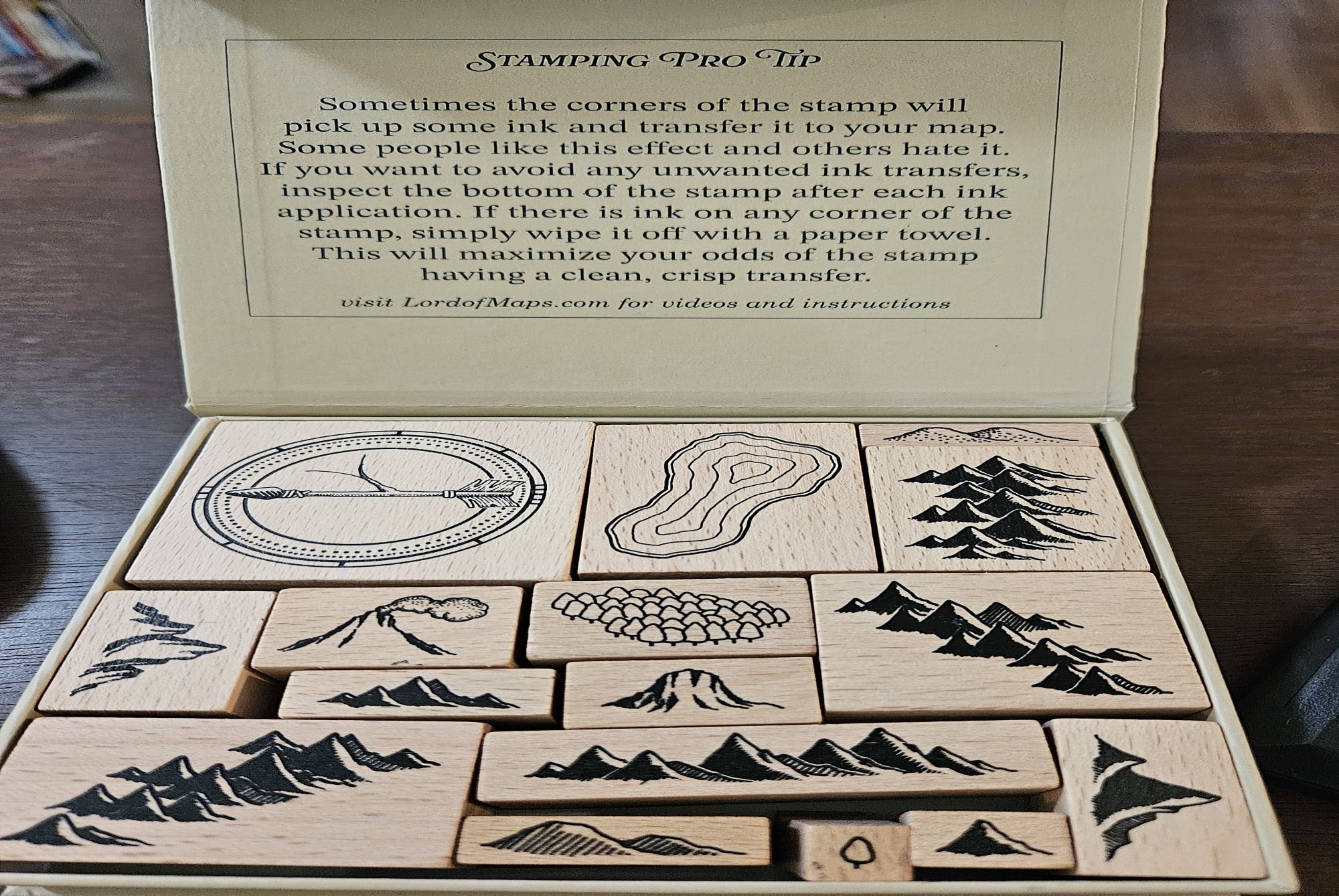
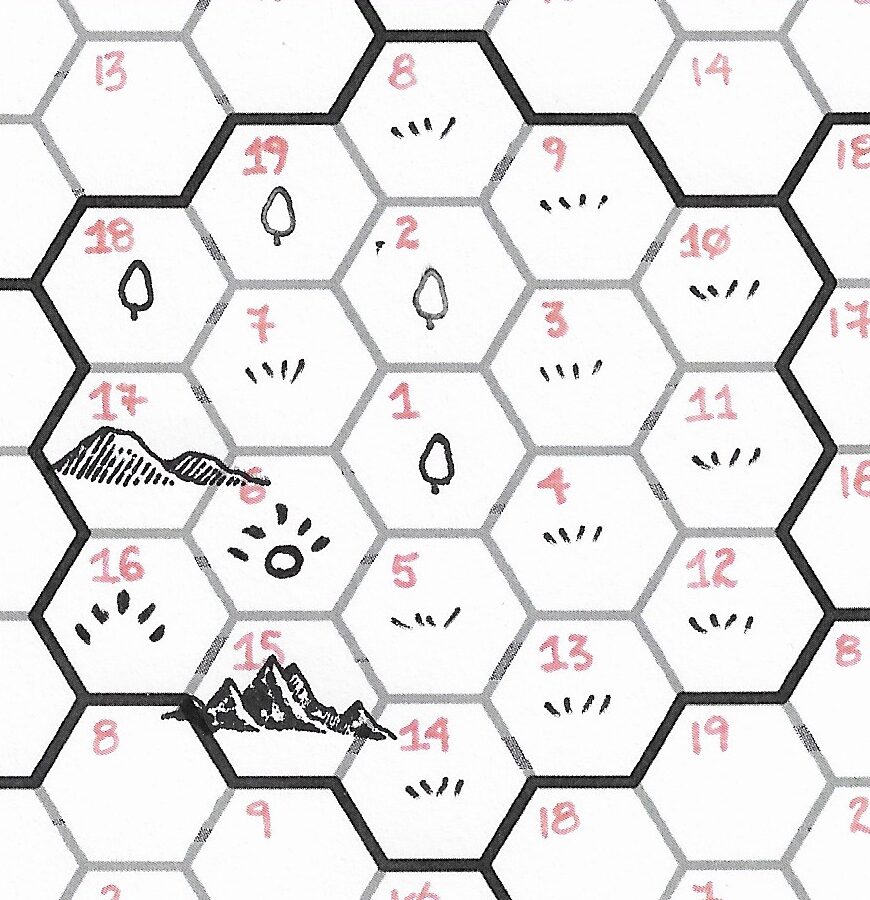
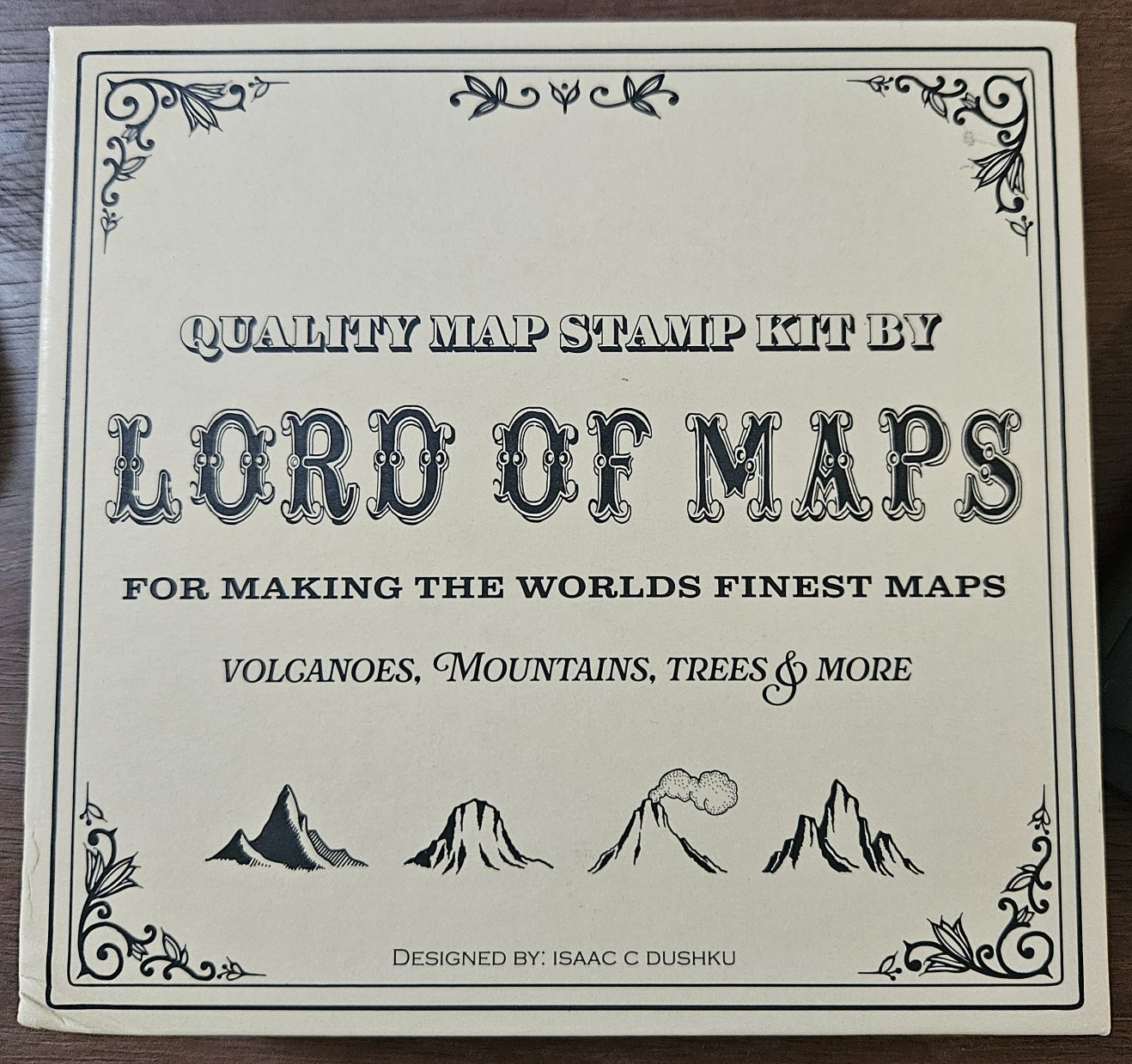
    A short post for today, but one that features the start of the hexcrawl map for the group of center hexes that includes Unvary-by-Water in hex 6. The mountains, hills, and forest hexes were marked using a set of delightful stamps I purchased from Lord of Maps. The Map Making Stamp Kit shown in the picture has sixteen pieces. There’s also an Expansion Pack available, but I’ve not purchased it…yet.

    Since I don’t yet have stamps for grasslands and swamps, I drew those by hand. The circle in hex 6 indicates that Unvary-by-Water is located there. I would have colored the map, but all of my coloring pencils are in storage in my classroom. I thought I had a set here at home, but, alas! and alack!, I was wrong.

    Next up? I need to randomly generate the key features of all the other hexes in the region. I hope to have that done and posted this coming Wednesday.

    June 30th, 2025  in RPG No Comments »

    Bayou of Feathers 4: Some Geology

    As mentioned in the first post about the Bayou of Feathers:

    Legend says that Droainon, Goddess of Water and Sorrow, created the Bayou of Feathers as a gift for Tronsos, God of Thieves and Beauty, who failed to be moved by Droainon’s display of unrequited love. The region had been rolling plains and forests divided by a mighty river. Droainon dammed the river with great granite blocks decorated with an enormous bas-relief of thousands of birds in flight. Hurt by Tronsos’s derision at her gift, Droainon wept bitter tears into the bayou’s waters, and these tears turned the water brackish and pestilential.

    Despite these adverse conditions, a group of refugees have settled in the Bayou, taking residence on a small group of a islands:

    Refugees fleeing a nearby region have moved into the Bayou of Feathers, encamping a few clustered islands. The establishment of their new community has not been easy. The bayou’s waters are not safe to drink unless properly treated; what’s more, the brackishness makes agriculture difficult.

    In the following two posts, I determined that the refugees are were-alligators. This throws a new light on the situation. The brackish water is not a problem for were-alligators, who are primarily carnivorous, thus alleviating the problems that agriculture might suffer. Also, alligators have immune systems well-adapted to swampy environments. So, the plethora of parasites and diseases in the Bayou are not a major concern either. It stands to reason that the refugees chose wisely the Bayou of Feathers. It is something akin to a paradise for were-alligators.

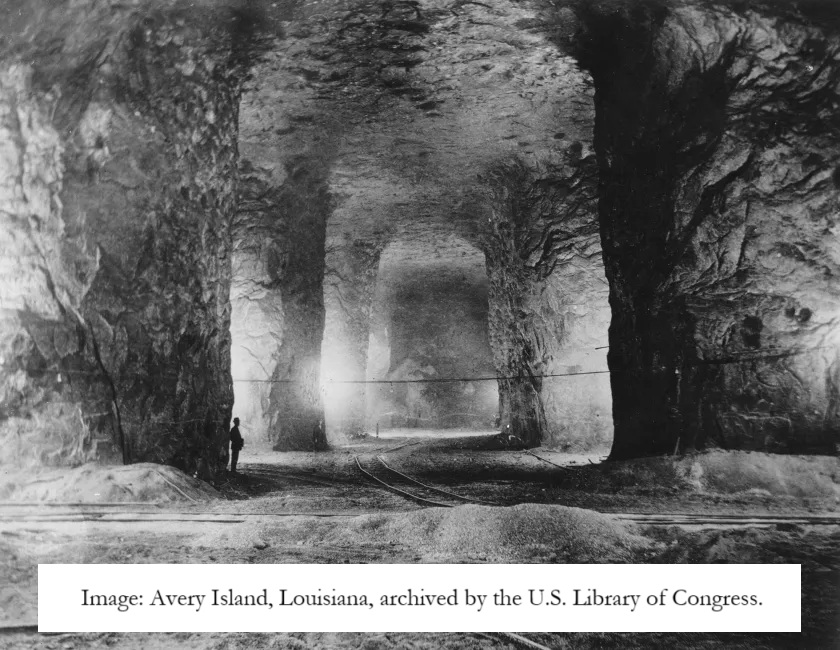
    Over the weekend, my lovely wife Katrina and I visited Avery Island in Louisiana. I learned new things, chief of which for this post is that Avery Island sits atop a salt dome. One or more the refugees’ islands also sit above a salt dome, which both provides a natural explanation for the brackish waters and also gives the were-alligators control of a vital resource. That’s right. The were-alligators also mine salt, which is high value export.

    As for the were-alligators themselves, I don’t see any reason why they ought to be especially evil. The accusations of cannibalism against them could be true, but what if the refugees only ate those who attacked their community? Under the best of circumstances, cannibalism is socially tricky, but defensive cannibalism could be a bit more palatable. What’s more, the were-alligators have left their belligerent neighbors to settle in an area with no human population, which makes defensive cannibalism unnecessary.

    The refugees are not wicked people. They want to be left alone, to raise their families, et cetera. The bulk of the were-alligator community is somewhere near neutral in terms of alignment.

    And last, there’s this: When reviewing my previous Bayou of Feathers posts, I reminded myself that I promised a hex map of the region. I need to get to work on that so that maybe – just maybe – I can get it posted later this week.

    June 23rd, 2025  in RPG No Comments »

    Bayou of Feathers 3: Unvary-by-Water

    Since the settlement of refugees in the Bayou of Feathers needs a name and other information, I put off adding more detail to the region’s hexes and turn to page 27 in Atelier Clandestin‘s Sandbox Generator.

    (Nota Bene: That product link is still an affiliate link. If you click and purchase, I get a small bit of pocket change.)

    The refugees live in a hamlet, the smallest settlement type. I roll 1d30 to determine the pattern for the hamlet’s name, getting a 12. The name pattern is “D-by-sea”, where D is the component table on which I roll next, which means roll 1d24. I do, and I get a 20.

    The refugees’ hamlet is Unvary-by-sea, but since they’re not by a sea, I tweak it a bit to Unvary-by-Water. Since I’ve said that Unvary-by-Water occupies “a few clustered islands”, I’ll also roll 1d3+2 to determine the number of islands. Unvary-by-Water is divided between four small islands.

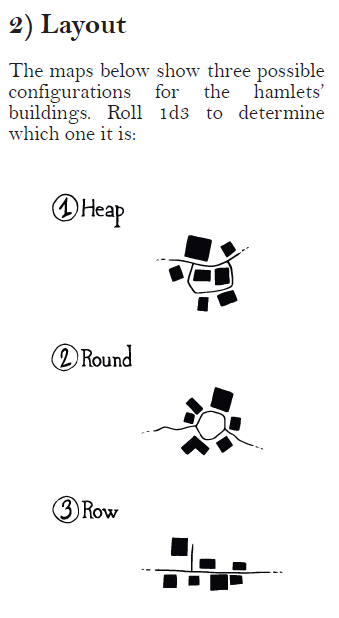
    Next I turn to the section on hamlets. I roll 1d12 for the main building, 1d3 for layout, 2d6 for disposition, and 1d6 for a secret, doing so for each of the four islands. The results are as follows:

    Island One: 12, 3, 7, 1
    Island Two: 9, 2, 5, 5
    Island Three: 2, 3, 9, 2
    Island Four: 4, 3, 4, 6

    This means:

    Island One has a watchtower. The layout is a row. The residents’ disposition is neutral, and they are secretly cannibals.

    Island Two has a tavern. The layout is round. The residents’ disposition is neutral, and they are secretly lycanthropes or vampires.

    Island Three has a chapel. The layout is a row. The residents’ disposition is welcoming, and they are secretly cultists.

    Island Four has a manor. The layout is a row. The residents’ disposition is hostile, and they are secretly murderers.

    Since all four islands are really the same community, these results call for some interpretation. In general, the residents of Unvary-by-Water are neutral toward visitors. I’ve overlap between cannibal, lycanthrope or vampire, and murder. I don’t like the vampires choice, which leaves lycanthropes. But what kind of lycanthrope? Since they’ve relocated to a marsh, the obvious-to-me choice is the alligator. So, the community of refugees turn out to be a cult of were-alligators who fled into the Bayou of Feathers so that they could both practice the rituals of their alligator cult and occasionally devour travelers in relative peace.

    Well, I did not expect the refugee community to end up like that!

    This is the great virtue of relying on a combination of random tables and GM fiat. The tables suggest combinations of traits that I doubt I would have come up with on my own. This makes the unfolding hexcrawl world both a surprise to GM and player alike.

    June 12th, 2025  in RPG No Comments »

    Bayou of Feathers 2: Sandbox Generating

    If you don’t have Atelier Clandestin‘s Sandbox Generator, you ought to check it out. I purchased the PDF and printed it, hole-punching the pages to fit in a three-brad folder. I used Sandbox Generator (SG hereafter) with my groups of student players last school year, and it was great fun for them and me.

    (Nota Bene: The product link in the previous paragraph is an affiliate link. If you click and purchase, I get a small bit of pocket change.)

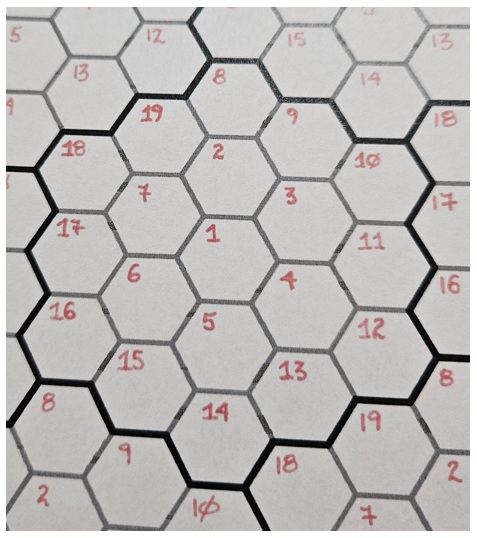
    The centerpiece of SG is the hex map. With my students, I used the pictured hex map. Seven clusters of 19 hexes each make up the map, and each hex is two miles across. A section of the map template I used with my student groups can be seen right to the right. There are six clusters of hexes surrounding the 19 hexes of the center cluster.

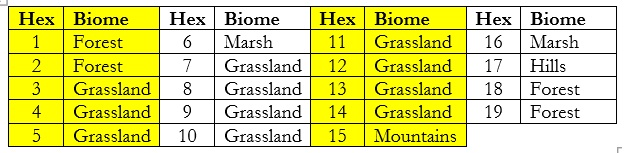
    The first step for a cluster? Determining the biome for each 2-mile hex. SG‘s biomes are determined by first rolling 1d10 for the starting hex. After this, I roll 1d10 on the “Next hexes” chart, which yields a 50% chance of repeating the previous hex’s biome.

    For example:

    The table above shows the unedited results of 19d10 rolls. Most of the region is grassland surrounding a stretch of forest that starts in the center hex and extends to the north and northwest. There are more forests and some mountains in the southwest as well as hills in the west.

    Linking this to my previous post about the Bayou of Feathers, the lack of marshlands becomes noticeable. This isn’t a problem. I can edit the biomes as I see fit. I change hexes 6 and 16 to marsh, sandwiching the biome between the mountains and the hills in hexes 15 and 17, respectively. Thus:

    This puts last post’s community of refugees somewhere within about 21 square miles of marshland situated in the southwest of the center cluster of hexes on my sandbox map.

    In the next post in this Bayou of Feathers series, I’ll randomly generator features for 18 of the 19 hexes in the center cluster. Either hex 6 or 16 will be location of the refugee community, which really does need a name.

    June 11th, 2025  in RPG No Comments »