Posts Tagged ‘ monsters ’

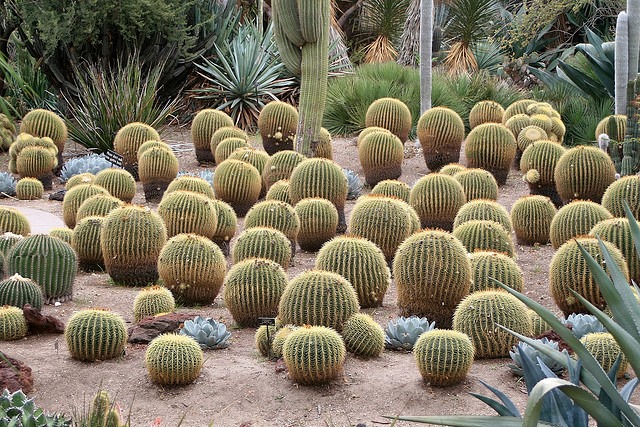
Dangerous Barrel Cacti

A post for today featuring yet another new AD&D monster? Can do easy!

Zeni
Frequency: Uncommon
No. Appearing: 4-24
Armor Class: 8, 6, or 4 (see below)
Move: up to 12″
Hit Dice: 1+1 to 3+3
% in Lair: Nil
Treasure Type: Nil
No. of Attacks: 1
Damage/Attack: See below
Special Attacks: See below
Special Defenses: See below
Magic Resistance: Standard
Intelligence: Animal
Alignment: Neutral
Size: S to L (3′ diameter per HD)
Psionic Ability: Nil
Attack/Defense Modes: Nil
Level/XP Value: 1+1 HD (III/56 + 2/hp), 2+2 HD (III/95 + 3/hp), 3+3 HD (IV/160 + 4/hp)

Zenis resemble ordinary barrel cacti, at least until they attack or move. These carnivorous plants move via rolling, and it takes time for them to build up speed. On the first round, zenis roll at 3″, and this speed increases by 3″ per round until a maximum speed of 12″ is reached.

As zenis increase in size, their exteriors become thicker and more resistant to injury. The smallest zenis are AC 8. Medium-size zenis are AC 6, and the largest zenis are AC 4.

Zenis attack one of two ways: rolling into their prey or by releasing a cloud of spines. A creature struck by a rolling zeni takes damage based on the zeni’s size and speed. A 1+1 hit die zeni inflicts 1-4 points of damage. This damage increases to 2-8 points for a 2+2 hit dice zeni and to 3-12 points for a 3+3 hit dice zeni. The monster inflicts additional damage equal to its movement rate divided by 3. So, a 3+3 hit dice zeni moving at 9″ inflicts 6-15 points of damage when it rolls into a creature. If the creature struck by a rolling zeni is not larger than the zeni, the creature may be knocked down unless it succeeds on a saving throw versus breath weapon. The saving throw is made with a +4 modifier if the creature is same size as the zeni.

Usually after it rolls into its prey, a zeni releases a cloud of spines. Each spine has wing-like structures that enable it to buzz about much like an insect. The spines fill a sphere in a 10-foot radius around the zeni. Creatures within the cloud sustain 1 hit point of damage for each melee round they remain in it, regardless of armour class. The referee will cause all creatures with one or fewer hit dice to check morale. Fire will force the spines back to their zeni, and a fireball clears the spines from its blast area. The spines lasts for up to 2 melee rounds for each of the zeni’s hit dice, and then they return to their zeni.

Zenis take half damage from lightning attacks. They are immune to fear, poison, and paralysis.

July 27th, 2020  in RPG No Comments »

Kill It With Fire!

On the Facebook, Luke Gygax posted, “Great job to Melf And The Green Arrows! Our Founders & Legends III Team broke the $6,000 mark! I’m so happy!”

Great job, indeed! I know my post about Founders & Legends III didn’t offer a glowing account of my limited experience with the on-line convention, but $6+K for Extra Life? That’s the icing on the cake and the cake, too.

On to another topic: It’s been months since I posted a new monster for AD&D. That doesn’t seem right. So, to honor the for-sale-via-Etsy tick horror, here we go.

Sceartán
Frequency: Very rare
No. Appearing: 2-12
Armor Class: 7
Move: 3″ (3″)
Hit Dice: 3-5
% in Lair: 5%
Treasure Type: Nil
No. of Attacks: 1
Damage/Attack: 2-5
Special Attacks: See below
Special Defenses: Nil
Magic Resistance: Standard
Intelligence: Low
Alignment: Neutral evil
Size: S
Psionic Ability: Nil
Attack/Defense Modes: Nil
Level/XP Value: 3 HD (III/80 + 3/hp), 4 HD (III/135 + 4/hp), 5 HD (IV/210 + 5/hp)

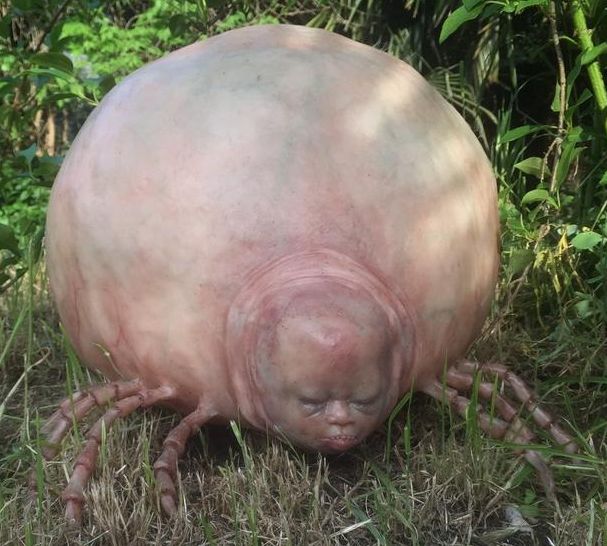
Sceartáns resemble bloated, fleshy ticks with the distorted faces of pudgy infants. They hunt forests, lairing in constricted burrows that some of the time lead to caves or caverns. These horrid things seek to drop upon prey or burst from hiding. They surprise others on a 1-4, and they treat falls as 20 feet shorter than actual for determining falling damage.

When sceartáns rush their prey, they double their movement rate for 1-4 melee rounds. Sceartáns attack via a long, hollow tongue that ends in a jagged spike. A hit by a sceartán scores 2-5 points of damage and indicates the monster has attached itself. Each melee round thereafter it drains 1-6 hit points of blood, until reaching satiation at a blood drain equal to its hit points. The sceartán then detaches and attempts to scurry for safety to slowly digest its meal. A sceartán must be killed, severely burned, or splashed with holy water to detach it prior to satiation. Holy water does not damage sceartáns, but they find the substance noxious.

If a sceartán is forcibly detached, its victim must make a saving throw versus poison. Failure indicates that part of the sceartán’s tongue spike breaks off in the victim’s body. The fragment wriggles deeper into the wound unless extracted within one melee round (causing 1-4 points of damage to the victim). Otherwise, only a cure disease spell prevents the fragment from reaching the victim’s heart and causing death in 1-3 turns.

July 23rd, 2020  in RPG No Comments »

The Goblins Swarm!

I dig goblins. They’re great little monsters. I liked them way back in may OD&D and AD&D days. When I got my hands on TSR’s excellent Oriental Adventures, I came to love goblins more thanks to the bakemono, those “cousins to the western goblins”. The bakemono are cool because “unlike the goblin, [they] come in a variety of differents shapes and sizes. No two [bakemonos] are alike.”

I have several goblin-related posts. There are the bakemono for the wonderful Fate Accelerated. For 5E D&D, I have ash goblins, goblin hags, two-headed goblins, and arctic charvogs. For AD&D and 5E, I’ve got goblin bombers. For OSR games, I’ve got That’s a Goblin!?, a supplement that presents 23 goblin mutations, 15 fey goblin abilities, 3 goblin subspecies, and 6 goblin tactical specialties.

And, for today, I’ve got the goblin swarm.

Large swarm of Small humanoids (goblinoids), neutral evil

Armor Class 15 (leather armor, shield)
Hit Points 44 (8d10)
Speed 30 ft.

STR 14 (+2), DEX 14 (+2), CON 10 (+0), INT 10 (+0), WIS 8 (-1), CHA 8 (-1)

Skills Stealth +4
Damage Resistances bludgeoning, piercing, slashing
Condition Immunities charmed, frightened, grappled, paralyzed, petrified, prone, restrained, stunned
Senses darkvision 60 ft., passive Perception 9
Languages Common, Goblin
Challenge 4 (1,100 XP)

Nimble Escape. The goblin bomber can take the Disengage or Hide action as a bonus action on each of its turns.

Swarm. The goblin swarm can occupy another creature’s space and vice versa, and the swarm can move through any opening large enough for a Small humanoid. The goblin swarm can’t regain hit points or gain temporary hit points. A creature in the goblin swarm’s space treats the goblin swarm’s space as difficult terrain.

Actions

Multiattack. Against creatures adjacent to the goblin swarm’s space, the goblin swarm can make up to three scimitar attacks. Against non-adjacent targets, the goblin swarm can make up to three shortbow attacks. Against a target in the swarm’s space, the goblin swarm can make one slashes attack. The goblin swarm cannot make more than one slashes attack on its turn. It cannot make more than three attacks on its turn. If the goblin swarm has half of its hit points or fewer, it cannot make more than two attacks on its turn.

Scimitar. Melee Weapon Attack: +4 to hit, reach 5 ft., one target. Hit: 5 (1d6+2) slashing damage.

Slashes. Melee Weapon Attack: +4 to hit, reach 0 ft., one in the swarm’s space. Hit: 21 (6d6) slashing damage, or 10 (3d6) if the goblin swarm has half of its hit points or fewer.

Shortbow. Ranged Weapon Attack: +4 to hit, range 80/320 ft., one target. Hit: 5 (1d6+2) piercing damage.

July 6th, 2020  in RPG No Comments »

The Return of the Caecilia

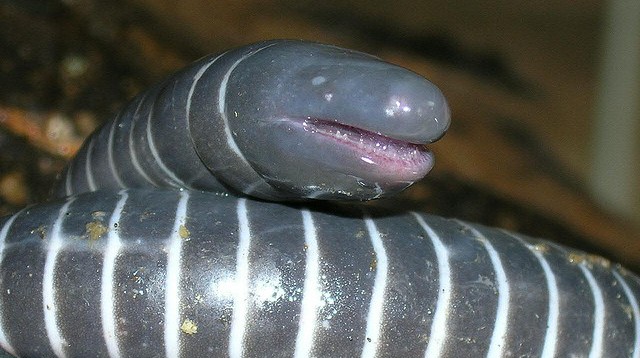
While caecilians appear worm-like or snake-like, they are limbless amphibians. The largest reach lengths of five feet. Their smooth, moist skin hides calcite scales, and the secretions that keep their skin moist contain a hemolytic toxin that destroys red blood cells. Caecilians are largely blind, able to perceive the presence of light. They burrow, using their strong skulls to force their way through soil. In water, they swim much like an eel. Caecilians have acute olfactory senses.

Caecilia are 30-foot-long wormlike creatures found in the D&D Expert Rulebook. They swallow their prey whole 10% of the time. This monster does not seem to have made the transition to later editions of D&D. Perhaps the Powers That Be didn’t see them as sufficiently different from the more dangerous purple worm, which appears in the same rulebook.

Whatever the reason, I figure a GM can’t have too many giant, voracious predators.

Caecilia
Huge monstrosity, unaligned

Armor Class 14 (natural)
Hit Points 126 (12d12+48)
Speed 25 ft., burrow 20 ft., swim 30 ft.

STR 24 (+7), DEX 11 (+0), CON 18 (+4), INT 1 (-5), WIS 10 (+0), CHA 4 (-3)

Saving Throws Con +7, Wis +3
Damage Resistances piercing from nonmagical weapons
Senses tremorsense 60 ft. (blind beyond this radius), passive Perception 10
Languages
Challenge 6 (2,300)

Amphibious. The caecilia can breathe air and water.

Keen Smell. The caecilia has advantage on Wisdom (Perception) checks that rely on smell.

Tunneler. The caecilia can burrow through solid rock at half its burrow speed and leaves a 5-foot-diameter tunnel in its wake.

Toxic Secretions. A creature that touches the caecilia or hits it with a melee attack while within 5 feet of it must make a DC 15 Dexterity saving throw or take 2 (1d4) poison damage.

Actions

Bite. Melee Weapon Attack: +10 to hit, reach 10 ft., one target. Hit: 17 (3d6+7) piercing damage plus 5 (2d4) poison damage. If the target is a Medium or smaller creature, it must succeed on a DC 15 Dexterity saving throw or be swallowed by the caecilia. A swallowed creature is blinded and restrained, it has total cover against attacks and other effects outside the caecilia, and it takes 15 (6d4) acid damage at the start of each of the caecilia’s turns.

If the caecilia takes 15 damage or more on a single turn from a creature inside it, the worm must succeed on a DC 17 Constitution saving throw at the end of that turn or regurgitate all swallowed creatures, which fall prone in a space within 10 feet of the caecilia. If the caecilia dies, a swallowed creature is no longer restrained by it and can escape from the corpse by using 20 feet of movement, exiting prone.

June 29th, 2020  in RPG No Comments »

The Severed Arm of the Hatiyara

The Ways Of…, which presents seven new monastic traditions for seven core races, seems to be doing well. I’ve gotten one three-star rating, which is okay, but also a bit irritating. Not that it’s three stars, mind you, but because I don’t know why it’s three stars instead of two or four. Tomorrow, I continue running The Lost City for four 3rd-level monks, each one using a different archetype from The Ways Of…. The first session went well, the only real problem due to laggy videoconferencing. (Nota Bene: That last link is an affiliate link. If you click and buy, I get a few copper pieces.)

I recently mused about what a 20-level samurai class for 5E D&D might look like. Those musings have been fleshed out into a document that includes said 20-level samurai class, three samurai archetypes, 12 new spells, and sidebars that briefly discuss samurai armor and weapons. I’ll be revising and editing the document more today and/or tomorrow before it too goes up on DriveThruRPG as a PWYW playtest supplement.

I have a few other Oriental Adventures-inspired ideas outlined. I’m probably going to put together a third OA-themed document, this one detailing subclasses. The bushi and sohei are fighter subclasses, the shugenja a cleric subclass, and the wu jen a wizard subclass. Likely the yakuza will get added in as a rogue subclass, but I’ve not outlined that one yet. I’m not sure about an OA-style barbarian subclass, and the assassin rogue archetype hits most of the ninja. More mulling over those that two must occur.

But none of that is what this post is about. This post is about a new 5E D&D monster.

Have you seen The Art of Stefan Koidl. No? Into the circle of shame you go. “Shame! Shame! Shame!” Now that those who deserve punishment have eaten their just desserts, let’s move on to the new monster. Since I don’t have the artist’s permission, I’m linking to today’s inspirational work of horror. If your SAN is low, don’t click here.

Hatiyara

The hatiyara is an undead monster that lairs in abandoned buildings or tunnel systems. In life, the hatiyara was an outcast, one who lived on the fringes of society, often surviving by begging and theft. In undeath, it survives by murder in order to consume the hands of its victims.

Medium undead, neutral evil

Armor Class 15 (natural)
Hit Points 90 (12d8+36)
Speed 30 feet

STR 17 (+3), DEX 12 (+1), CON 16 (+3), INT 8 (-1), WIS 13 (+1), CHA 15 (+2)

Skills Athletics +6, Sleight of Hand +4, Stealth +4, Perception +4
Damage Resistances cold, necrotic; bludgeoning, piercing, and slashing not made with silvered weapons
Damage Immunities poison
Condition Immunities exhaustion, poisoned
Senses darkvision 60 ft., passive Perception 14
Languages the languages it knew in life
Challenge 5 (1,800)

Dimension Door. As part of its move, the hatiyara can pass through a portal (such as a doorway or a window) and appear in another portal within 60 feet. The hatiyara does not need to be able to see the destination portal.

Regrowth. The hatiyara regrows severed arms after a short or long rest. When it regrows a severed arm, its detached limbs cease to be active.

Actions

Multiattack. The hatiyara makes three attacks with its claws.

Claws. Melee Weapon Attack: +6 to hit, reach 5 ft., one target. Hit: 8 (2d4+3) slashing damage plus 2 (1d4) necrotic damage.

Reactions

Severed Arm. When the hatiyara takes slashing damage, it can choose to have one of its six arms be severed by the attack. The hatiyara takes no damage from the attack. As a bonus action, the hatiyara can control its severed arms as long as they remain within 30 feet of it. If more than 30 feet separates the hatiyara and a severed arm, the severed arm “dies” at the end of the hatiyara’s turn. A severed arm has a base speed of 15 feet. It has the hatiyara’s AC, resistances, and immunities. A severed arm has 9 hit points, and it can make one claws attack on its turn.

June 17th, 2020  in RPG No Comments »