Bellatrix

In the picture, we see Thérèse of Lisieux in costume as Joan of Arc. The photograph dates from early 1895, about two years before Thérèse’s death from tuberculosis at the age of 24. Her sainthood was declared in May 1925 by Pius IX. Thérèse is the patron saint of aviators, florists, and those who suffer illnesses. Along with Francis Xavier, Thérèse is the patron of missions, and she and Joan are co-patrons of France. John Paul II declared Thérèse a Doctor of the Church in 1997, an honor Thérèse shares with three other women and about 30 men, an impressive accomplishment for such a young lady. Thérèse had a special fondness for Joan of Arc. You can read more about Thérèse at this site.

“But now,” [Jesus] said, “take your money and a traveler’s bag. And if you don’t have a sword, sell your cloak and buy one!” (The Gospel According to St. Luke 22:36)

Bellatrix

Background & Origin: Emmanuelle Paquet, orphan and raised in a convent school by Discalced Carmelites, received an exceptional education growing up, to include a most unusual course of rigorous training in swordsmanship by Sister Joaquina de Olot, who had been a skilled athlete before taking vows. Emmanuelle also embraced an ethos focused on the works of mercy. After completing her schooling, Emmanuelle left the convent, taking on a position as a music tutor and earning additional monies as a secretary for a law office. In the latter position, Emmanuelle saw first-hand the effects of crime and poverty on people, especially on women and children.

The plight of several families at the hands of Hugo Mesrine, an extortionist and racketeer, greatly disturbed Emmanuelle. The young lady donned a costume and armed herself with sword and shield. Over a period of several days, Emmanuelle brought the fight to Mesrine and his criminal cohorts. She protected those families, disrupted Mesrine’s operations, and gathered evidence against Mesrine. The Parisian press exploded with sensational stories of a mysterious female vigilante. One journalist, picking up on the religious motifs of Emmanuelle’s costume and exploits, dubbed her Bellatrix, and the name stuck. In the end, Mesrine’s operations were crippled, and Mesrine himself found himself facing a date with Madame Guillotine. The Parisian underworld was shaken to its roots, and the people of Paris largely embraced Bellatrix as their protectress.

Motivation: To serve God and fight evil!

Qualities: Master [+6] Swordswoman, Master [+6] Gadget: Shield, Expert [+4] Athlete, Good [+2] Classical Education, Good [+2] Contacts with the Press, Good [+2] Criminology, Good [+2] Devotion to St. Joan of Arc, Good [+2] Hero of the People, Good [+2] Polyglot, Poor [-2] Ability to Compromise

Powers: None

Stunts: Expert [+4] Ricochet Shield Throw (Gadget: Shield Spin-Off, 1 HP)

Hero Point Pool: 5/10

June 24th, 2017  in RPG No Comments »

The Search

A movie review I wrote way back in August 2013 (with some edits):

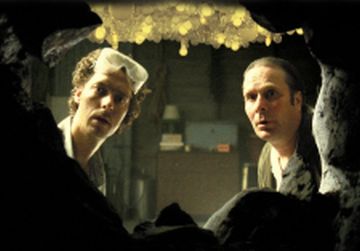
I watched The Bothersome Man, an unrated Norwegian film. The film’s protagonist, Andreas (Trond Fausa Aurvåg), finds himself in a clean, efficient city after being dropped off by a bus at a gas station in the middle of nowhere. He’s given a job as an accountant, and a clean and efficient apartment which comes fully furnished, to include a wardrobe full of clean, efficient suits. His co-workers are polite and well-groomed.

Andreas’s first clue that something is wrong with this new world happens when he finds himself in the men’s room of a nightclub. An unseen man in a stall laments loudly, sadly that no matter how he drinks he can’t get drunk. He complains that hot chocolate no longer tastes or smells good. Andreas, curious about this sad man, follows him home to where the man lives in a basement apartment.

The movie progresses, and Andreas moves from one scene to the next, becoming more aware that no one around him has any real passion for life. The most common adjective used to describe things is “nice”. Andreas’s girlfriend Anne (Petronella Barker) says he’s nice. He has nice conversations with nice people, usually about the nice things they can buy from nice catalogs. Andreas and his girlfriend have nice furniture. Their meals are nice. When Andreas starts an affair with a lady in his office, she also informs Andreas that he is nice. In fact, he’s just as nice as all her other boyfriends. Even in the most intimate of relationships, one person is just as nice as the next.

Driven to the point of despair, Andreas tries to commit suicide by jumping in front of a subway train. Not to give too much more of the movie away, but it doesn’t work. He limps out of the tunnel, is picked up by the ubiquitous jump-suited men who patrol the city, and is taken to Anne’s house. He stands there, broken and bleeding, and Anne informs him they have a date to go ride go-carts.

Andreas lives in a utilitarian world, where everyone’s happiness is maximized, but where there is no yearning for the true, the good, or the beautiful. Indeed, expressing such yearning is met with disapproval. Andreas confesses to his boss that he misses seeing children (for there are no children in a clean, efficient city). The only response Andreas gets is to be quickly ignored, as if he had just said something that no one would ever admit in polite company.

The real world — the world in which at least some things are genuinely and objectively true, good, and/or beautiful — is not a clean, efficient, polite place that can be described by so weak a word as nice. The real world is glorious and tragic and scary and awe-inspiring and depressing and wonderfully full of such a mess of thoughts, sights, sounds, and experiences. The classical liberal arts embrace this apparent chaos, and seek to find the order beneath the mess of contradictions.

I often remind myself, and I remind my students, the search isn’t without hope. Through the proper use of reason, we can discover the true, the good, and the beautiful, and we can at least begin to understand that those three qualities are not always a matter of mere opinion. Some things are truly true, truly good, truly beautiful, and to disagree about those things isn’t to express an opinion. To disagree is to be wrong.

The search for the true, the good, and the beautiful isn’t easy. Many people give up after one too many disappointments. But, I am reminded of the words of a wise man. To paraphrase, those that seek without surrender will eventually find what they’re looking for.

June 23rd, 2017  in RPG No Comments »

Grasping the Ineffable

Lately, I’ve mulled about using Monster of the Week to run a Call of Cthulhu-style game that would be more about investigating unspeakable horrors than confronting monsters and destroying them. One of my thoughts involves replacing Luck with Madness, and treating Madness much like Harm. I’m not quite sure what that means. Regardless, I did fiddle about with a couple of new basic moves. A hunter’s Weird rating would modify that hunter’s Madness. For example, a hunter with Weird +2 would have two fewer Madness boxes.

Grasp the Ineffable
When you attempt to understand the unfathomable nature of cosmic horror, roll + Weird.

On a 10+, hold 2 and 0-madness. On a 7-9, hold 1 and 1-madness.

One hold can be spent to ask the Keeper a question. Use the questions for investigate a mystery or read a bad situation. If you act on the answers, you get +1 ongoing while the information is relevant.

Advanced: On a 12+, you may ask the Keeper any questions you want about the cosmic horror, not just the listed ones.

Maintain Sanity
When you confront sanity-blasting eldritch terror, roll + Cool.

On a 10+, you do not succumb to the terror you feel. You suffer less madness (-1 madness). On a 7-9, choose 1:

* You briefly lose control in the face of the terror. The Keeper will give you a worse outcome, hard choice, or price to pay, but you gain hold 1 as if you attempted to grasp the ineffable. This does not grant +1 ongoing while the information is relevant.
* You maintain composure, but are shaken. You get -1 ongoing until you get a chance to collect yourself.

Advanced: On a 12+, not only do you not succumb to the terror you feel, but you may choose 1:

* You gain hold 1 as if you attempted to grasp the ineffable. This does not grant +1 ongoing while the information is relevant.
* Your courage rallies all hunters involved in the confrontation, giving them +1 forward.
* You suffer no madness at all.
* You recover 1-madness.

June 21st, 2017  in RPG No Comments »

The Great and Terrible Wilderness

Thy heart be lifted up, and thou remember not the Lord thy God, who brought thee out of the land of Egypt, out of the house of bondage: And was thy leader in the great and terrible wilderness, wherein there was the serpent burning with his breath, and the scorpion and the dipsas, and no waters at all: who brought forth streams out of the hardest rock, And fed thee in the wilderness with manna which thy fathers knew not. And after he had afflicted and proved thee, at the last he had mercy on thee, Lest thou shouldst say in thy heart: My own might, and the strength of my own hand have achieved all these things for me. (Deuteronomy 8:14-16)

Fire Serpent
Armor Class: 5 [14]
Hit Dice: 4
Attacks: Bite
Special: Breath weapon, immune to fire, poison
Move: 12
Save: 15
HDE/XP: 6/400

Fire serpents, magical beasts that hunt during the heat of the day in certain deserts, appear much like normal snakes except for their brilliant scarlet coloration and the heat shimmer that surrounds them. An adult fire serpent may reach lengths between 12 and 16 feet. A fire serpent is uncomfortably hot to the touch, but not hot enough to cause immediate damage. When startled or threatened, this creature curls into striking position and exhales a gout of flame in a line 5 feet wide and 30 feet long. The blazing heat of this breath weapon inflcits 4d6 points of damage (a successful saving throw indicates half damage). A fire serpent’s bite packs a deadly poison. Those that succumb to this toxin burn from the inside.

Dipsas
Armor Class: 7 [12]
Hit Dice: 2
Attacks: Bite (1d6-1)
Special: Induce thirst, surprise foes
Move: 9/6 (burrowing)
Save: 17
HDE/XP: 3/60

Another rarer sort of magical snake found in certain deserts is the dipsas, also known as the thirst snake. These snakes lurk near oases, waiting buried in the sand or within the spaces between rocks. A dispas surprises its prey 4 in 6 times. Its bite forces a saving throw to avoid magically induced thirst. This thirst is so powerful that the victim will ignore even attacks for 1d6 rounds in order to slake the maddening hunger for water. Dipsas prefer to attack prey gripped by overwhelming thirst.

June 19th, 2017  in RPG No Comments »

Poetry Is Like a Fist

From December 2012 and posted elsewhere:

Years ago, when my children were somewhere roundabout the 1st and 2nd grades instead of the earlier years of high school, I taught 5th through 8th grade English and reading at Resurrection Catholic School out in east Houston. On the weekends during much of the year, the school’s classrooms were used by the church for the religious education of parish children. Supervision of these children on the weekend often appeared a bit lax judging by the mess left in my classroom for me to clean up many Monday mornings.

During one of these Monday morning clean-ups, I found a spiral notebook in one of the desks. Figuring it might belong to one of my 80-or-so students, I opened it up for identifying information. The name inside was a girl’s but not any of the girls enrolled at Resurrection. She was a high school religious education student. The first page in the notebook had a poem written on it. Since I’m nosy, I read the poem, and then turned the page.

More poetry, and more reading, and then on the fourth or fifth page were these words, which I still remember to this day:

“When I close my arms, I feel you not hugging me.”

I can think of no expression of loss more succinct and yet more packed with meaning than these eleven words.

Recently, I shared these words with my students as an example of what good writing can accomplish. There’s an entire story packed into that one sentence. Who is gone? Why are they gone? How long have they been gone? Was the loss the result of a death, a break-up, a divorce? Do these words not reflect the experience of anyone who has ever lost someone they’ve loved?

Not too long ago, one of the people I follow on Google+ was complaining about his daughter’s poetry homework. I understood some of his frustration since he was having to read Maya Angelou, who I am convinced is overrated as a poet. He expressed his opinion that poetry is horrible, and on this point I disagree.

Horrible poetry is horrible. Great poetry — such as what I found on that one page of that misplaced spiral notebook — is something else entirely. Great poetry opens another person’s heart and soul to the reader, and invites the reader to share in the poet’s experiences. Great poetry even demands that the reader do so. As Calvin Hernton explained, poetry can be like a fist beating against my ear.

June 14th, 2017  in RPG No Comments »