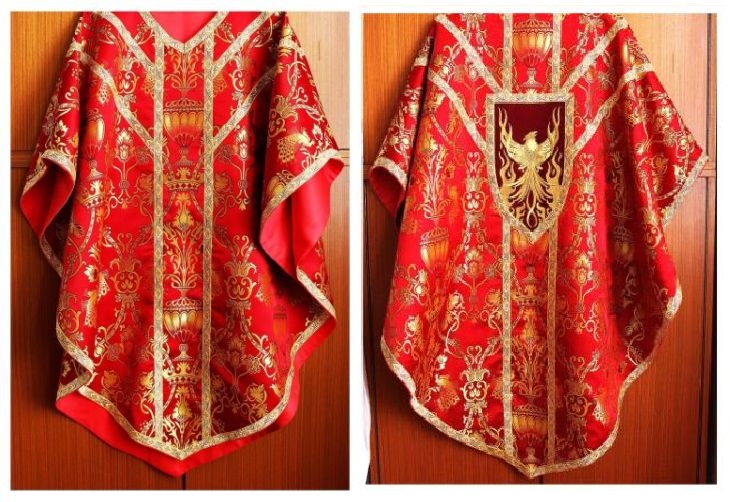
The Phoenix Chasuble of Acqui Terme

Shown in the pictures above are the front and back of a beautiful chasuble made by Geneviève Gomi of Maris Stella Vestments. I read about these remarkable garments on New Liturgical Movement’s site, specifically this post right here.

A chasuble is a liturgical vestment worn over other vestments. It is something like a poncho. It’s an oval-shaped (or nearly so) piece of cloth with a round hole for the priest’s head to pass through. It tends to fall below the knees all around. It originated as a adaptation of common garb worn all over the Roman Empire in the first few centuries of Christianity. Originally, the priest at the altar would have been dressed very much the lay people in attendance at the Mass. In some way, the idea of reserving a special outer garment arose, possibly for no more reason than it was easier to keep one clean if it wasn’t worn every day like normal clothing. As you can see from the pictures, chasubles today are no longer common articles of clothing, but can be works of art embroidered with ornate designs and images symbolic of religious doctrines, such as the use of the phoenix as a symbol for the resurrection of Jesus Christ.

My aims here, however, are significantly more modest. I’m just using a wonderful picture as inspiration for fantasy gaming.

The Phoenix Chasuble: This remarkable relic was created for the first bishop of Acqui Terme, who wore it on certain sacred days, including the day in which the bishop faced down an army of marauders at the city gates. The bishop’s words and courage so impressed the war-like chiefs of that horde that they ordered that Acqui Terme remain unharmed. For more than the past two centuries, the Phoenix Chasuble has remained in the cathedral vestry, handed down from one bishop to the next. The full powers of the Phoenix Chasuble are perhaps unknown. The wearer gains complete immunity to fire, even magical flame. He also enjoys a +4 bonus to saving throws against magic. Once per day each, the wearer can use the following magical abilities: Continual Light, Detect Invisibility, Dispel Evil, Fireball, Fly, Protection from Evil 10-Foot Radius, and Wall of Fire. The wearer can communicate with any type of fire elemental while wearing the Phoenix Chasuble. Once per week upon command, the Phoenix Chasuble causes its wearer to burst in flames. The wearer’s melee attacks inflict an additional 1d6 points of fire damage. Any creature striking the wearer in melee combat likewise suffers 1d6 points of fire damage. Usable By: Lawful Clerics only.

June 8th, 2017  in RPG No Comments »

On Mercy & Charity

From way back in November of 2012:

This month, our focus virtue has been charity. An important precondition of charity is mercy.

Nowadays, in our do-whatever-you-please postmodern world, it seems as if many people have done mercy’s reputation some damage. Too often, mercy is mistaken for either weakness or for letting those who do wrong get away unpunished. Neither of these views is accurate. Mercy is not weakness or coddling, but instead it is the use of strength rightly ordered toward the genuine good of another.

Ancient Christian tradition speaks about works of mercy, dividing these into two categories, the corporal and the spiritual. Among the former are acts such as feeding the hungry; the latter includes my vocation, instructing the ignorant. Notice the first, feeding the hungry, is a common goal of charitable organizations today. Television commercials display wide-eyed, impoverished children while the voice-over asks us for a few dollars a day. We are assured that our charitable contributions will be used to help those children be fed, clothed, housed, et cetera. The organization intends to provoke mercy which in turn compels me to give my money to the cause.

My ability to give that money, to communicate what I’ve learned to others, or to mow a lawn for someone not fit enough to do it himself are all forms of strength. Money, knowledge, and physical health can be powerful, and all three can be used for selfish ends. I could tell my daughter Adrienne that we don’t have the money for violin lessons, and then spend that money on things I want. I can use my knowledge to manipulate others, and once upon a time I was strong enough and fast enough to use my body to intimidate, steal, or harm. Any of these activities would be a use of a strength, but in a disordered manner.

To avoid these and other abuses of my various strengths, I must ensure that my actions are rightly ordered. Mercy assists me in doing this. I recognize the weaknesses of others, such as Adrienne’s lack of an income, and I apply my strength to give the other person what they truly need. Much of the time, this means I do things that are beneficial to the other, such as paying for those violin lessons. Other times, however, mercy demands that I act in ways that may appear punitive. A student who refuses to complete his lessons rejects both my mercy and his own genuine good. If I am to be a responsible teacher, mercy and charity both demand that I devise ways to encourage the student to embrace what is truly in his best interest. Those ways may involve the temporary removal of some privilege, such as recess time, or enlisting the assistance of parental pressure. The student may not perceive these sorts of actions as merciful and charitable, but a failure of perception does not alter reality.

Merciful action is often difficult. It requires time, effort, and self-control to surrender the advantages of my strengths in order to meet the needs of others. The opposites of mercy, cruelty and neglect, do not make these sorts of demands. They are instead the easy way out, which probably goes a long way toward explaining why the world is the way it is.

At the same time, reflection on the nature of mercy and the resulting demands of charity that flow from mercy point the way to a better world. Not that any amount of mercy or charity on my part will make the world perfect or make life fair. As I’ve told my students more than once, life isn’t fair, and it’s never going to be fair, but that’s no excuse for us to not do what we can.

As Calvin Coolidge observed, “We cannot do everything at once, but we can do something at once.”

June 2nd, 2017  in RPG No Comments »

Fun with Laws

This week, I’ve posted thrice about Galgenbaum, a fantasy town ruled by Mayor-Justices who long ago bound minor death gods via contract to help defend the town. Galgenbaum is a magistracy, a community ruled by judges and their subordinate judicial officials. At least on the surface, Galgenbaum is a well-ordered, disciplined town, but, as Circero observed, “More law, less justice.”

My musings this week about Galgenbaum included pondering just what sorts of laws the town would have. Writing up a body of legal precedents and statutes is well beyond the scope of this blog, but I was reminded of Chaotic Shiny. If you’re not acquainted with this site, give it a visit. Chaotic Shiny offers numerous random generators for categories such as alphabet, RPG class, and ballads.

Curious, I generated ten laws using Chaotic Shiny’s Law Generator. Here’re the results:

The penalty for attempting bribery is a warning.

The penalty for robbing an official is a considerable term of servitude.

The penalty for killing a tradesman is a long imprisonment.

The penalty for smuggling spell scrolls is a moderate fine.

The penalty for a nobleman smuggling body parts is life imprisonment.

The penalty for a craftsman lying under oath is execution.

The penalty for maiming a mule is a considerable fine.

The penalty for plotting against a member of the royalty is a warning.

The penalty for a member of a certain bloodline stealing artifacts is public humiliation.

The penalty for a guild leader trespassing is execution.

At first glance, some of these seem appropriate, some seem interesting, and at least one seems silly. Take a gander at the eighth one about plotting against the royalty. Really? You get off with a warning? Absurd? On the surface, sure, but it did make me think.

The first function of the law is to instruct the citizenry, especially the young, about what is acceptable and not acceptable. In this respect, the tired canard that one cannot legislate morality becomes glaringly untrue. If the primary function of law is to teach about right and wrong, then one cannot help but legislate morality. With that in mind, what sort of community would punish plotting against the royalty with a warning?

Well, it seems fairly obvious that the community would be one that places little value on being royal. It would be a community that encourages plotting against the royalty. This doesn’t mean that the royalty don’t serve their usual functions within the community. The king is still the king, but His Majesty’s power and authority are subordinate in the community’s esteem regarding a well-executed plot against the royal family and its interests. The crime isn’t in the plotting against the royalty; the crime is in getting caught, and getting caught is embarrassing. One should be ashamed of oneself for not being devious enough to get away with whatever it was one was trying to get away with.

There’s probably an adventure idea in there….

May 19th, 2017  in RPG No Comments »

“Oyez! Oyez! Oyez!”

Galgenbaum is ruled by five Mayor-Justices, each one serving for life and holding jurisdiction over part of the town, and all five meeting to decide matters that affect more than a single jurisdiction or the entire town. When a Mayor-Justice dies in office or is no longer able to perform his or her duties due to ill health, a new Mayor-Justice is carefully chosen from the Rechtsanwälte, the guild of lawyers. The selectee must be approved by the unanimous consent of the Mayor-Justices. Each Mayor-Justice possesses a magical gavel and sounding board. When a Mayor-Justice takes the oaths of office, the other Mayor-Justices invest the new justice with the gavel and sounding board. This ceremonial process links the Mayor-Justice with the gavel and sounding board. Their powers function only for the Mayor-Justice to whom they have been entrusted.

When a Mayor-Justices strikes the sounding board with the gavel, the magic takes effect on all who hear the gavel’s raps. Mayor-Justices are immune to these effects, which vary depending on the number of raps of the gavel. A Mayor-Justice may choose to exempt certain persons present from the effects. Typically this courtesy is limited to the bailiffs present in the court.

One Rap: All those affected are subjected to a Hold Person effect. After one minute, a saving throw can be attempted to move normally.

Two Raps: Those affected must stand up and remain relatively motionless. After one round, a saving throw can be attempted in order to move normally.

Three Raps: Those affected must sit down. After sitting down for one round, a saving throw can be attempted in order to stand and move about normally.

Should a gavel and its sounding board fall into unauthorized hands, the magical powers still function, but the user cannot exempt anyone from those effects. This includes the unauthorized user himself. Furthermore, the gavel and sounding board are invested to a particular Mayor-Justice, who becomes instantly aware of the items’ misuse. The Mayor-Justice even knows the general direction and distance to the gavel and sounding board. The closer the Mayor-Justice is to the items, the more precise is his or her knowledge of their location.

May 18th, 2017  in RPG No Comments »

The Henker of Galgenbaum

The hanged undead of Galgenwälder are not the only defense present in Galgenbaum. Aside from the town watch, mostly volunteers who patrol certain neighborhoods in small groups armed with clubs and whistles, there are the bailiffs, court officials with some martial training who are empowered to determine guilt and mete out minor punishments on the spot for lesser infractions of the law or offenses against the public order.

More serious threats to law and order might be met by a Henker backed up by a squad of guards and possibly some of the watch as well. A Henker is a religious official who answers only to Galgenbaum’s Mayor-Justices. Each Mayor-Justice has several Henkers under his or her command. Because of their devotion to the gods of law and due process, a Henker possesses certain magical abilities that help defeat and punish scofflaws. Whereas the guard is authorized to only mete out minor punishments, such as a fine or a mild beating, a Henker enforces the law with stiffer penalties, up to and including summary execution.

A Henker is recognizable by the distinctive uniform of black leather, white gloves, high-collared cloak, and hangman’s hood. He wears a noose around his neck as a badge of office. In combat, a Henker fights with a stout rope, one end of which is tied into a noose. He can strike with the rope, using it as a bludgeon or a whip.

He may also command the noose to ensnare a foe’s neck, after which he releases the rope, which snakes up into the air, jerking the foe several feet off the ground. A successful saving throw avoids this attack; otherwise, the foe takes 2d6 points of damage each round from strangulation. The rope can be severed as normal, and the Henker can command the rope to cease its attack.

Once per day each, a Henker may use Darkness 15-Foot Radius and Fear. A Henker is immune to sleep and hold magic.

Hit Dice: 3
Armor Class: 6 [13]
Attack (Damage): By weapon (1d6)
Move: 12
Save: 14
Alignment: Law
Challenge Level/XP: 5/240
Special: Darkness, fear, hangman’s noose, immune to hold and sleep

May 17th, 2017  in RPG No Comments »