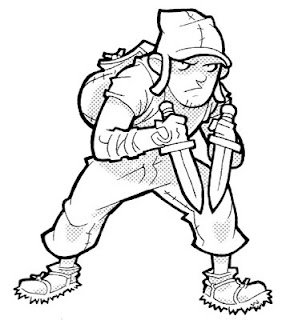
Y Is for Yo-Yo Magus

Yes, that’s right. Y is for yo-yo fighting. First, I enlist the aid of yo-yo fighting spokesman, Andy Lau:

As you can plainly see, a yo-yo is superior weapon in many respects. It has reach. It can be used to disarm and trip. One can perform a variety of amusing tricks with it. (See the Yo-Yo Man in action here.) With all that in mind, here’re stats for the martial yo-yo:

Martial Yo-Yo

The martial yo-yo is a light exotic melee weapon. The martial yo-yo consists of an axle that connects to two beveled metal disks. A length of martial twine loops around the axle. A martial yo-yo is wielded by holding the free end of the martial twine and allowing the force of a throw to spin the connected disks. This causes the martial twine to unwind, allowing the martial yo-yo’s spin to wind itself back to the wielder’s hand.

Martial Yo-Yo: cost 10 gp; Damage 1d3 (S), 1d4 (M); critical x2; range –; weight 1 lbs.; type B/S; special disarm, performance, reach, trip

Yo-Yo Magus

The yo-yo magus combines magic with the fine art of yo-yo fighting. Obviously, this makes yo-yo magi the most envied of all magi.

Class Skills: Add Perform (act), Perform (comedy), and Perform (dance) to the magus’s list of class skills.

Yo-Yo Fighter (Ex): At 1st level, a yo-yo magus gains Exotic Weapon Proficiency (martial yo-yo) as a bonus feat. He gains a competence bonus to attack rolls with a martial yo-yo. The competence bonus equals +1 for levels 1st-4th; +2 for 5th-8th; +3 for 9th-12th; +4 for 13th-16th; and +5 for levels 17th and higher.

The yo-yo magus is otherwise proficient with only simple weapons.

Yo-Yo Acrobatics (Ex): At 1st level, as part of a move action either before or after making an attack with a martial yo-yo, a yo-yo magus can make an Acrobatics check with a bonus equal to his magus level.

This feature replaces the ability to cast cantrips. The magus can learn and prepare detect magic and read magic as 1st-level spells.

Yo-Yo Mystic (Su): At 7th level, when a yo-yo magus prepares his magus spells, he can decide to expend 1 or more points from his arcane pool, up to his Intelligence bonus. For each point he expends, he can treat any one spell prepared as if it were affected by one of the following metamagic feats: Disruptive Spell, Elemental Spell, Flaring Spell, Lingering Spell, Rime Spell, or Toppling Spell. In order to gain the effects of the metamagic feat, the yo-yo magus must cast the affected spell via spell combat or spellstrike while wielding a martial yo-yo. The metamagic effect does not adjust the level of the prepared spell.

This ability replaces knowledge pool.

April 28th, 2012  in RPG No Comments »

X Is for X-Ray Vision

One thing that 1E has over some of the later Es is the plethora of visions. There was infravision and ultravision, which survive mutated into darkvision and low-light vision. Some monsters, such as the Fiend Folio‘s nycadaemon had x-ray vision, gamma vision, and indeed a vision for every part of the electromagnetic spectrum. Imagine cosmic ray vision, radio wave vision, and microwave vision. Pretty whacky, huh?

As I mentioned in S Is for Snakes, many snakes are sensitive to the infrared portion of the spectrum, but the Pathfinder Roleplaying Game doesn’t really have rules to simulate such heat sensitivity. And more exotic visions, such as gamma vision? Forget about that!

Or, if forgetting about it isn’t your cup of tea, take a gander at these completely unplaytested and only vaguely scientifically accurate rules:

X-Ray Vision

Some monsters have x-ray vision, although this is a slight misnomer. These monsters don’t so much as just see x-rays the way the human eye “sees” visible light. Instead the monsters’ eyes actually project low levels of x-rays by which they can see through certain materials. Glomming text from the ring of x-ray vision is a good place to start.

X-ray vision gives a creature the ability to see into and through solid matter. Vision range is 20 feet, with the creature seeing as if it were looking at something in normal light even if there is no illumination. X-ray vision can penetrate 1 foot of stone, 1 inch of common metal, or up to 3 feet of wood or dirt. Thicker substances or a thin sheet of lead blocks the vision. Among its obvious uses, x-ray vision makes defeating conventional disguises child’s play.

“Nice mask you got there,” said the nycadaemon. “Shame you didn’t line it with lead. Of course, then I’d wonder why you’d wrapped your face with lead, but, hey, no plan’s perfect.”

Infravision

A creature with infravision sees variations in heat. This sort of vision is especially good at detecting creatures that generate their own body heat, such as most humanoids. (Are lizard folk cold-blooded? What about frost giants?) Detection is even possible through solid matter.

Infravision works just like normal sight in terms of range, complete with appropriate Perception check penalties for distance. Heat signatures can be detected through up to 1/2 foot of stone, 1 inch of common metal, or up to 1 foot of wood or dirt. Thicker substances block heat signatures, although extreme heat sources may be visible through thicker substances at the GM’s discretion.

A creature with infravision can also track the residual heat of a quarry’s foot steps. The base Survival DC for tracking a heat signature is 10, but it rapidly increases by +2 per minute that has passed since the tracks were made. Certain environmental conditions, such as a forest fire or shifting desert sands, may further increase the DC or even make such tracking impossible, at the GM’s discretion.

Sudden exposure to extreme heat can dazzle a creature relying on infravision. The creature must make a DC 15 Fortitude save to avoid being dazzled for 1 round. If the extreme heat persists, it would be appropriate to have the creature remain dazzled as long as it remains in the area. For example, an infravision using giant snake is tracking its prey, a druid. The druid lures the snake into an ambush zone, and then uses some appropriate fire spell to ignite a bonfire. The snake fails its Fortitude save and becomes dazzled as long as it remains within the full illumination area of the bonfire.

More Exotic Vision Traits

Other types of more exotic vision, such as gamma vision, could work like x-ray vision, only moreso. Odd side effects could also result. Since gamma rays will pass right through a mirror, a creature relying on solely gamma vision couldn’t see a reflection. Would this, perhaps, also impart some sort of resistance or immunity to certain illusions? For that matter, would x-ray vision or infravision do so?

The possibilities boggle the imagination.

April 27th, 2012  in RPG 1 Comment »

W Is for Warp Thief

One of the neatest things Pathfinder has done is to introduce a variety of archetypes as variations on character classes. The gist of archetypes is that you lose some standard class features in exchange for gaining other class features that fit a particular theme. For example, at 1st level, an armored hulk barbarian gains heavy armor proficiency and the indomitable stance extraordinary ability, but loses fast movement.

Now that you’ve got the gist, here’s my contribution to the archetype army:

Warp Thief

Some rogues have the supernatural ability to open small extradimensional portals that connect points in space without transversing the distance between those points. Warp thieves specialize in using these portals in combat.

Class Skills: Substitute Knowledge (the planes) for Knowledge (dungeoneering).

Warp Portals (Su): At 1st level, a warp thief can open two connected extradimensional portals as a standard action. One portal is always adjacent to the warp thief, and it remains so when the warp thief moves. The other portal can be in any chosen square within 30 feet of the warp thief that he has line of sight to, but this other portal is stationary unless the warp thief uses a move-equivalent action to adjust its position by up to 30 feet. With a free action at the start of his turn for the portals’ maintenance each round, the warp thief can keep his warp portals open for up to 3 + Intelligence modifier rounds per day.

As a standard action, the warp thief can reach through the portals to attack with a melee weapon. Alternatively, as a standard action, he may attempt one of these combat maneuver through the portals: dirty trick, disarm, steal, or trip. The second portal’s position is treated as the warp thief’s position to determine flanking, both for the warp thief and for his allies.

If the warp thief moves farther than 30 feet away from his second portal, both portals close immediately. If the warp thief cannot take a free action at the start of his turn to maintain his portals, they close immediately.

This ability replaces the warp thief’s first d6 of sneak attack damage. Consequently, the warp thief’s total sneak attack dice are always 1d6 lower than they otherwise would be.

Warp Step (Su): At 2nd level, a warp thief can step into his adjacent portal and emerge from the other portal, doing so as a move action. Both portals close immediately after the warp thief makes his warp step. This movement does not provoke attacks of opportunity.

This ability replaces evasion.

Portal Mastery (Su): At 8th level, a warp thief can open his two connected extradimensional portals as a move-equivalent action. The maximum range for his second portal becomes 45 feet. He also gains the ability to attack normally through his portals with melee weapons, meaning he can make full attacks. The list of combat maneuvers he can perform through the portals does not change, but these maneuvers are performed as per their normal actions, meaning, for example, that a trip can be performed in place of a melee attack rather than as a standard action.

This ability replaces improved uncanny dodge.

April 26th, 2012  in RPG No Comments »

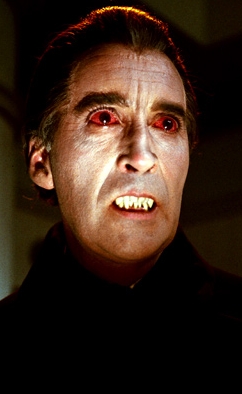
V Is for Vampires & Energy Drain

For as long as I can remember, the World’s Most Popular Roleplaying Game has included energy drain as a special attack for various monsters, especially certain iconic undead such as vampires. Regardless of edition, energy drain invokes fear from players as well as a degree of frustration from everyone since the mechanics have often been cumbersome.

The Pathfinder Roleplaying Game defines energy drain’s game effects as follows:

This attack saps a living opponent’s vital energy and happens automatically when a melee or ranged attack hits. Each successful energy drain bestows one or more negative levels (the creature’s description specifies how many). If an attack that includes an energy drain scores a critical hit, it bestows twice the listed number of negative levels.

Unless otherwise specified in the creature’s description, a draining creature gains 5 temporary hit points for each negative level it bestows on an opponent. These temporary hit points last for a maximum of 1 hour.

For each negative level a creature has, it suffers the following:

* A cumulative -1 penalty on all ability checks, attack rolls, combat maneuver checks, Combat Maneuver Defense, saving throws, and skill checks.
* In addition, the creature reduces its current and total hit points by 5 for each negative level it possesses.
* The creature is also treated as one level lower for the purpose of level-dependent variables (such as spellcasting) for each negative level possessed. Spellcasters do not lose any prepared spells or slots as a result of negative levels.
* If a creature’s negative levels equal or exceed its total Hit Dice, it dies.

Negative levels remain until 24 hours have passed or until they are removed with a spell such as restoration. If a negative level is not removed before 24 hours have passed, the affected creature must attempt a Fortitude save (DC 10 + 1/2 the draining creature’s racial HD + the draining creature’s Cha modifier; the exact DC is given in the creature’s descriptive text). On a success, the negative level goes away with no harm to the creature. On a failure, the negative level becomes permanent. A separate saving throw is required for each negative level.

A Problem: Energy Drain & Sameness

The core rules for energy drain do an adequate job of making energy-draining monsters fearsomer, but the rules themselves lack something I as a GM desire, namely variety. Other than differing save DCs and differing numbers of negative levels inflicted, all energy drain is pretty much the same. This seems a shame. After all, there isn’t just one type of poison or disease, even though almost all poisons and diseases use the same basic mechanics.

Feeling the lack of energy drain variety unacceptable, I said to myself, “Self, let’s see if we can ‘fix’ this ‘problem’.”

A Solution: Energy Drain as Inflicted Conditions

To use these optional rules, you don’t have to change the energy-draining monster. Use the same save DC, the same attack mode, and the same number of negative levels inflicted. Instead of using the energy drain rules explained above, give these are whirl.

Each negative level inflicts a condition. Additional negative levels increase the severity of the effect. Conditions are tracked by degree of severity, and can be immediately resisted by a saving throw. Degrees of severity (DoS) above the first DoS fade after 1 round per Hit Die of the inflicting monster, but the first DoS remains and the higher degrees may reassert themselves under the right conditions.

The inflicting monster still benefits from condition-causing energy drain as outlined above. Thus, the monster gains 5 temporary hit points for each negative level it bestows on an opponent. These temporary hit points last for a maximum of 1 hour.

To get a grip on what this means, let’s look at one increasing scale of conditions:

Fear Condition Degrees of Seriousness

1st Degree 2nd Degree 3rd Degree 4th Degree
shaken frightened panicked cowering

Now imagine your PCs are facing a vampire spawn. This is a 4 Hit Die monster that inflicts one negative level with a 14 save DC. This particular vampire spawn, however, doesn’t actually inflict negative levels. Instead, it inflicts fear conditions of increasing severity.

Combat starts, the vampire hits a PC, and the PC must make a DC 14 Fortitude save. The PC fails the save, becomes shaken for 4 rounds, and the vampire spawn gains 5 temporary hit points. Another round starts. The PC is hit again, fails the Fortitude save again, and is now frightened for 4 rounds. The vampire spawn is defeated despite the 10 temporary hit points it gained. The PC is no longer frightened, but he remains shaken.

Now here’s where things get interesting. The PC stays shaken until 24 hours have passed or until the shaken condition is removed with an appropriate spell. (I recommend the spell be of at least 4th level even if you don’t opt to let restoration work.) If the shaken condition is not removed before 24 hours have passed, the PC must attempt another DC 14 Fortitude save. On a success, the shaken condition goes away with no harm to the PC. On a failure, the shaken condition becomes permanent (albeit only in the sense that it now requires magic to dispel, as mentioned above).

What’s worse, as long as the PC remains shaken, he is more vulnerable to fear effects. Should the PC be affected by any effect that inflicts a fear condition, he automatically gains the fear condition that is equal to highest DoS caused by the energy-draining creature (unless the fear-causing attack would normally inflict a more serious condition).

Imagine our shaken PC. The vampire spawn encounter is over and done with, but he still can’t pull himself together. A gnawing dread nibbles at the fraying edges of his imagination. Several hours later, the PC is still shaken when he encounters a hill giant. The hill giant uses Intimidate to demoralize the PC and succeeds. Normally, this would cause the PC to become shaken, but he’s already shaken. Instead, he automatically becomes frightened, since this was the highest DoS inflicted by the vampire spawn.

DoS for Other Conditions

With some thought (and descriptive refluffing where necessary), energy drain could inflict other conditions with varying DoS. For example:

Fatigue Condition Degrees of Seriousness

1st Degree 2nd Degree 3rd Degree
fatigued exhausted unconscious

Lethargy Condition Degrees of Seriousness

1st Degree 2nd Degree 3rd Degree
entangled staggered paralyzed

The fatigue condition DoS represents energy drain that saps physical vitality. An affected PC is winded as from great exertion, and more susceptible to effects that cause fatigue. The lethargy condition DoS simulates energy drain making a PC’s movements slower. The entangled condition doesn’t prevent movement, but has its other normal effects, which are that the entangled creature moves at half speed, cannot run or charge, and takes a -2 penalty on all attack rolls and a -4 penalty to Dexterity. Also, an entangled character who attempts to cast a spell must make a concentration check (DC 15 + spell level) or lose the spell.

When using monsters that inflict more than one negative level with an attack (such as vampires and spectres), consider combining the core rules with these optional rules. A vampire that inflicts both a negative level and forces a Fortitude save to resist fatigue condition DoS presents a different threat than players would normally expect.

And how could shaking up too comfortable players be a bad thing?

April 25th, 2012  in RPG No Comments »

U Is for Undead Turning

Remember the good old days when your cleric unleashed some turning against some undead? Some of them ran away. Others exploded. What variety! Nowadays with Pathfinder, undead take damage from turning, which is now called channel energy. The undead get a saving throw for half damage. Your cleric can get them to run away if he happens to have the Turn Undead feat. Again, what variety!

And, just in case my sarcasm wasn’t detectable, by “What variety!” I mean pretty much the opposite. Unleashing all that channeled positive energy at the undead ought to do more than a few d6 points worth of damage, and it ought to do so without having to spend precious resources like feats to get a limited effect. So, here’s my latest, completely unplaytested idea.

Whenever a cleric channels positive energy, he can opt to sacrifice a certain number of d6s of channeling damage in order to tack on additional effects. The two quickie charts below show the number of d6s of channeling damage that must be sacrificed to gain a desired effect for a desired duration. N.B. The maximum duration for dazed equals 1 round.

Additional Positive Channeling Effects
1d6: dazed
2d6: fatigued, shaken, or sickened
3d6: blinded, stunned, exhausted, or frightened
4d6: nauseated or panicked
5d6: paralyzed

Positive Channeling Effect Durations
0d6: 1 round
1d6: 1d3 rounds
2d6: 1d4 rounds
3d6: 1d6 rounds
4d6: 1d8 rounds

All additional effects can affect undead creatures even though undead are normally immune to such effects. The positive energy overwhelms normal undead immunities when channeled properly. The undead affected still get a Will save against the channel energy at the same DC as before. If the save succeeds, the undead takes one-half the damage and the additional effect is negated.

For example, Bob the Brewer is a 9th-level cleric who channels 5d6 worth of positive energy. He confronts a ghoul pack, and lets fly with some holy power. Bob sacrifices 4d6 to add 1d3 rounds of blinded to his channeling. The ghouls attempt their Will saves. Those that fail suffer 1d6 points of damage and are blinded for 1d3 rounds. Those that succeed take one-half of 1d6 points of damage.

Of course, we don’t want to leave the evil clerics without some of the fun. Evil clerics normally can channel negative energy to damage enemies or to heal undead creatures. Instead of the latter, evil clerics can channel negative energy to make undead temporarily more formidable. N.B. The maximum duration for “+1 move action” equals 1 round.

Additional Negative Channeling Effects
1d6: +1 move action
2d6: +2 profane bonus to Strength or Dexterity
3d6: +4 profane bonus to Strength or Dexterity
4d6: +4 profane bonus to Strength and Dexterity
5d6: haste

Negative Channeling Effect Durations
0d6: 1 round
1d6: 1d3 rounds
2d6: 1d4 rounds
3d6: 1d6 rounds
4d6: 1d8 rounds

For example, Evil Ed is a 9th-level cleric who channels 5d6 worth of negative energy. He and his ghoul pack confront a gang of adventurers, and Ed lets fly with some unholy power. He sacrifices all 5d6 to add 1 round of haste to his undead minions.

April 24th, 2012  in RPG 2 Comments »