Socially awkward? Don’t make me disintegrate you!

Stereotypes are just oh so convenient, being a sort of shorthand generalization that encompasses so much in so little space. Work as a television writer? Need to instantly identify a throwaway character as a bad guy? Toss in the shaven-headed, tattooed Hispanic male wearing a white undershirt and baggy pants. Instant identification from the audience. “He looks like a bad guy; therefore, he’s a bad guy.” Next, spice up the dialogue with a few Spanish words, especially if they’re delivered with a noticeable accent and bad grammar. Example when addressing a female detective: “I ain’t gonna talk, chica.” More instant identification from the audience. “Ooh, he speaks a foreign language, and he’s disrespectful to both authority and women; therefore, he’s a bad guy.”

Simple, huh?

The only problem with the syllogisms that stereotypes tend to prompt is that they’re not really syllogistic. Straight from “looks bad” to “is bad” is not a reasonable conclusion, but the images aren’t meant to be reasonable. They’re meant to evoke responses based on prejudice in order to create a quick, cheap emotional reaction as a substitute for thoughtful writing crafted to lead to a more authentic emotional investment and reflective conclusion.

And television isn’t the only medium that goes for the easy reaction. Watch The Avengers. It’s an entertaining movie full of paper-thin characters (but, to be fair, I’m certain no one meant for it be anything more). Now watch Spider-Man 2. Compare Loki with Doctor Octopus, and tell me the latter isn’t a much more interesting character. In comparison, Loki is just another stereotype (specifically, the neglected foster child jealous of the real son’s paternal relationship).

So, what does this have to do with gaming?

Attend a gaming convention. Even if you’re a gamer, you have to admit that some of the attendees look like geeks. Sure, not you, but certainly that guy over there. He most likely gets no exercise and is way too socially awkward. He certainly doesn’t date anyone outside of World of Warcraft taverns, probably lives at home with Mother (in the basement, of course), and you just know there’s a personal hygiene problem going on.

Sound familiar? If you’re a gamer, it’s dollars to donuts it does.

And, to be sure, it’s likely true about someone somewhere. That’s another convenient part of stereotypes. They’re always true at least some of the time, which only makes sense. All generalizations are ultimately false, which means they’re sometimes penultimately true.

But remember the advice about books and covers? I’m a gamer. I get some exercise. I don’t date, but that’s because I’m married. I haven’t lived at home with Mom since I was 17, and I never lived in Mom’s basement. My personal hygiene is impeccable, unless you count not shaving every day as a problem. None of my gamer friends fit the stereotype either. Last time I went to a convention, I gamed with about 20 or so strangers over the course of the weekend. Not a one of them was immediately identifiable as the stereotypical gamer. I mean, maybe they had hygiene problems, but, since I don’t have a sense of smell, I couldn’t tell. We didn’t talk much about living arrangements or dating either, but that’s not what we were at the convention to do.

Gamers go to gaming conventions to game. That means we walk into rooms and sit at tables with six or so strangers, and spend about four hours pretending to be hard-boiled pulp noir detectives, dwarven warriors, elven wizards, cape-wearing superheroes, and dauntless space explorers. We crack jokes, use bad accents, engage in Shatnerian feats of thespianism, and boldly save the day with humor and aplomb. We do this largely with the approval and encouragement of those strangers, and without fear of being judged or mocked. This sort of self-confidence and camaraderie is, in my experience, the norm for gaming convention attendees.

Whatever else that norm might be, what it ain’t is socially awkward.

May 11th, 2012  in RPG No Comments »

A to Z Reflections

Well, the Powers That Be tell me I need to reflect on the A to Z blogging challenge. So, here goes.

Those few of you that keep track of what I write know that I had a heart attack back in October 2011. That really took the wind of my sails. My almost-vanity publishing of material for the Pathfinder Roleplaying Game came to a screeching halt, and inertia set in. My body may have needed rest, but my mind, my aspirations, my life did not.

“A dead thing can go with the stream, but only a living thing can go against it,” G. K. Chesterton observed. I needed to go against the stream of just getting by that I’d fallen into. My family and friends helped. My students helped. But all the help in the world isn’t much good if one doesn’t accept it and act accordingly.

So, I said to myself, “Self, people keep telling you to do something. So, let’s try to write something nearly everyday for a month.”

And I did, and most of the time I found it rather easy to do, which makes me wonder why I don’t do it more often. There were a few blogposts that gave me trouble, but overall I enjoyed the challenge. I like writing. I like sharing my ideas, and I like imagining that at least a few dozen people enjoy me doing so.

I hesitate to say that the A to Z challenge was therapeutic, but it did help remind me that I’m not dead yet. I may have taken a beating, but I’m not beaten.

And I’ve even taken up a new challenge: a 45-day exercise and diet program that my son Giant Boy and I are now one-fifth of the way through. While I doubt I’ll ever run a five-minute mile or knock out 70 push-ups in two minutes again, I’m going to get into better shape, and I’m taking Giant Boy along with me for the ride.

Another quote to close with, this one from William Ernest Henley: “Under the bludgeonings of chance / My head is bloody, but unbowed.”

May 10th, 2012  in RPG 2 Comments »

Adventurers, Assemble!

During the A to Z blogging challenge, when I got to T, I faced a dilemma. I had shared with my son Giant Boy my idea for making a monster out of Michael Jackson based on “Thriller”. We had loads of fun geeking out in the car driving to wherever it was we were driving to at the time. Then, a few weeks later, I finished up S Is for Snakes, and Giant Boy, basking in the glory of my achievement, said, “Patermaximus, next is T. You get to do ‘Thriller’.”
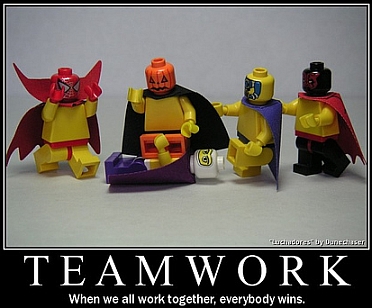
And so I did, but in doing so, I didn’t talk about teamwork feats, which had also been on my list. Paizo’s Advanced Player’s Guide introduced teamwork feats, informing us that “[t]eamwork feats grant large bonuses, but they only function under specific circumstances. In most cases, these feats require an ally who also possesses the feat to be positioned carefully on the battlefield. Teamwork feats provide no bonus if the listed conditions are not met.”

This is such a great idea, but is marred by one glaring flaw, namely that it requires two or more players to deliberately plan their characters so that their characters all end up with the necessary prerequisites and choose the same feats. (Ignore the exceptions of inquisitors and cavaliers, who break the general teamwork rules in minor ways.) Skill points and feats are scarce resources, and the sort of character advancement via committee necessary to build teamwork feats into an adventuring group seems to ask a bit too much of most players.

Which is a shame because I really like the idea of teamwork feats.

I’ve read a couple of people suggesting to give teamwork feats to teams, but I haven’t seen any concrete suggestions on what this might look like in actual play. Here’s my stab at it.

Team Feats

Over time, an adventuring party does all sorts of things together. They kick down doors, kill monsters, and steal their stuff in a wide variety of settings. Adventurers experiment with various weapons, spells, and items, devising new tactics to adapt to a dizzying array of situations and foes. Along the way, the adventurers learn to read the intentions of their comrades-in-arms, forging themselves into a cohesive engine of destruction, death, and grave robbery.

Starting at 3rd level and every two levels thereafter, an adventuring party gets to choose one teamwork feat that the party can use. This is a bonus feat, and only members of the party who meet the feat’s prerequisites can use the feat. Since the teamwork feat doesn’t “belong” to any single character, party members who later meet the prerequisites gain access to the teamwork feat at that time.

For example: Wes, Eric, Terry, and Christopher create a new batch of characters to adventure together. Their PCs face many dangers and reach 3rd level. At this time, they get to choose a teamwork feat. They choose Coordinated Defense, which has no prerequisites, meaning all four PCs now gain the benefits of this feat.

By the way, I’m not sure if animal companions should gain the benefits of these bonus teamwork feats. My initial instinct is that, no, they shouldn’t, unless the animal companion has at least a 3 Intelligence. Since this won’t happen in the early levels, the animal companion would be treated as a new PC.

What about New PCs?

The idea of team teamwork feats assumes that your players run a stable group of PCs that does not suffer changes in personnel over several levels. This won’t always be the case. A life of monster-killing and treasure-stealing is dangerous, and PCs die, at which time they are replaced. Also, new players may join your group, and old players may end up with cohorts or animal companions that suddenly don’t have animal-level intelligence any more. These new additions to the party haven’t had the training time to justify use of the team’s teamwork feats. What to do? I see two ways to handle this: the easy way and the harder way. (Really, there’re are three ways, but when I typed this paragraph, I’d only thought of two, and I ended up adding the third way later on, but didn’t edit this paragraph. Go figure.)

The easy way is to let the new additions gain access to the team’s teamwork feats after they’ve been part of the team for one level. At that time, the new additions can use all of the team’s teamwork feats.

The harder way requires new additions to earn access at a slower pace. When the team next earns a new team teamwork feat, the team decides if they want to allow the new teammates to gain access to an old feat, in which case no new feat is earned, or gain a new team teamwork feat that everyone can use. (Did I just set a record for the most times “team” gets used in a sentence?)

For example: Christopher’s PC dies a horrible death. Next game session, Christopher’s new PC joins the team. He doesn’t get to use the team’s Coordinated Defense feat because he hasn’t been part of the on-the-job training for it. Using the easy way, Christopher’s new PC gets to use Coordinated Defense after he earns a level. Using the harder way is more laborious. The heroes fight and loot until they reach 5th level. At this time, the players face a choice. Have they been training Christopher’s PC to work with the team, or have they been training the team to work together in new ways? If they opt for the former, Christopher’s PC gets to use Coordinated Defense, but the team doesn’t get a new feat. If they go for the latter, the team chooses a new team teamwork feat. Christopher’s PC gets to use this new feat, but not Coordinated Defense.

Of course, there is also a via media. You could use the harder way, but eliminate the dilemma. Christopher’s PC learns Coordinated Defense and the team gets to choose a new teamwork feat for all of its members.

But What about Game Balance!?

Balance, shmalance. Over the course of 20 levels, a team of PCs end up with 10 bonus teamwork feats. Will this make them more powerful? Obviously. Will it destroy game balance? Not really. Treat the team’s average party level (APL) as being one level higher for every X number of bonus teamwork feats. I’m not sure what value should be assigned to X. E6 rules suggest that 5 feats equals one level, but those rules don’t take into account the generally more powerful nature of teamwork feats. Since I like numbers to divide evenly, perhaps treating every four bonus teamwork feats as +1 to APL would work. So, that hypothetical party of four 20th-level characters with 10 bonus teamwork feats would be treated like an APL 24 group of adventurers. That might work, but without extensive playtesting, it’s really just a guess.

May 5th, 2012  in RPG 2 Comments »

A to Z Coming to PDF

Due to a flood of requests (Well, really three of them.), I’ve started to compile all 26 A to Z blogposts into a single PDF that will at least be distributed for free to Quid Novi? subscribers. I’m shooting for a release date of no later than 31 May.

I’m also about ready to start would should be the last round of edits for Dodeca Weather, a new PDF compatible with the Pathfinder Roleplaying Game that will add more detail to your campaign’s meteorological verisimilitude. This product is months overdue, and I really can’t blame all of that delay on my heart attack. I’ve just been in too much of a funk, which is not a good thing. (While being in a funk is bad, funk music is good, and certain ways of being funky can also be good. What a strange world we live in!)

I also nearly finished with Dodeca Decor, a smaller PDF that includes hundreds of decorating tips for your dungeons.

If I stay on track, both of these should be available to the gaming public by the end of May.

Z Is for Zahia

And here I am, finishing up the A to Z blogging challenge. Huzzah! Since I’ve been doing an NPC a week, that seemed like a good way to wrap things up. The other NPCs (Gröd the Gorilla, Sultan Nagendra, and the Thriller) were all leader monsters, conquerors of sorts who seek to expand their ability to control and destroy. Zahia, however, wants to be left alone to play with her pets.

Zahia is a half-fiend mermaid, the child of an aquatic fiend and an extremely unfortunate mermaid. Under normal circumstances, the progeny of such a union would never permitted to be born, but the fiend kept its victim captive until its unholy offspring was delivered. It then fed Zahia’s mother to her as its first post-natal meal. Zahia’s father then transported her to a remote ocean chasm and abandoned her to fend for herself.

Fend she did, surviving by hunting and scavenging, roaming through the chasm alone. One fateful evening while she was stargazing among the waves, she spotted a passing ship. Curious, Zahia followed the vessel, catching her first glimpses of surface dwellers. The ship led her to a harbor and port, and the monstrous mermaid hid herself in some sea caves. Quite by accident, she was discovered by a witch, who taught Zahia to contact otherworldly powers that could teach her arcane arts. Zahia was a capable student with an affinity for wild things. When she learned all she could from the local witch, Zahia killed her and ate her, as befits a mother figure.

Zahia swam to a bigger harbor with a larger port near more extensive sea caves. She fortified her sea caves with devious traps and schools of predatory fish. She discovered the routes used by smugglers to enter the city’s substructures so that she can move about, watching what she regards as the amusing antics of the surface dwellers. Often, when a stray surface dweller catches her fancy, she takes him or her back to her watery lair. Zahia’s victims seldom live long, but that’s satisfactory for the mermaid. She enjoys playing with the drowned corpses almost as much as she enjoys her torturous games with them while they live. When the bodies are too decayed for play, Zahia eats them, sharing the remains with her fishy guards.

All of this happens without the knowledge of almost everyone in the city. It isn’t uncommon for people to disappear in a big city, especially one so near to the lures of a life at sea. A few smugglers have seen Zahia flying slowly through the tunnels beneath the city, and then cower and hide until she passes. A few drunken sailors think they may have seen a mermaid slipping through the dark harbor waters at night, but who believes the tales of besotted salt dogs?

Zahia
Female advanced half-fiend merfolk white hair witch 11
CR 15; XP 51,200
NE Medium outsider (aquatic, native)
Init +6; Senses darkvision 60 ft., low-light vision; Perception +2

DEFENSE
AC 27, touch 19, flat-footed 20 (+2 deflection, +6 Dex, +1 dodge, +8 natural)
hp 107 (11d6+66)
Fort +13, Ref +13, Will +10
DR 10/magic; Immune poison; Resist acid 10, cold 10, electricity 10, fire 10; SR 25

OFFENSE
Speed 5 ft., fly 10 ft. (good), swim 50 ft.
Melee 2 claws +11 (1d4+3), bite +11 (1d6+3), or
Melee hair +12 (1d6+7 plus grapple)
Reach (with hair) 15 ft.
Special Attacks cunning trigger, white hair
Spell-Like Abilities (CL 11th, concentration +17)
3/day- darkness, poison (Fort 20)
1/day- blasphemy (Will partial 23), contagion (Fort 19), desecrate, unholy blight (Will partial 20)
Spells Prepared (CL 11th, concentration +18)
6th- greater heroism, slay living (Fort partial 23)
5th- cure critical wounds, teleport, wreath of blades (Ref half 22)
4th- summon nature’s ally IV, spite (vampiric touch), threefold aspect
3rd- countless eyes, dispel magic, eruptive postules (Fort partial 20), ray of exhaustion (Fort partial 20), spit venom (Fort partial 20), vampiric touch (already cast)
2nd- cure moderate wounds, feast of ashes (Fort 19), glitterdust (Will 19), haunting mists (Will partial 19), pernicious poison (x2)
1st- bungle (Will 18), fumbletongue (Will 18), frostbite, infernal healing, mage armor, ray of enfeeblement
0th- detect magic, guidance, read magic, resistance

STATISTICS
Str 16, Dex 23, Con 22, Int 25, Wis 14, Cha 22
Base Atk +5; CMB +8 (+14 grapple with hair); CMD 24 (can’t be tripped)
Feats Combat Expertise (-2 attacks/+2 dodge), Combat Reflexes, Dodge, Improved Natural Attack (hair), Improved Trip, Weapon Finesse
Skills Craft (traps) +21, Fly +24, Handle Animal +17, Intimidate +20, Knowledge (arcana) +21, Knowledge (history) +21, Knowledge (nature) +21, Knowledge (the planes) +21, Spellcraft +21, Swim +22; Racial Modifiers +4 Fly, +8 Swim
Languages Aboleth, Abyssal, Aklo, Aquan, Common, Draconic, Elven, Sahuagin, Sylvan
SQ amphibious, witch’s familiar (king crab), witch’s patron (animals)

SPECIAL ABILITIES
Cunning Trigger (Ex): Zahia can use a swift action to set off any trap within 30 feet that she constructed.

White Hair (Su): Zahia has the ability to use her hair as a weapon. Whenever the hair strikes a foe, the witch can attempt to grapple that foe with her hair as a swift action without provoking an attack of opportunity. When Zahia grapples a foe in this way, she does not gain the grappled condition. The hair cannot be sundered or attacked as a separate creature. In addition, Zahia’s hair has the following abilities:

Constrict (Ex): When Zahia’s hair successfully grapples an opponent, it can begin constricting her victim as a swift action, dealing damage equal to that of its attack.

Trip (Ex): When Zahia successfully strikes a foe with her hair, she can attempt a combat maneuver check to trip the creature as a swift action.

Pull (Ex): When Zahia successfully strikes a foe with her hair, she can attempt a combat maneuver check to pull the creature 5 feet closer to her as a swift action.

Strangle (Ex): When Zahia’s hair is grappling with an opponent, that creature is considered strangled, and cannot speak or cast spells with verbal components.

GEAR
cauldron of the dead, cloak of resistance +4, ring of invisibility, ring of protection +2, staff of dread (50 charges), wand of vision of hell (50 charges), plus 92,350 gp for traps in her lair, other equipment, et cetera

Staff of Dread
Aura moderate necromancy; CL 8th
Slot none; Price 18,400 gp; Weight 5 lbs.

Description: This twisted, dark gray staff allows use of the following spells:

* cause fear (1 charge)
* qualm (1 charge)
* cackling skull (1 charge)
* fear (2 charges)

Construction Requirements: Craft Staff, cackling skull, cause fear, fear, qualm; Cost 9,200 gp

April 30th, 2012  in RPG 2 Comments »