A Quick OSR PSA
Speaking of Old School gaming, there are oodles of sites dedicated to the OSR out there. Two of my faves are Tenkar’s Tavern and Grognardia. I check them daily. So should you if you like the Old School.
Speaking of Old School gaming, there are oodles of sites dedicated to the OSR out there. Two of my faves are Tenkar’s Tavern and Grognardia. I check them daily. So should you if you like the Old School.
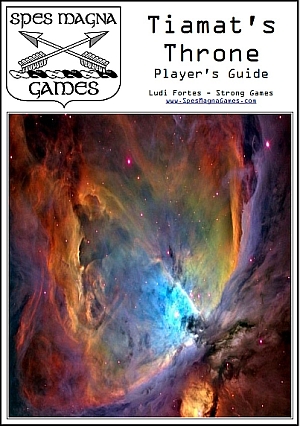 Excerpts from my first non-Pathfinder project, Tiamat’s Throne, a sci-fi/fantasy setting using the Stars Without Number core rules:
The Rage of Dragons
In 2665, the time-space continuum ripped. What I mean is this: A hole was torn from another universe into ours. This was no accident. Forces beyond human comprehension purposefully rent asunder the fabric of reality separating the two universes.
And through this tear came the dragons.
Hundreds of them, each one with the size, speed, and power of a frigate. They rampaged across the sector, raining down death and terror on world after world. Humanity — reeling from the sudden disruption of technology and the psychic chaos of that metadimensional “shriek” — rallied as well as could be expected. Some dragons died in combat against armed spaceships. A few worlds managed to lessen the destruction wrought by the dragons.
Then, the dragons turned on each other. By the end of 2675, only four dragons survived, and the weaker three combined could not match the power of Her Draconic Majesty Tiamat the Unconquerable.
…
Kouranism: Many wizards suffer from Kouranism, a magical condition that mutates the body and mind while making it possible for the sufferer to manipulate eldritch energies in ways not possible for the unafflicted. Rules for this new skill are found in the Kouranism section below.
…
When the Eugenics Commissars finished designing the duonos genome, the plan was that the new species would be genetically predisposed toward obedience. Thus, genome manipulation aimed at docility and timidity. The first two or three generations of duonos functioned well in their various roles as compliant domestic servants too afraid of their masters’ authority to be disobedient. In the fourth and following generations, however, a genetic instability evidenced itself. Centered in the amygdala, this instability resulted in a minority of duonos exhibiting the binary psychological traits of fear or wrath. Put more simply, some duonos were typically docile and timid, but only up to a point. After that, these aberrant duonos — called koleros — became violent, sometimes shockingly so as they fell into the grip of rage verging on psychotic in intensity.
…
Wizard Class Traits
Prime Attributes: Intelligence or Dexterity
Hit Dice: d4
Special Ability: The wizard is the only class that can learn to cast spells.
Wizard Class Skills: Artist, Combat/Magitech, Culture/Any, Kouranism, Language, Religion, Perception, Profession/Any
Additional Skill Points per Level: 2
…
While most worlds have intermittent problems with the undead, Castor is overrun with them. Her cities exist in a state of constant siege. The most prominent undead menace are the hordes of zombies. Tens of thousands of zombie surround the cities, and more wander the wilderness between Castor’s urban centers. Other undead monsters are less common, but more dangerous, especially those that can fly such as ghosts and spectres. These types of monsters can not only bypass city walls, but they can also threaten the dirigibles that link the cities via the airways.
Despite the planetary quarantine, groups of adventurers sometimes travel to Castor. Caches of pretech can be found in ancient ruins by those willing and able to brave Castor’s the undead terrors.
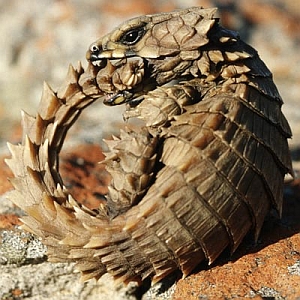 More xenobeasts for Stars Without Number:
Elanoran Tailbiter
Armor Class: 6
Hit Dice: 1/2
Attack Bonus: +1 (tail) or +3 (tumble attack)
Damage: 1d3 (tail) or 1d6 (tumble attack)
No. Appearing: 2d4
Saving Throw: 15+
Movement: 20 ft. (see below)
Morale: 8
The Elanoran tailbiter is a rugged reptilian scavenger found all over Elanor. An adult tailbiter weighs about 40 pounds, and it measures about 3 feet from nosetip to the end of its tail. Thick, overlapping scales protect its head, back, and tail. The scales closer to and on the tail sport sharp edges and blunt spikes. A tailbiter’s coloration varies depending on its environment. Tailbiters that live in forests, for example, tend toward dark greens and browns, whereas those that live in deserts are usually yellow-brown.
As mentioned, Elanoran tailbiters are scavengers. They are not particularly aggressive, but they will lash out to when threatened or frightened. A tailbiter usually attacks with a tail strike. If a tailbiter has at least 20 feet to move before attacking, it might use the strange maneuver that gives the species its name. The reptile bites its tail, curls into something like a ball, and launches a rolling charge at a foe. While tumbling in this manner, the tailbiter uses its clawed feet to guide its movement.
Heavy mining operations on Elanor have disrupted numerous planetary ecosystems, displacing large numbers of tailbiters. Being scavengers, the reptiles have moved into urban areas looking for food and breeding spaces. In some cases, these urbanized tailbiters have become feral. Feral tailbiters can be dangerously aggressive, even predatory. Add +2 to a feral tailbiter’s morale.
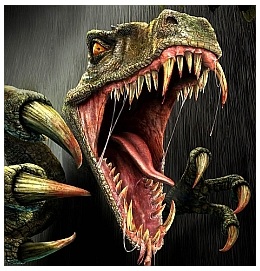 Yet another Stars Without Number xenobeast:
Denebian Ripper
Armor Class: 5
Hit Dice: 6
Attack Bonus: +6/+6/+6
Damage: 1d6/1d6/1d8 (claw/claw/bite)
No. Appearing: 1d3+1
Saving Throw: 12+
Movement: 40 ft.
Morale: 10
Denebian rippers roam Deneb’s ice fields and tundras, claiming huge tracks of wilderness as their hunting grounds. These man-sized predators possess exceptionally keen senses of sight and smell. A ripper’s vision extends into the infrared portion of the spectrum, and it can detect as little as a pint of blood up to a mile away if downwind of the source.
Despite their reptilian appearance, rippers are warm-blooded, being more closely related to a predatory flightless bird than a lizard. They have unusually high body temperatures (average 115 degrees Fahrenheit) and thick epidermal scales covering highly insulative fatty tissues. Consequently, rippers are comfortable in low temperatures that would rapidly kill an unprotected human.
Rippers are voracious, and they must consume large quantities of protein and fat to maintain their metabolisms. During Deneb’s brutal winters, when prey is even scarcer, rippers turn on each other. This seasonal cannibalism helps ensure only the most fit rippers survive to reproduce.
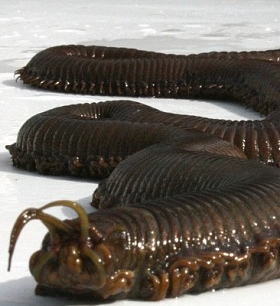 Another Stars Without Number xenobeast:
Castoran Salt Worm
Armor Class: 6
Hit Dice: 2+2
Attack Bonus: +3
Damage: 2d4+2 bite
No. Appearing: 1
Saving Throw: 14+
Movement: 20 ft., burrow 10 ft.
Morale: 7
The Castoran salt worm is a solitary ambush predator that grows to lengths of 10 to 15 feet and weights of 75 to 125 pounds. It spends most of its time lurking in a vertical burrow just a foot or two beneath the surface. Its leathery, boneless body is covered with millions of sensory hairs that detect minute changes in pressure, such as those caused by a creature walking across the surface of the salt flats these worms prefer to lair in.
The Castoran salt worm’s lightning fast strike (+1 initiative rolls) as it erupts from its burrow has a 75% chance of gaining surprise. The worm attacks with its crushing bite.
Fortunately, Castoran salt worms are not especially aggressive or voracious. This xenobeast is likely to retreat if strongly opposed, and its slow metabolic rates require it to consume little more than half its body weight a month.

