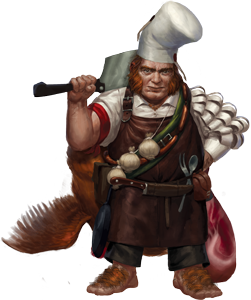
 The first demi-human race I’ve rough-drafted for SWN:
Eugenics Commissars gengineered the duonos from selected human populations born with different forms of dwarfism. Through selective breeding and genetic manipulation, a dimininutive variation on the human species emerged and was put into production for use as domestic servants.
Appearance and Biology: Duonos average 3 feet in height. They tend to have thin arms and legs with pudgy, short torsos with short necks. A duono’s hands and feet are often quite hairy as well as oversized for his stature, being nearly as large as the hands and feet of an adult human. As a result, a duono’s overall appearance may seem somewhat comical to non-duonos. Facial hair is uncommon even among adult male duonos.
History: As Tiamat and her dukes solidified their control over the sector, there arose a need for an upper class of military officers, bureaucrats, and so forth who would be loyal to the dragons. Even with all of their power, our draconic masters cannot oversee billions of people spread across 18 worlds separated from each other by light years. Loyalty, however, has its price. For some, fear can serve as payment, but most demand wealth and power. The gengineering of the duonos was meant to fill part of this demand. The Eugenics Commissars gave the rising elite of Tiamat’s empire the duonos as a reward for loyal service. For years, the reward was happily received. The sector’s duono population grew rapidly, and the new species was assigned a growing number of mostly menial jobs.
When the kolero mutation manifested itself, the situation changed. Koleros are duonos with a serious psychological disorder that makes the koleros subject to fits of extreme rage. On several worlds, berserk koleros murdered dozens of imperial loyalists and injured scores more. Something had to be done, and so the Eugenics Commissars established the Pogrommers.
Few if any imperial factions are more feared than the Pogrommers. These highly trained personnel, expert in the arts of assassination and espionage and equipped with the empire’s latest tech, hunt the sector’s worlds. The Pogrommers primary mission is the enforcement of racial sanitation codes. The Pogrommers have authority to execute summary judgment against those with “deviant” genetic disorders, such as the koleros.
Today, the duono population is diminished, but duonos are still found in substantial numbers on most worlds. Koleros, on the other hand, live cautiously and often in underground communities. Being a member of a kill-on-sight species doesn’t encourage bold lifestyles, at least not in heavily populated imperial centers.
Psychology: When the Eugenics Commissars finished designing the duono genome, the plan was that the new species would be genetically predisposed toward obedience. Thus, genome manipulation aimed at docility and timidity. The first two or three generations of duonos functioned well in their various roles as compliant domestic servants too afraid of their masters’ authority to be disobedient. In the fourth and following generations, however, a genetic instability evidenced itself. Centered in the amygdala, this instability resulted in a minority of duonos exhibiting the binary psychological traits of fear or wrath. Put more simply, some duonos were typically docile and timid, but only up to a point. After that, these aberrant duonos — called koleros — became violent, sometimes shockingly so as they fell into the grip of rage verging on psychotic in intensity.
Flavor: This species comes in two different flavors: duono and kolero. On the surface, there seems to be little difference between them. There are no physical differences between duonos and koleros above the genetic level.
Duonos tend to be polite, deferential, even obsequious. They have been gengineered to serve, and many find contentment in doing their jobs well and pleasing their masters. Duonos often live in relative freedom, and many of them hold influential positions. A duono secretary assigned to a high-ranking imperial official may have privileges that the average imperial citizen can only dream of. While duonos usually have their civil liberties restricted even moreso than the norm, most duonos are not considered chattel.
Koleros also tend to be polite, but more to avoid drawing attention to themselves. Most koleros occupy low-profile positions or else live as much as possible in underground economies. Consequently, many koleros survive via lives of crime. They work as smugglers, thieves, black marketeers, and so forth. Resistance groups, working against imperial hegemony, often include several kolero members.
Racial Traits: Any player running a duono character must decide if his character is a normal duono or a kolero. This choice affects racial traits. It also has social consequences. Koleros live under constant threat of exposure as unlawful genetic aberrations, and death is the usual punishment under imperial racial sanitation codes for this crime.
All duonos and koleros move slower than larger races. Their movement speed is 15 feet per round slower than a human’s at all categories of encumbrance (45 feet per round normal, 30 feet per round when Lightly Encumbered, 15 feet per round when Heavily Encumbered). Duonos and koleros are sure-footed and quiet. They enjoy a +1 bonus to Stealth checks.
A duono must have at least a 13 Dexterity, and his Strength and Charisma cannot be higher than 13. Due to their docility and timidity, duonos suffer a -1 penalty on saving throws against effects related to authority, command, and fear. Their near-constant state of alertness to avoid incurring the displeasure of others grants duonos a +1 bonus to initiative rolls and to Perception checks. It is assumed that all duono characters have spent some time “in service” as well. A duono character gets to add one of these skills to his background package: Artist, Bureaucracy, Business, Computer, Profession (any), or Steward. A duono cannot be a warrior.
Koleros also must have at least a 13 Dexterity, but his Strength and Wisdom cannot be higher than 13. Koleros also suffer the same -1 penalty on saving throws against effects related to authority, command, and fear. Unlike duonos, subjecting a kolero to such an effect may trigger blood rage.
If a kolero makes a saving throw against an effect related to authority, command, or fear, he involuntarily enters blood rage for the next 1d6+4 rounds. During this time, the kolero gains a +2 bonus to his Strength and Dexterity scores (gaining the benefits appropriate to the boosted ability scores). His increased speed and strength also grants him a -1 to his Armor Class (in addition to any changes due to boosted Dexterity), normal human movement rates, and a +4 bonus to saves against Mental Effects. While in the grip of blood rage, a kolero must attack every round, but he is not so deranged that he cannot choose his targets (or even vent his rage on inanimate objects). If a kolero has a full round to spend working himself into an emotional frenzy, he can voluntarily trigger his blood rage. Every instance of blood rage experienced by a kolero also imposes one point of System Strain on that character.
A kolero can be of any character class.
Tags: Stars Without Number, Tiamat's Throne
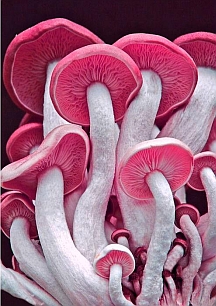 Another one from the xenobestiary for Tiamat’s Throne, my
  I checked over at
  My
My 
