2011’s Conan Stinks, but the Kummai!
This morning, I watched 2011’s execrable Conan the Barbarian. In a perfectly just universe, those responsible for this film would never have been permitted to make the movie, or, at a minimum, they would have to refund the 113 headache-inducing minutes I spent suffering through the cinematic excrement. On the plus side, Conan’s fight against those ninja sand monsters was kind of spiffy. So, in that vein:

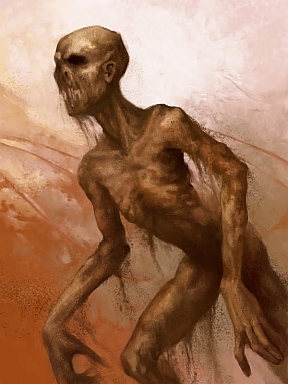
The kummuai inhabit desert regions, lurking at the edges of inhabited places. They haunt the outskirts of towns and the routes between oases. In its natural form, a kummua is invisible and incorporeal. They cannot affect material creatures or objects in this form, but they are also immune to almost all attacks. Cleric spells and undead turning can affect a kummua in its natural form, assuming the monster can be detected.

All kummuai hate living creatures and seek to destroy them. To do so, a kummua “possesses” a quantity of sand and earth taken directly from the ground. It shapes this material into vessel resembling an emaciated humanoid body endowed with remarkable speed and agility. On the round a kummua forms a vessel, it can make only one attack and move only at half speed. After that, the kummua moves at full speed and makes two claw attacks per round. On any round after it forms its vessel, a kummua may dissolve its vessel and instantly form a new vessel from suitable materials within 60 feet of the kummua’s original position. A kummua who chooses this tactic may make only one attack and move only at half speed, either before or after it dissolves and reforms elsewhere.

A kummua whose vessel is destroyed (reduced to 0 hit points) must make a saving throw to avoid having its natural form destroyed as well. If the saving throw is successful, that kummua cannot reform a new vessel until (4d4 minus HD) nights have passed.

Swords & Wizardry

Hit Dice: 1-3
Armor Class: 5 [14] (1 HD); 4 [15] (2 HD); 3 [16] (3 HD)
Attacks: 2 claws (1d4 plus additional damage equal to HD)
Saving Throw: 17 (1 HD); 16 (2 HD); 14 (3 HD)
Special: form vessel, immune to sleep and charm spells, invisible/incorporeal natural form
Move: 12 (15 flying in natural form)
Alignment: Chaos
Challenge Level/XP: 3/60 (1 HD); 4/120 (2 HD); 5/240 (3 HD)

June 19th, 2013  in RPG 2 Comments »

A Request from Spes Magna Games

I established Spes Magna Games roundabout December 2009. Between then and now, I’ve written and published almost 20 gaming PDFs, mostly for The Pathfinder Roleplaying Game. On average, I guesstimate I’ve made about $25 a month from the sale of my PDFs. That’s not a lot; I’m in no danger of retiring early, but that’s okay. I run Spes Magna Games because I love the hobby.

Those of you who follow this site know that I teach at a small, open-enrollment public charter school in Katy, Texas. I’ve been there three years. Aristoi Classical Academy strives mightily to offer tuition-free the sort of classical education normally available only in private schools charging several thousand dollars a year per student. As far as I know, we’re the only public school in Texas that offers a classical education.

A few years before I started teaching at Aristoi, the previous administration irresponsibly took out way too much debt in the form of bonds. The school’s debt situation the year before last was bad enough that the Texas Education Agency could’ve shut us down. This year we’re no longer in danger of being closed because of bad debt. Our current administration has worked heroically, and this year our debt has been reduced by about $1.4 million dollars (approximately half of the overall debt). We did this by cutting some salaries, freezing others, streamlining costs, eliminating overhead, consolidating jobs, et cetera. About a half a million dollars was saved through these efforts.

The state education commission has been so impressed by Aristoi’s financial and educational accomplishments that we have been approved to expand our enrollment from 325 to 440 students for the upcoming school. We’ve also been green-lighted to add a 9th grade class for the 2014-2015 school. To fully meet the needs of our incoming, larger student body, we need more space. Aristoi’s school board and administration have a plan to grow the school’s facilities.

Part of that plan includes raising $550,000 for construction and purchasing adjacent, undeveloped land.

At Aristoi, we don’t teach to a state test. We educate the whole child, mind, body, and spirit, and seek to fill the students’ hearts with great tales of heroes such as Jason and Argonauts, Don Quixote, George Washington, Stuart Little, Sherlock Holmes, and Frederick Douglass, to name just a few. I know classical education works better than traditional public education for many students because I’ve seen the difference it can make in the lives of children, including my own.

I’ve been a gamer longer than I’ve been a teacher, and I’ve also seen the hearts of gamers in action. We gamers know the value of education, the importance of friends, and about the wonders of imagination that can be inspired by great stories. So, here I am, asking for donations. But I’m not forgetting the lesson I learned from First Lieutenant Freehill while I was stationed at Schofield Barracks, Hawaii. I’m not asking anyone to do something I’m not willing to do.

Spes Magna Games has donated $50 to Aristoi’s indiegogo campaign. I’m asking you to donate one-tenth of that amount just one time. Help us at Aristoi inspire our students to aspire toward lives of heroic virtue.

Thanks for your time and attention.

June 18th, 2013  in Spes Magna News No Comments »

The Fombui

The Fombu (pl. Fombui) is a strange crystalline creature that dwells in the dark and muck of lake bottoms and sea floors. They are seldom encountered as the Fombui have little reason to leave their aquatic abodes. A Fombu appears to be a five stems growing from a central clump. Frail-seeming projections grow upward from these stems, creating a sort of comb-like structure. The longer, more mature projections end in sensory nodules. No one is quite sure how large Fombui grow. Individuals with stems reaching lengths of six feet have been reported. Fombui are filter feeders, sucking water into their bodies and straining out tiny shrimp, algae, and so on. They move slowly by crawling about on stubby feet. Once every 1d6 rounds, a fombui can generate a powerful jolt of electricity. Creatures within 5 feet of the fombui suffer 4d8 points of electricity damage and are stunned for 1d6 rounds. Those within 10 feet suffer 2d8 points of electricity damage and are stunned for 1d3 rounds. Creatures no farther away than 15 feet suffer 1d8 points of electricity damage and are stunned for 1 round. A successful save halves this damage and negates stunning. Fombui cannot be harmed by electrical attacks.

Fombui are remarkably intelligent. They communicate with each other via targeted electrical impulses, doing so over distances as great as two or three miles. While the Fombui lack most trappings of civilization, they have eidetic memories and a rich, complex oral history.

Swords & Wizardry

Hit Dice: 4
Armor Class: 6 [13]
Attacks: electrical jolt
Saving Throw: 13
Special: immune to electricity
Move: 3
Alignment: Lawful
Challenge Level/XP: 6/400

Stars Without Number

Armor Class: 6
Hit Dice: 4
Attack Bonus: NA
Damage: electrical jolt
No. Appearing: 1d6
Saving Throw: 13
Movement: 10 ft.
Morale: 7

June 17th, 2013  in RPG No Comments »

The Konstruaĵo

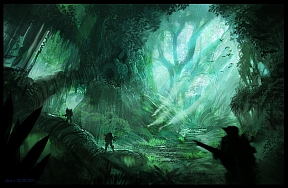
Centuries ago, when we moved into Stelo Sector to explore and colonize, settlers discovered the first Konstruaĵo sites, which, by that time, were already hundreds of centuries old. To this date, no one can say with certainty what happened to the Konstruaĵo or even what the Konstruaĵo looked like.
What is known? Well, this:

* Konstruaĵo architecture was designed to blend into the natural environment. Many Konstruaĵo structures extend into subterranean spaces.

* No stairs or ladders have been discovered in Konstruaĵo sites. The Konstruaĵo did make use of ramps, some of them quite steep.

* Most curiously perhaps, no depictions of Konstruaĵo life have ever been found. Likewise, xenoarchaeologists have uncovered very few Konstruaĵo artifacts. Those artifacts that have been found are invariably simple tools or utensils, most of them broken.

* It is believed the Konstruaĵo had a highly mystical culture. After the discovery of the Traduko Codex, which led xenocryptologists to reconstruct portions of the Konstruaĵo language, translations of rare Konstruaĵo literary fragments were completed.

* It appears as if Konstruaĵo religion centered on the idea that “enlightened ones” could manipulate reality via “purified senses”. It is almost certain that at least some Konstruaĵo were psychics.

* Inferences drawn from Konstruaĵo texts indicate that the Konstruaĵo were not bipedal humanoids. It is likely that the Konstruaĵo did not consume solid foods, but rather they had a system of externalized digestion, using enzymes to liquefy food before consumption.

The Traduko Codex

Among the many mysteries associated with the Konstruaĵo is the origin of the Traduko Codex, discovered accidentally by construction workers on Ryloth when the ground beneath an earth mover caved in, uncovering an ancient Konstruaĵo cave dwelling. Quite improbably, the fragmentary Traduko Codex included text in both the Konstruaĵo’s language as well as eme-ĝir, the standard dialect of ancient Sumeria, a Terran culture that dates back to the beginnings of recorded history on the human motherworld.

This Konstruaĵo-Terra connection has fueled speculation for decades. It must be that the Konstruaĵo visited Terra during the earliest periods of Terran history. What purpose these visits may have had, when the visits began, when they ended, et cetera, are questions that have yet to be answered.

June 14th, 2013  in RPG No Comments »

Pay What You Want?

I decided to experiment with the new “Pay What You Want” option at DriveThruRPG. Currently, these PDFs are available for prices ranging from free to however much money you think they’re worth:

Ars Metamagica: Underwhelmed by metamagic feats? Wish your casters had more flexibility when modifying their spells? Then get Ars Metamagica today. This 13-page, printer-friendly PDF describes an alternate metamagic system that replaces metamagic feats with a metamagic check mechanic.

Dodeca Decor: What will your players do when they see claw marks on the ceiling? Find a dead three-headed snake? Detect a thick, reptilian odor? These are just three of more than 144 details that Dodeca Decor randomly adds to your game, all contained in 13 printer-friendly PDF pages.

Dodeca Encounters: Dodeca Encounters includes two blank tables on a page on which GMs can create their own customized random encounter tables. Each table uses 1d12 plus 1d8 to generate a number between 2 and 20 with most of the numbers falling into Average Party level +0 or -1 range.

Dodeca Weather: Dodeca Weather helps restore the noble d12 to a position of respectability and importance by making it the randomizer that determines your campaign’s weather from day to day. This printer-friendly, 20-page PDF presents a plethora of tables that help GMs determine daily weather by taking into account season, climate, altitude, and terrain.

Gazae et Monstri: This 14-page PDF includes 6 magic items and 5 monsters drawn from Greek and Roman myth. Arm your fighter with the cesti of Eryx. Quest for Pandora’s box. Trade blows with the mighty Antaeus, or match wits with the terrifying Python.

Making Craft Work: Do you wish the rules for the Craft skill made sense? Do you wish it were possible to craft equipment and still have time to adventure? Well, your wishes are our commands! Making Craft Work presents a new system for the Craft skill that uses complexity rather than price to determine how long it takes to finish an item. This is an 8-page, black-and-white PDF.

Quid Novi? Perilous Penguin Edition: Do you know what’s Quid Novi? Well, now you can find out with this free PDF. The Perilous Penguin Edition presents the complete contents of one of Spes Magna’s Quid Novi? e-letters. Included in the Perilous Penguin Edition are a strange disease, a magical glove, two arctic creatures, an arcane trap, a dangerous haunt, and a musical cantrip.

The Baykok: Baykoks stalk forests. Since they favor humanoid prey, they tend to stay close to communities, especially frontier settlements. A baykok, however, seldom ventures within the confines of a community. Instead, it prefers to haunt the outskirts and near wilderness, hunting people who venture into the woods.

The Swamp Isle of the Croaking Priestess: The Croaking Priestess and her boggard followers run a brisk business trading magical potions for sacrificial victims. Local marshfolk have suffered the predations of wicked swamp denizens long enough. They need adventurers to head into the muck, assault the Swamp Isle, and finally put an end to the Croaking Priestess’s evil.

Trekking to the Side: Trekking to the Side features two short adventures originally published for Quid Novi? subscribers in June and July 2012. The Ruined Fort is suitable for 5th-7th level PCs. The Coming Storm is suitable for 9th-11th level PCs. In addition to the short adventures, this printer-friendly PDF includes a new monster, new haunts, new afflictions, and more.

June 14th, 2013  in Spes Magna News No Comments »