Gearing Up for Fate?

The twice-monthly (or thereabouts) sessions of Man Day Adventures have been through a few game systems over the years: AD&D (2nd edition), the d20 System (3.0, 3.5, and Pathfinder), Sine Nomine’s excellent Stars Without Number, brief excursions into d20 Modern, Swords & Wizardry, and Mutants & Masterminds, and, most recently, the fabulous Dungeon World for a rollicking campaign under the auspices of three GMs.

As July 2015 bears down on us, we prepare to bid a sad adieu to one of Man Day’s adventurers, who is leaving the U.S. for a new life in a foreign land. The consensus is that his final Man Day will be the final act of our Dungeon World campaign. Further, it seems most likely that our next game with be Fate Accelerated (or FAE), published under both the Open Gaming License and Creative Commons Attribution license by Evil Hat Productions.

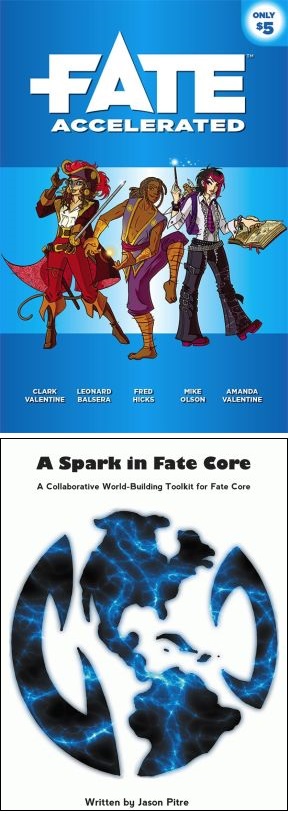
To prepare for the upcoming new campaign, I trundled my virtual self to DriveThruRPG and purchased FAE. While I was there, I also picked up A Spark in Fate Core, published by Genesis of Legend Publishing. This latter product bills itself as a “Fate World Building Toolkit” and, since one Man Day adventurer had talked several times about using FAE to create a collaborative campaign world, it seemed like a well duh acquisition.

FAE claims that it can be used to play (just about?) any genre. The players get together, decide on a genre, and then make characters that fit that genre. I’ve run across this claim before (GURPS, for example), and I’ve almost always been at least somewhat underwhelmed. Often, it seems based on my experience, the system claims to work for (just about?) any genre, but then the system ends up working against that claim because the system itself is too rigidly defined.

Keeping in mind I’ve not played FAE yet, it does seem as if FAE avoid at least this pitfall. Characters are defined more by narrative hooks than by ability scores. These hooks come in three flavors: a high concept, which “is a single phrase or sentence that neatly sums up your character”; a trouble, which is that “one thing that always get you into trouble”; and at least one other aspect, which is something “really important or interesting about your character.” Characters also have approaches, which describe how characters accomplish tasks. Each of the six approaches are rated as a bonus ranging from +0 to +3. One character might be Flashy +3, whereas another character might be Careful +3. Lastly, FAE recommends each character start with one stunt, which “is a special trait that changes the way an approach works for your character.” Stunts either grant a bonus (usually +2) or else let the character ignore certain rules in a predefined circumstance.

Since the action resolution system starts and ends with narration built around some combination of high concepts, troubles, aspects, approaches, and stunts, a huge range of activities can be accounted for without dozens of pages of rules. For example, one of the sample characters, Reth of the Andrali Resistance, has “Suncaller of the Andral Desert” as a high concept. This lets him “magically call forth the power of fire.” FAE doesn’t include pages of fire spells or powers. Instead, Reth’s player would narrate Reth’s desired course of action, such as:

“I lunge at the robot, sheathing my body with flame, as I attempt to slam my foe.”

The player would then roll four Fate Dice, apply Reth’s Good (+3) Forceful modifier, and then compare the result to the robot’s defense total. The degree of success determines the results, ranging from failure to short-term benefit to damage to more damage plus a possible short-term benefit. Pretty much everything works more or less like this (narrate, roll, determine results). The use of Fate Points can further amplify results or even establish facts about a current scene.

In short, I kind of psyched to give FAE a test drive. There are oodles of reviews for the system out there, many of which do a better job explaining things than I do. Check them out.

So, what about A Spark in Fate Core? In short, it’s almost exactly what I hoped for. ASiFC offers a step-by-step method to collaborative world building that helps ensure all players at the table have a pretty much equal say.

This process starts by listing favorite media, such as a particular television show or comic book. Each player then explains the inspiration for his choice. For example, if I choose Pee-Wee’s Playhouse as my favorite, I would then expand on this choice by noting how much I like the all of the goofy supporting characters such as Cowboy Curtis and Billy Baloney. After all players have shared their favorite media and related inspiration, the group then decides on a genre that incorporates those media and inspirations. The genre should have a descriptor that shows how the group’s take on the genre stands apart from the genre’s most common examples.

This process of players taking turn sharing, arriving at group decisions, asking and answering questions, et cetera, continues until the world has a scale (small or large), a list of facts, a title, several Sparks (the system’s name for potential problems or sources of conflict), a group of Faces (important NPCs), and noteworthy places. The GM uses the Sparks to set up issues that impact the shared story. One Spark is a Legacy Issue; it used to be a problem, but now serves as history and culture. Another Spark is the Current Issue. This is the main focus of the campaign to start with. A third Spark is an Impending Issue. It’s not a problem yet, but it will be eventually.

The process described in ASiFC is simple enough, flexible, and truly collaborative. The downloadable PDF is free. If there had been a pay what you want option, I’d have paid for it. It’s worth at least a couple of bucks, and ASiFC‘s process is generic enough that it would work well with just about any game system.

June 17th, 2015  in Man-Day Adventures No Comments »

Vodyanoi & Rusalki

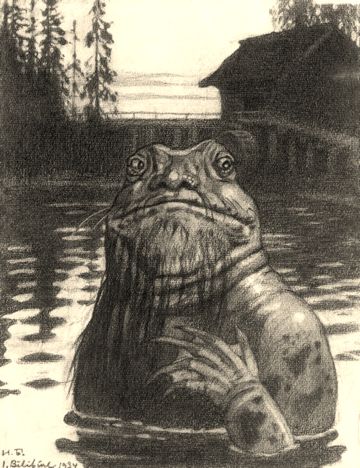
From the waist up, a vodyanoy appears as a naked old man, but its frog-like face, tangled greenish hair, and covering of algae and muck over fish scales surely prevents anyone from mistaking this creature for human. What’s more, it has not hands but instead webbed paws, and in place of its legs extends a powerful fish’s tail. A vodyanoy’s eyes burn like red-hot coals.

When not swimming, it usually rides along its river on a half-sunken log, making loud splashes. When angered, a vodyanoy breaks dams, destroys water mills, and drowns both people and animals alike. Consequently, those who live along the banks of a vodyanoy’s river make sacrifices to appease the monster. Vodyanoi also drag down people to their underwater dwellings to serve as slaves.

For Barbarians of Lemuria

Attributes: Strength 4, Agility 0, Mind 1

Combat Abilities: 2 claws +1, damage d6-1; Defence 1; Protection d3-1 (scales); Lifeblood 10

Special: Vodyanoi breathe water as well as air. Against man-made structures, vodyanoi can exert enormous destructive power, comparable in many ways to the effects of a catapult.

For Dungeon World

Group, Hoarder, Intelligent
Claws (d8+2 damage, forceful)
6 HP
2 Armor
Close
Special Qualities: Amphibious
Instinct: To dominate its territory

* Destroy a man-made structure
* Drag victim to the bottom
* Swim silently and swiftly

For Swords & Wizardry

HD 4+1; AC 5 (14); Atks 2 claws (1d6); SV 13; Special breathe water, destroy man-made structure; MV 6 (Swim 12); AL C; CL/XP 5/240

The rusalka, an unquiet undead monster, was in life a young woman who either committed suicide by drowning due to an unhappy marriage or who was murdered by drowning, especially after becoming pregnant with an unwanted child. A rusalka must suffer its tortured existence in or near the body of water in which it both died and was reborn.

This undead creature is not invariably malevolent, for it may die in peace if its death is avenged. Nevertheless, a rusalka’s main activity is far from benign. It seduces by either by looks or by voice young men, who the monster then leads into the depths of its waterway. Therein, the rusalka entangles its victim with her long red hair and submerges, dragging the would-be lover to his death.

For Barbarians of Lemuria

Attributes: Strength 2, Agility 2, Mind 2

Combat Abilities: grappling hair +2, damage d3; Defence 2; Protection d4-1 (lacks any vulnerable organs); Lifeblood 10

Special: Rusalki appear as beautiful, red-haired maidens to mask their true, more horrific appearance. If engaged in seductive efforts against a male hero, the hero must attempt a Hard Mind action to avoid being charmed by the monster.

For Dungeon World

Devious, Group, Intelligent
Entangling hair (d4 damage)
10 HP
0 Armor
Close, Reach
Special Qualities: Undead
Instinct: To kill young men

* Appear beautiful
* Ensare in its entangling hair
* Inflame the passions

For Swords & Wizardry

HD 8; AC 3 (16); Atks Entangling hair (1d3 then constrict); SV 8; Special appear human, charm male, constrict (1d6), undead; MV 9 (Swim 9); AL C; CL/XP 11/1,700

June 3rd, 2015  in RPG No Comments »

The Mouth of Truth

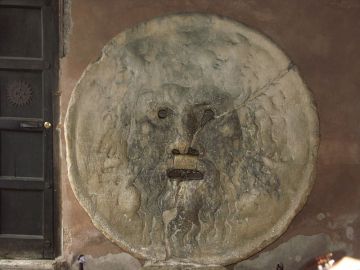
Nota Bene: The accompanying photograph was taken by Dnalor_01 and is released under the CC-BY-SA 3.0 license. Source: Wikimedia Commons.

For Dungeon World

Carved from marble, cracked and worn after centuries of use and misuse, the Mouth of Truth currently rests against a wall in the portico of the sea god in a bustling, nearly lawless coastal trade center. The fog of history and legend obscures the Mouth’s true origins, but it’s powers are well and widely known.

If someone tells a lie while their hand the rests in the sculpture’s mouth, the marble aperture slams shut, almost certainly crushing muscle and bone to pulp. Those about to embark on a voyage may also propitiate the Mouth and ask for an oracle about the journey.

When you propitiate the Mouth of Truth, spend 100 coins and roll +1 for every extra 100 coins spent. ✴On a 10+, choose 2. ✴On a 7–9, choose 1.

* The voyage will likely be less perilous. Take +1 forward when you undertake a perilous journey.
* You will meet a significant person during your journey.
* A beneficial opportunity will be encountered while traveling.
* An unexpected benefit waits at the journey’s end.

June 1st, 2015  in RPG No Comments »

Bosch-Inspired Monsters

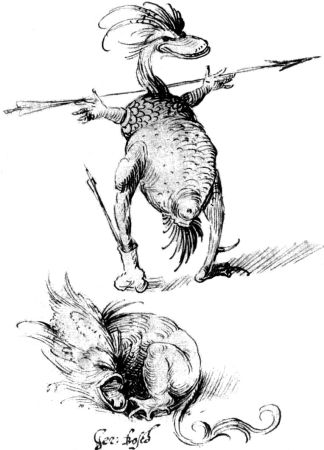
Yndspeers appear as a bizarre avian-like humanoid roughly the size of a dwarf. A yndspeer is devoid of feathers except for a crest on its head and a tuft growing downward from its abdomen. Rather than wings, a yndspeer has stubby arms and hands. Males also sport wickedly sharp, upward curving barbs on their legs half way between the knee and ankle. These creatures cannot fly, but move rapidly along with a herky-jerky gait. Despite their somewhat comical appears, yndspeers are mischievous and cruel.

HD 1+1; AC 7 (12); Atks barbed spear (1d6); SV 18; Special spears lodge in victim (save negates); MV 12; AL C; CL/XP 2/30

The lyuwvis — a bizarre hybrid of frog, lion, and fish — hunts coastal marshlands. In the water, it swims sluggishly; on land, it hops about on its legs or else scoots through muck and mud on its belly. What the lyuwvis lacks in grace, it makes up for in strength and tenacity. This monster grows to the size of a large hound, and its powerful jaws inflict terrible wounds. The lyuwvis spits a noxious mixture of mud, saliva, and mucous before it attacks. Those struck by this foul substance find their reflexes impeded (as a Slow spell; save negates).

HD 3+2; AC 5 (14); Atks bite (1d6+2); SV 14; Special noxious spit; MV 6 (Swim 6); AL N; CL/XP 4/120

May 31st, 2015  in RPG No Comments »

Memorial Day

“Some things in life are too beautiful to be forgotten. These things may be what men do in this world; they may even be their manner of passing from it. For example, almost every country has instituted a memorial day to recall the supreme sacrifice its patriots have made in defense of country and civilization. Because life was the most precious thing they could give, the living cannot forget their gift. They themselves could not ask for any such memorial, nor could they institute it; that was left to their survivors.” — Archbishop Fulton J. Sheen

May 25th, 2015  in RPG No Comments »