A Great Cause & Little Baby Sings

Did you know that you can buy both Erik Jensen’s Bonespur Glacier and Jason Paul McCartan’s The Tomb of Bashyr as an OSRIC game system, double-feature module? Well, you do now.

Best of all, this double-feature module helps fund a worthwhile charitable effort: St. Jude Children’s Research Hospital. This link takes you the pay-what-you-want version. There’s also this $4.99 version. I’ve purchased my copy, and you should too. It’s a great pair of adventures written for a great game that help support a great organization.

And now, a new magic item!
Little Baby Sings

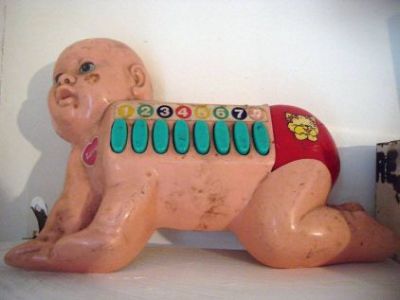
This strange toy, cast from metal into the shape of a crawling infant and painted with bright colors, features eight oblong buttons on one side. The first seven buttons are numbered; the last is labeled with a musical note.

The toy’s holder can press a numbered button and then the musical note button to produce a magical effect. The exact effects vary as it seems as if no two of these items are identical.

Possibilities could include such effects as these:

1. A single humanoid creature of 4 or fewer Hit Dice within 30 feet is dazed and loses its next action.

2. For one round, the use can make a rope move as commanded.

3. A single creature of 5 or fewer Hit Dice suffer from severe fear for 1d4 rounds.

4. An illusionary duplicate of the holder appears and lasts for 1d4 rounds. The duplicate mimics the holder’s actions.

5. Secret doors within 30 feet are revealed.

6. For the next minute, the holder can walk across water or other similiar substances as if they were solid ground.

7. Ignite a flammable object within 30 feet.

May 23rd, 2015  in RPG No Comments »

Things I Don’t Miss about the D20 System

1. Attacks of opportunity and the accompanying square/hex counting

2. Character build optimization

3. “That encounter’s CR was too high for our level!”

4. “That’s broken!”

5. “That’s under-powered!”

6. One-hour-long combat rounds

7. Having to hunt through a dozen books to find a single rule

8. Feat chains

9. Spending 12 hours to prep for a 4 hour game session

10. “What kind of action is that? Standard? Move?”

May 19th, 2015  in RPG No Comments »

Z is for ZZZ

img

Well, that’s it. The month is over. This post is actually two days late. I lost my rhythm, and just couldn’t get caught back up, especially what with me falling asleep at about eight or each evening.

Speaking of sleep, one of the things that has bugged me a little bit about the sleep spell in the d20 System is this line: “Slapping or wounding awakens an affected creature, but normal noise does not.” When I think about it, I cannot help but think that this sentence pretty much ruins the spell’s effectiveness much of the time.

If slapping a target of sleep wakes them up, then wouldn’t the targets wake up when they collapse and hit the ground, especially if they were running, jumping, fighting, et cetera, before the spell took effect?

GM: “The orcs charge.”

Player: “I cast sleep.”

GM: “The orcs fall asleep instantly. They tumble roughly to the ground, landing on each other, smacking their heads on the ground, and what not. Of course, this wakes them up.”

I’ve never adjudicated sleep that way, but it kind of makes sense.

April 30th, 2015  in RPG No Comments »

Y is for Yondral in the Sky

img

The island of Yondral with its collection of some half dozen buildings floats on invisible, eldritch currents, perpetually surrounded in mist. Once upon a time, an order of mystics called Yondral home. Peaceful, contemplative, and erudite, these mystics practiced arcane meditative arts, seeking to divine the mysteries of reality for no other purpose than the pure joy of learning. Life on Yondral was peaceful, even idyllic.

That is until one of the mystics named Blaise turned his mind toward darkness. A malignant force wormed its way into Blaise’s psyche, and slowly the mystic became more wicked while the force became stronger. Before the other mystics could figure out what was wrong with Blaise and take steps to heal him, the force lashed out. Yondral was sundered, but not into pieces. Instead, beneath the floating island, there appeared a demon-haunted mirror image of Yondral.

Today, Yondral and its twisted opposite drift about, abandoned but not abandoned, perhaps still home to ancient wisdom but certainly home to ineffable evil.

April 29th, 2015  in RPG No Comments »

X is for X-tra Time

img

(See what I did there?)

Took advantage of some extra time this morning while my students were in computer to start writing Unenägu. First step: Start to clarify how these new rules differ from that on which they are based. Here’s a sample:

Unenägu, like Swords & Wizardry: WhiteBox, requires two sets of players who differ in kind. The first is the Referee, and the second are the Players. The bulk of the first part of what follows aims primarily at the Players, who each must create a Player Character (PC), who becomes one of the characters in the shared story played out at the table during a game session.

What’s the Same?
If you’re reading these words, I’m assuming you have your own copy of Swords & Wizardry: WhiteBox. You’ll need to refer to it. Unenägu doesn’t repeat information from Swords & Wizardry: WhiteBox any more than necessary. For example, you’ll not find much in the way of items and equipment in what follows. Those guidelines are in Swords & Wizardry: WhiteBox, and I didn’t feel the need to retype them. Still, I do want to point out briefly what Unenägu doesn’t change, so here goes.

Rule Number One is still rule number one. This is your game now. Feel free to change it, add to it, subtract from it, et cetera. One of the beautiful things about old-school games is that they are about rulings not rules. This is especially important for the Referee. When something happens in the game that the rules don’t cover, make a ruling and move on.

Unenägu also uses all the same dice as Swords & Wizardry: WhiteBox. Attribute scores remain the same, and experience point (XP) calculations are unchanged. Likewise, hit points, starting gold, and alignment remain the same (unless, of course, you want to change them).

What’s more, the three basic character classes — the Cleric, the Fighter, and the Magic-User — work in Unenägu just like they do in Swords & Wizardry: WhiteBox. So, too, do Dwarves, Elves, and Halflings.

What’s Different?
Unenägu adds new class options related to PCs who are Visitors, those special children who have left behind the real world and entered the Realm of Dream. As Visitors, these children are aware that they now live in a dream, and they can manipulate reality, which, in game terms, is reflected in the use of Oneiric Points.

In addition to Humans, Dwaves, Elves, and Halflings, PCs who are not Visitors may be Talking Animals. The fables and fairy tales from which Unenägu draws inspiration often include animals with human intelligence and characteristics. Some Talking Animals appear very much like normal animals, while others are more anthropomorphic (such as Puss-in-Boots).

Lastly, a few non-Visitors PCs who have exceptionally high ability scores (14+) may perform Legendary Feats. A Fighter with an exceptional Strength might be able to twist iron chains asunder, whereas a Halfling with an exceptional Dexterity may be able to race up a wall.

April 28th, 2015  in Product Development No Comments »