Lean and Athirst!

More horrors for The Cthulhu Hack.

Flying Polyp

According to these scraps of information, the basis of the fear was a horrible elder race of half-polypous, utterly alien entities which had come through space from immeasurably distant universes and had dominated the earth and three other solar planets about six hundred million years ago. They were only partly material—as we understand matter—and their type of consciousness and media of perception differed wholly from those of terrestrial organisms. For example, their senses did not include that of sight; their mental world being a strange, non-visual pattern of impressions. They were, however, sufficiently material to use implements of normal matter when in cosmic areas containing it; and they required housing—albeit of a peculiar kind. Though their senses could penetrate all material barriers, their substance could not; and certain forms of electrical energy could wholly destroy them. They had the power of aërial motion despite the absence of wings or any other visible means of levitation. … Such was the fixed mood of horror that the very aspect of the creatures was left unmentioned—at no time was I able to gain a clear hint of what they looked like. There were veiled suggestions of a monstrous plasticity, and of temporary lapses of visibility, while other fragmentary whispers referred to their control and military use of great winds. Singular whistling noises, and colossal footprints made up of five circular toe-marks, seemed also to be associated with them. (The Shadow Out of Time by H. P. Lovecraft)

Hit Dice: 8
Notes: Tentacle (1d10). Windblast (1d6+1 Nearby targets must make DEX Saves to avoid 2d8 points of damage). Sucking wind (1d6+1 Distant target must make STR Saves to avoid being pulled one range category closer). Armor 4, plus invisibility. Takes minimum damage from physical weapons. Casts 1d6-1 spells.

Formless Spawn of Tsathogghua

At any rate, when the men of K’n-yan went down into N’kai’s black abyss with their great atom-power searchlights they found living things—living things that oozed along stone channels and worshipped onyx and basalt images of Tsathoggua. But they were not toads like Tsathoggua himself. Far worse—they were amorphous lumps of viscous black slime that took temporary shapes for various purposes. The explorers of K’n-yan did not pause for detailed observations, and those who escaped alive sealed the passage leading from red-litten Yoth down into the gulfs of nether horror. Then all the images of Tsathoggua in the land of K’n-yan were dissolved into the ether by disintegrating rays, and the cult was abolished forever. (The Mound by H. P. Lovecraft and Zealia Bishop)

Hit Dice: 4
Notes: 1d3 whips (2d4), or bite (1d4 plus engulf), or tentacle (1d10). Engulf (STR Save at Disadvantage to claw free; otherwise take points of damage equal to the number of Moments engulfed). Immune physical weapons, including magical weapons. Can be harmed by spells, fire, chemicals, et cetera. Casts 1d4-1 spells.

Ghoul

Rubbery flesh encrusted with earth and mold, hooved, wolf-like features, clawed fingers. Speaks in gibbers and meeps.

Hit Dice: 3
Notes: 2 claws (1d4) and a bite (1d6). Firearms do only half damage.
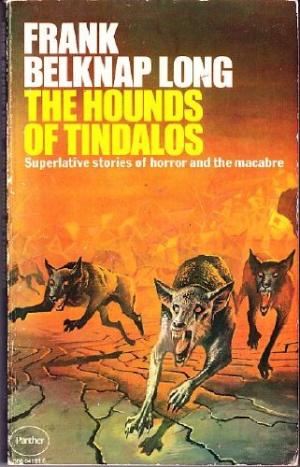
Hound of Tindalos

“They are lean and athirst!” he shrieked. “The Hounds of Tindalos!”

“Chalmers, shall I phone for a physician”

“A physician cannot help me now They are horrors of the soul, and yet”—he hid his face in his hands and groaned—”they are real, Frank. I saw them for a ghastly moment. For a moment I stood on the other side. I stood on the pale gray shores beyond time and space. In an awful light that was not light, in a silence that shrieked, I saw them.

“All the evil in the universe was concentrated in their lean, hungry bodies. Or had they bodies? I saw them only for a moment; I cannot be certain. But I heard them breathe. Indescribably for a moment I felt their breath upon my face. They turned toward me and I fled screaming. In a single moment I fled screaming through time. I fled down quintillions of years.” (The Hounds of Tindalos by Frank Belknap Long)

Hit Dice: 5
Notes: Paw (2d4 plus CON Save to avoid 2d4 damage from poison), or tongue (WIS Save to avoid losing 1d3 points of WIS). Armor 2, plus regenerates 4 hit points per Moment unless dead. Can fly, travel through time, and materialize through any corner. Cannot be harmed by non-magical weapons. 1d4 spells.

July 19th, 2016  in RPG 1 Comment »

Sacred Places

In those days, the Lord appeared to Abraham by the oaks of Mamre as he sat at the door of his tent in the heat of the day. He lifted up his eyes and looked, and behold, three men stood in front of him. (Genesis 18:1-2)

When the divine appears to a person, that person experiences a theophany. Ancient literature, such as the Illiad, and ancient religious texts, such as the Book of Genesis, describe such experiences, which take a variety of forms but always lead to an important change, event, or revelation. Thus, as the story of Abraham quoted in part above continues, Abraham is told that his wife Sarah will give birth to a son.

The site of the theophany itself may take on new signifance as it marks a place where the sacred and the profane touched, transforming the latter into a place set now apart from the normal. For example, near modern-day Hebron, the Oak of Mamre, reportedly 50 centuries old, stands at the site said to be where Abraham welcomed three visitors from Heaven.

Such sites attract pilgrims, many of whom journey with specific intentions, such as hope for healing for themselves or a loved one. Often, these sites become the focus of a group of believers, and then a larger community that may include residents whose motives are primarily related to just making a living. Not everyone can live a life solely devoted to prayer or contemplation. Someone has to do the laundry and grow the food, and the larger the community around or near a sacred site, the more varied the motives of people in the community become. The city of Jerusalem is perhaps the most famous example of a community with a complex, rich history that attracts pilgrims year-round.

The inclusion of sacred pilgrimage sites is a good way to inject some verisimilitude into a campaign. Even in our postmodern age, where what appears to be a distressingly large number of people think that divine favor or good fortune can be curried by liking and/or sharing pictures on Facebook, the attraction exerted by sacred places ought not be too difficult to understand. Wars are still fought over holy places, and people still shed blood in the streets in defense of ideals that, while not necessarily religious, are clung to with religious fervor.

The potential for conflict, and the resulting adventure, grows when a site’s significance acquires various interpretations that conflict with each other, as when the persecution of Christians and destruction of Christian holy places in Jerusalem by the caliph of Egypt helped motivate Christendom into the First Crusade. Translate the events of the First Crusade into a swords-and-sorcery campaign and a GM at least has a dynamic backdrop against which his players’ characters adventure.

To this backdrop, add sacred places that ought to be important to the party’s religiously motivated members. What does the party’s cleric of Olidammara do when the local ruling hierarchy of Wastri decides to suppress all music that does not sing the praises of the Hopping Prophet? What happens when the faithful of Merikka take action against the planting rites of Sheela Peryroyl right under the nose of an adventuring cleric of Yondalla?

And, of course, don’t neglect putting some thought into specific game effects or events attached to the site of a theophany.

Six Things That Might Happen at a Sacred Site
1: A cleric of suitable alignment or faith receives an extra first level spell for the day.
2: A character of suitable alignment or faith is cured of an illness or freed from a curse.
3: Someone sleeping at the site receives a prophetic dream.
4: A pilgrim who possesses useful information or skills may help the party.
5: A divine messenger, probably in disguise, requests the party’s help.
6: A gang with reason to dislike what the site represents shows up to cause trouble.

July 18th, 2016  in RPG No Comments »

Fiends for The Black Hack

Monsters from the Fiend Folio for The Black Hack, an ebon slice of RPG genius.

Al-Mi’Raj

This large, yellow rabbit sports a unicorn-like horn. Adventurers may find al-mi’rajes in pastures and woodlands, or perhaps lairing in a small cave.

Hit Dice: 1
Notes: Horn (1d3). Highly nimble. Attacks suffer disadvantage to DEX tests to hit an al-mi’raj with ranged weapons.

Bloodworm

Found in shallow pools in underground caverns. Cannot swim, but instead wriggle along the bottom of their watery lairs. Reach lengths of nearly 20 feet, but slender and lithe.

Hit Dice: 6
Notes: Bite (1d8). CON test if bitten to avoid 1d8 points of damage from blood drain the moment after the attack.

Coffer Corpse

Emaciated, rotting flesh, eyes burning with hatred, fingernails grown into talons.

Hit Dice: 2
Notes: Claws (1d6). Ignores the first 6 points of damage (no other armor), but collapses as if destroyed if it takes at least 6 points of damage. The next moment, it springs back to unlife. Those who witness this attack must test versus WIS to avoid fleeing in panic.

Death Knight

Skeletal creature in ancient, decaying finery and plate armor.

Hit Dice: 9
Notes: Mighty attacks with weapons (3d6). Tests to see if magic is powerful enough to overcome a death knight’s defenses suffer a +2 penalty (in addition to applicable modifiers for a powerful opponent). Can cast Wall of Ice once per moment. Can Detect Magic and see invisible creatures. Can use Fireball and Power Word, Kill once per day each.

July 16th, 2016  in RPG No Comments »

Horrors for The Cthulhu Hack

One of the first things I do with a game system is write up monsters, villains, et cetera. Hereafter, I try my hand with a few horrors for The Cthulhu Hack.

Chthonian

An enormous squid-like monstrosity at least 20 feet long. Numerous grasping tentacles. Its worm-like body coated with slime. All around, an alien chanting that seems to come from the very air itself.

Hit Dice: 10
Notes: Tentacle (1d6 plus CON Save to avoid additional 1d6 from blood drain). Crush (1d4 nearby targets for 1d8; DEX Save avoids). Armor 5. Powerful telepathy. Regenerates 5 hit points per round until dead. Casts 1d6 spells. Multiple Chthonians working in concert can cause earthquakes.

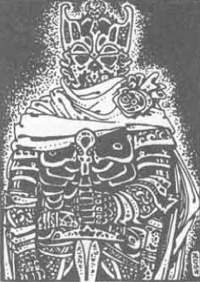
Dark Young of Shub-Niggurath

An vast mass of writhing, ropy tentacles the color of night. Covered with puckered mouths that drool green goo. Lower tentacles end in ebon hooves upon which the monster walks. The stench of an open grave hangs thick in the air.

Hit Dice: 7
Notes: Tentacle (1d8 plus CON Save to avoid weakness causing a Disadvantage in STR Saves). Firearms do minimum damage. Casts 1d6 spells. Stealthy in forests.

Dimensional Shambler

“Shuffling toward him in the darkness was the gigantic, blasphemous form of a black thing not wholly ape and not wholly insect. Its hide hung loosely upon its frame, and its rugose, dead-eyed rudiment of a head swayed drunkenly from side to side. Its fore paws were extended, with talons spread wide, and its whole body was taut with murderous malignity despite its utter lack of facial expression. After the screams and the final coming of darkness it leaped, and in a moment had Jones pinned to the floor. There was no struggle, for the watcher had fainted.” (The Horror in the Museum by H. P. Lovecraft and Hazel Heald)

Hit Dice: 4
Notes: 2 claws (1d4). Travel between planes (INT Save prevents being dragged along when applicable). Armor 3. Casts 1d3 spells.

Fire Vampire

“On the instant that the final guttural sound had left his lips, there began a sequence of events no human eye was ever destined to witness. For suddenly the darkness was gone, giving way to a fearsome amber glow; simultaneously the flute-like music ceased, and in its place rose cries of rage and terror. Then, instantaneously, there appeared thousands of tiny points of light—not only on and among the trees, but on the earth itself, on the lodge and the car standing before it. For still a further moment, we were rooted to the spot, and then it was borne in upon us that the myriad points of light were living entities of flame!” (The Dweller in Darkness by August Derleth)

Hit Dice: 1
Notes: Touch (1d6). Immune to material weapons. Suffers improvised damage from materials that smother flame.

July 14th, 2016  in RPG 1 Comment »

The Cthulhu Hack: A Read-Through Review

If you don’t own Paul Baldowski’s The Cthulhu Hack, buy it now. You can learn more about this wonderful game by visiting www.justcrunch.com. I’ll wait here until your done.

Now that you’re back, take a look at Mr. Baldowski’s work, a clever hack of David Black’s The Black Hack, an inspired role-playing game for dungeon-crawling fantasy adventure. In just a little more than 40 pages, The Cthulhu Hack gives you a complete game that launches its players into deadly conflict with the soul-shrivelling horrors of a Lovecraftian world.

The game’s core mechanic — roll a Save on a d20 that is below a specific value — determines success or failure of everything and everyone, including blood-crazed Cultists and sanity-blasting Shoggoths. Like Dungeon World, another favorite game of mine, the players rather than the GM, make almost all the rolls, including actions related to whether that mad Cultist’s machete painfully slices through muscle or harmlessly through air.

Add to the core mechanic features such as Usage Dice, Advantages, and Disadvantages to this simple, flexible core mechanic, and these simple rules cover everything from clue finding, suspect interrogating, ammo tracking, and sanity losing. It is the latter aspect of The Cthulhu Hack that I’ve been looking for for years, but more on sanity later.

Usage Dice cover resource management. For example, all investigators have a Flashlight Die that represents that investigators resources when he “needs to spot, uncover, trip over, research, stumble [upon], recall or otherwise discover something” (to quote the rules). When this comes up, the player rolls his investigator’s Flashlight Die. If the die comes up a 1 or 2, it decreases in size (from d8 to d6, for example). If a d4 Usage Die comes up a 1 or 2, the investigator is out of that resource. Nota Bene: A 1 or 2 doesn’t mean the investigator fails. It means he succeeds, but at a cost (represented by the Usage Die decreasing in size).

An Advantage means the player rolls 2d20 for a Save and choose whichever die result he prefers. A Disadvantage means the player rolls 2d20 for a Save and the GM chooses whichever die result he prefers. I’ve read this mechanic comes from D&D 5E. Regardless of its origin, it’s a great rule that replaces charts full of situational modifiers. Does your investigator have to sneak across a squeaky, dilapidated floor made of water-damaged boards? No need to consult a chart of stealth modifiers. The GM simply rules that your investigator is at a Disadvantage to do so.

I’ve played horror games before, and most I’ve played use some sort of fear or sanity point mechanic that tends to be both cumbersome and tedious, as well as requiring several pages of text to explain. The Cthulhu Hack handles sanity (or the lack thereof) as a Usage Die detailed by little more than one page of rules. Seriously. I could cut-and-paste the sanity rules into a document, fiddle with font and size and margins, and fit all of the sanity rules on one side of a single page.

The Cthulhu Hack stands severed head and mangled shoulders above every other game of its genre that I’ve read or played. Get some friends together and have them choose from one of five Classes and add one of 30 occupations. Creating an investigator is snap, and the rules for antagonists facilitate making them up more or less on the fly if necessary, which makes it easier for the GM to put more thought into the story rather than the stats behind the story.

Speaking of investigators, a sample character follows this paragraph. Ability scores (which make up the aforementioned Saves) are generated by rolling 3d6. “If a player rolls a Save with a value of 15 or more the next must be rolled with 2d6+2. After that continue with 3d6 until the end or another 15+ is rolled. Once the player rolls all six, she can choose to swap around” (to quote the rules again).

Dr. Horatio Phelps
Occupation: Archaeologist
Class/Level: Adventurer/1

STR 7, DEX 7, CON 9, WIS 15, INT 16, CHA 8

Hit Points: 9
Hit Die: d8
Sanity Die: d8
Armed Damage: 1d6
Improvised Damage: 1d4
Flashlights/Smokes: d8/d6

Special: Roll with Advantage when making a CON Save to avoid damage from poison, drugs, alcohol, or paralysis. Once per game session, apply powers of deduction and reasoning to reach an apposite conclusion.

Postscript: The last Sunday of this month, I’m hosting a dinner-and-gaming night featuring The Cthulhu Hack and a short adventure I’m writing entitled The Strange Case of the Bell Witch Bootleggers. I intend to post a playtest review a day or two later.

July 12th, 2016  in RPG 1 Comment »