Posts Tagged ‘ monsters ’

Day 20: My Favorite Humanoid/Natural/Fey

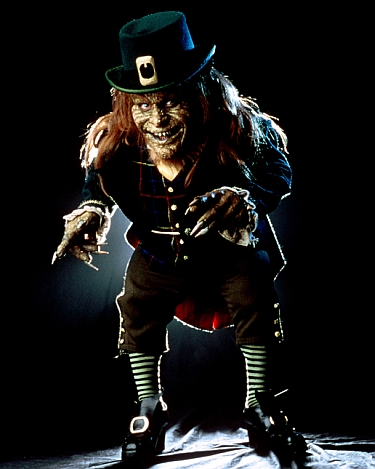
Today’s challenge? A no-brainer for me. Without hesitation, I choose one of the most powerful monsters in 1E’s Monster Manual. Yes, that’s right. I choose the leprechaun.

Sure, a leprechaun only has 2-5 hit points. Sure, he has zero attacks that inflict nil damage. Formidable limitations for a most powerful monster, but it’s what the leprechaun can do that makes him dangerous. First off, he’s 80% magic resistant. That means he’s 100% magic resistant for magic-users 7th level and below. You can’t surprise a leprechaun; his keen ears prevent it. The leprechaun also “can become invisible at will, polymorph nonliving objects, create illusions, and use ventriloquism spells as often as they like.”

Notice that the second and third abilities on that list of magical powers don’t have exact spell equivalents. The list doesn’t say a leprechaun can use polymorph other or phantasmal force. When I used leprechauns in my 1E games, I interpreted polymorph nonliving objects to mean that a leprechaun can use polymorph any object as long as the object being polymorphed starts out as nonliving. Create illusions meant that, if it’s an Illusion/Phantasm spell, a leprechaun can bring that effect into being.

So, yes, a leprechaun could bring that bronze statue to life as a giant. A leprechaun could turn your PC’s rope into a python, or his sword into a sunflower. A leprechaun could set up a Leomund’s trap to befuddle thieves, get an adventuring party lost in a hallucinatory terrain, or trick a foe with spectral force. And he could do most to all of this while invisible.

I remember gamers with belligerent styles of play becoming obsequious when the leprechauns came out to play. The consequences for escalating the encounter with violence were just too great to risk.

August 20th, 2013  in RPG No Comments »

Day 19: My Favorite Elemental/Plant

Continuing with the assumption that the slash represents the word “or”, today’s choice between elemental or plant leaves me a wee bit conflicted. I like both elemental and plant monsters. I probably use elementals more than plants, but I did once write a dungeon crawl that included every single plant monster in both the Monster Manual and Monster Manual II (counting fungi as plants, of course).

As a player, elementals have been memorable foes and useful tools. Once upon a time, Lord Korbok was operating in fighter mode (wearing his magical platemail, wielding his magical battle axe, forgoing most of his thief abilities, et cetera). Fred gleefully threw a fire elemental at us. Korbok quaffed his potion of speed, went into two-weapon fighting mode, and tore the elemental apart in a single round. It wasn’t quite what Fred had pictured.

Another time, during a game played when I was stationed at Fort Bragg, North Carolina, I was doing something rare for me, which was playing a magic-user. Our PCs were supposed to put a stop to some pirates. We’d tracked them back to their island lair. Most of the party moved forward across the wooden piers to engage the pirates in a surprise attack. My magic-user hung back among the barrels and crates. The surprise attack didn’t work well. I asked the GM what was in the barrels and crates. He told me. My magic-user called for the retreat.

Our PCs raced back to our small boat. The pirates surged down the pier to their ships. Fear was expressed that we’d never be able to outrun the pirates.

“Don’t worry,” said my magic-user. “See those barrels?”

“Yeah.”

“They’re full of oil,” said my magic-user.

“So?”

Then my magic-user screamed out the command word for the iron flask he’d hidden among the crates and barrels, thereby releasing the berserk 24-Hit-Die fire elemental from its magical prison. It burned the pirates’ pier and ships while we rowed away laughing.

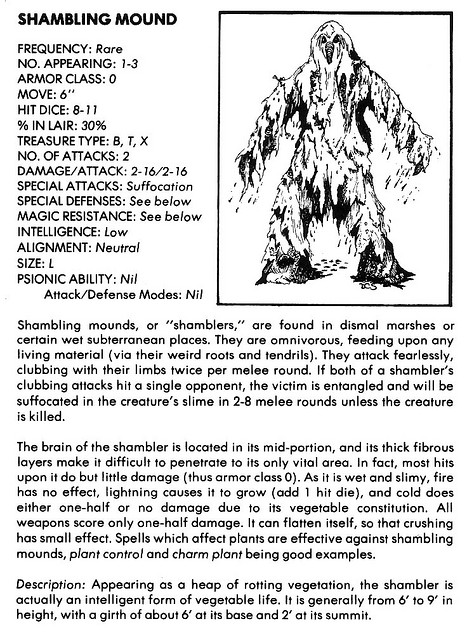
But I digress. I’m supposed to be picking a favorite elemental or plant, and so I pick the dreaded shambling mound. (Nota Bene: Click the pic for 25% embiggening.)

The 1E shambling mound was a brute. Low AC, crushing attacks, high-ish Hit Dice, half-damage from weapons, resistant or impervious to our best attack spells, and that’s not even mentioning its gruesome suffocation ability.

Get clubbed for 4d8 points of damage in a round, and then smother in entangling vegetable goo 2d4 rounds later! What fun!

August 19th, 2013  in RPG No Comments »

Day 18: My Favorite Immortal/Outsider

Back in my 1E days before I joined the Army, we didn’t ever really have just one GM. I ran games. Fred ran games. Big Greg ran games. Ben ran games. Little Greg ran games. We shifted GMing around a bit. With our 1E games, we sort of had a shared campaign set at least somewhat in the World Of Greyhawk. We each had a stable of characters. I didn’t always run Lord Korbok. Some of the time, for example, I was Morgaf the elf wizard. Later on, I had a Morgaf the elf cleric. I have no idea why, but I do remember enjoying cleric Morgaf more than wizard Morgaf.

When not running our characters, we’d make up tales about our characters, and these tales sort of became part of the lore of the campaign, even though they weren’t necessarily ever anything that actually got played out at the table. This is how Lord Korbok ended up with Balor as his archenemy.

Balor was a Type VI demon. Balor was his name, not the sort of monster he was. I don’t remember ever any character actually facing Balor in a game, but he was there, lurking in the background as sort of a metaplot device. If I was running Lord Korbok and he encountered demons, he would wonder, “Did Balor send them?” When I ran games, if demons were part of the adventure, I’d wonder, “Should Balor be involved?”

I can’t say for certain, but this is probably where I first got hooked on the idea of a power-behind-the-scenes villain for a campaign. When I ran the lengthy Man Day Adventures 3E campaign revolving around the Chalice of Dawn, the Deathless One was this sort of villain for much of the campaign. The Deathless One was the uber-lich that the players were tricked into freeing, thus unleasing Nerull’s champion to plague the world. The PCs met him once. Then for the longest time, the Deathless One was just a name rumored to be the source of one evil after another.

The power-behind-the-scenes has been a part of every lengthy campaign I’ve ever run for as long as I can remember. The names, goals, powers, et cetera change from campaign to campaign, genre to genre, but the basic idea remains the same, and it all gets traced back to a part of gaming that I don’t remember ever actually having gamed.

August 18th, 2013  in RPG No Comments »

Day 17: My Animal/Vermin

When 3E hit the streets, the idea of monster types was introduced into D&D. As I mentioned yesterday, a monster type is sort of like a monster’s base character class. Its type defines the monster’s Hit Die type, most likely skills, common traits (such as the undead’s immunity to charm spells), and so forth. Among the types introduced to us was the vermin, which I’ve long found curious.

An animal is “a living, nonhuman creature, usually a vertebrate with no magical abilities and no innate capacity for language or culture.” Vermin “includes insects, arachnids, other arthropods, worms, and similar invertebrates.” The difference? One has vertebrae; the other doesn’t. The vermin’s invertebrate status someone seems to mean that vermin are mindless, which means they have “[n]o Intelligence score, and immunity to all mind-affecting effects (charms, compulsions, morale effects, patterns, and phantasms). Mindless creatures have no feats or skills.”

I’ve never understood this. Bugs might not be terribly bright, but the things that many of them can do certainly qualify as feats or skills. Clicking randomly on five or so vermin over at d20pfsrd.com confirms this. Five for five have skills listed. So, vermin “have no feats or skills” except when they do. That clear?

But I digress.
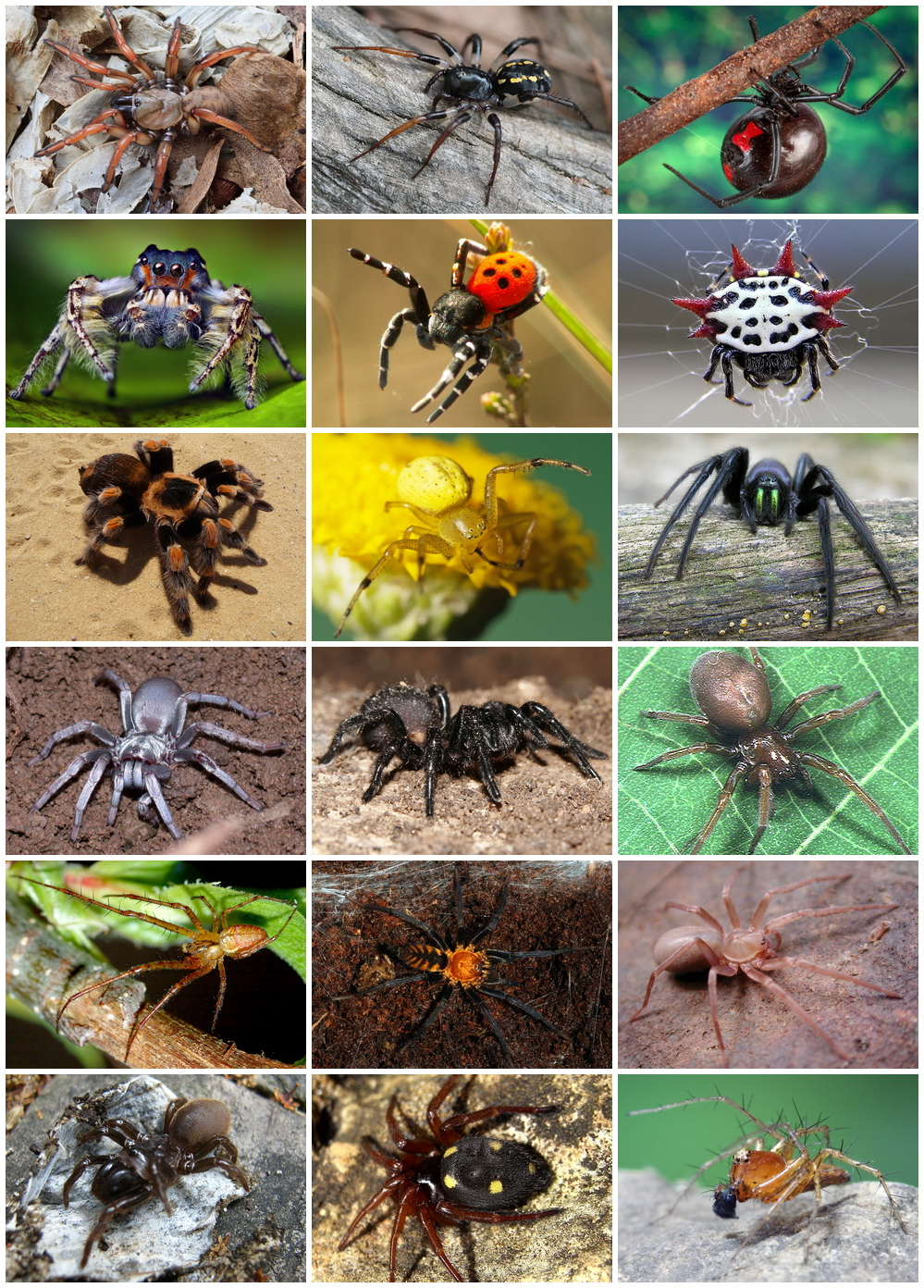
Today looks to be offering me two choices. First, I choose animal or vermin. Then, I choose my favorite example of that type. So, I choose vermin, and I choose giant spider. (Nota bene: Click on the picture to embiggen.)

Spiders are awesome. Let’s scour Wikipedia for 1d6 examples of arachnid awesomeness:

1. “Spiders are found worldwide on every continent except for Antarctica, and have become established in nearly every habitat with the exception of air and sea colonization.”

That’s right, GMs. You can almost always use giant spiders. They live everywhere.

2. “Unlike most arthropods, spiders have no extensor muscles in their limbs and instead extend them by hydraulic pressure.”

Whoa!

3. “Spiders use a wide range of strategies to capture prey: trapping it in sticky webs, lassoing it with sticky bolas, mimicking the prey to avoid detection, or running it down. Most detect prey mainly by sensing vibrations, but the active hunters have acute vision, and hunters of the genus Portia show signs of intelligence in their choice of tactics and ability to develop new ones.”

Emphases added to increase your terror.

4. “Spiders’ guts are too narrow to take solids, and they liquidize their food by flooding it with digestive enzymes and grinding it with the bases of their pedipalps, as they do not have true jaws.”

Please join me in screaming now.

5. “Spiders can generate pressures up to eight times their resting level to extend their legs, and jumping spiders can jump up to 50 times their own length by suddenly increasing the blood pressure in the third or fourth pair of legs.”

That’s right. Fifty times!

6. “A few species of spiders that build webs live together in large colonies and show social behavior, although not as complex as in social insects. Anelosimus eximius (in the family Theridiidae) can form colonies of up to 50,000 individuals.”

Anelosimus eximius lives in South America. I’m never going to visit South America. It’s not worth the risk of being mobbed by 50,000 spiders.

August 17th, 2013  in RPG No Comments »

Days 15-16: My Favorite Undead & Aberration

Today is a two-fer since I didn’t post yesterday. Busy, busy with the beginning of the new school year, making sure all those T’s are dotted and all those I’s are crossed. For my favorite undead, I’m tempted to just link my old post about the death knight and be done with it, but that seems kind of lazy. I’m not going to do that.

My favorite undead is hard to pin down. If I were writing about movies/TV shows, my favorite undead would be zombies, but only when they’re a metaphor (such as in 1978’s Dawn of the Dead) and/or when they serve as a mirror in which the survivors’ humanity becomes reflected (such as in 2011’s State of Emergency, which I found to be surprisingly hopeful). Of course, I’m not supposed to be writing about movies. This is the 30-Day D&D Challenge, and zombies don’t really do it for me in D&D. I’ve used them, of course, and quite a bit, but D&D and survival horror are a tough match.

For D&D, the mummy reigns as my favorite undead.

“But why, Mark?” you ask.

Well, the picture piercing your soul with its glowing stare probably gave it away, but I reply to your question with a simple, “Because Boris Karloff.”

Sure, you can play mummies like lumbering, bandage-wrapped mashers, and the inferior sequels to 1932’s The Mummy veered in that direction, but that’s not the way I feel mummies should be played. The word “mummy” conjures up visions of ancient Egypt. Pyramids and sphinxes and scarabs. Kings, high priests, and powerful ministers got the mummy treatment, which isn’t quite the whole story, but it provides the hook for what a mummy ought to be.

Oh, sure, the boss mummy could have lumbering, bandage-wrapped mummy lackeys to bash interlopers, but the mummy should be more like Ardath Bey, also known as Imhotep. He’s clever, obsessed, powerful, urbane, and menacing. He doesn’t just lunge out of a sarcophagus and start swinging. To get the full-on Imhotep experience, add some divination powers and a vampire-like ability to charm the PC who’s the reincarnation of his forbidden love.

My favorite aberration bears some defining ahead of time. Early D&D didn’t have monster types as introduced by 3E. A monster type is sort of like the monster’s base character class. “An aberration has a bizarre anatomy, strange abilities, an alien mindset, or any combination of the three,” says the SRD. Classic D&D aberrations include monsters such as adherers, blindheims, boggarts, and cloakers.

And, of course, the dreaded aboleth. Evil, intelligent, vaguely fish-like, and tentacled, aboleths fool your senses with illusions and crush you will with charms. Aboleths lair in lightless, flooded caverns or deep under the sea. It’s almost a moral imperative that choirs of aboleths chant obscene litanies to Lovecraftian horrors.

“Ia! Ia! Nyarlathotep Fthagan!”

August 16th, 2013  in RPG No Comments »