Archive for the ‘ RPG ’ Category

The Giant Lynx for 5E

One of the nifty aspects of the AD&D Monster Manual might be missed by a less-than-careful reading.

“Really?” you say. “And what might that nifty aspect be?”

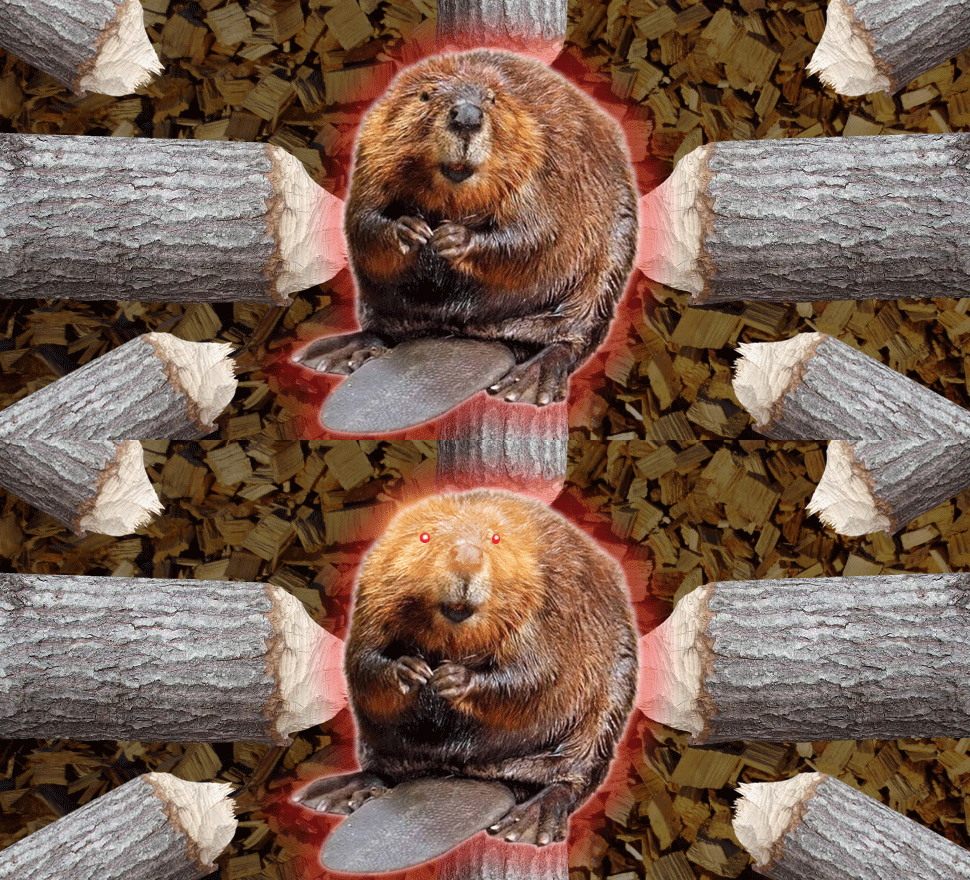
Yes, really, and good question. Of course, we all know that the Monster Manual includes giant animals. There are giant ants, giant beetles, giant gars, giant pikes, giant slugs, giant turtles, and more. A few of these over-sized animals have intelligences approaching or even exceeding human average. Some of this might be due to the influence of J. R. R. Tolkien. Giant eagles, for example, have Average intelligence. Worgs and giant spiders have Low intelligence. In a decidedly non-Tolkien move, giant beavers are Low to Average.

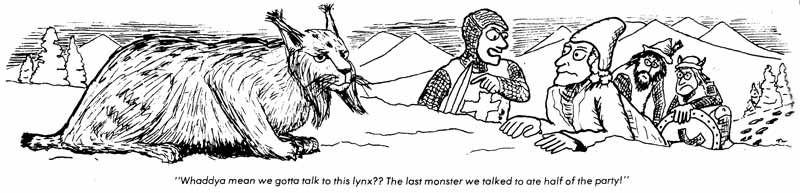
And then there’s the giant lynx, which is Very intelligent. In numerical terms, that’s an 11-12 Intelligence, compared to 8-10 for Average.

Back in the day, when I DMed AD&D, yes, I did use giant lynxes at least once. I don’t recall many of the details, but I’m pretty sure the PCs had to negotiate with the canny arctic feline for something related to the adventure. When I DMed in high school, I was on a mission to use every single monster in the Monster Manual (I and II) and Fiend Folio in an adventure somehow. I never achieved that goal, but not for lack of trying. For example, I made a jungle ruin-crawl adventure that included every single plant and fungus monster from the Monster Manual. Also, there was a mind flayer. I guess it was the gardener.

Even farther back in more distant days, Theophrastus (circa 320 B.C. or thereabouts), wrote about lynx stones in his On Stones, an ancient text about stones. On Stones was used by mineralogists for centuries. A lynx stone forms when lynx urine hardens into a stone-like substance. Since the lynx doesn’t want humans taking its lynx stones, the clever beast buries its urine.

Theophrastus says the lynx stone attracts straw, wood, copper, and iron. The urine of tame lynxes doesn’t produce lynx stones, nor does the urine of female lynxes, tame or otherwise. Ovid, Pliny the Elder, and Isidore of Seville all confirm the existence and origin of lynx stones, although Pliny and Isidore call the substance lynx water. Pliny and Isidore also note that lynxes know this happens. According to Pliny, lynxes cover their urine to speed up the solidification process. Isidore says lynxes bury their urine because they are naturally jealous and don’t want humans owning lynx stones.

So, obviously, if motivated by knowledge and jealously, lynxes must be intelligent, maybe even Very intelligent.

Giant Lynx
Medium monstrosity, neutral

Armor Class 14 (natural armor)
Hit Points 22 (4d8+4)
Speed 30 ft.

STR 12 (+1), DEX 17 (+3), CON 12 (+1), INT 12 (+1), WIS 14 (+2), CHA 10 (+0)

Skills Athletics +3, Perception +4, Stealth +5
Damage Resistances cold
Senses passive Perception 14
Languages Giant Lynx
Challenge 1 (200 XP)

Aggressive. As a bonus action, the giant lynx can move up to its speed toward a hostile creature that it can see.

Pounce. If the giant lynx moves at least 20 feet straight toward a creature and then hits it with a claw attack on the same turn, that target must succeed on a DC 13 Strength saving throw or be knocked prone. If the target is prone, the giant lynx can make one bite attack against it as a bonus action.

Keen Hearing and Sight. The giant lynx has advantage on Wisdom (Perception) checks that rely on hearing and sight.

Running Leap. With a 10-foot running start, the giant lynx can leap up to 15 feet.

Snow Camouflage. The giant lynx has advantage on Dexterity (Stealth) checks made to hide in snowy terrain.

Actions

Bite. Melee Weapon Attack: +5 to hit, reach 5 ft., one target. Hit: 6 (1d6+3) piercing damage.

Claw. Melee Weapon Attack: +5 to hit, reach 5 ft., one target. Hit: 5 (1d4+3) slashing damage.

March 4th, 2020  in RPG No Comments »

Ash Goblins

The masterly Matt Jackson continues to post captivating CollabDungeons. Numbers two and three beg to be admired and adapted into adventures. When Matt posted the first CollaboDungeon, I imagined it as one of several tombs now lost in some remote wilderness region. Then, I wrote this:

For centuries, persons of wealth, power, and achievement sought to be buried in the wide, winding valleys near the wooded frontier of the kingdom. The villages nearest to the frontier adopted various funerary specialties. The coffinmakers here, the masons there, the mourners elsewhere, and so forth. Representatives from each village, elected by their constituents, formed the Mortuary Moot, a rowdy assembly of leaders who met regularly to debate and settle disputes related to the economic governance of the region. The people prospered until Mount Beinn, looming on the eastern horizon, roared back to life. Enormous clouds of volcanic ash rushed down the valleys, blasting the forests away and burying most of Mortuary Moot under yards of debris. Thousands died. In the aftermath, evil humanoids from the Wilderlands ventured into the frontier, killing or driving away those who survived Beinn’s fury.

In recent years, baronial mayors closest to what had been Mortuary Moot have increasingly sought to reclaim the devastated region. To this end, the mayors have made it clear that they welcome adventurers who seek fame and fortune. With sword, spell, and stealth, those adventurers may drive back the hordes of evil humanoids that plague the region, making it possible for the baronial mayors to send soldiers and settlers back into the frontier. Among the most tempting targets drawing adventurers into the area are the tremuli, the numerous artificial hills under which persons of wealth, power, and achievement were buried. Who knows what treasures wait the next intrepid band of would-be tomb robbers?

I like this idea. It could work its way into a sort of Indiana Jones meets the Magnificent Seven meets Mad Max. The PCs would try to recover lost artifacts while avoiding roaming bands of savages while helping protect the re-establishment of civilization while slowly discovering sinister forces working to exploit, destroy, enslave, et cetera. I wonder if I could talk Matt into doing a blighted wilderness map suitable for a starting campaign location? Perhaps if I threaten him with ash goblins?

Ash goblins are small, murderous humanoids that lurk in volcanic regions. They appear much like normal goblins, albeit with gray flesh and small, close-set eyes. Ash goblins tend to be smarter and more organized than their more common relatives.

Ash Goblin
Small humanoid (goblinoid), lawful evil

Armor Class 13 (leather armor)
Hit Points 18 (4d6+4)
Speed 30 ft., burrow 15 ft.

STR 10 (+0), DEX 14 (+2), CON 13 (+1), INT 8 (-1), WIS 11 (+0), CHA 9 (-1)

Skills Stealth +4, Survival +2
Damage Resistances fire
Senses darkvision 30 ft., tremorsense 60 ft., passive Perception 10
Languages Common, Goblin, Ignan
Challenge 1/2 (100 XP)

Hold Breath. The ash goblin can hold its breath for 15 minutes.

Nimble Escape. The ash goblin can take the Disengage or Hide action as a bonus action on each of its turns.

Actions

Shortsword. Melee Weapon Attack: +4 to hit, reach 5 ft., one target. Hit: 5 (1d6+2) piercing damage.

Javelin. Melee or Ranged Weapon Attack: +2 to hit, reach 5 ft. or range 30/120 ft., one target. Hit: 3 (1d6) piercing damage.

February 17th, 2020  in RPG No Comments »

Saintly Devotion

You are no longer strangers and sojourners, but you are fellow citizens with the saints and members of the household of God, built upon the foundation of the apostles and prophets, Christ Jesus himself being the cornerstone, in whom the whole structure is joined together and grows into a holy temple in the Lord, in whom you are also built into it for a dwelling place of God in the Spirit. (The Epistle of St. Paul to the Ephesians 2:19-22)

All religions and secular ideologies hold up certain people as exemplars for those who adhere to the beliefs of the religion or ideology. In the United States, we see this with respect to the Founding Fathers, for example. In the Church, most obviously we see this in the hundreds of saints venerated for their heroic virtue. Numerous other examples could be provided across a wide variety of societies, cultures, religions, political parties, et cetera. When it comes to the various versions of D&D, I’ve often read suggestions that saint-like figures be treated as demi-gods or maybe lesser gods. Most famously, D&D presents to us St. Cuthbert of the Cudgel, a mortal who ascended into the ranks of divinity.

If I were to write up something like a cult of the saints for a fantasy deity, I’d be less inclined to treat those saints as divine themselves, but what would I treat them as? Well, primarily they’d serve the same function as they do in the world today. They’d be role models, men and women and children who offer others examples of grace under pressure. In AD&D terms, they’d be heroes or quasi-deities rather than gods or goddesses. In 5E D&D terms, strong devotion to one of these heroes could be treated as a feat. Here’re a couple of examples:

Sacred Fool
You possess a strong devotion to a sacred fool. This hero is likely someone born into wealth and privilege who renounced his or her birthright in a dramatic fashion, thereafter living life as an example of traits counter to the hero’s culture. For example, a sacred fool born into an sophisticated urban society that strongly emphasized the acquisition of wealth might have become a humble beggar and preacher. Your devotion to a sacred fool provides the following benefits:

  • Increase your Wisdom or Charisma score by 1, to a maximum of 20.
  • You have advantage on Wisdom (Insight) and Charisma (Persuasion) checks as long as you have not inflicted damage on any intelligent creature since your last short or long rest.
  • Choose one of the following spells: animal friendship, charm person, sanctuary, or speak with animals. Using this feat, you can the spell once at its lowest level, and you must finish a long rest before you can it in this way again. Your spellcasting ability is Wisdom or Charisma, depending on which score you increased with this feat.

Scion of a Divine Host
You possess a strong devotion to a martial figure known for his or her victories over unnatural creatures. Choose one type of creature from this list: celestials, elementals, fey, fiends, or undead. Your devotion to a scion of a divine host grants the following benefits:

  • Increase your Strength or Constitution score by 1, to a maximum of 20.
  • When attacking your chosen type of creature, you gain a +2 bonus to damage rolls.
  • When you can see your chosen type of creature and it attacks a target other than you that is within 5 feet of you, you can use your reaction to make a melee weapon attack against that creature.
  • You have advantage on saving throws made to resist attacks, spells, and magic effects made by your chosen type of creature.
February 16th, 2020  in RPG 1 Comment »

The Sybil Ants

The prolific virtual pen of Bearded-Devil has written about me. How exciting! Elsewhere on the interwebz, Matt Jackson’s CollaboDungeon 02 has gone live. CollaboDungeon 02 is bigger and perhaps niftier than its predecessor. Check it out, and be a collaborator. (It’s okay in this instance; normally, collaborators get shot.)

My previous post perhaps included one too many puns, assuming such a thing is possible. It’s okay. I forgive me. Since only a fool laughs at his own jokes, I’m still kind of giggling about the Sybil ants. Therefore, today’s monster, written for the wonderful Basic Fantasy Role-Playing Game. (Nota Bene: The link for the Basic Fantasy RPG is an affiliate link.)

Swarm of Sybil Ants
Armor Class: 12
Hit Dice: 4**
No. of Attacks: 1 bite plus paralysis
Damage: 2d4
Movement: 60′ (10′)
No. Appearing: 1d6, Wild 2d6 , Lair 4d6
Save As: Fighter: 4
Morale: 7 on first sighting, 12 after engaged
Treasure Type: U
XP: 320

The hissing Sybil ants build vast networks of tunnels and chambers in the Saar Chasm. These stealthy, precognitive insects have swarmed more than one careless traveler, their venom quickly inducing paralysis but not unconsciousness, making it easier to drag their hapless prey underground to be drained of blood over a period of several days.

A swarm of Sybil ants covers up to a 10-foot square, but it may move in column, et cetera. It makes only one melee attack against a creature adjacent to or within its mass. If more than one target exists, randomly determine which one is affected. A creature bitten by the swarm must make a save versus Poison or become paralyzed for 1d4 days. A creature that starts its turn within a swarm must make a saving throw versus Poison or be unable to take any actions other than moving at half speed due to the large number of insects crawling and biting the creature.

A swarm of Sybil ants takes half damage from weapons. It is immune to magical effects that target a single creature. Since Sybil ants have low-level precognitive abilities, they are surprised only a 1 (in 6). If a swarm of Sybil ants has lost at least 50% of its hit points, its bite inflicts 1d4 points of damage and saving throws against the swarm’s effects are made with a +2 bonus.

January 28th, 2020  in RPG No Comments »

“Hello!” “No one loves you!”

Travelers travailing across the Saar Desert face many hazards and obstacles. Sandmen prowl moonless nights. Windstorms whip up scouring clouds that can strip flesh to the bone. Brutal heat and numbing cold alternate each day and night. Wicked water elementals pose as life-giving oases, and all manner of venomous creatures lurk and hunt. Centuries of flash floods during the all-too-brief but fearsome rainy season gouged miles of twisting canyons, the deepest and most treacherous of which is the dreaded Saar Chasm.

The hissing Sybil ants build vast networks of tunnels and chambers in the chasm. Those stealthy, precognitive insects have swarmed more than one careless traveler, their venom quickly inducing paralysis but not unconsciousness, making it easier to drag their hapless prey underground to be drained of blood over a period of several days. Other ambush predators, most of them solitary and reptilian, wait in the chasm, often lairing in the crumbling cliff crypts built long ago by a now dead yet territorial race of deaf necromancers. Would-be tomb robbers venturing into the chasm must do so with the utmost care and quiet. Vicious enchantments etched into the very walls of the chasm transform echoes into stinging words of rebuke and ridicule, made all the more hurtful because they often carry the weight of truth.

Sounds louder than normal speech echo in the Saar Chasm. When such echoes occur, roll 1d4, but rolling no more than once per round. Add +1 for very loud noises, such as multiple combatants smiting about. Consult the list of effects below. In all cases, such effects only apply to those who can hear them and have a language. Creatures hear the echoes of Saar Chasm in their native tongue.

1 – Succeed on a DC 13 Wisdom saving throw or take 1d4 psychic damage and have disadvantage on your next attack roll made before the end of your next turn.

2 – Succeed on a DC 13 Wisdom saving throw or fall prone, becoming incapacitated with laughter at another’s expense. You are unable to stand up 1 minute. At the end of each of your turns, and each time you takes damage, make another DC 13 Wisdom saving throw. You have advantage on the saving throw if it’s triggered by damage. On a success, the effect ends.

3 – Succeed on a DC 15 Wisdom saving throw or take 2d4 psychic damage and have disadvantage on your next attack roll made before the end of your next turn.

4 – Succeed on a DC 15 Wisdom saving throw or fall prone, becoming incapacitated with laughter at another’s expense. You are unable to stand up 1 minute. At the end of each of your turns, and each time you takes damage, make another DC 15 Wisdom saving throw. You have advantage on the saving throw if it’s triggered by damage. On a success, the effect ends.

5 – The echoes reveal your darkest, most embarrassing secrets. Make a DC 15 Wisdom saving throw or drop whatever you are holding and become frightened for 1 minute. While frightened by this effect, you must take the Dash action and move away from others by the safest available route on each of your turns, unless there is nowhere to move. If you end your turn in a location where no creature has line of sight to you, the creature can attempt a DC 15 Wisdom saving throw. On a successful save, the effect ends.

January 25th, 2020  in RPG No Comments »