Archive for the ‘ RPG ’ Category

CollaboDungeons & Fomorians

Matt Jackson, gamer/mapper icon, recently posted CollaboDungeon 01 on his site. As Matt explains, “An idea that came to me while walking my pooches just now. A dungeon and collaboration between all of us to to make something, just for fun. The CollaboDungeon! I post a new map, you blokes and I turn it into an adventure.” Since I’ve turned one of Matt’s maps into an adventure before, I figured why not? Also, I needed something to run for my middle-school gamers at this week’s Ludi Fabularum meeting, so Matt’s map became a stone, and I killed two birds with it.

The result? The Barnacle Barrow of Blunderbuss Crain, a Dungeon World adventure set on Jonathan Newell’s wonder-full Genial Jack from Lost Pages . (Nota Bene: That second link in this paragraph is an affiliate link. If you use it to purchase the PDF, then I got a few coppers. The third link is for the store that sells copies from the first print run. The first link lets you glom the adventure via Google drive.)

When I cobbled together my brief review of Genial Jack, I noted that none of the new races introduced in the book have subraces. To quote me, “Oddly, none of the races have subraces. …. [This] seems a blank space that begs the application of creativity by the players and DM.” Permit me to muse about how subraces might be presented for one of the groups residing in Jackburg.

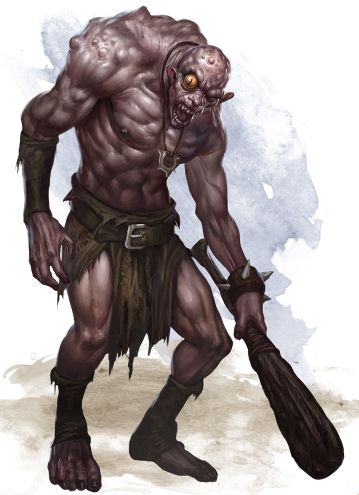
My choice? The Fomorians. Another quote, this time from Genial Jack: “The giants know as the Fomorians were banished from Faerie by Queen Mab after their leader, King Balor, sought to depose her.” These outcasts went off and conquered an island, which later got earthquaked and deluged, vanishing beneath the waves. Genial Jack literally took in the survivors, and they’ve been part of Jackburg ever since.

Since the book itself establishes that there are two types of Fomorians, it seems most sensible that those become subraces. If I make up a Fomorian PC, I choose between Fair Fomorian or Foul Fomorian. Reading the Fomorian traits presented in the book, I start to see a way they can be retooled gently between “core” traits and subrace traits. Ergo:

Fomorian Traits

Ability Score Increase. Your Strength score increases by 2.

Age. Fomorians age slowly, reaching adulthood around 25 years of age. They can live indefinitely, with some being thousands of years old.

Alignment. Fomorians retain a tendency toward Chaos from their former ruler, the mischievous Queen Mab.

Size. Fomorians vary in height widely, but all adults are over 10 feet high. You are Large in size.

Speed. Your walking speed is 40 feet.

Tool Proficiency. You gain proficiency with your choice of smith’s, brewer’s, or mason’s tools.

Languages. You can read, speak, and write Common and Jetsam, as well as a dialect of Giant.

Fair Fomorian

You appear very much like a human, but of prodigious size. As a Fair Fomorian, you may be considered comely to human eyes.

Ability Score Increase. Your Charisma score increases by 1.

Persuasive. You gain proficiency with the Persuasion skill.

Benevolent Gaze. You can cast Bless once, and it recharges after a long rest.

Foul Fomorian

About nine of out ten Fomorians have warped bodies, perhaps missing a limb, or having mis-sized limbs or misshapen bones.

Ability Score Increase. Your Constitution score increases by 1.

Intimidating. You gain proficiency with the Intimidation skill.

Evil Eye. You can cast Bane once, and it recharges after a long rest. Charisma is your spellcasting ability for this spell.

January 23rd, 2020  in RPG No Comments »

Whale Ho!

Nota Bene: The first link below is an affiliate link. If you use it to purchase the PDF, then I got a few coppers. The second link is for the store that sells copies from the first print run (not print-on-demand as I mistakenly had thought). That’s the route I went. All direct quotes come from the book itself.

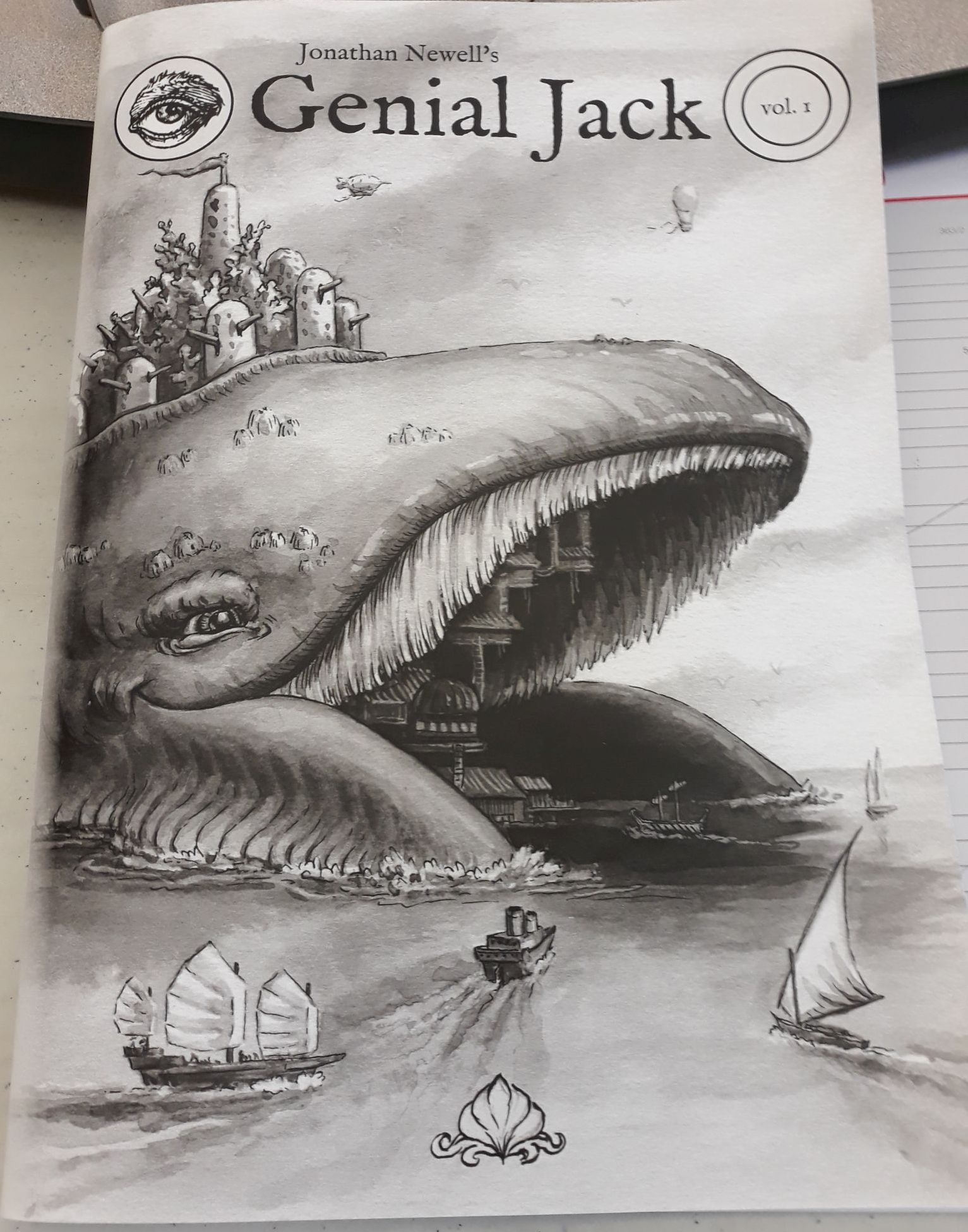
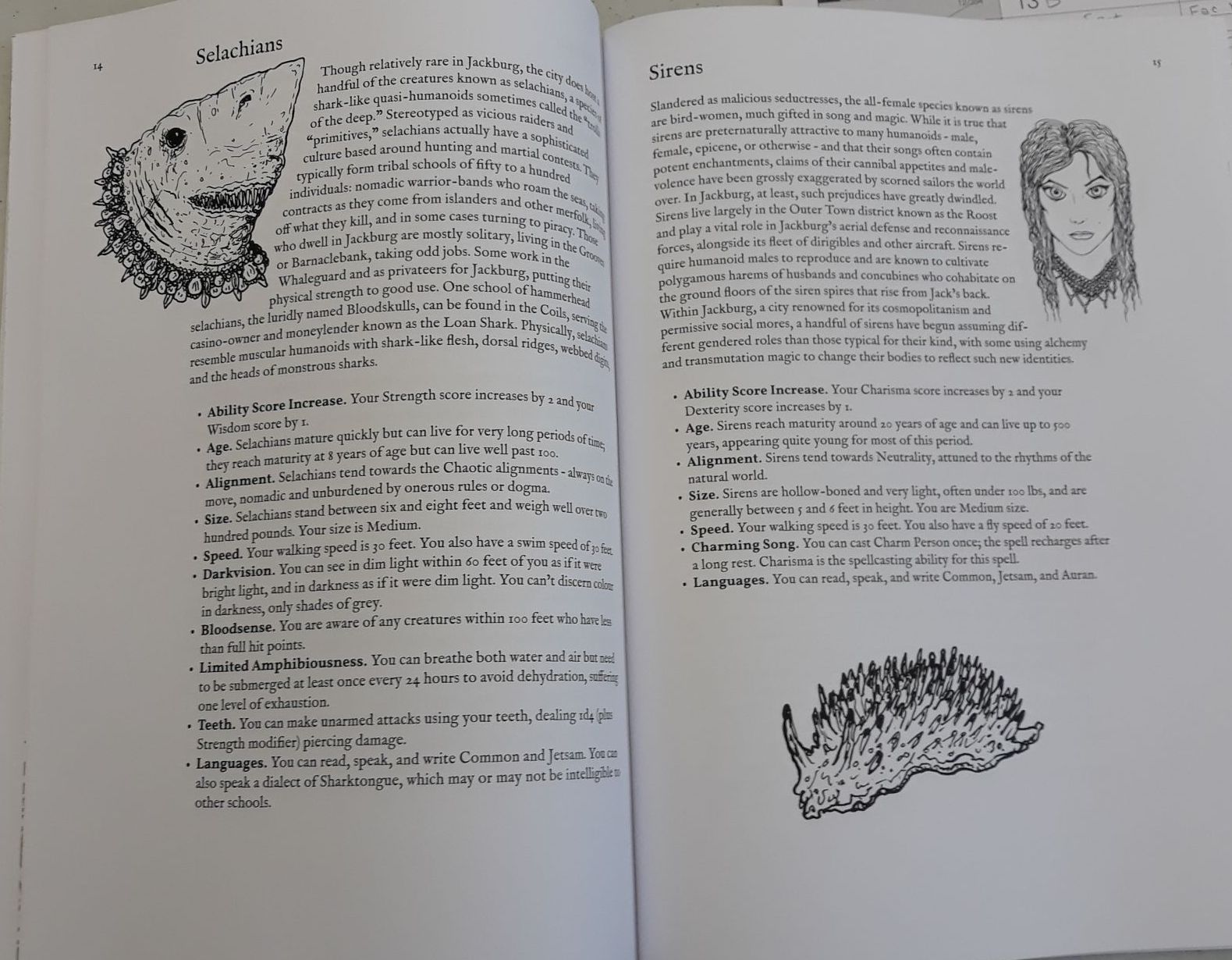
Jonathan Newell’s Genial Jack from Lost Pages astonishes from cover to cover. Within its 50ish 8.5-inch-by-11.5-inch pages, one finds a fascinating introduction to Genial Jack, “a whale the size of a mountain” that has been for hundreds of years “the host to the teeming town of Jackburg”. Oodles of creatures representing more than a dozen different races/species call the buildings both within and without Jack their home. Ships anchor in Jack’s cavernous mouth. Elevators climb Jack’s inner mouth to reach Mawtown. One can ride the Esophogeal Tram to reach the villages in Jack’s guts. If that’s not one’s cup of tea, then wander across Jack’s immense back, marveling at the Coral Fortress or sampling the wares of the Dorsal District. Able to breathe water? Then dive in and swim down to the Grooves or visit the Barnaclebank Fish Market. All along the way, rub elbows with Draugar, Finfolk, Fomorians, Jellyfolk, and nine other races ready for use as PCs.

After a short introduction that includes a bit of Jack’s history and suggestions about how to use Jack in your campaign, the book details the People. Each of the 13 races are presented on a single page along with a portrait of a representative member. The races include 5E D&D stats, and each is sufficiently detailed and different to avoid Finfolk seeming too much like Jellyfolk. Unsurprisingly, many of the races are aquatic. Each race has a niche carved out in or on Jack. For example, Octopoids “have become merchant princes and princesses par excellence, with tendrils in every business in the city.” The shark-like Selachians tend to live on the fringes of Jackburg society as they hail from “nomadic warrior-bands who roam the seas, taking contracts as they come from islanders and other merfolk, living off what they kill, and in some cases turning to piracy.” I like this approach to handling races. Each has its distinctive appearance, racial abilities, and a societal role within the context of the setting.

Oddly, none of the races have subraces. Perhaps these will be detailed in the next issue of the Genial Jack? If so, it seems an odd way to present the information. If not, it seems a blank space that begs the application of creativity by the players and DM.

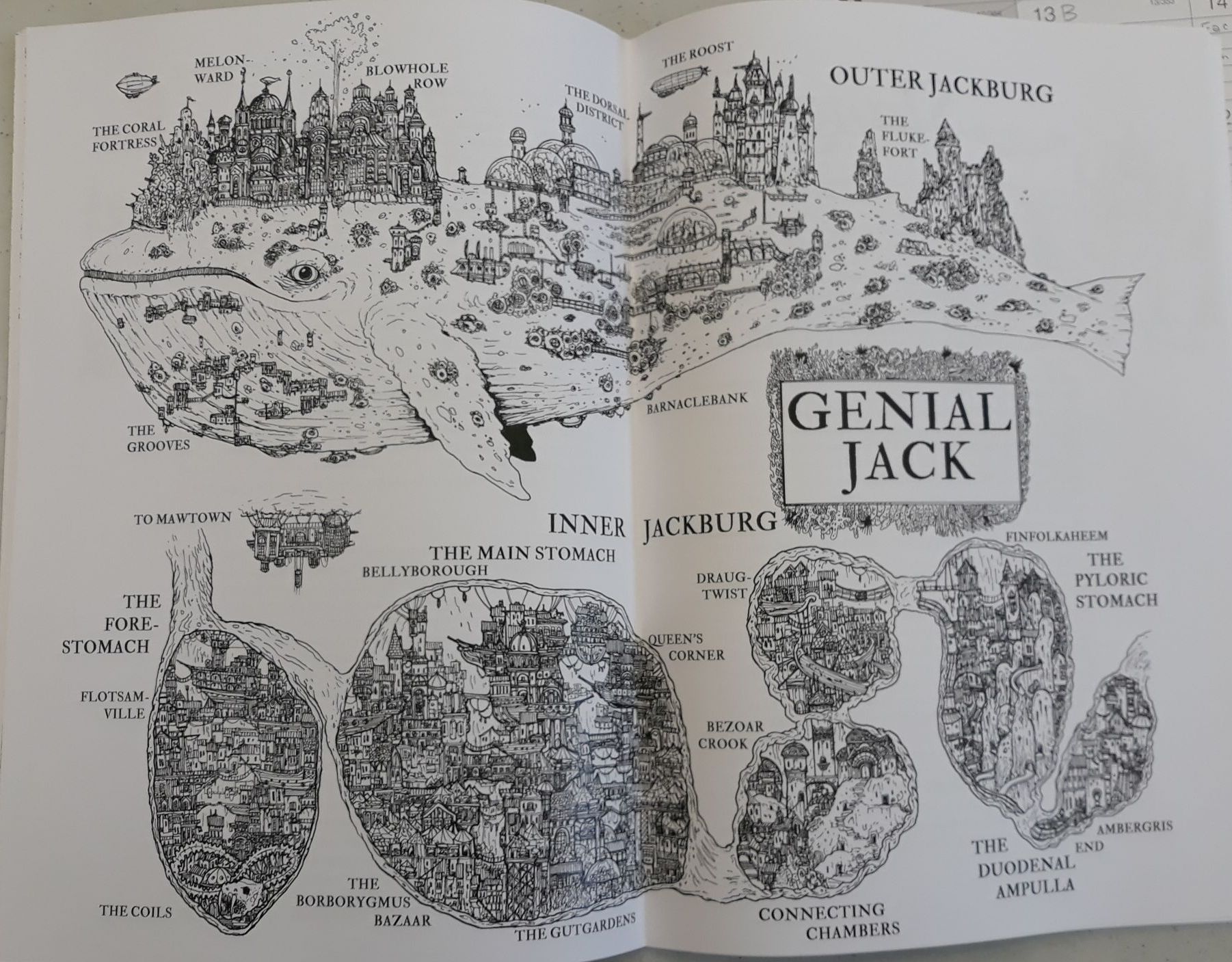
Jackburg itself is divided into two sections: Outer Jackburg and Inner Jackburg. Multiple districts comprise each section, and Genial Jack doesn’t so much as detail the districts as it presents them in a few paragraphs of evocative text that introduce the general flavor of the district and then briefly describes possible encounters and noteworthy locations. The encounters and locations sections are like oysters. Pry them open, and one can find pearls, if by “pearls” one means hooks for adventures both short and long. Along the way, the reader gets to meet some of the power groups and movers-and-shakers of Jackburg, from the Whaleguards to spectral pirates to Selachian clerics serving the Sharkfather. Jackburg’s government, laws, and criminal organizations (of which there are five mentioned) also get some description as well.

Smack in the middle of the book is a wonderful double-page poster of Genial Jack, showing the locations of the different districts. It’s not really a map per se. There’s no scale, for example. A nice touch is that back of the right half of the poster includes examples of Jackburg slang. When a ratfolk ruffian says you’re “eelish”, you’ll know if that’s a good thing or a bad thing. (Hint: It’s not a good thing.) Then, if you’ve got the “cannonballs” for it, you can pummel him until he’s half “crab-eaten”.

One oddity is the back of the left half of the poster, which is blank. Page 26 talks about the Melonward district. Page 27 is nothing but white. Paolo Greco on DriveThruRPG explains that the page “is blank on purpose, when printed is the back of the removable centrefold.” I’m a bit meh about this. There should be something there. Perhaps more Jackburg slang? A typical tavern menu? Just about anything rather than a blank page. If you’re the type of person who would unbend staples to remove the center map, don’t fret. The two-page illustration of Genial Jack appears near the end of the book as well, right after Appendix A, which is a d20 list of interesting Jackburghers, each one of which could become an adventure hook.

In addition to the lack of subraces and that blank page, there is one other oddity: The table of contents appears at the end of the book, right before the Open Gaming License. It wasn’t until my third or fourth flip through the book that I noticed what I thought was the missing table of contents. The Draugr race is also missing from the table of contents, but they’re a bit aloof, being undead and misunderstood, so they probably don’t mind.

So, Genial Jack isn’t perfect, but what is? Rather than perfection, Genial Jack achieves others effects, all on me the reader. It enchants, amuses, and inspires. Most of the money I spend on RPG products buys something that either sits in a computer folder or gathers dust on a book shelf. Not so with Genial Jack. I want to use it. I want to share it with others via the medium of a game. Indeed, I am doing so, adapting it piecemeal for Dungeon World with my group of middle school students with whom I game about once a week.

I’m most pleased with Genial Jack, and I eagerly await the next issue.

By the way, each picture below embiggens when you click on it.

January 21st, 2020  in RPG No Comments »

Augenfarben-Tafel

I’ve not gotten much writing done in the past several weeks. No good reasons why. I did start outlining Commandos & Cultists, a mash-up of The Cthulhu Hack and WWII: Operation WhiteBox. As I’ve written once before, the heroes in ComCul fight against the Thule Society, an occult society that directs much of Nazi Germany’s occult activities, operating through the Heereswaffenamt (HWA) (with its Wissenschaft (HWW) and Okkulte (HWO) divisions) as well as the Ahnenerbe, a Nazi-backed archaeological and occult organization. (Nota Bene: These groups come from the “Mini-Setting: Nazi Occult” section of WWII: Operation WhiteBox.)

The real Thule Society was founded in the early 20th century. It was a bizarre mixture of neopaganism, anti-Semitism, eugenics, pan-nationalism, and occultism. Heinrich Himmler, Reichsführer of the Schutzstaffel, strove mightily to make his devotion to the racialist occultism of the Thule Society into a sort of state religion for the Reich, envisioning Thule Society beliefs replacing other religions, especially Christianity, which Himmler loathed. An important part of Thule-inspired doctrines involved discovering the undiluted blood of Aryan descendants. Those with pure Aryan blood were destined to rule. Others were fit to serve, except for the lowest of the Untermensch, which had to be exterminated.

To assist with the racial classification and establishment of the race-based caste system, Munich-based Lehmann Publishers, a publisher of eugenics materials, manufactured the Augenfarben-Tafel shown in the picture. The glass eyes show 20 different eye colors used by proponents of Nazi racial ideology to help better classify individuals based on their suitability for various state-granted privileges, such as those related to marriage and children.

A small number of Augenfarben-Tafel possess magical properties. Various high-ranking Nazi officials, especially those assigned to the HWA, own magical Augenfarben-Tafel. A person carrying a magical Augenfarben-Tafel is surprised 1 in 6 times and suffers only a -2 penalty to hit invisible foes. The carrier also enjoys a +1 bonus on saving throws against being blinded. Fully 75% of magical Augenfarben-Tafel enable the user to cast Darkvision (50%), Wizard Eye (25%), or both (25%). Spells cast via a magical Augenfarben-Tafel can be used once per day.

January 14th, 2020  in RPG 2 Comments »

Confounding Light

Today is the first day of Epiphanytide, assuming one is using the Gregorian calendar. For the octave of Epiphany, my Magus character class written for Swords & Wizardry is available as a pay-what-you-want product. This means you can snag it for any price between free and, say, $250. Almost a year ago to the day, I wrote up gold, frankincense, and myrrh as magic items for D&D 5E. That post is here.

One of the better changes introduced into D&D quite some time ago is the idea of domains or spheres of influence through which clerics end up getting themed abilities based on deity, ethos, et cetera. These sorts of clerical special abilities appear early on the game.

For example, in 1988’s Greyhawk Adventures by James M. Ward, we find out that Boccob’s clerics “gain limited sage ability” at 8th level. The ever-popular St. Cuthbert has three orders of clerics: “the Chapeaux, the Stars, and the Billets.” Each order has a different special ability. The Billets, for example, “can cast one friends spell per day.” By the time AD&D 2E was all the rage, specialty priests were an established thing, at least in the Forgotten Realms. No more were the clerics of different deities the same.

(N. B.: That previous link is an affliate link. If you click and make a purchase, I get a wee bit of money.)

And the light shineth in darkness, and the darkness did not comprehend it. (The Gospel According to St. John 1:5)

In D&D 5E, a cleric chooses a divine domain related to his deity. This choice grants access to special domain spells, maybe some sort of bonus proficiency or cantrip, and various special abilities that kick in as the cleric advances in level. Since one of Epiphanytide’s motifs relates to light, I thought an alternate 1st-level Light Domain ability might be fun. This ability would replace Warding Flare.

Confounding Light
Also at 1st level, when in an area of dim light or darkness, you can emit a divine light. You shed bright light in a 20-foot radius and dim light for an additional 20 feet. This light can be colored as you like. Aberrations, evil-aligned elementals, evil-aligned fey, fiends, and undead creatures treat the radius of bright light as magical darkness. Your Confounding Light lasts as long as you concentrate, up to 10 minutes. You can use this feature a number of times equal to your Wisdom modifier (a minimum of once). You regain all expended uses when you finish a long rest.

January 5th, 2020  in RPG No Comments »

Feral Zombie Plague

Most people in the typical D&D 5E world are commoners (MM, p. 345). A commoner is likely to lose initiative to a feral zombie. Even if the commoner wins initiative, he or she is unlikely to survive the first round of combat against a feral zombie. The feral zombie is only 20% likely to miss a commoner with an attack, and its claws are going to take a commoner to 0 hit points with one successful attack. The commoner is 60% likely to be infected by the feral zombie’s claw attack. Say one feral zombie breaks into a household in which five commoners live. All of the commoners are killed. Four hours after the attack, one feral zombie has become four feral zombies (with three-fifths of the dead commoners becoming new feral zombies). In a commoner-rich environment, such as a city, the presence of a pack of feral zombies quickly becomes a serious threat.

That major urban’s center first line of defense, the guard (MM, p. 347), is also a poor match against a feral zombie. A pouncing feral zombie can kill a guard in one round about half the time, and the guard is unlikely to survive a second round of combat against a feral zombie. The city’s first response to the feral zombies is going to fail, and every guard killed is 55% likely to become a new feral zombie.

Since feral zombies abhor sunlight, the majority of attacks occur after sunset. During daylight hours, feral zombies move into hiding. They aren’t inactive, however. Defenders who move into an infected area to root out the monsters still have a fight on their hands as they move from house to house, shop to shop, sewer tunnel to sewer tunnel. Meanwhile, the majority of those injured but not killed are suffering the effects of feral zombie infection. Many of them are dead six hours after being attacked, and the initial attacks (at least) are likely to overwhelm the city’s healing capabilities.

A group of adventurers using the city as its base of operations could depart on some heroic endeavor and return days later to find the city overrun with undead monsters. The adventurers could also face problems related to refugees who flee the city with infected friends and family, hoping to find succor in a nearby town and bringing the infection with them to a new location. In cases where the nearest other community to is too far to reach before the infection kills its host, the adventurers then must deal with feral zombies running loose in the countryside, preying on farmers and travelers. As the plague spreads, society breaks down. Structures that nourished communities become compromised, and people become desperate. Opportunists loot homes and shops, and even otherwise decent people are more likely to take drastic steps to survive and protect their loved ones. Law and order give way to what Jack London called “the law of the club” (see chapter two of The Call of the Wild).

And, of course, D&D being a fantasy game full of monsters, strange cults, and dark gods, the feral zombie outbreak could have sinister origins. Cultists and cult fanatics (MM, p. 345) under the sway of evil priests (MM, p. 348) direct the chaos. They smuggle feral zombies into new locations. Masquerading as beneficient helpers, they finagle their way into positions of trust and authority within populations of survivors. If the adventurers figure out what’s going on, they find themselves opposed by good but desperate people who have been duped by the forces of evil. Before the adventurers figure out what’s going on, they themselves might number among the dupes, embarking on missions of mercy that really expand the influence of those who seek to spread the undead plague. Meanwhile, other groups and creatures inimical to civilization muster at the borders of the affected regions. When the center fails to hold, the frontiers run the risk of collapsing as well.

One way to outline the horror unleashed by a single pack of feral zombies set loose in a city comes from the wonderful RPG Dungeon World, which uses a technique called a front. If you’re not familiar with fronts, check them out by clicking here. A front “is a collection of linked dangers—threats to the characters specifically and to the people, places, and things the characters care about.” If the characters don’t intervene, the front progresses to its natural conclusion, usually ending in widespread death and destruction.

A series of zombie plague adventurers can be started as two or three types of dangers. The most obvious type of danger is the Horde, described at the aforelinked site. Combine the Horde danger with an Ambitious Organization and Arcane Enemies, and you’ve got a wealth of material that can be spun into several adventures to challenge any group of characters.

January 3rd, 2020  in RPG No Comments »