The Salt Sucker

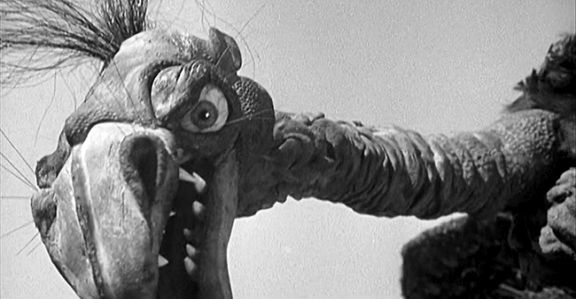
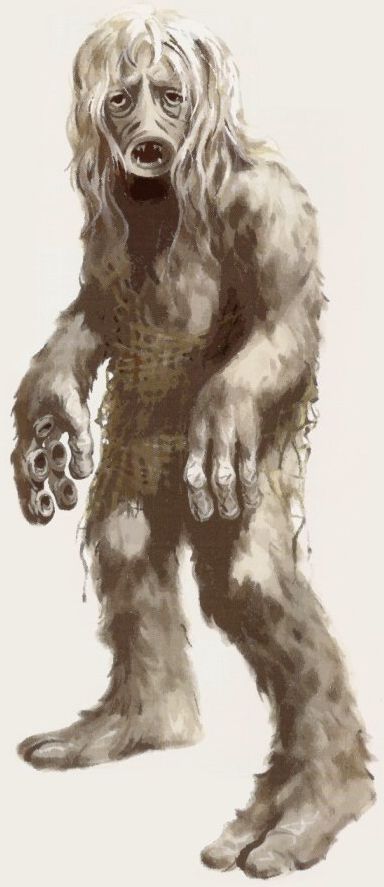
Tropical jungle wildernesses, especially those close to coastal regions, conceal many threats, among them the dreaded salt sucker. Intelligent and manipulative, a salt sucker’s natural appearance is monstrous, with dark eyes, a lamprey-like mouth, downy fur, and powerful arms that end in three-fingered hands. These fingers are quite long and the gripping surfaces are covered with strong, sucker-shaped muscles.

A salt sucker is seldom seen in its natural appearance. These creatures possess telempathic abilities that enable them to instantly appear as any humanoid drawn from the emotional memories of its victims. Under cover of this illusory appearance, the salt sucker then causes paralysis with its gaze. At this time, its victim is helpless. The salt sucker uses its fingers to suck all of the salt from the victim, an act which kills the victim in 1d4 rounds. If forced to defend itself in melee, a salt sucker uses its powerful strike.

Salt Sucker
Armor Class: 6 [13]
Hit Dice: 6
Attacks: Strike (1d6+1)
Special: Gaze causes paralysis, suck salt, telempathic illusion
Move: 12
Save: 13
HDE/XP: 9/1,100

March 2nd, 2017  in RPG No Comments »

Read All About It!

The Bishop’s Secret, written for White Box: Fantastic Medieval Adventure Game, was released to my few Patrons yesterday. This short adventure was written in hopes that it could dropped into your Old School game with minimal changes.

This marks my third release of Dangerous Places for OSR Systems. The first, Narvon’s Stair, is available to everyone for nothing more than the time it takes to download. Last month saw the arrival of Goshahri: The City in a Cave, a ruin in the process of being restored by miscreants under the iron fist of the Bandit King. I plan to return to Goshahri for at least one more adventure.

For March, I’m going to shift away from fantasy into horror with The Strange Case of the Bell Witch Bootleggers, a one-shot descent into madness and terror written for The Cthulhu Hack. I also still plan on fleshing out Goshahri a bit with The Harpy’s Nest, a more detailed description of a location in the aforementioned release that go short shrifted because I didn’t manage my time well enough.

You can get in on the Old School action by becoming one my patrons. It won’t ever cost you more than $1 a month.

In other news, I think I’m nearly ready to release The Four Color Hack. It’s changed quite a bit from its initial pay-what-you-want release. I’ve got one last section to write in which I’m including an assortment of villains and threats. I’ll also probably include a short, introductory scenario. Part of me would like The Four Color Hack to be available print-on-demand, but I’m not sure I can figure out how to correctly format, et cetera, the necessary files. I’m looking at Lulu, which seems to have a pretty user-friendly set up. Maybe during the downtime of Spring Break I can give it a go.

I have two other major (for me) projects that I need to finish. The first is the long-neglected Boogie Knights of the Round Table in which the heroes fight the Man with the powers of song and dance. No, really. I’ve run one playtest of the system to rave reviews. I’ve also dusted off an idea I had for a fantasy game involving real-world children transported to a world of twisted fairy tales very much inspired by Grimm and Little Fears. Unfortunately, my original work on it quickly displeased me, and I abandoned the project, but it’s back now with a simpler system built on The Black Hack.

So, in short, I’ve got some big (for me) plans for 2017, and I seem to be off to a good start. Huzzah.

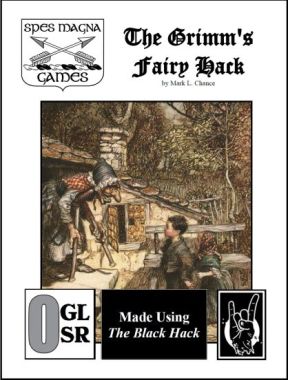
The Grimm’s Fairy Hack

Some time ago, I toyed with the idea of an OSR system for playing children transported into a fantasy realm. I abandoned the idea. It just seemed like a whole lot of work, and I couldn’t really keep excited about it. I’ve recently returned to the idea using a much more user-friendly system, specifically The Black Hack, about which I’ve written here before.

Thus, I’ve started work on The Grimm’s Fairy Hack.

In this “based on The Black Hack” game, the players take on the roles of children from our real world. In addition to The Black Hack, I’m also referring to Grimm Lite and Horizon: Grimm. The character classes are based on childhood archetypes/stereotypes. Players choose from six character classes: Bully, Dreamer, Jock, Nerd, Normal, Outcast, and Popular. Each class has certain special abilities and a special weakness.

Since the characters are children, they do not have Stats like regular fantasy characters. No STR, DEX, CON, et cetera to be found here. Rather that the familiar six made famous by Dungeons & Dragons, characters have seven Stats, each one defining a particular facet of the character’s childhood:

Academics: Covers arithmetic, reading, writing, et cetera. In short, Academics reflects how good a student the character was.

Explorer: Covers survival, first aid, reading a map, et cetera. Explorer includes the sorts of things one might learn in the Boy Scouts.

Hick: Covers rural life. A character with a good Hick stat would know how to milk a cow, dig fence post holes, cook, et cetera.

Lore: Covers knowledge of myths, legends, and fairy tales. Where Academics is knowledge of the real world, Lore is knowledge of the fantasy world.

Shenanigans: Covers lying, stealing, being sneaky, et cetera. A character with a high Shenanigans Stat is good at making trouble and getting away with it.

Upbringing: Covers being polite, fitting in with adults, knowing the right thing to do, et cetera.

Zip: Covers strength, dexterity, toughness, athletics, et cetera. Children lack real experience and training in actual combat, but Zip helps them attack and avoid getting hurt.

The success mechanic from The Black Hack remains. For a character to succeed with an action, the player must roll under the character’s relevant Stat on 1d20.

All characters also have a special ability called Imagination. Imagination is not a Stat, but instead is a power governed by a Usage Die, the size of which varies depending on character class. Thus, a Dreamer has more Imagination than a Bully. As a character improves in level, his Imagination becomes stronger. Imagination powers a class’s special abilities. Also, Imagination lets a character manipulate the fantasy world in a variety of different ways, so long as the character doesn’t violate two simple rules:

1. Imagination cannot be used to directly damage or destroy anything.
2. Imagination cannot be used to copy the special abilities of another class.

Of course, all of this is just a brief overview; it’s not comprehensive. The Grimm’s Fairy Hack will eventually include all of this and more. Some of the more will almost certainly be advice for using The Grimm’s Fairy Hack characters and The Black Hack characters at the same time. The former is based on the latter, and there ought to be little in either set of rules that makes mixing them impossible.

February 23rd, 2017  in Product Development No Comments »

The Four Color Hack Gets Updated

The Four Color Hack is enduring a series of major edits. All in all, I think these are some positive changes, some resulting from player feedback and others resulting from me being displeased with how some things were playing out during sessions. I need to do another read-through or two over the next couple of days or so to root out inconsistencies, errors, et cetera. After that, the new playtest iteration of the rules should be made available via the usual suspects. Huzzah. Here’s a list of the major changes:

1. Changed Body to Hit Points. Back to basics, so to speak. This necessitated small changes throughout the rules that previously referred to Body and/or Spirit.

2. Changed Spirit to Fortune, which is no longer a capacity for damage but instead represent a way to exert narrative control for point cost. Fortune is spent and earned during play.

3. Changed base protection to Vigor. Both CON and CHA add to Vigor, which works like temporary Hit Points.

4. Merged Skills and Idioms, which are now just called Idioms. Idioms can be narrow or broad, and they let the player roll with Advantage.

5. Simplified odd and even mechanic, limiting it to failures. Simplified how Idioms affect this mechanic.

6. Expanded and clarified how Hero Dice are used. The major additions are using Hero Dice for multiple attacks and to create lasting effects.

7. Fortune has replaced the Bonus Hero Die. Fortune is earned and spent during play. It functions somewhat like Karma did way back when with TSR’s Marvel Super Heroes.

8. Changed Hero Die Benchmarks to reflect alterations to STR and Super-Strength previously blogged about at my site.

9. Changed how XP is earned. The Bonus Hero Die is gone. Fortune now becomes part of XP awards.

10. Retooled villain creation a bit.

February 17th, 2017  in Product Development No Comments »

Have No Fear!

The Lord is my light and my salvation, whom shall I fear? The Lord is the protector of my life: of whom shall I be afraid? (Psalm 26:1, Douay-Rheims)

Last Sunday, I wrote about using turn undead as a way of transforming the Cleric into a melee master against affected undead. This seems especially appropriate for Clerics who follow deities devoted to battle, undead smashing, et cetera. Not all Clerics, however, fit that mold, so this Sunday I want to turn my attention to Clerics who seek to encourage their allies in conflict with the soul-rending terrors of the undead. Such a Cleric’s player rolls 2d10 and refers to the table for turning the undead as normal, but the results of success differ as follows:

* If the number on the dice is equal to or greater than the number shown on the table, the Cleric’s allies gain for 3d6 rounds a +1 “to-hit” bonus when fighting affected undead. Those allies also gain a +1 saving throw bonus against special attacks from the affected undead.

* If the table indicates “T”, the Cleric’s allies gain for 3d6 rounds +1 bonuses both “to-hit” and to damage. The saving throw bonus increases to +2. Furthermore, any ally who fails or who has failed a saving throw against a special attack from the affected undead immediately gains a reroll on that saving throw with that +2 bonus.

* If the table indicates “D”, the Cleric’s allies gain for 3d6 rounds a +2 “to-hit” and +2 damage bonus against the affected undead. Furthermore, the allies become immune to the special attacks of the affected undead.

January 22nd, 2017  in RPG No Comments »