The Tariit

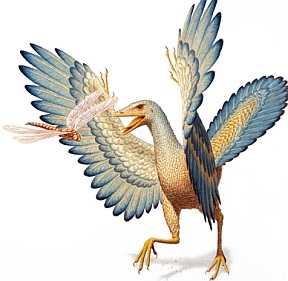
Tariits are an avian species native to Lygia, a world of vast plains, impenetrable jungles, and volcanic ridges. They appear to be small birds with three agile clawed digits growing from each wing. Their plumage tends toward shades of blue, yellow, or white, with females having feathers of duller shades. A full-grown adult taritt stands about three feet high with a wingspan about twice that.

To the casual off-worlder, a Tariit can easily be mistaken for a mere animal. These creatures are, however, intelligent beings who live in chaotic tribal communities. Tariits weave well-camoflauged dwellings out of grasses and leaves in the treetops of Lygian jungles. They make use of simple tools made of wood, bone, and stone. They subsist on insects, small reptiles, fruits, and nuts.

Life within a Tariit tribe is far from harmonious. Relations within a tribe are fractious as Tariits jockey for leadership over various aspects of daily life. Allegiances shift with confusing rapidity, and, what with the constant squabbling, it’s a wonder that Tariits manage their day-to-day affairs. Despite the constant power struggles and ever-changing factions, violence between Tariits of the tribe remains rare.

Psychology: Lygia is terrifying to Tariits, who are far from being the alpha predator of their environs. Tariit society based around hiding or protecting themselves from these many natural hazards of their world. The most revered Tariits are those who are best hidden or best protected, and who can give protection and concealment to their fellows. Most Tariits are quite cowardly by human measure, but occasionally they can be driven into a frenzy of terror in which they fight with the courage of the doomed.

Tariit as Player Characters: No Tariits have ventured off-world from Lygia. The very idea of taking to the heavens with the aliens who’ve set up a research outpost on Lygia is too terrifying to consider. Given their low tech level and cowardly disposition, Tariits would make poor player characters. Of course, an exceptional Tariit or two could defy their nature enough to become adventurers of sorts. If this is the case, Tariits should have a Strength score no higher than 10, a Constitution score no higher than 12, and a Dexterity score no lower than 13.

Stars Without Number Data

Tariit
Armor Class: 8
Hit Dice: 1
Attack Bonus: +1
Damage: 1d4 various primitive weapons
No. Appearing: 7-20
Saving Throw: 15+
Movement: 20 ft., 30 ft. flying
Skill Bonus: +1
Morale: 6

Lygia at a Glance
Population: Outpost
Atmosphere: Breathable Mix
Climate: Warm
Biosphere: Human Miscible
Government: Corporatist
Tech Level: 4 (0 among natives)
Tags: Friendly Foe, Primitive Aliens

October 3rd, 2013  in RPG 1 Comment »

The Nowhere Stairs

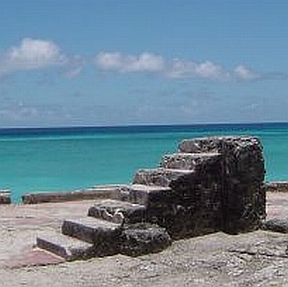
The Nowhere Stairs sit alone on a cracked and crumbling foundation on Mpira Utapotea, the southernmost island in the rugged Kupotea Archipelago. The Mpotevus, the people native to the archipelago, believe Mpira Utapotea to be hallowed ground sacred to the Bahari, their pantheon of mercurial sea deities. When conquerors from the Pơtao Imperium invaded Kupotea in search of gold and silver, the Mpotevus were quickly subjugated due to the Imperium’s technological superiority and the destructive magic of the Gămƀhet, the Mages of the Seven Fires.

Imperial Administrator Gai Gat was installed to oversee the subjugated Mpotevus. He defied the ancient taboos about building on Mpira Utapotea. He forced Mpotevu slaves to build a formidable fort overlooking the sea. From the beginning, the construction was fraught with difficulties. The Mpotevus sabotaged the work when they could. Strange accidents claimed many lives. Ships bearing construction materials were lost at sea. Gai Gat ignored these omens, and, in the eleventh year of his reign, his fort was nearly completed. Gai Gat and his family, along with a garrison of Imperium marines, moved to the fort in a show of force calculated to impress upon the locals how total was Pơtao mastery over the region.

In the dead of night, a fearsome storm rose from the sea and swept over Mpira Utapotea. Hours later, when the roiling clouds cleared and calm returned to the sea, nothing remained of Gai Gat’s fort except for its foundation and a set of seven stone steps leading up to nowhere. No sign of Gai Gat, his family, or the garrison was ever found.

Word of the storm and the fort’s destruction swept through the Kupotea Archipelago. Emboldened, the Mpotevus rebelled. Pwezas, great tentacled beasts, surged from the depths to aid the Mpotevus, and not even the Gămƀhet could burn away these monsters faster than the monsters tore apart the Imperium’s port towns.

Today, the Kupotea Archipelago remains free of Pơtao control. The natives remain hostile toward outsiders, and monstrous pwezas still lurk in the deep coastal waters. Adventurers sometimes brave the dangers of the archipelago in hopes finding lost Pơtao riches in the ruined port towns. Rumor also has it that, when the stars align properly, the Nowhere Stairs on Mpira Utapotea lead to and from the domain of the Bahari. This vast, watery realm reportedly contains enormous riches, for the Bahari consider all ships lost at sea to be sacrifices to their glory.

October 1st, 2013  in RPG No Comments »

Sequeko’s Coextensive Neck

Sequeko was a powerful magic-user from the ancient land of Kush. Famous for her beauty and wisdom, Sequeko ruled Kush for two centuries, sustaining her youth and vitality by means of annual exposure to a strange fire that erupted from a crater in a cavern deep beneath the royal palace. While skilled in all arcane arts, Sequeko’s greatest power resided in her mastery of interdimensionalism. She could open portals to other planes of existence, and she forged alliances with several extradimensional powers. Sequeko crafted several unique magic items, both for her personal use and as gifts and rewards for those who with whom she was well-pleased. Many of these magic items made use of Sequeko’s interdimensionalism.

Sequeko’s Coextensive Neck: This rare and unusual magic item appears to be a series of gold rings that fit snugly around the neck. When worn, they create a protective aura around the wearer’s neck. Hazards related to swallowing dangerous substances, invasive parasites, et cetera, do not affect the wearer, for the source of the harm is shunted into another dimension. Attacks that affect the neck are likewise ineffective.

September 30th, 2013  in RPG No Comments »

The Fichae

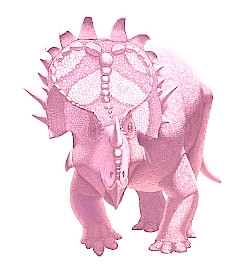
Herbivorous fichae (singular ficha) travel the vast verdant prairies of Lygia in small, competitive herds, usually comprised of an adult male, an adult female, and their offspring of various ages. Adult fichae are ponderous land animals. A full-grown bull stands 12 feet at the shoulder on average, and weighs around three tons. Full-grown cows are slightly smaller and lighter. These xenobeasts resemble ancient Terran ceratopsid dinosaurs, such as the triceratops or centrosaurus, but with rose and light purple scales.

Ficha cows go into heat about every seven Terran months, gestate for fourteen terran months on average, and typically deliver one or two young, which reach sexual maturity after about 16 Terran years. Mature bulls leave the herd in order to find a mate from another herd. This is a dangerous time the male’s life, for rival herds view unrelated males as threats. Violence against a rogue male by the herd’s alpha male is common.

Speaking of violence, fichae may be herbivores, but they are also aggressive, more likely to run at than away from a perceived threat. Against larger creatures, a ficha attacks with its powerful gore attack. Smaller creatures simply get trampled. When faced with a charging ficha, a smaller creature has a choice: either stand their ground and try to attack the ficha, or else to jump out of the way. In the former case, the smaller creature can attack with a -2 penalty before getting trampled for 4d6 points of damage. Otherwise, the smaller creature can attempt an Evasion save to leap out of the path of the ficha’s charge and avoid damage.

Stars Without Number

Armor Class: 3
Hit Dice: 12+12
Attack Bonus: +10
Damage: 2d6 gore, or 4d6 trample
No. Appearing: 3-9
Saving Throw:
Movement: 45 ft.
Morale: 8

September 29th, 2013  in RPG No Comments »

Epiloguing

Last OwlCon, I played in an Arabian Nights-inspired adventure that used Barbarians of Lemuria for the rule system. It was quite a hoot. Our characters explored a lost jungle island, fell victim to the machinations of the serpent people, and alternately engaged in fleeing in terror and fighting for their lives. As the session came to an end, we got to “epilogue” about what happened to our characters after the adventure.

I narrated briefly about how my character, who had killed the ship’s captain during the adventure, managed to set himself up as the new ship’s captain, much to the delight of the crew and the gaggle of wenches being entertained by my character’s tale of adventure. Every other players did the same for their characters, and then the GM added his own epilogue, revealing an unexpected twist. In each case, the epilogues could serve as plot hooks. So, if that session were not a convention game but part of an ongoing campaign, the GM could use my epilogue to explore another sea adventure with my character as ship’s captain.

I liked epiloguing so much that I added it to both sessions of Stars Without Number I ran at OwlCon. It seemed to be a big hit with the players. Best of all, at the end of the session, I had one potential plot hook per player, plus the epilogue that I added as the GM. (I remember one of my two GM epilogues describing the lost space yacht shifting out of warp near inhabited space while on board the Cthulhoid horror in the form of a long dead mother comforted her long dead son.)

I remain intrigued by epiloguing.

The basic idea is simple. After an adventure is over, each player gets about two minutes to describe some of that adventure’s consequences as they relate specifically to that player’s character. Each player does this, taking turns in whatever manner seems appropriate. Then, after all the players have epilogued, the GM gets to add his two cents worth. The events of the epilogue are assumed to happen during the downtime between adventures.

Unless things go horribly awry, Man Day Adventures meets again this Saturday. I don’t know if we’ll get an entire adventure done that day. I’m thinking not, but, regardless, I think I’m going to introduce epiloguing to the group and see what happens.

Might be fun.

September 17th, 2013  in Man-Day Adventures No Comments »