Contests!

The inestimable Dyson Logos has announced a contest involving a map. Of course. Check this out. The short version is that I take one of Dyson’s unfinished maps, finish it in an undoubtedly inferior style, and e-mail the finished map to Dyson himself.

Dyson writes, “I’ll post every entry I get here on the blog (with full credit to the artists involved), and if I get a dozen or more entries that get past the curating process (see below) I’ll give away one of the last remaining copies of the Deluxe Edition of Dyson’s Delves and will include at LEAST one hand-written original and never before published adventure inside it (as well as the adventure that only appears in the Deluxe Edition that has never appeared on the blog).

“Anyone can win – winner of the book will not be chosen by style, ability or product, but by random lottery (although only ‘serious’ entries will make it into the random lottery – so just drawing six lines in crayon will NOT get you a prize – this is the curating process described above). Any other prizes I decide to give away (like some original maps and stuff) will be based on curated and judged contest entries, but the main prize (the book) will be won by a random entrant from the curated list.”

Excellent contest. I must enter. I’ve already won one Dyson Logos map. How can I not covet more?

Speaking of contests, Erik Tenkar’s got one going as well. Do you want to be an OSR superstar? Of course you do, and this contest is a chance to make all of those dreams come true.

Erik’s contest runs in three rounds. Each round focuses on a different facet of OSR superstardom among a dwindling pool of competitors. Think of round one as a sort of OSR superstardom contest dungeon funnel. Prizes for OSR superstardom include virtual cash for use at RPGNow, cash via PayPal, and one OD&D Reprint Box.

The gauntlet has been cast! Roll initiative!

February 9th, 2014  in RPG No Comments »

More Story Cubes

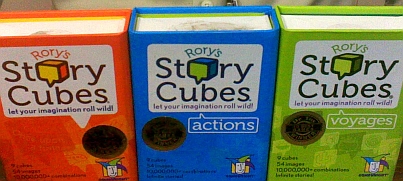
A bit more than a year ago, I blogged about Rory’s Story Cubes (see here for details). Back then, I had two of the three sets of Story Cubes. Over this last holiday, I got the third set at 8th Dimension Comics & Games.

Each set of Story Cubes includes nine six-sided dice with each die having six different pictures. In set one, the orange box, each picture is a noun, such as a flower, a lightning bolt, or a pyramid. Set two includes actions. Each picture shows one or more people doing something, such as climbing a tree, laughing, or digging a hole. My new set, in a lovely lime green box, includes more nouns, all built around the theme of “Voyages”. For example, some of the pictures include six beans (magical?), a sun peaking over a horizon, or a puzzle piece. With the Story Cubes in hand, I’ve got a powerful tool to generate adventure hooks.

“How so?” you ask.

Well, perhaps by using this format as a guide: noun-verb direct-object, corresponding to orange box-blue box-lime box, respectively.

For example, let’s say I rolled the dice, and I get these pictures: abacus, person with hurt thumb, rain cloud. Here’re two possibilities:

“A magical abacus built by a wizard after a personal tragedy controls the weather.”

“Advanced mathematical formulae discovered by researchers working for the Resistance hold the key to undoing world-wide ecological damage.”

Either one of those sentences could serve as adventure hooks. When you consider that three boxes together can be used to create about a bajillion different simple sentences, you have an enormous resource available to you. If you don’t have Rory’s Story Cubes, check them out. There worth a few bucks a set.

January 25th, 2014  in RPG No Comments »

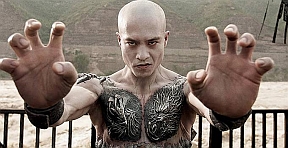
Yuan of the Five Venom Fist

Yuan of the Five Venom Fist serves as governor of Tsinghai Province, the remoteness of which grants Yuan greater autonomy than enjoyed by governors closer to the Imperial City. Terror and brutality characterize his rule, but taxes flow to the capital on time, which is the Jade Emperor’s primary concern. Yuan has mastered the Five Venom Fist, an evil martial art that uses dark chi further corrupted by deliberate exposure to the stings of scorpions. Yuan has also had dark gold armor stitched into his very flesh, granting him remarkable resistance to injury.

Dark Gold Armor: In addition to augmenting his Armor Class, Yuan’s dark gold armor enables him to completely avoid damage from any single weapon attack or magic missile spell once per round by making a saving throw. If his dark gold armor is somehow negated or removed, Yuan’s Armor Class drops to 1 [18].

Five Venom Fist: Any hand strike made by Yuan can be empowered by dark chi. A Five Venom Fist strike inflicts only 1d8+4 points of damage, but the target must make a saving throw. Failure means dark chi enters his body, causing terrible lesions and pain that inflicts 1d4+2 points of damage for 2d4 rounds.

Thieving Skills: Climb Walls 94%, Delicate Tasks 70%, Hear Sounds 5 in 6, Hide in Shadows 75%, Move Silently 80%, Open Locks 75%

For Swords & Wizardry:

Yuan of the Five Venom Fist
Hit Dice: 10
Armor Class: -3 [22]
Attacks: 2 weaponless attacks (2d8+4), or by weapon (+4 damage)
Saving Throw: 5
Special: dark gold armor, five venom fist, immune to mental control and mind reading, immune to poison, slow falling 40 ft., surprised on a 1 in 6, thieving skills
Move: 21
Alignment: Chaos
Challenge Level/XP: 15/2,900

December 27th, 2013  in RPG No Comments »

Babur the Solicitous

The holy man called Babur the Solicitous travels the spaceways, seldom in luxury but often for little or no cost to himself. Babur is an adherent to a tiny Buddhist sect, and the faithful believe Babur has been shown special favor due to his sacred lineage. Wealthy members of the sect provide Babur with generous stipends that permit him to wander the cosmos, spreading the message of enlightenment and aiding the oppressed, including those who are oppressed by their own selfish attachments.

Due to his martial arts training and unusual psychic powers, Babur is remarkably agile and quick-footed. His graceful punches, kicks, and walking stick moves can inflict damage even against targets that would otherwise be immune to low-tech attacks. A victim reduced to 0 hit points by such attacks is either unconscious for 1d4 minutes or helplessly restrained by the holy man, at the Babur’s discretion. Babur has an intuitive ability to communicate via psychic empathy with animal-intelligence xenobeasts. Such creatures seldom menace or attack Babur, and he can often influence them to follow simple mental instructions.

Stars Without Number Data

Babur the Solicitous
Armor Class: 6
Hit Dice: 4
Attack Bonus: +4
Damage: 1d6+2 walking stick, or 1d8 weaponless
Skill Bonus: +3 (+6 for anything related to athleticism or perception)
Saving Throw: 13+
Movement: 45 ft.
Morale: 10

December 1st, 2013  in RPG 1 Comment »

More Thinking about Skills

A couple of days ago, I meandered through a post about Negative GMs to reach some basic ideas about a skill system for Swords & Wizardry. By the end of that post, I’d taken some inspiration from Barbarians of Lemuria and had also put together a list of things that a skill system should not include. Here’re what a skill system should be without:

1. Skill lists
2. Heat that melts special snowflakes
3. “No!” as the default answer
4. Any more than minimal modifications to Swords & Wizardry

BoL uses 2d6 for task resolution. The success number is always 9 or better, and certain modifiers apply to the dice, most of the modifiers providing bonuses. The task’s difficulty may apply a negative modifier. On 2d6 without modifiers, about 28% of rolls are going to end up 9 or higher.

For a S&W skill system, I’m leaning toward 2d12 since d12s don’t get enough table time. To get as close as possible to 28% success rate on 2d12 without modifiers, the target number is 16 or 17 or better (25% chance versus 31.25% chance, or a difference of 3% versus 3.25%). Since I like to make tasks easier rather than harder, let’s use 16+ on 2d12 for now.

So far, so good.

But (and There’s Always a Big But)

BoL‘s task resolution modifiers don’t mirror those available in S&W. In the former game, a character’s 2d6 roll will almost always be modified by an ability score and a combat (when fighting) or career rank (when not fighting). That could result in a +6 modifier for even a beginning character (+3 from an ability score and +3 from either combat rank or career rank). For 2d6 aiming at 9+, that’s a huge bonus that bumps the success rate to about 97%.

To mirror the effects of a beginning BoL best case scenario with S&W on 2d12, a 1st-level character would need about a +12 bonus. S&W characters don’t have these sorts of bonuses because S&W isn’t built with the same game engine as BoL. So, what does a 1st-level S&W character have that can be retooled for bonuses?:

1. Ability scores
2. Character class
3. Race

S&W doesn’t have careers like BoL. Character classes are sort of like careers, but not really. Sure, a fighter should be skilled at doing fighter things (such as bivouacking, riding, being intimidating, and repairing armor), but what if your fighter is also a pirate? A noble? For determining what a character can be skilled at, it seems as if character classes are more limiting than careers.

BoL‘s list of careers include alchemist, assassin, barbarian, beggar, blacksmith, dancer, farmer, gladiator, hunter, magician, mariner, merchant, mercenary, minstrel, noble, physician, pirate, priest, serving wench, scribe, sky pilot (!), slave, soldier, thief, torturer, and worker. That’s a pretty exhaustive list.

I like BoL‘s career concept. Every character starts with four careers and four points to divide between those careers. No career starts with more than 3 points allocated to it. A 0 career rank indicates basic training in that career. The careers themselves represent what the character did before he became an adventuring hero. Importing a career system into a game with character classes, however, presents certain difficulties.

For example, could a fighter (character class) have been a thief (career) before he became a fighter? Sure. Does that mean a fighter (character class) with a thief (career) in his past should be as good as a thief (character class) at doing thiefly things? Hardly, because that would melt a special snowflake.

Even if my WIP skill system facilitates a fighter do thiefly things, that thiefly fighter should not be better at those tasks than a thief (character class). A career like magician is even more problematic. I mean, anyone at least try to sneak, but not everyone should be able to cast spells.

I need some time to digest all that thought food.

Task Difficulty & Success

I like having a static target number for task resolution. It seems to make things easier. The player rolls the dice and applies modifiers. Is the total 16 or better? Yes? Success! No? Not success!

Of course, not all tasks are equally easy. A system with a static target number needs difficulty modifiers (which even a system without a static success number is going to have). I’ll take my cue from BoL, adjusting modifiers to account for the change from 2d6 to 2d12:

Difficulty: Modifier
Easy: +2
Moderate: +0
Tricky: -2
Hard: -4
Tough: -8
Demanding: -12

I’m also considering degrees of success based on the task resolution total. Right now, in my mind, the degrees look something like this:

Task Total: Degree of Success
16 or higher: Success. The character does what he set out to do.
14-15: Success, But. The character does what he set out to do, but with a complication, such as the task taking longer.
Below 15: Failure. The character does not do what he set out to do.

I want to introduce critical successes and critical failures as well. I’m looking at a natural 21-22 being a success with a minor benefit, and a natural 23-24 being a success with a major benefit. A natural 2-4 would be a failure with an additional complication. Monte Cook’s interesting Numenera proves inspirational here.

Anyhoo, that’s enough for now. Time for other activities while these ideas simmer beneath the surface.

November 29th, 2013  in RPG 1 Comment »