Posts Tagged ‘ monsters ’

Ribbit! Ribbit!

For Swords & Wizardry:

Giant Heliotrope Frog
Hit Dice: 6
Armor Class: 5 [14]
Attacks: Bite (1d6+3)
Saving Throw: 11
Special: hypnotic patterning
Move: 15
Alignment: Neutrality
Challenge Level/XP: 7/600

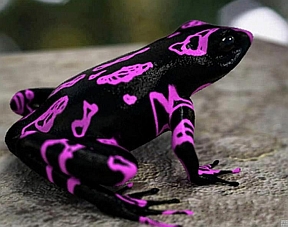
Native to the steamy, thick jungles of savage tropical wildlands, the giant heliotrope frog is a dangerous predator. It appears to be a black-skinned frog covered with lovely patterns of brilliant purple. A full grown specimen is roughly the size of an adult human.

Before attacking, this monster shifts up and down, left and right, on its legs. Creatures who witness this instinctive dance must make a saving throw to avoid becoming entranced by the frog’s hypnotic patterning. An entranced creature can take no action except staring in fascination for 2d4 rounds. A victim remains enchanted by the frog’s beauty even while it’s being devoured.

December 30th, 2012  in RPG No Comments »

Terror Has No Shape!

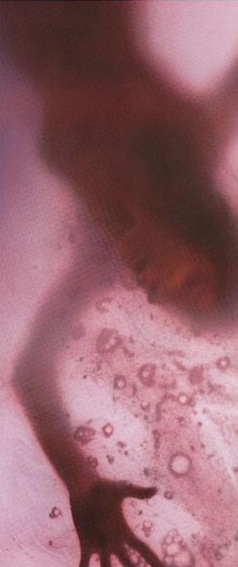
A sarpashana, or poison eater, is an aggressive colony of disparate microbes that have mutated to excrete and survive within a protoplasmic medium. This creature appears to be a bulging, surging mass of blotchy, semi-transparent ooze. At rest, a sarpashana would just about fill a 125-cubic-foot container. It weighs approximately 1,400 pounds, but has it has enough bouyancy to swim clumsily. Its protoplasmic mass has sufficient cohesion and strength to climb up walls, but is still fluid enough to ooze through spaces no larger than the diameter of a adult’s little finger.

As its name implies, a sarpashana survives by consuming toxins. It is especially attracted to the toxins produced by the metabolic processes of mammals. These include carbon dioxide, sulfates, nitrogen compounds, and phosphates. Using acute chemical sensors (roughly analogous to olfactory senses), a sarpashana detects its preferred foods. Devoid of anything resembling intelligence and always hungry, a sarpashana always moves toward the closest source of nourishment in order to feed. Unfortunately for mammals, a sarpashana’s preferred foods are found in vital places such as the kidneys, bladder, liver, lungs, and bloodstream.

A sarpashana attacks with a crushing lash by rapidly funneling a portion of its mass into a protoplasmic extension. The power of its lash is not main danger posed by a sarpashana. Rather, the creeping residue invariably left behind on the victim merits the greater amount of fear. This residue slithers rapidly on the victim, seeking ingress via whatever orifices are avaiable. Inside the victim’s body, the microbes burrow through soft membranes in order to enter the bloodstream, which then carries the microbes to those aforementioned internal organs richest in the creature’s preferred food. This can wreak horrible internal damage on the host.

Stars Without Number Stats

Armor Class: 6
Hit Dice: 3
Attack Bonus: +6
Damage: 1d10 protoplasmic lash
No. Appearing: 1d8
Saving Throw: 14
Movement: 20 ft.
Morale: 9

Swords & Wizardry Stats

Hit Dice: 3
Armor Class: 6 [13]
Attacks: Protoplasmic lash (1d10 + creeping residue)
Saving Throw: 14
Special: Immune to poison & weapons
Move: 9
Alignment: Neutrality
Challenge Level/XP: 6/400

Creeping Residue: Anyone struck by a sarpashana’s lash runs the risk of being invaded by slithering bits of microbe-laden protoplasm. A successful protoplasmic lash attack leaves behind 1d4 bits of creeping residue (a saving throw — Evasion or Luck for SWN players — avoids 1d3 bits). Each bit reaches a bodily orifice in 1d6 rounds. Removing a bit of creeping residue isn’t difficult, assuming it can be reached. (Bits that have slithered inside a victim’s armor may prove problematic.) Once within the victim, the infection goes to work. If the host dies, the microbes continue to feed and grow, producing a new sarpashana that oozes forth to hunt and feed.

Sarpashana Infection: (SWN) Toxicity 10, Interval 1d8 minutes, Virulence 3. At each interval, the victim suffers 2d4 points of damage. (S&W) Every 1d8 minutes, the victim must make a saving throw or suffer 2d4 points of damage. If the victim makes three successful saving throws before dying, his body’s natural defenses overwhelm and defeat the infection.

Immune to Poison & Weapons: A sarpashana cannot be easily harmed. It is completely immune to poisons. Likewise, most weapons cannot damage it (although they can splash microbe-filled gobs of protoplasm around). Conventional weaponry that relies on kinetic force (bullets, arrows, melee weapons, et cetera) do not damage a sarpashana. Those in melee range of a sarpashana when it is struck by such weapons may be splashed with creeping residue. A saving throw (an Evasion or Luck saving throw for SWN players) avoids being splashed with creeping residue.

Energy attacks (such as lasers and lightning bolts) and especially powerful weapons (such as high-explosive devices or a giant’s boulder) inflict normal damage on a sarpashana. Effects that specifically target pathogens are especially harmful to a sarpashana. Psionic powers or spells that cure disease inflict 1d6 points of damage per power/spell level (no saving throw). A medkit can be used against a sarpashana. The medic can deploy antibiotics (requiring an attack roll as adjudicated by the GM) to inflict up to 1d6 points of damage per Tech/Medical skill level.

December 27th, 2012  in RPG No Comments »

“Stand ho, ho, ho!”

Blitzkringler
Hit Dice: 4
Armor Class: 4 [15] (8 [11] unarmored)
Attacks: Two-handed sword (1d10 plus 1 point of lightning damage)
Saving Throw: 13
Special: Immune to cold & lightning
Move: 12
Alignment: Lawful
Challenge Level/XP: 5/240

Blitzkringlers are a mysterious race of lawful warriors who inhabit arctic regions. When dealing with those who are nice, blitzkringlers act benevolently. Against those who are naughty, blitzkringlers can be terrible.

The red-and-white suits of fur and leather worn by blitzkringlers are equal to chain armor. Blitzkringlers prefer to fight with two-handed swords. Any metal weapon wielded by a blitzkringler inflicts an extra point of lightning damage with a successful hit.

December 24th, 2012  in RPG No Comments »

Bellatrixian Plague Fungus

Another one from the xenobestiary for Tiamat’s Throne, my Stars Without Number-inspired setting that mixes fantasy elements with the sci-fi.

Bellatrixian Plague Fungus
Armor Class: 10
Hit Dice: 1/2
Attack Bonus: NA
Damage: special
No. Appearing: 3d4 troops per victim
Saving Throw: 15+ (see below)
Movement: 5 ft.
Morale: NA

Bellatrix was founded as a gengineering research outpost by the Meteor Alliance, a long-defunct corporation. The planet’s minimal biosphere was believed to be an ideal location for genetic manipulation of microorganisms, including the wide variety of alien microbial life that still manages to thrive in the planet’s waterless, inhospitable conditions. Today, Highbeam Multistellar runs Bellatrix’s corporatist government, and the gengineering research continues.

One of the more horrible results finding its way from HM’s gengineering labs to the Imperial Navy is the Bellatrixian plague fungus. Weaponized spores secure within shielded missiles can be deployed from orbit with near-perfect precision. These missiles disintegrate above the target areas, dispersing the weaponized spores into the atmosphere. The spores then drift and gradually settle due to atmospheric currents and gravity.

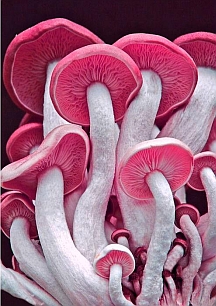
Plague fungus spores quickly germinate in any organic medium, and the fungal mycelium spreads through tissues for 1d4 minutes after exposure (a Physical Effect, Evasion, or Luck save made with a -4 penalty avoids spore infestation). Affected living targets suffer 1d4 points of damage every five rounds as the fungal mycelium invades tissues. The spreading fungal mycelium manifests itself in physical symptoms that include pain, nausea, and a growing network of dull pink “threads” visible in the dermis.

After the fungal mycelium stage, the transition to mushroom primordia and then to growing mushrooms occurs within another 1d4 minutes. This process rapidly destroys tissues, inflicting 1d4 points of damage per round (no saving throw). A single victim (almost certainly dead by the end of the plague fungus’s initial life cycle) typically sprouts 3d4 troops of mushrooms. These mushrooms reach full maturity in another 1d4 minutes, at which time each troop swells and bursts, releasing a cloud of spores in a radius equal to 5 feet per troop.

At this time, the plague fungus’s life cycle starts over again at the fungal mycelium stage.

There is little that can be done to save an infected target. A Tech (Medical) check made with an appropriate array of anti-fungal medicines can stop the plague fungus’s life cycle. Doing so, however, is not easy (difficulty number 10). Biopsionic powers may also be helpful, but halting the fungus’s life cycle requires purge toxin. Psychic succor can heal damage, certainly, but this doesn’t stop the fungus’s life cycle, and biostasis is completely useless.

October 18th, 2012  in Product Development, RPG No Comments »

Elanoran Tailbiter

More xenobeasts for Stars Without Number:

Elanoran Tailbiter
Armor Class: 6
Hit Dice: 1/2
Attack Bonus: +1 (tail) or +3 (tumble attack)
Damage: 1d3 (tail) or 1d6 (tumble attack)
No. Appearing: 2d4
Saving Throw: 15+
Movement: 20 ft. (see below)
Morale: 8

The Elanoran tailbiter is a rugged reptilian scavenger found all over Elanor. An adult tailbiter weighs about 40 pounds, and it measures about 3 feet from nosetip to the end of its tail. Thick, overlapping scales protect its head, back, and tail. The scales closer to and on the tail sport sharp edges and blunt spikes. A tailbiter’s coloration varies depending on its environment. Tailbiters that live in forests, for example, tend toward dark greens and browns, whereas those that live in deserts are usually yellow-brown.

As mentioned, Elanoran tailbiters are scavengers. They are not particularly aggressive, but they will lash out to when threatened or frightened. A tailbiter usually attacks with a tail strike. If a tailbiter has at least 20 feet to move before attacking, it might use the strange maneuver that gives the species its name. The reptile bites its tail, curls into something like a ball, and launches a rolling charge at a foe. While tumbling in this manner, the tailbiter uses its clawed feet to guide its movement.

Heavy mining operations on Elanor have disrupted numerous planetary ecosystems, displacing large numbers of tailbiters. Being scavengers, the reptiles have moved into urban areas looking for food and breeding spaces. In some cases, these urbanized tailbiters have become feral. Feral tailbiters can be dangerously aggressive, even predatory. Add +2 to a feral tailbiter’s morale.

September 20th, 2012  in RPG No Comments »