Posts Tagged ‘ monsters ’

Q Is for Querulous

querulous: (adj.) complaining in a petulant or whining manner

Nota Bene: Again a move away from Swords & Wizardry and Stars Without Number to focus briefly on a genuine Old School game. I’m back with Chaosium today for that esteemed company’s greatest game, Call of Cthulhu, using my 3rd edition hardback from 1986 for the first time in too long. The day after tomorrow I’m going to go way back again to TSR’s Top Secret.

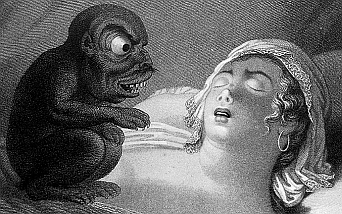
Black-eyed children appear as preadolescents, but their eyes are solid black with no differentiation between sclera, pupil, or iris. Often, Black-eyed children can be seen playing games and singing the nursery songs in or near abandoned areas. Other reports claim these entities show up alone or in a pairs at people’s doors, usually at night. They avoid eye contact, looking down to hide their eyes. Black-eyed children tend to whine and sulk, and they have bad tempers.

Black-eyed children often attempt to talk a victim into allowing them entry into the home to use a telephone or to be safe from some unspecified danger. Other times, they approach strangers, asking for a place to stay or for an escort home. Victims cannot always refuse these requests, for black-eyed children seem to possess the power to compel obedience. When a black-eyed child attacks, it does so with savage ferocity and a strength that belies its size. At this time, the entity’s skin changes, becoming pallid and corpse-like.

Black-Eyed Child (Lesser Independent Race)

“Let us in,” came the whisper through mail slot, and despite the fearful chill down my back, I reached for the door’s lock.

Black-eyed children may attempt to compel nonviolent behavior through the semi-hypnotic power of their voices. A successful POW vs. POW roll resists the child’s words. It costs a child 1d4 magic points to use this ability.

Characteristics (Average)
STR 3d6+10 (20-21)
CON 2d6+6 (13)
SIZ 1d6+6 (9-10)
INT 3d6 (10-11)
POW 3d6+3 (13-14)
DEX 3d6+3 (13-14)
APP 3d6 (10-11)
Hit Pts 11-12
Move 8

Weapon (Attk%, Damage)
Fist/Punch (55%, 1d3+1d4)
Kick (45%, 1d6+1d4)
Weapon (30%, by weapon+1d4)

Armor: None
Spells: To determine spells known by a black-eyed child, roll 1d100. If the roll is higher than the child’s INT, it knows no spells. If the roll is equal to or lower than the child’s INT, it knows that many spells.
Skills: Climb 45%, Dodge DEX+10%, Hide 65%, Jump 45%, Listen 80%, Sneak 65%, Spot Hidden 50%
SAN: Meeting a black-eyed child’s gaze costs 1 SAN, but a successful SAN roll indicates no loss. Seeing a black-eyed child’s skin change costs 1d6 points of SAN, or no loss with a successful SAN roll.

April 19th, 2014  in RPG No Comments »

P Is for Pithikosophobic

pithikosophobic: (adj.) abnormally or persistently afraid of monkeys

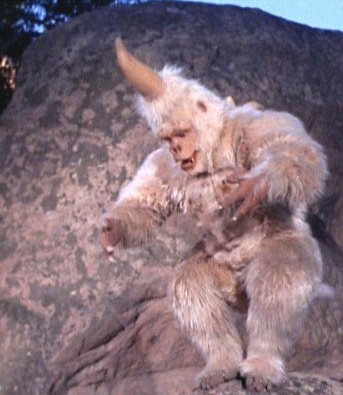
Mugatos are large, intimidating animals that can reach a height of six and one-half feet (not counting the cranial horn). Covered by a thick pelt of white fur all over their bodies with the exception of their faces and hands, they are similar to the great apes of Earth in their physical proportions and prehensile hands and feet. All of their teeth are sharp and serrated, and their fangs contained a strong venom that can be fatal within a matter of hours. Mugatos have large, thick horns projecting from the tops of their craniums as well as smaller spikes running down the spine.

Mugatos’ natural habitats cover tropical or subtropical forests covering a wide range of elevations from montane cloud forests (7,200–14,100 feet above sea level) to dense forests and lowland swamps and marshes as low as sea level. These creatures live in groups called troops. Troops tend to be made of one adult male and multiple adult females and their offspring. Mugato lifespan is normally between 35 and 40 years.

Mugato
Armor Class: 4
Hit Dice: 8
Attack Bonus: +10
Damage: 1d8 bite
No. Appearing: 1d4
Saving Throw: 11+
Movement: 30 ft.
Morale: 11

Mugato Venom: Toxicity 10, Interval 30 minutes, Virulence 3, Damage 1d6

April 18th, 2014  in RPG No Comments »

O Is for Oppressive

oppressive: (adj.) unjustly inflicting hardship and constraint

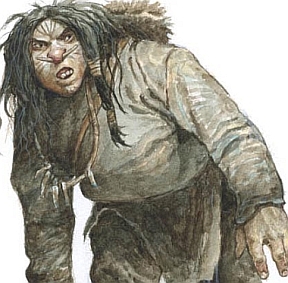
Ogres have long been a threat to civilized peoples. Strong, brutish, given to looting and pillaging, gangs of ogres are menaces that cannot be tolerated for long. Ogres revel in the misery of others. When smaller races aren’t available to crush between meaty fists or defile in blood-red lusts of violence, they turn to each other for entertainment. It takes a forceful leader to keep an ogre gang focused.

Within ogre tribes, few leaders prove more forceful than harridans. An ogre harridan rules by fear and violence, using her superior strength, intelligence, and magic powers to keep her underlings in line. Most especially it the harridan’s magic that elicits the most terror, for harridans practice gut magic.

Whenever a harridan succeeds with a bite attack against a living foe, she gains 2 gut-magic points. The harridan cannot have more than twice her Hit Dice in gut-magic points. She uses stored gut-magic points to cast spells from the lists that follow. Gut-magic points fade at a rate of 2 points per minute.

1 Gut-Point Spells: Charm Person, Magic Missile, Shield, Sleep

2 Gut-Point Spells: Darkness 15-Foot Radius, Levitate, Mirror Image, Pyrotechnics

4 Gut-Point Spells: Dispel Magic, Fly, Lightning Bolt, Slow

Harridan
Hit Dice: 8+2
Armor Class: 3 [16]
Attacks: 1 bite (1d6), 1 weapon (1d10+1)
Special: Gut-magic
Move: 9
Saving Throw: 8
Alignment: Chaos
Number Encountered: Up to 1 harridan per 15 ogres
Challenge Level/XP: 10/1,400

April 17th, 2014  in RPG No Comments »

N Is for Nascent

nascent: (adj.) just coming into existence and beginning to display signs of future potential

Spacers first encountered nyotagomas during the early decades of interstellar travel as humanity slowly recovered from the Scream’s devastation. The total absence of nyotagomas from surviving pre-Scream records led many to conclude that this species is either a mutation of a previously benign creature, or else nyotagomas entered human-inhabited space as a result of the Scream. Whatever the truth, nyotagomas proved too dangerous to be left alone, and a genocidal program was launched against them. The program seemed successful after several hard-fought years. Attacks on spacers and orbital installations by nyotagomas dwindled to nearly none at all.

Stellae Zaibatsu, an industrial conglomerate focused on planetary mining and metallurgy, took a keen interest in nyotagoma physiology and reproduction. The organism’s ability to survive in the hard vacuum intrigued corporate researchers, who sought better ways for miners to live and work in environments often deadly to humans. As a result, Stellae Zaibatsu xenogengineers made a remarkable discovery.

Nyotagoma reproduce asexually via budding. The adult organism submerges itself in a marine environment and produces several immature organisms, which bud from the parent’s body near the base of its tentacles. After a brief period of growth, these buds separate from the parent, becoming independent marine creatures. If these buds are harvested and subjected to the proper combination of chemicals and genetic manipulation, they cease maturing and enter a symbiotic stage which enables the organism to be grafted onto a human host.

The nyotagoma symbiote, or Nyosym (available in many tech level 4 markets for 10,000 credits), integrates itself with its host’s body and helps regulate the host’s metabolism. A Nyosym host’s gains a +2 bonus to saving throws against toxins and biological hazards. He also gains +1 hit point per Hit Die. These hit points are lost before the host’s own hit points, at a rate of 1 hit point per die of damage inflicted. For example, a host suffering 7 points of damage from 2d6 points of damage would suffer 5 hit points of damage while the Nyosym’s bonus hit points are depleted by 2 points.

Any time a host fails a saving throw versus a toxin or biological host or suffers sufficient damage to deplete the Nyosym’s bonus hit points, the Nyosym has a 25% chance of dying. Should this happen, emergency surgery is necessary to remove the dead organism before infection sets in. Otherwise, a Nyosym with no bonus hit points remaining becomes dormant, recovering 1 hit point per day. The host receives no benefits from a dormant Nyosym.

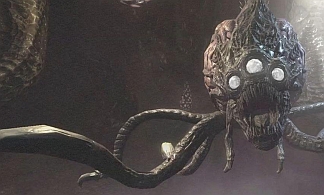
Adult nyotagomas remain rare in inhabited space, which is a good thing for spacers since adult nyotagomas are highly intelligent and extremely dangerous. In addition to the impressive stats below, a nyotagoma has an effective 16 Intelligence. It can survive in a hard vacuum with ease. It is immune to the hazards of outer space, such as the vacuum, cosmic radiation, et cetera. Extreme conditions, such as flying too close to a star, still prove disastrous. A nyotagoma can fly through outer space as if it were a drive-1 rated starship. These creatures always succeed at Navigation checks. It has extremely acute vision, able to see emissions throughout the entire electromagnetic spectrum. If a nyotagoma forgoes its normal attacks, it can make a single devastating attack 2d12 points of damage that affects inanimate objects like a gunnery weapon.

Nyotagoma
Armor Class: 2
Hit Dice: 10
Attack Bonus: +18/+18
Damage: 1d12/1d12 hooked tentacle
No. Appearing: 1d4
Saving Throw: 10+
Movement: 40 ft. fly
Morale: 12

April 16th, 2014  in RPG No Comments »

F Is for Fearful

fearful: (adj.) feeling afraid; showing fear or anxiety

Nota Bene: Saturday, I posted a mutant monster for 1st edition Gamma World. Today’s monster fits Chaosium’s Basic Roleplaying, specifically the iteration found in the 4th edition of Stormbringer. Inspiration for this creature came from a conversation with my son Christopher about what fainting goats might evolve into in the far future.

Balo, Jester of Chaos, does not make himself felt in the Young Kingdoms with the same force as, say, Arioch, Pyaray, or Chardhros, but that doesn’t mean Balo’s peculiar sense of humor leaves the world untouched. Case in point: Balo’s goats, which are most often encountered in Argimiliarian outlands.

These magical animals appear very much like ordinary goats, except for their purple fur and that curious shine to their eyes. Like normal goats, Balo’s goats are largely inoffensive herbivores. When threatened, they prefer to run away. Of course, since that’s not very funny, Balo has blessed his goats with an unusual power that manifests when these beasts panic.

When a Balo’s goat panics, it emanates a 20-foot radius aura that affects non-Balo’s goat creatures. Compare the goat’s and the victim’s POW attributes. For every point the goat’s POW is higher than the victim’s, add 5% to the base 50% that the victim will be affected. For every point the goat’s POW is lower than the victim’s, subtract 5% from the base 50% that the victim will be affected. If affected, the victim’s extremities become paralyzed for 3d10 combat rounds. During this time, Balo’s goats tend to run away, leaving the paralyzed to whatever fate may be lurking nearby.

Balo’s Goats
Attributes
STR 2d6
CON 2d6+3
SIZ 2d6
INT 1d6
POW 3d6+7
DEX 2d6
Hit Points CON

Skills
Dodge 20% + 1d10
Panic 80% + 1d10
See 50% + 1d10
Scent 25% + 1d10

Weapon (Attack | Damage)
Butt (20% + 1d6 | 1d4)

April 7th, 2014  in RPG No Comments »