Archive for the ‘ RPG ’ Category

The Salt Sucker

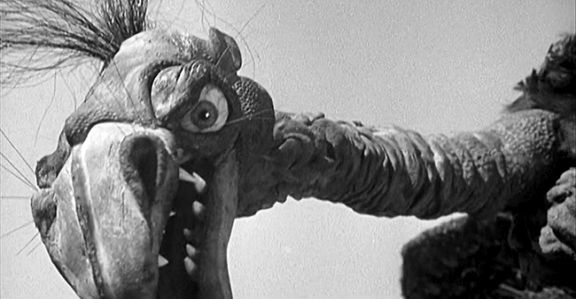
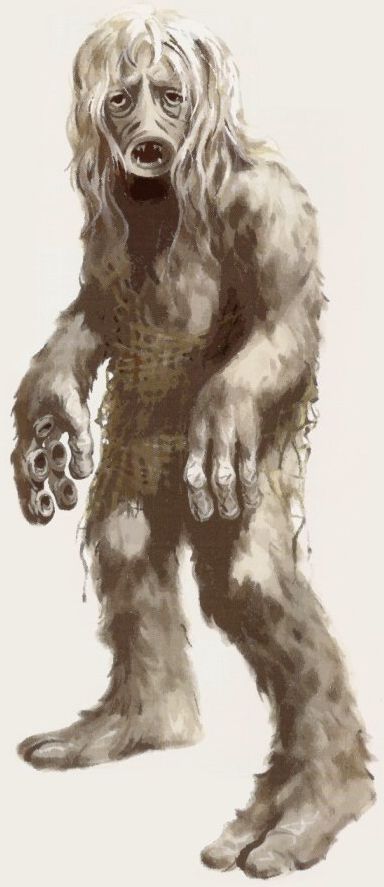
Tropical jungle wildernesses, especially those close to coastal regions, conceal many threats, among them the dreaded salt sucker. Intelligent and manipulative, a salt sucker’s natural appearance is monstrous, with dark eyes, a lamprey-like mouth, downy fur, and powerful arms that end in three-fingered hands. These fingers are quite long and the gripping surfaces are covered with strong, sucker-shaped muscles.

A salt sucker is seldom seen in its natural appearance. These creatures possess telempathic abilities that enable them to instantly appear as any humanoid drawn from the emotional memories of its victims. Under cover of this illusory appearance, the salt sucker then causes paralysis with its gaze. At this time, its victim is helpless. The salt sucker uses its fingers to suck all of the salt from the victim, an act which kills the victim in 1d4 rounds. If forced to defend itself in melee, a salt sucker uses its powerful strike.

Salt Sucker
Armor Class: 6 [13]
Hit Dice: 6
Attacks: Strike (1d6+1)
Special: Gaze causes paralysis, suck salt, telempathic illusion
Move: 12
Save: 13
HDE/XP: 9/1,100

March 2nd, 2017  in RPG No Comments »

Have No Fear!

The Lord is my light and my salvation, whom shall I fear? The Lord is the protector of my life: of whom shall I be afraid? (Psalm 26:1, Douay-Rheims)

Last Sunday, I wrote about using turn undead as a way of transforming the Cleric into a melee master against affected undead. This seems especially appropriate for Clerics who follow deities devoted to battle, undead smashing, et cetera. Not all Clerics, however, fit that mold, so this Sunday I want to turn my attention to Clerics who seek to encourage their allies in conflict with the soul-rending terrors of the undead. Such a Cleric’s player rolls 2d10 and refers to the table for turning the undead as normal, but the results of success differ as follows:

* If the number on the dice is equal to or greater than the number shown on the table, the Cleric’s allies gain for 3d6 rounds a +1 “to-hit” bonus when fighting affected undead. Those allies also gain a +1 saving throw bonus against special attacks from the affected undead.

* If the table indicates “T”, the Cleric’s allies gain for 3d6 rounds +1 bonuses both “to-hit” and to damage. The saving throw bonus increases to +2. Furthermore, any ally who fails or who has failed a saving throw against a special attack from the affected undead immediately gains a reroll on that saving throw with that +2 bonus.

* If the table indicates “D”, the Cleric’s allies gain for 3d6 rounds a +2 “to-hit” and +2 damage bonus against the affected undead. Furthermore, the allies become immune to the special attacks of the affected undead.

January 22nd, 2017  in RPG No Comments »

Smite Those Undead!

…I am glorified in the eyes of the Lord, and my God is made my strength. (Isaiah 49:5)

Certain Lawful Clerics do not “turn” undead monsters. Instead, these Clerics call for divine assistance in direct combat with the undead. Such a Cleric’s player rolls 2d10 and refers to the table for turning the undead as normal, but the results of success differ as follows:

* If the number on the dice is equal to or greater than the number shown on the table, the Cleric gains for 3d6 rounds a +1 “to-hit” bonus and a damage bonus equal to the half Cleric’s level (round up) when fighting affected undead.

* If the table indicates “T”, the Cleric gains for 3d6 rounds a +1 “to hit” bonus and a damage bonus equal to the Cleric’s level when fighting the affected undead. Furthermore, the Cleric makes one attack per level each round against the affected undead.

* If the table indicates “D”, the Cleric gains for 3d6 rounds a +1 “to hit” against the affected undead. Any hit automatically destroys the undead monster, reducing it to dust. Furthermore, the Cleric makes one attack per level each round against the affected undead.

January 15th, 2017  in RPG No Comments »

Brutacles and Agents of H.U.R.T.

So, my soon-to-be-released-in-playtest-format superhero RPG The Four Color Hack is almost ready for DriveThruRPG. As part of the section on villains, I include stats for agents of H.U.R.T., but I have no idea what H.U.R.T. stands for. Thoughts? Suggestions?

Also, let’s take a look at the rules for creating villains and mobs.

Each Issue features certain villains, mobs, and non-heroes. In all three instances, the rules for hero creation do not apply. Those rules exist for the Writers to create their heroes. As the Editor, you have more freedom.

Villains: Every villain has a level, which ranges from 1 to 10. The villain’s level determines his base damage, damage points, and Hero Dice equivalent for powers and abilities.
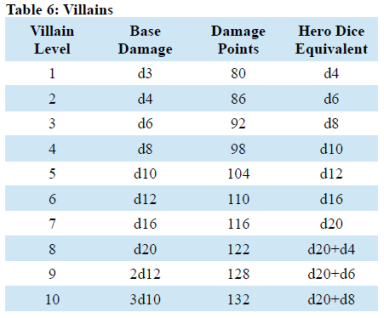
Base damage shows what to roll when the villain makes a successful attack. You’ll need to define that this attack looks like. Damage points are divided between Body and Spirit in whatever ratio seems appropriate for the villain. Also, the villain has base protection points equal to his level. These base protection points are divided between Body and Spirit as deemed acceptable. The Hero Dice equivalent column shows you the strength of the villain’s powers and abilities. Average the Villain Level column to approximate the villain’s actual level if you mix and match values from the chart.

For example, let’s consider Brutacles, who is something of a novice villain, but he’s not a complete novice. He is level two for base damage and damage points. He derives his powers from mutagenic steroids, which has a d8 value, and he wears protective armor and fights with a ball-and-chain.

Brutacles (Level 2 Villain)
Body: 66 (2 protection)
Spirit: 20 (0 protection)
Base Damage: d4
Powers: Ball-and-Chain d6 (1d4+1d6+1d8 damage), Brutal Armor d6 (4 protection), Mutagenic Steroids d8

Sadistic and violent, Brutacles fights with a Ball-and-Chain aided by muscles enhanced with Mutagenic Steroids. He is physically tough (6 points of protection for Body), but his mental and spiritual defenses are quite lacking. Brutacles is strong enough to lift about 2,400 pounds.

Mobs: Not all threats rise to the level of villain, but that doesn’t mean they can be ignored. Mobs represent a middle ground between villains and non-heroes. Most heroes won’t have too much trouble dealing with mobs, but these bad guys can still serve to slow down, confuse, and harrass heroes. All mobs have d3 base damage, 80 damage points, and at most a d4 Hero Die equivalent. They have one point of base protection at most, and some item of equipment usually explains this defense. Each mob represents either a large group (9-12 individuals) or small group (2-5 individuals). Divide the mob’s damage points as evenly as possible among the individuals.

When a mob (or part of a mob) targets a hero, don’t expect a roll to defend against each member of the mob. A single roll suffices, but increase the mob’s damage by +1 for each member after the first. For example, a mob of ten H.U.R.T. agents lay down a barrage of blaster fire at Diesel. Diesel’s player rolls 1d20 to defend, and fails. Diesel suffers 1d3+1d4+9 points of damage from the combined assault, which is probably enough to inflict a small amount of Body damage to the metal-skinned hero.

Agents of H.U.R.T. (Mob of 10)
Body: 50 (5 per agent)
Spirit: 30 (3 per agent)
Base Damage: d3
Equipment: Body Armor (1 protection)
Powers: Anti-Hero Weaponry d4

The agents of H.U.R.T. are trained, paramilitary operatives. Individually, they present little threat to heroes, but they operate in squads and are typically armed with high-powered blasters or other anti-hero weaponry.

December 19th, 2016  in RPG No Comments »

Your Comic Book

Thoughts about superhero gaming in general as rough drafted in The Four Color Hack.

The first step to playing your comic book is to get all of the players together. One player assumes the role of the Editor. The Editor referees the game during play. Also, the Editor prepares Events and Issues, including the various villains and regulars that the heroes may encounter during a game session. The other players will assume the roles of the Writers, whose job it is to create a hero and determine what that hero does when, where, why, and how during the game.

For your first session, the main goal is to have fun creating the setting and the heroes that your comic book will be about. Don’t worry about figuring out every single detail of your comic book’s setting. Right now, you just need to answer some of the big picture questions that help define your setting in somewhat broad terms. If you want to get really serious about setting creation, I heartily recommend Microscope by Ben Robbins as the best collaborative roleplaying game for creating a campaign background.

Style

Every setting has a certain style and a certain focus. The styles can be divided into four broad categories: Humor, Four Color, Cinematic, and Gritty.

Humor: Think zany. Think older cartoons such as Mighty Mouse or The Impossibles. Think newer cartoons such as Freakazoid! or Darkwing Duck. Think Adam West and Burt Ward being menaced by an egg-wielding, bald Vincent Price. No ever gets killed or even seriously hurt, and evil the wickedest villain’s schemes have a strong dose of silliness.

Four Color: The heroes are definitely the good guys, the villains are certainly bad, but the tone seldom ventures too deep into darkness. We expect the good guys to win, and the fall out from the villains’ schemes seldom have dire, lasting effects. A Four Color world is also a black and white world. Contrasts are sharp, and the lines between right and wrong are clear and inflexible. Think of stories such as the Silver Age Justice League of America. Think of the Comics Code era and its restrictions on graphic violence, sexuality, et cetera.

Cinematic: Shifting to Cinematic, we find that our heroes are less like mythic figures and more like ordinary people with extraordinary abilities. The action tends to be melodramatic, focusing on a sensational series of events that play on emotions while avoiding too much character development. Many of the big-budget motion pictures depicting superheroes fit into the Cinematic style. So too do some of the more recent comic books, such as Marvel’s Guardians of the Galaxy and Uncanny Inhumans. Cinematic stories might tackle real-world issues, but usually in a ham-fisted manner, ignoring nuance and even accuracy in order to emphasize melodramatic elements.

Gritty: This style seeks to emulate the real world while emphasizing those elements of life that create ambiguity, uncertainty, and apprehension. People in the Gritty style still believe in right and wrong, but those with strong moral convictions often face existential challenges that threaten to undermine or even destroy their certainty. Real-world issues are a mainstay of the Gritty style, and heroes that face strong temptations to resort to extreme measures that blur the line between heroism and villainy. The late 80s to early 90s series starring the Shadow written by Gerard Jones and Eduardo Barreto fits the Gritty style. So too does the recent Netflix series Daredevil and Jessica Jones.

Focus

The foci can likewise be divided, but into three broad categories: Street, Superhero, and Cosmic.

Street: This focus keeps most of the story confined to a particular city or part of a city. The heroes seldom stray too far from their stomping grounds, and, when they do, they usually end up involved in another city’s Street focus. The villains’ plans likewise tend to be localized and don’t usually require widespread destruction. Examples include the aforementioned Daredevil series and many stories involving Spider-Man and Batman.

Superhero: The heroes’ sphere of concern expands to encompass an entire nation or perhaps the world itself. The heroes are likely to be jetsetters, traveling long distances in their efforts to thwart villainous plots that might affect millions, even billions, of people. Marvel’s The Avengers and DC’s Justice League of America exemplify this focus.

Cosmic: As you’ve probably deduced, a Cosmic focus means the heroes travel from planet to planet, maybe even from galaxy to galaxy, in their quest to fight the forces of evil. Jim Starlin’s thoroughly awesome Dreadstar exemplifies the Cosmic focus.

Keep in mind that neither style nor focus speak definitively about the power levels of either the heroes or villains. Gotham’s most famous masked vigilante has regularly had adventures across all three foci, and he’s run the gamut of styles from Humor to Gritty.

Period

When does your comic book take place? Today? Some time in the recent past, such as the 1960s with the Cold War at its height? The most distant past, such as the American Revolution, Augustus Caesar’s Roman Empire, or maybe further back when the ancient Israelites fought to conquer the land they believed had been promised to them? If the present day or the past don’t interest you, there’s the uncharted decades or centuries of the future waiting for your heroes.

Genre Crossovers

Is your comic book going to be a straight-up superhero saga, or do elements from other genres appear? If the heroes all work for a secret government agency, then spies and intrigue enter the picture. Have strange visitors from distant worlds made contact with your comic’s world? If so, then all sorts of possibilities from “To Serve Man” on The Twilight Zone and The War of the Worlds to the more recent Defiance television series make themselves available. Perhaps all of the heroes are high school kids dealing not only with villains but also social pressures and homework?

To Trope or Not to Trope

Superhero comics, like any genre, tend toward certain conventions or patterns. The colorful, skin-tight costumes worn by most superheroes, for example, is a nearly ubiquitous trope. Hardly anyone in Metropolis thinks its odd that the Man of Steel wears his underwear outside his tights. Many superheroes also have romantic difficulties ranging from missing dates because Professor Evil is at it again to having loved ones kidnapped or attacked. In short, you should decide on two or three tropes that your comic book embraces and two or three tropes that your comic book downplays or avoids entirely.

December 14th, 2016  in RPG No Comments »