Archive for the ‘ RPG ’ Category

Hero Advancement! Huzzah!

About a week ago, I hit a wall writing The Four Color Hack. For several days, it seemed as if the rules were pretty much writing themselves, but them I hit the section on character advancement. Since TFCH doesn’t have classes, and since superheroes changing powers or gaining new powers and so forth is so much a part of the genre, I knew level advancement would have to be more complex than The Black Hack, but I just couldn’t nail down how to rough-draft the rules. That is, until I had a flash of insight, so to speak, while driving to work this morning. What follows is the gist of the system.

When you create your hero, he starts at 1st level. As he saves lives, fights villains, and figures out how to balance hero-ing with his normal life, he grows in experience and knowledge. Your hero needs experience points (XP) equal to 4 plus his current level to gain a level. XP is earned at certain specific points during game play.

End of Session

At the end of each game session, your hero gains 1 XP. He gains additional XP equal to the highest Bonus Hero Die earned during the session: 1d4, 1d6, or 1d8 = 1 XP; 1d10, 1d12, or 1d16 = 2 XP; 1d20 = 3 XP. You may also rename or redefine one of your hero’s idioms to reflect your hero’s experiences during the session. You may also rearrange the Hero Dice within a power container. You may also rename or redefine one of your hero’s idioms to reflect your hero’s experiences during the session. You may also rearrange the Hero Dice within a power container.

End of Issue

At the end of an Issue, your hero gains 2 XP. He gains additional XP equal to the highest Bonus Hero Die earned during the session the Issue ended: 1d4, 1d6, or 1d8 = 1 XP; 1d10, 1d12, or 1d16 = 2 XP; 1d20 = 3 XP. As at the end of session, you may also rename or redefine one of your hero’s idioms to reflect your hero’s experiences during the issue. You may also rearrange the Hero Dice within a power container. Lastly, you gain a Hero Improvement Die, which is explained more immediately below.

Leveling Up

When your hero earns sufficient XP to advance a level, you may perform the following:

See If Ability Scores Increase: Roll 1d20 for each ability score. If the die result is higher than the ability score, increase that score by 1 point. You may roll twice for one ability score, choosing the better of the two results. No ability score may increase to higher than 20. Increases in ability scores change Body and Spirit totals.

Gain a New Skill: You may decide to not roll to increase any two ability scores in order to give your hero a new skill. A skill is a relatively narrow specialization tied to an ability score. When your hero uses a skill, roll with Advantage.

See if Body and Spirit Increase: Aside from any increases to Body and Spirit gained from higher ability scores, your hero’s damage thresholds may rise. Roll 1d8-1 for one and 1d6-1 for the other. It’s your choice as to which die applies to which set of points with each level increase.

Spend Hero Improvement Dice: Your hero has earned a Hero Improvement Die. This die starts as a d4 and upgrades one step each time a new Hero Improvement Die is earned. You use a Hero Improvement Die to add new powers or to improve old powers. Adding new powers works just like spending Hero Dice during character creation. These new powers can be part of an old power container, or they can form a new power container, which must have a limitation as normal. Upgrading an old power to the next highest die requires a die equal to the power’s current value. Bee Girl had Flight d6. In order to gain Flight d8, Bee Girl would have to spend a d6 Hero Improvement Die.

If you want, a Hero Improvement Die can be exchanged for a larger number of lesser dice just like you did when you created your hero. So, if Bee Girl had earned a d8 Hero Improvement Die, she could trade that it for 2d6 and improve both Flight and Bee Senses, add two new powers at 1d6 each, et cetera.

December 13th, 2016  in RPG No Comments »

The Accursed Hirviö

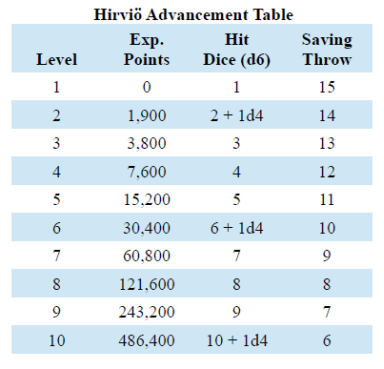
With the ascendancy of the Via Lucis to political and theological supremacy, the Emperors began to enforce a more rigid orthodoxy. Those people judged heretical, schismatic, or pagan often faced serious social and economic penalties. Rather than convert or endure these penalties, many groups chose to leave imperial lands, establishing outlaw communities in wild places. But the price of their freedom is often high, especially for those who cross the Renos and Danuvius rivers into the Recondite Frontier. Strange machines and eldritch dangers haunt that vast forest now growing where the cities of the Sortarii once stood, built around the blood-stained ziggurats of those wicked sorcerers. Rarely, living in cursed places has cruel effects on newborns who come into the world as Hirviöes. Deformed, of prodigious size and strength, often disabled both mentally and morally, few Hirviöes survive to adulthood. Those that do most often turn to lives of violence and crime, outcasts unwelcome and feared by most.

Hirviö Class Abilities

Attribute Scores: When creating a Hirviö, do not roll attribute scores as normal. Instead, roll 1d6 for both Strength and Constitution, and record the following results: 1 = 13, 2 = 14, 3-4 = 15, 5 = 17, 6 = 18. Roll 3d4 and total the results to determine Intelligence, Wisdom, Dexterity, and Charisma.

Great Size, Great Strength: The average Hirviö stands a bit more than 7 feet tall and tips the scales at about 25 stone. A Hirviö’s bulk and might enable him to perform enormous feats of strength, each of which is described hereafter.

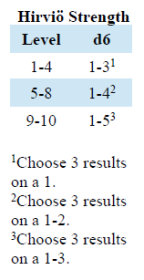
When a Hirviö uses brute strength against an inanimate obstacle, roll 1d6. The chance of success is shown on the adjacent table. If successful, the player chooses two or three consequences from the following list. Consequences not chosen indicate results that were not avoided.

* The attempt doesn’t take a very long time.
* Nothing of value is damaged.
* The attempt doesn’t make an inordinate amount of noise.
* The inanimate obstacle can be fixed again without a lot of effort.

In melee combat, if a Hirviö scores maximum damage against a foe, some additional physical consequence results from the powerful attack. Possibilities include events such as sundering the foe’s shield, breaking the foe’s weapon, or forcing the foe into a disadvantageous position.

Finally, a Hirviö may move and brace himself so that his armor or shield takes the brunt of an attack. Reduce damage by half and roll 1d6. If the die result equals or exceeds the amount of protection provided by the armor or shield, the armor or shield is damaged. Reduce its effect on Armor Class by 1 point, which makes the armor or shield more suspectible to harm should this ability be used again. If the effect on Armor Class is reduced to 0, the armor or shield is ruined. Nota Bene: In most cases, a shield is destroyed by a single use of this ability.

Saving Throws: Hirviöes possess enormous strength and vitality, gaining a +2 bonus to saving throws against disease and poison.

Weapon and Armor Restrictions: Hirviöes may wear any kind of armor and may use shields; however, their armor and shields must be specially made for their great size. Hirviöes may use any weapons. They are large and strong enough to use two-handed melee weapons with only one hand, although they suffer a -2 penalty to attack rolls when doing so. Hirviöes resolve their attacks using the same table as Fighters.

December 10th, 2016  in RPG No Comments »

Mnorh’s Chosen: The Halflings

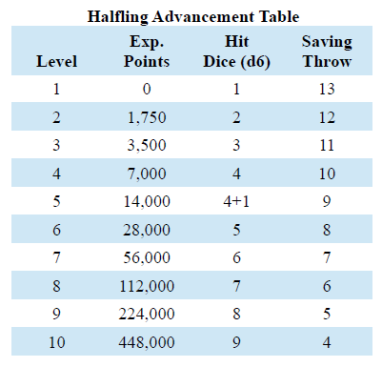
The Halflings, so-called because they resemble humans in most ways except for height and toughness of foot, are not a numerous race, but they have an ancient pedigree. Indeed, the Halflings claim they were the first race created by the true god, whom they call Mnorh, which means “Illumination” in Trgovija, the trade tongue. Halfling scholars disagree on whether Mnorh created the other races, or whether Mnorh created the gods who created the other races, but either way the message remains the same: Mnorh is supreme. Most Halflings live semi-nomadic lives, establishing temporary settlements in fertile lands to graze their sheep and farm for a season before moving on. They are prolific traders, and those Halflings that reside in towns almost always seem to be engaged in business of some sort. Scrupulous and industrious, Halflings would be more trusted and liked if not for their religious beliefs, which many peoples view as insulting, even dangerous. Spates of terrible violence aimed at Halflings punctuate their history, and Halflings have developed a strong warrior tradition in response to the not infrequent threats to their way of life.

Halfling Class Abilities

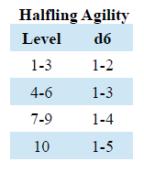
Accuracy and Agility: Halflings receive a +2 attack bonus when firing missile weapons in combat. Halfling have special skill in fighting giants, ogres, and similar giant-type creatures such as trolls. Against Halflings, such monsters only inflict half the normal damage. Halflings possess natural agility and grace. They move quietly, climb and hide well, and perform acrobatic feats. The chances to do so are shown on the adjacent table. Of course, a Halfling may not be able to perform such feats wearing certain types of armor or if carrying too much weight.

Establish Fort: At tenth level, a Halfling who chooses to build a fort may attract a body of loyal followers who swear fealty to the character.

Experience Bonus for Dexterity: Dexterity is the Prime Attribute for Halflings, which means a Halfling with Dexterity of 15 or higher receives an additional 5% experience.

Saving Throws: Halflings possess great resolve and courage, gaining a +2 bonus to saving throws against fear.

Weapon and Armor Restrictions: Halflings may wear any kind of armor and may use shields; however, their armor and shields must be specially made for their small size. Halflings may use any small-sized weapons (such as a dagger, short sword, or short bow). Halflings may not use two-handed swords, longbows, battle axes, pole arms, or other large weapons. Halflings resolve their attacks using the same table as Fighters.

December 9th, 2016  in RPG No Comments »

Gnomes, Shadows, and Stealth

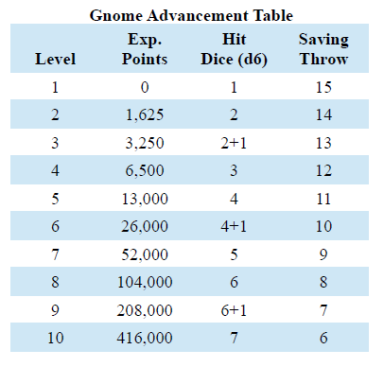
The Gnomes, seldom seen above ground during the day, dwell mostly deep within the earth, within caverns and tunnels carved by forces both natural and unnatural. In their subterranean world, lit only by magic, fire, or the caps of giant phosphorescent mushrooms, Gnomes live in small communities most often ruled by jarl, a chief chosen from among the families of the tribe. War-like and territorial, Gnomes guard their cavern-halls against the predations of monsters, especially the cruel and cowardly kobolds. Segojan Earthcaller sang the first Gnomes into existence, shaping clay and into living creatures by the power of his voice. Segojan’s brother Baravar Cloakshadow taught the Gnomes the arts of illusion and stealth, and Gaerdal Ironhand taught them the arts of war. Gnomes are a secretive race who often have flexible notions about the importance of honesty, especially when dealing with those who are not Gnomes.

Gnome Class Abilities

Establish Cavern Hall: At tenth level, a Gnome who chooses to build and dedicate a cavern hall to his clan may attract a body of loyal followers who swear fealty to the character.

Experience Bonus for Intelligence: Intelligence is the Prime Attribute for Gnome, which means a Gnome with Intelligence of 15 or higher receives an additional 5% experience.

Infravision: Gnomes have infravision in addition to normal sight and can see 60′ in the dark. Infravision is the ability to see heat (and the lack of heat). Normal and magical light makes infravision useless.

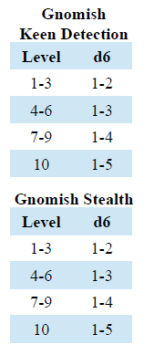
Keen Detection: Gnomes are good at spotting unsafe cave features, slanting passages, depth underground, and direction underground. See adjacent table for the chance of success.

Saving Throws: Gnomes are preternaturally alert. They gain a +2 bonus on saving throws versus illusions and traps. Also, when surprised, a Gnome may attempt a saving throw. If successful, he isn’t surprised after all.

Shadows and Stealth: Gnomes possess natural stealth and an affinity for illusion magic. Once per day, a Gnome may use either Invisibility or Phantasmal Force, both of which duplicate the spells of the same name except that the duration is one round per level of the Gnome. Gnomes can move silently, avoid detection, and climb walls free-handed in much the same manner as a Thief. The Gnome’s chances of doing so are shown on the adjacent table.

Speak with Animals: Gnomes can speak with burrowing animals within 30 feet. This ability is similar to the spell Speak with Animals.

Weapon and Armor Restrictions: Gnomes have no restrictions on weapons, but their small stature makes heavy and two-handed weapons problematic. Thus, Gnomes may use one-handed weapons without restriction, but the Referee may adjudicate the permissibility of other weapons as necessary. Gnomes may wear only leather armor. Gnomes resolves attacks using the same table as Clerics.

December 9th, 2016  in RPG No Comments »

The Duality of the Elves

Centuries ago, Elves ruled the world through sorcerous might and military power. Now, the Elven hegemony exists largely in history books. The only Elven city that still exists as a functioning political body is ancient Aachen. The rest of former Elven possessions and vassals have either been overtaken by wilderness or else exist today long free of Elven overlords. The Elves were created by Corellon Larethian and Sehanine Moobow, the Elven deities of the sun and moon, of life and death. Sehanine fashioned the Elven body while Corellon infused the spark of life. The duality of their creators affects the very core of Elven existence for every Elf is both male and female, changing sex with the passing of the hours. Most Elves are amoral. Their actions are determined by tradition and by the search for pleasure and new sensations. Elven sophisticates take pride their love of cruelty and pleasure. Their self-centered ways are held in check by rigid adherence to tradition. Elaborate rituals dedicated to the sun and the moon dominate Elven society, and few Elves have the courage to ignore these rites.

Elven Class Abilities

Duality: All Elves are both male and female, both martial (makar) and magical (istar). At 1st level, the player must decide which sex corresponds with which adjective. Thus, an Elf can be magical male and martial female, or vice versa. At moonrise each day, an Elf’s sex changes. An Elf can attempt to resist this change by making a saving throw. When an Elf changes form, the Elf recovers 1d6+1 lost hit points.

Establish Stronghold: At tenth level, an Elf who chooses to build a stronghold may attract a body of loyal followers who swear fealty to the character.

Experience Bonus for Strength and Intelligence: Strength and Intelligence are the Prime Attributes for Elves. An Elf with a Strength of 15 or higher receives a 2.5% bonus to experience. An Elf with a 15 or higher in Intelligence receives an additional 2.5% experience. These bonuses are cumulative for an Elf with 15+ in both attributes.

Keen Detection: Elves are good at spotting hidden and concealed doors (1-4 on a d6 when searching or 1-2 on a d6 if just passing by).

Saving Throws: An Elf receives a +2 bonus on saving throws against the special attacks of the undead.

Weapon and Armor Restrictions: An Elf in either form can wear any armor up to and including chain mail. The Elf cannot use two-handed weapons or shields while casting spells.

Elven Istar Abilities

Combat: In istar form, an Elf resolves attack rolls using the same table as Magic-Users, but enjoys a +1 bonus to-hit with any type of bow or one-handed sword.

Saving Throws: An Elf in istar form receives a +2 bonus on saving throws against charm and sleep.

Spellcasting: Like the Magic-User, an Elf owns a book of spells, which does not necessarily include all of the spells on the standard lists. Reading from this book, the Elf presses select spell formulae into the mind, thus “preparing” those spells to be cast. Once a prepared spell is cast, the spell formulae disappears from the Elf’s mind, and must be prepared again before another attempt can be made to cast it. However, it is possible to prepare a spell multiple times using the available “slots” in the Elf’s memory. If the Elf finds spell scrolls during an adventure, those can be copied into the spellbook.

Elven Makar Abilities

Combat: In makar form, an Elf resolves attack rolls using the same table as Clerics, but enjoys a +1 bonus to-hit with any type of bow or one-handed sword.

Saving Throws: An Elf in makar form receives a +2 bonus on saving throws against charm and fear.

December 8th, 2016  in RPG No Comments »