Archive for the ‘ RPG ’ Category

The Drukkin

Whew!

I started back up as a full-time teacher this month. I’m at a Catholic boys school about eight minutes from the house. So far, I’m enjoying the new gig. It’s certainly a huge improvement over my last full-time teaching position.

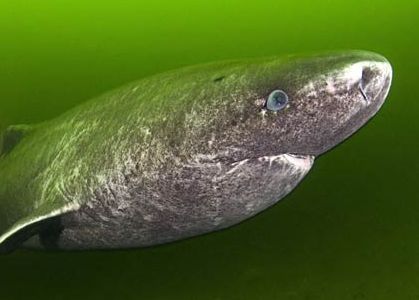
Anyway, on 7 August, Terry, a friend and fellow gamer, suggested I stat up the Greenland shark as a monster. I did a bit of reading about Greenland sharks. They are one more confirmation that nature hates us and will eat us given the chance. Seriously scary animal. Don’t let its goofy smile fool you. It’s hungry, and you’re lunch.

And so, here’s my take on the Greenland shark as a amphibious horror for use with Savage Worlds Deluxe Explorer’s Edition. (N.B. That’s an affiliate link also.)

Drukkin

We saw the blunt dorsal fin break the surface a dozen or so yards from the edge of the ice shelf. The seals must have seen it too. Those in the water flopped up onto the ice, and all of them moved away from the edge. None of could identify the shark, and we became a bit excited at the thought of stumbling onto a new species.

“Um, it’s picking up speed,” Roberts said.

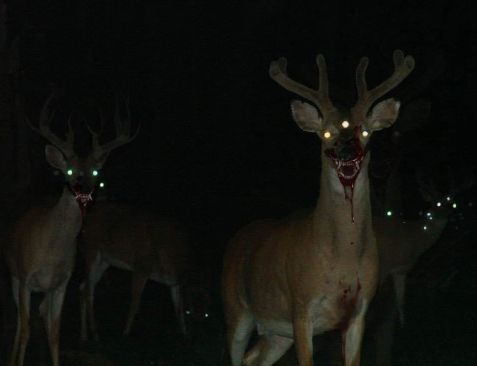
He was right. The shark surged through the water, straight toward the ice shelf’s edge. Just as it was about to hit, rather than veering or diving, it burst from the water, it’s eyes flashing with an unearthly green light. Before it hit the ice, its pectoral fins changed, lengthened, became segmented. Monstrous three-toed paws with yard-long talons burst from the end of each limb.

“Run!”

We ran, desperately trying to avoid the panicked seals as well as escape the horrid fish. When I heard Roberts’s scream end abruptly, I knew it was gaining on us….

Attributes: Agility d8, Smarts d4 (A), Spirit d8, Strength d12+4, Vigor d12
Skills: Fighting d10, Notice d12, Shooting d8, Swimming d10
Pace: 8; Parry: 7; Toughness 12

Special Abilities
Aquatic: Pace 10.
Bite: STR+d6.
Eye Bolts: Range: 30/60/120. Damage: 1-3d6, based on range. Rate of Fire: 1 or 2. The drukkin can fire bolts of burning energy from its eyes. After using its eye bolts, the drukkin is -2 on Notice checks until the end of its next turn.
Fear: -2. The drukkin inspires fear when it attacks or transforms.
Hardy: The drukkin does not suffer a wound from being Shaken twice.
Large: Attackers add +2 to their attack rolls when attacking the drukkin due to its large size.
Size: +4. The drukkin can grow up to 25 feet in length.
Transformation: As an action, the drukkin can transform so that it can function on land or revert back to its aquatic form.

August 28th, 2019  in RPG No Comments »

Shaolin Beaver Returns

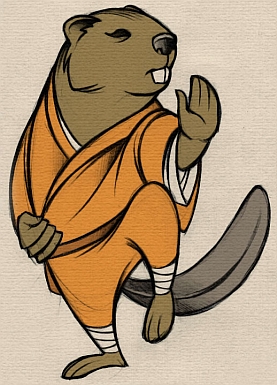
A bit more than six years ago, I presented Shaolin Beaver, illustrated by the phenomenal Darren Calvert, as a hero for the second edition of Mutants & Masterminds. You check him out at this link. Here’s the short version: Edward is a humanoid beaver with remarkable kung fu skills. He’s not sure if he’s the last of his people, and so he travels the land, doing good deeds and searching for others of his kind, all the while trying to avoid the xenocollectors.

Here’s Shaolin Beaver for M&M‘s third edition. (Nota Bene: That’s an affiliate link.)

Shaolin Beaver
Strength 1, Stamina 3, Agility 5, Dexterity 5, Fighting 11, Intellect 0, Awareness 5, Presence 0

Powers

Humanoid Beaver
Shrinking 4 (Extras: Continuous, Innate; Flaw: Permanent) [Cost: 2/rank, 9 points]
Speed 1 (Array, 4 MPH) [Cost: 1/rank, 3 points]; Swimming 3 (Alternate Effect; 4 MPH) [Cost: 1 point]

Shaolin Strike
Strength-Based Damage 4 [Cost: 1/rank, 4 points]

Advantages: Agile Feint, Contacts, Defensive Attack, Defensive Roll 4, Evasion 2, Favored Environment (Aquatic), Improved Critical (Unarmed), Improved Initiative, Languages (English and Mandarin), Power Attack, Set-Up, Skill Mastery (Acrobatics), Takedown 2, Uncanny Dodge, Well-Informed

Skills: Acrobatics 10 (+15), Athletics 9 (+10), Close Combat: Unarmed 4 (+15), Expertise: Philosophy 5 (+5), Insight 5 (+10), Perception 10 (+15), Treatment 5 (+5), Stealth 6 (+15)

Offense
Initiative: +9
Unarmed +15 (Close, Damage 5, Crit 19-20)

Defense
Dodge 13
Parry 13
Fortitude 10
Toughness 7 (3 without Defensive Roll)
Will 10

Power Point Totals: Abilities 68 + Powers 17 + Advantages 20 + Skills 27 + Defenses 18 = 150

August 26th, 2019  in RPG No Comments »

Mulling About TSR’s MSH

Back in the day, one of our favorite games was TSR’s Marvel Super Heroes. It was a simple, flexible system that handled heroes and villains of various power levels, from street-level crime fighters like Moon Knight to galactic defenders like Silver Surfer. TSR published several adventures for use the game. Almost all of them were pretty sparse if not closer to horrible, but they featured a variety of comic book characters. Part of the fun of the game was collecting the stats for published characters.

In our games, we never ran published heroes. Instead, we made up our own heroes, who the GM-of-the-Week pitted against a combination of original characters along side Marvel’s plethora of supers. In one fight atop a Manhattan skyscraper, my character, tired of Captain America’s moralizing, grabbed the Star-Spangled Avenger and tossed him off the roof. Another character went to toe to toe with the Rhino in a bare-knuckle brawl that ended in a draw.

And it’s that last point that leads to what I think is the one big flaw in the system. A hero with an Excellent (20) Strength does 20 points of damage with a punch. It’s simple. No dice roll required. Did you hit? 20 points of damage. You might get a Slam or Stun result, but you might not, especially if your foe has too much Body Armor.

Which was the problem in the fight with the Rhino. My character (an early version of the Mighty Jethro) was a nigh invulnerable cello player. He was kind of strong and sort of handy in a fist fight, but he wasn’t superhuman in either regard. Jethro squared off against the Rhino. Jethro couldn’t hit hard enough to hurt Rhino, and Rhino couldn’t hit hard enough to hurt Jethro. There were some clever moves (such as impaling a fire extinguisher on Rhino’s horn to temporarily blind him), and Rhino knocked Jethro through more than one wall, but, when all was said and done, neither character had inflicted a single point of damage on the other.

To an extant, this fits the genre. In a fist fight, no matter how hard he tries, Daredevil isn’t going to put a scratch on the likes of, say, Annihilus. Some villains are just too tough for some heroes to face head-on. That’s why the Avengers have relative light-weights like Black Widow fighting shoulder-to-shoulder with folks like Thor and Iron Man. Those two deal with the major threats, leaving Black Widow free to mop the floor with mooks and put her espionage skills into play.

In MSH, a d100 roll determines success or failure. The higher the number the better. I’ve been mulling over a way to add some variety to MSH’s static damage (and defense) values without adding more dice or dice rolls to the game. Here’s my initial idea:

Roll the d100. Determine success. Subtract the one’s digit from the ten’s digit. The difference modifies the acting character’s static value.

For example, the Mighty Jethro has an Excellent (20) Strength. He swings and hits with an 84. 8 – 4 = 4, and so Jethro’s punch does 24 points of damage. He throws another punch, and gets a 59. Still a hit, let’s say, but 5 – 9 = -4, and so his punch does 16 points of damage. Then, on the third round, he really connects with a 100. 10 – 0 = 10, and his punch does 30 points of damage.

I think this is a pretty solid idea. I’m also toying with the idea that the color result on the FEAT table would further modify the value. A white would still be a failure. A green would be no modifier, whereas yellow would equal +X and red would equal +X+Y. I’m not sure what X and Y would equal. Probably +5 and +10, respectively, just to keep the math a bit easier to mentally calculate.

Thus, with that 100 dice roll, Jethro would score a red result with his punch, adding 20 points to his Strength damage. For that one punch, he’d hit as hard as Spider-Man does with an average result.

August 23rd, 2019  in RPG No Comments »

Meet Double-Header

Thanks to the generosity of a friend, I got me a copy of the Mutants & Masterminds Deluxe Hero’s Handbook by Green Ronin Publishing, LLC. (Nota Bene: That’s an affiliate link.) It’s a lovely book. Great art throughout, easy-to-read double-column format, et cetera. It’s got some neat stuff, including a spiffy Quickstart Character Generation section, which I’ve used to help me figure out hero creation. The MMDHH is the third edition of Mutants & Masterminds, and it bills itself as “The World’s Greatest Superhero RPG!” It’s not, but it’s still a solid system that I’d love to play, but probably less-than-love to GM.

The first and second editions of Mutants & Masterminds are both too fiddly and too slow (in my opinion) to be a really enjoyable superhero RPG from a GM’s perspective. Those editions aren’t as fiddly and slow as Champions, but few games I’ve played over the past four decades can match Champions in slow fiddliness.

The third edition Mutants & Masterminds resembles the first two editions in big ways at first glance. It’s still sort of a d20 System game, but it deviates from that system enough that it’s closer to its own system than not. It feels like gameplay would be faster than the earlier editions, but only once the differences are learned. I’ve only run a short trial combat with one player to try to get a feel for the new edition. We both had plenty of questions about how to do this, that, or the other thing. Thus, our brief playtest had numerous interruptions, but, like I said, that’s more due to the newness of the edition as compared to what we’re accustomed to with Mutants & Masterminds.

One thing that’s still the same is how much I enjoy making up heroes using the system, and I do think the third edition improves on the earlier ones in this regard. There’s still more math and accounting than I’d normally want to bother with to make up a character, but it’s math and accounting that’s kind of enjoyable. It’s fun to come up with a character concept, to take 150 points, and then to figure out how to turn those 150 points into that character. This is, I think, the strongest feature of the system in any edition, especially when I consider the system as a GM.

I am not a fan of having to crunch numbers in order to come up with adversaries and what not for a group of players. That sort of ciphering is the major factor that turned me off on GMing Pathfinder. It’s too much like work, and, for me, the simplicity of an AD&D stat block wins the day against the complexity of a Pathfinder stat block. I’m also not a fan of systems in which adversaries are built using the same rules used for player characters.

But, because I enjoy making up Mutants & Masterminds characters, that sort of number-crunching doesn’t bother me with Green Ronin’s superhero game. Taking a villain from concept to finished product with Mutants & Masterminds both amuses and relaxes in ways that creating a level-appropriate NPC in Pathfinder ceased doing months before I retired from that game system.

I want to play the new Mutants & Masterminds. If that happens, it probably means I’ll end up having to GM the game. My gaming group’s track record with superhero games is spotty at best. The most success we had was with the excellent Marvel Heroic Roleplaying. That campaign went on for a good while (and then we lost half the players). Our two or three attempts at superhero campaigns using earlier editions of Mutants & Masterminds and even my own Four Color Hack all fizzled out pretty quick.

But I digress.

The main point of this point is show off that great picture of Double-Header. The artist is Chris Schweizer, who graciously agreed to let me use the piece for this post. This sentence is a link to Mr. Schweizer’s Patreon site. This sentence links to an article about Mr. Schweizer with links to places related to his work.

Double-Header stands out in the category of wannabe superheroes. He had the will but not the ability. Among Double-Header’s liabilities? In addition to his complete lack of superpowers or noteworthy skills, Double-Header was a member of an alien race who “twin” as they mature, eventually separating into two adults. Double-Header isn’t a guy with two heads. He’s two guys sharing a body until such a time as they reach a level of maturity resulting in separation. Among Double-Header’s people, twins love and help each other. Not in Double-Header’s case. They couldn’t stand each other.

My version of Double-Header can function as a superhero. They’ve got powers and abilities suitable for the gig. While they’re not terribly fond of each other all the time, they do get along well enough to function as a team. Also, my version isn’t an alien. They’re human mutants, super-powered conjoined twins.

If you click on the pic of Double-Header, it opens up a PDF of their character sheet.

August 18th, 2019  in RPG No Comments »

Savage Wednesday: Star Frontiers Races

Today, I take a break from converting creatures found in the AD&D Monster Manual. Instead, I look within the pages of TSR’s Star Frontiers. (N.B. Those are affiliate links.) I’ve drawn inspiration from Star Frontiers once before, retooling the rasties for use with 5E D&D. You can check that post out here. As usual for Savage Wednesday, I’m using Savage Worlds Deluxe Explorer’s Edition. (N.B. That’s an affiliate link also.)

Dralasite

Dralasites are short, rubbery aliens that have no bones or hard body parts. Their skin is a flexible membrane that is very tough and scratchy. It is generally dull gray and lined with dark veins that meet at the Dralasite’s two eyespots.

The internal structure of a Dralasite is very different from the other races. The Dralasite’s central nerve bundle (brain), numerous small hearts and other organs float in a pudding-like mixture of protein and organic fluids. Dralasites breathe by absorbing oxygen directly through their skin, so they have no lungs. They are omnivores, but eat by surrounding their food and absorbing it, so they have also have no digestive tract or intestines.

All Dralasites go through male, female and neutral stages during their lives (these phases can be controlled with medicines). Males release spores into the air, which drift until they become attached to a female. A young Dralasite then “sprouts” from its mother, eventually maturing and dropping off.

Elasticity. A Dralasite’s skin is stretchable and supported by a complex muscle structure. A Dralasite can change the shape of its body, growing arms and legs to use for walking and handling tools or weapons. The Dralasite reabsorbs limbs when they aren’t needed. A Dralasite can have a number of limbs equal to 1 plus half Agility. Growing or absorbing a limb takes five minutes. Only one limb can be grown or absorbed at a time. A limb can be up to 1 yard long. Regardless of the number of limbs, a Dralasite with more than two arms is limited to one extra non-movement action that incurs no multi-action penalty.

Hard to Kill. A Dralasite’s lack of internal organs and bones lets a Dralasite ignore wound modifiers when forced to make a Vigor roll due to Incapacitation.

Keen Olfactory Senses. Since a Dralasite breathes directly through its skin, that entire membrane is an olfactory sensory organ. A Dralasite gets a +2 to Notice when using its sense of smell or taste.

Lie Detection. A Dralasite has an innate sensitivity to spoken falsehoods. A Dralasite gets a +2 to Notice when to see if other characters are lying.

Slower. A Dralasite has a Pace of 5.


Vrusk

Vrusk look like large insects. Eight legs grow from their abdomen, four on each side. Their torso is upright in front of the abdomen. The torso is humanoid, with two arms connected at the shoulders. The head is above the shoulders. Vrusk hands are circular pads with five fingers spaced evenly around the edge. A Vrusk’s shoulders are double-jointed, so they can rotate their arms in a full circle without straining any muscles. They can reach any point on their abdomen or behind the backs easily.

A Vrusk’s body is covered by a carapace (hard shell). This shell is jointed at the Vrusk’s elbows, hips, knees, etc. The carapace protects the Vrusk from bruises, cuts, scratches and other minor injuries. Unlike insects, Vrusk have an internal skeleton to support their bodies. Young Vrusk have a blue carapace with bright orange near the joints. As the Vrusk gets older, its carapace changes to dull green with yellow joints.

Vrusk have large eyes that are protected by a hard, clear covering. The mouth is surrounded by four eating mandibles. The two larger mandibles hold food while the small ones tear it apart and place it in the mouth. They are omnivores. Vrusk have lungs, and breathe through many small nostrils under the abdomens. This arrangement makes it difficult from Vrusk to swim.

Ambidexterous. A Vrusk can use both hands equally well and does not suffer the normal -2 penalty when performing physical tasks with the off-hand.

Carapace. A Vrusk’s carapace provides +2 Armor. Armor-piercing weapons may negate this protection.

Comprehension. Vrusk society is a complicated maze of mercantile and family structures. A Vrusk is adept at navigating social situations. A Vrusk has a free d6 in Persuasion or Streetwise (player’s choice).

Scuttle Quickly. A Vrusk has a Pace of 10.

Trouble Swimming.. A Vrusk has a -2 penalty to Swimming rolls.


Yazirian

Yazirians are tall, thin humanoids. They have long arms and legs and slender torsos. Two large flaps of skin grow on either side of their bodies, attached along their arms, torso and legs. When a Yazirian raises its arms, this membrane is stretched tight and forms a sort of wing.

Yazirians have muzzles and high foreheads, giving them an animal-like appearance. Their heads are surrounded by manes and collars of hair, which varies in color from glossy black to pale yellow. Their skin color ranges from gray to light tan. Because their bodies do no sweat, Yazirians pant to keep cool. They are omnivores.

Yazirians have four knuckles (one more than Humans) on their fingers and toes. The inside toe is opposed like a thumb, allowing them to grasp things with their feet. The tips of their fingers and toes end in broad, ribbed pads, giving them excellent grip. These characteristics, combined with their animal-like appearance, earned them the nickname “monkeys.”

Agile. A Yazirian starts with a d6 in Agility.

Battle Rage. A Yazirian may become enraged in combat. This ability is equivalent to the Berserk Edge.

Excellent Climber. A Yazirian has a free d6 in Climbing.

Gliding. Yazirians can glide short distances using the membranes along their sides. To do so, a Yazirian must start at least 5″ (10 yards) above the ground. A Yazirian glides up to 1″ (2 yards) for every inch of altitude at the start the start of the glide. Glide speed equals Pace.

Low-Light Vision. Yazirians are nocturnal. A Yazirian can see in all but pitch black conditions and ignores penalties for Dim and Dark lighting. A Yazirians eyes are sensitive to light. Without protective goggles, a Yazirian has a -2 penalty to attack rolls and cannot see targets farther away than 10″ when lighting is not Dim or Dark.

July 31st, 2019  in RPG No Comments »