Archive for the ‘ RPG ’ Category

D Is for Death Knight

Ah, memories! How fondly I recall my acquisition of 1E’s Fiend Folio and my amazement at the assortment of bizarre creatures therein. From the sticky adherer to the preposterous flumph to science-fictiony yellow musk zombie, there was so much in that slim volume that just screamed, “Use us! Use us!”

And use them I did. One monster that still makes me smile while I imagine the charred remains of adventurers is the death knight. What a nasty piece of work it was! AC 0, 75% magic resistance with an 11% chance of spell reflection, immunity to turning, 18/00 Strength, at will wall of ice, demon gating, power word spells, and that awesome 20-dice fireball, and that’s not everything. The death knight was an end boss monster back before computer games had made such terminology common in RPGs. If your 1E PC ran across one of these baddies and lived to tell the tale, you knew you’d accomplished a legend-worthy deed.
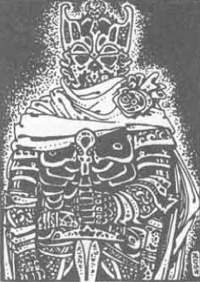
Surely an assortment of evil creatures would love to follow such an exquisitely deadly monster. Put the death knight at the top of a wicked pyramid, served by oodles of aspiring lackeys eager to prove just how evil they too can be. And, just to add some concreteness to this nasty army’s modus operandi, consider using this unholy code of anti-chivalry I once wrote up for some Mutants & Masterminds villains:

1. Thou shalt believe the opposite of all that the Church teaches, and shalt openly defy all its directions.
2. Thou shalt seek to harm the Church and its defenders.
3. Thou shalt hate all weakness and shalt constitute thyself the oppressor of them.
4. Thou shalt hate the country in which thou wast born.
5. Thou shalt use base cunning and deceit against thine enemies.
6. Thou shalt make war against law enforcers without cessation and without mercy.
7. Thou shalt perform all of thy duties without regard for laws of both God and man.
8. Thy pledged word shalt mean nothing.
9. Thou shalt be greedy and covetous, and shalt give no one largess.
10. Thou shalt be everywhere and always the champion of injustice and evil against the right and the good.

Just substitute references to the Church and God with whatever lawful good power structure and deity best suits your campaign, and let the holy war against the powers of darkness begin. After all, those that uphold this code of conduct deserve some serious smiting.
April 4th, 2012  in RPG No Comments »

C Is for Carrot

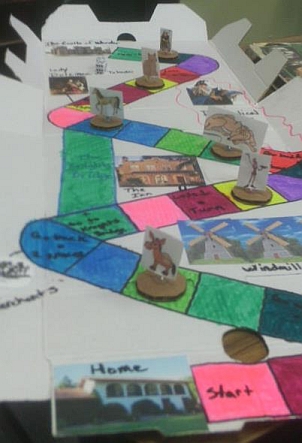
How many ways are their to motivate players? Well, if we’re to believe cliches, there are two: the carrot and the stick. Since today is C, I’m going to talk about the carrot. I know from years of teaching that a great way to get students invested in learning is to give them choices about how they want to show what they’ve learned. So, when we got done reading Don Quixote, my students didn’t have a single, mandatory assignment, but instead had their choice of one out of five or six different assignments. One of my students produced the delightful boardgame shown in the picture to the right as her project.

Borrowing an idea from Gnome Stew, you the GM can give your players choices in order to foster a greater sense of investment in your game. Give each player four index cards and about a week’s time. Ask them to write on each index card their ideas about what they’d like to encounter in the current campaign, dividing those likes into four categories: Enemy, Friend, Setting, and Reward. Let them be as vague or as specific as they’d like, as long as the idea fits on an index card. Let your players know that the ideas on the cards don’t need to be related to each other, although they could be. The cards also don’t need to be related to the player’s own character. Why suggest a reward for your character when you can suggest that a fellow player’s character receive the honor of an Amazonian queen asking for his hand in marriage?

Enemy: This could be something as simple as scrawling “ogres” on the card, or as involved as requesting the existence of a nefarious organization of wicked psions who masquerade as benevolent seekers of enlightenment. These cards are your players’ chance to get some of their favorite bad guys into game play, an option that could be especially attractive to folks who play rangers.

Friend: The PCs need more than just enemies. They should also have an assortment of friends, allies, and supporters, garnered during their adventures as well as part of their respective backgrounds. These friends can be valuable sources of aid and information, as well fodder for plot hooks.

Setting: A memorable setting can be a great boon for an encounter, an adventure, and even an entire campaign. Odds are good your players have always wanted to explore or survive some exotic place. I know I’ve always wanted to play through a high-action brawl atop a maze of unstable catwalks that collapse above a rumbling pool of magma.

Reward: Here’s your players’ chance to think outside the treasure box if they want. Forget yet another magic sword or a bag full of platinum. How about a grant of land accompanied by knighthood? Maybe free room and board for life at a famous tavern would be something worth having? A PC could somehow earn a reward that would otherwise be difficult to provide via the rules-as-written. I remember way back in 1E days when my dwarf fighter/thief acquired the ability to speak with wolves. Why? Because it was cool!

Best of all, encourage the players to not discuss their cards with each other. That way, as each requested element is brought into play, most of the players will be surprised by the turn of events. Imagine the limitless possibilities:

Terry: “The Amazon queen asked me what?”

Mark the GM: “For your hand in marriage before the assembled court of the Warrior Women. An expectant hush has fallen across the entire banquet hall. What do you do?”

Terry: “Wes, why are you giggling? Was this your idea?”

April 3rd, 2012  in RPG 2 Comments »

B Is for Boring

It’s time for your weekly game. You’re ready to sit down and roleplay for the next six to eight hours. You’re in character. Your fellow players are in character. The scenario is interesting, engaging, and then combat starts. Three hours later, you’re on round six, and there’s no end in sight. You start to consider having your character commit suicide.

Now, don’t get me wrong. There’s nothing wrong with a long, complicated combat unless that combat gets boring. The problem isn’t the combat’s length per se, but instead comes when every round is the same thing: waiting for five to ten minutes for each other player to get finished with his turn so you can have yours, and that’s not counting the minutes that drag by while the GM figures out what the various enemies are going to do.

It’s also not just combats that can cause the game to grind. Don’t you just enjoy those long, meta-gamey discussions about the absolute best tactics to use prior to a fight? Yeah, me neither. And how about those lengthy in-character discussions between the GM and one or two other players while the rest of you sit and twiddle your thumbs? I’ve never found that particularly enjoyable either.

What’s even more frustrating is that these bouts of boredom can happen even in the best prepared games with the most experienced, dedicated players.

Do Something! Chips

At the start of each game session, give every player, including the GM, a do something! chip. This chip can be any suitable item, such as a poker chip, a game token, or a shiny penny. When a particular scene starts to get dull, toss your do something! chip onto the table (or into a special container, such as a boredom bowl). Clever, considerate players will note your displeasure and maybe take steps to ameliorate the situation. If other players are bored as well, they can toss in their do something! chips.

Boredom’s Critical Mass

If during any scene more than one-half of group’s do something! chips are tossed onto the table, then that scene has reached boredom’s critical mass. What happens next? Well, it’s time for some shared narrative control.

After all, surely you’ve not just been sitting their being bored. Surely you’ve been thinking of some way to make the scene more exciting. The player whose do something! chip triggers critical mass has the responsibility to offer a suggestion as to what could happen next in order to make the game more exciting. The entire group can then take a quick five minute break while the GM figures out how to best implement the suggestion as quickly as possible.

An Example

Wes, Christopher, Eric, Terry, and Mark, the GM, are playing Pathfinder. The PCs are trying to solve a puzzle that will open a magically locked portal leading deeper into the dungeon. Unfortunately, the players’ puzzle-solving skills are lacking this particular day, and the group has grown bored. Wes tosses his do something! chip, setting off a chain reaction. Eric and Terry toss their do something! chips also. Boredom’s critical mass is reached, and it’s up to Terry to offer a suggestion.

“Um, how about this? Uh, previously undiscovered secret doors linked to magical timers slide open, reacting to how long we’ve been in the puzzle room. Undead monsters attack. The undead monsters were the puzzle room’s original designers, sealed in the chamber to forever hide the puzzle’s solution. If we win, a grateful spirit can reveal the puzzle’s solution as a way of thanking us for releasing him from his horrid unlife.”

Players nod and grin. The GM fires up the search engine at d20pfsrd.com. A few minutes later, the PCs face down a gang of undead terrors.

April 2nd, 2012  in RPG 5 Comments »

A Is for Angels

Medieval scholastic philosophy posited that angels exist as purely intellectual beings. In other words, angels have no corporeal substance. This doesn’t mean that angels are ethereal or vaporous creatures. Rather, angels have no material form at all. This idea has several interesting consequences. Although angels are purely intellectual beings, they can assume material form. When doing so, however, these bodies are not alive. Angels do not experience sensory impressions the way material creatures do. They do not receive knowledge of the world around them from their senses, but instead receive knowledge immediately via the intellect unimpeded by physical limitations.

Thus, while embodied, angels are immune to any thing which requires a sensing, living body to be acted upon. Angels cannot be poisoned, do not require food or water or air, cannot be fooled by Stealth or tricked by illusions, do not feel physical pain or pleasure, et cetera. Angels always win opposed skill checks related to mental ability scores. You can’t Bluff or Intimidate an angel. Angels don’t have to make Perception checks; they always perceive via pure intellectual means unencumbered by the vagaries of physical senses. Since an angel’s temporary body is composed of reshaped matter, it can be damaged. Effects that can harm inanimate objects can harm angels, at least insofar as such effects may destroy the angel’s fake body.

When not embodied, angels are invisibile, completely immaterial, and are not physically limited in the way corporeal creatures are. Time and space, for example, are not barriers to an angel. Angels do not travel. They simply arrive and depart, sort of like an always active, unlimited greater teleport. When engaging in divination, angels are no more likely to err than the powers they serve. Also, they do not have to learn, since learning is a corporeal activity mediated through the senses over time. Angels simply know, immediately and fully.

Since, according to the medieval scholastics, not all angels are good, the same characteristics posited about angels also apply to demons and devils.

In game terms, adopting these medieval theories about angels can be handled largely as background data. The actual stats of the creatures need not be changed. Reactions that ought not occur (such as an intellectual creature failing a Sense Motive check) can be written off as some sort of trick, the result of hubris on the creature’s part, et cetera. Then, when the time is right, you can spring the full power of such a creature on the party, having laid the groundwork with suitable hints related to player character Knowledge checks and so forth. Imagine your players’ surprise and annoyance when they discover that the demon they’ve killed isn’t really destroyed, but instead has been shadowing them while immaterial, waiting for a chance to spring its trap.

April 1st, 2012  in RPG No Comments »

The True The Gouda The Beautiful

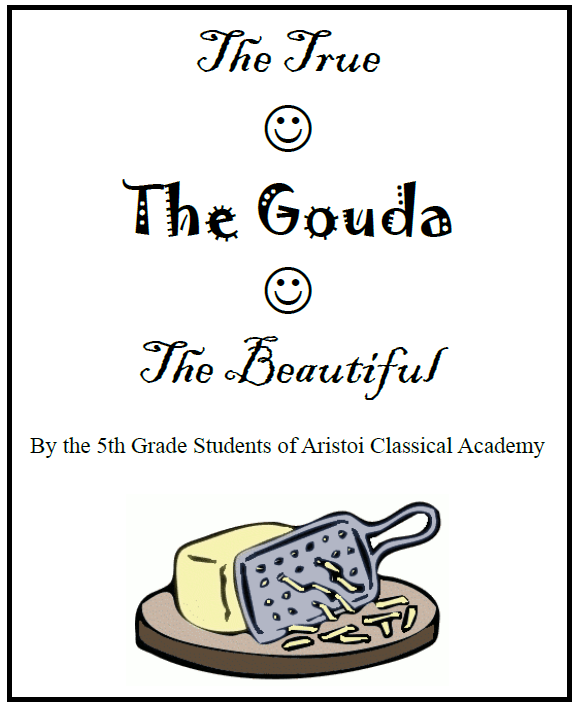
My students recently wrote haikus, tankas, limericks, and Elizabethan sonnets about cheese. The True The Gouda The Beautiful collects these 34 of these poems in a single volume of grade A, pasteurized poetic excellence.

Download your copy today!

March 26th, 2012  in RPG No Comments »