February’s Quid Novi? Excerpt
February’s Quid Novi? featured some more free content for Pathfinder. Here’re some excerpts, the first two having been written by Shane “Alzrius” O’Connor.
A New Oracle’s Curse
Clumsy: You are terribly uncoordinated, and tend to trip over your own feet. Whenever you take more than a 5-foot step, you must make a DC 10 Dexterity check or fall prone at the end of your movement; you may not take 10 on this check. The DC rises to 12 if you make a double move or withdraw action, or 15 if you run. You may stand up as a swift action that does not provoke an attack of opportunity. At 5th level, you ignore rough terrain. At 10th level, you gain evasion. At 15th level, you are under a permanent freedom of movement.
A New Feat
Hurl Weapon (Combat)
You can throw weapons very far.
Benefit: You can throw weapons up to ten range increments.
 About this feat, Shane wrote, “Pathfinder inherited the bow’s status as king of ranged weapons. While there are specialized builds that help make other distance-weapons usable, I was surprised that nothing had been done to let thrown weapon-wielders close the gap in terms of available range increments. I was initially going to set a Strength prerequisite on this feat, the pretext being that you needed to be strong to hurl a weapon so far. However, that seemed too punitive with regard to alchemists and other characters that are likely to have thrown weapons but not necessarily a high Strength. Given that thrown weapons have shorter range increments than projectile weapons, and how few ranged combats take place at more than five range increments anyway, it seemed like a good idea to give this feat the broadest availability possible.”
If you like Shane’s stuff (and who wouldn’t?), check out his great blog, Intelligence Check.
And now for some of what I wrote!
Bazaar of the Bizarre – You Look Mah-velous!
Froderick was an illusionist with a reputation for insanity that varied between whimsical to dangerous. This item is an example more on the former end of the spectrum. It appears to be a fabulously colored feathered boa of the type worn by certain exotic dancers. Its gaudy appearance hides potent magical powers.
Froderick’s Beauteous Feather Boa
Aura moderate transmutation; CL 8th
Slot shoulders; Price 7,800 gp; Weight 1 lb.
Description: This fashionable feather boa has two properties. When worn, it provides a +2 enhancement bonus to Charisma. Treat this as a temporary ability bonus for the first 24 hours the belt is worn. Upon command, the feather boa animates to fight as Medium animated object with the grab and constriction special attacks.
The feather boa can maintain its animated status for only 24 hours per week, but the duration need not be continuous. If the feather boa is broken or destroyed in its normal form, it is forever ruined. All magic is lost; its power departed. If slain in animated form, the feather boa simply reverts to an item of apparel that can be used again at a later time.
Construction Requirements: Craft Wondrous Item, animate objects, eagle’s splendor; Cost 3,900 gp.
If you want your very own copies of Quid Novi? via email, visit here and sign up.
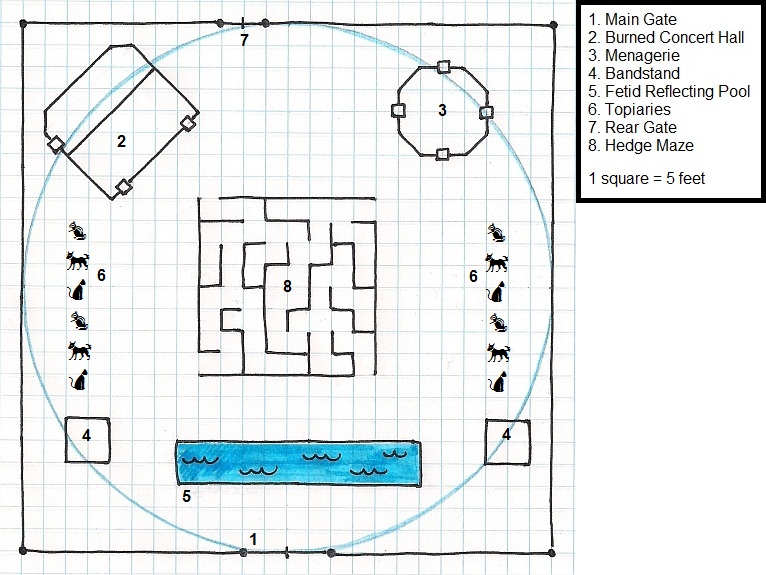 In its full splendor, the pleasure garden was a wonder to visit. Townsfolk once congregated there regularly to enjoy the various entertainments presented in the small concert hall or upon one of the several bandstands. The cleverly trimmed topiaries delighted children, and the centerpiece, a hedge maze, provided fleeting privacy for young lovers to steal a kiss or two. All of this was before the tragic fire in the concert hall that claimed the lives of several townsfolk. One of those killed was a gnome lass betrothed to an emotionally unstable illusionist. The couple had argued earlier that day. The lass went to the pleasure garden alone while her beau sulked at home. When he found out his love had died, the illusionist was inconsolable. He took his own life in the center of the hedge maze a couple of days later. His anguished spirit now jealously guards the decaying pleasure garden.
 After quite a slump in writing output, I’m back in stride. I’ve nearly completed the first draft of Dodeca Weather, a new PDF that harnesses d12 power to determine your campaign’s weather. A few finishing touches remain before the draft PDF gets emailed to my growing list of playtesters. Excellent!
 I love
