Archive for the ‘ RPG ’ Category

New Dawn Combine’s Last & Present Days

I had intended this for The Grand Original Map Contest, but I didn’t get it done in time. Ah well. Just because I missed a deadline doesn’t mean all of these electrons have to go to waste.

What Happened to the New Dawn Combine?

Two generations ago, the New Dawn Combine on Cygnus III thrived as a center for innovation in sector heavy weapons technologies. Lynley, the company town built around NDC labs and offices, provided workers, executives, researchers, and their families with every modern convenience. Life was good.

But nothing lasts forever.

A massive solar storm overwhelmed Cygnus’s magnetic field, disrupting electronics throughout Lynley. This was the time the Freedom Fellowship struck a blow for the proletariat. Mobs well armed but ill organized rampaged through the streets while the Fellowship’s elite assaulted key arsenals. The revolutionary violence climaxed when someone — to this day, historians debate whom to blame — launched a multiple independently targetable reentry vehicle armed with payload of chemical weaponry. Thousands died within minutes, and even more sickened and expired over the next few days. Much of Lynley burned as fires raged out of control as first responders were overwhelmed by the number of emergencies.

Planetary government moved in much too late. By the time military personnel and disaster management teams arrived, Lynley was a city fit only for the dead. Sporadic violence near the city limits lasted for a few more days, and then the government declared Lynley and the surrounding area in a 50-mile radius to be a quarantine zone (or QZ for short). No one and nothing is allowed in or out of the zone.

But life finds a way.

A handful of Freedom Fellowship radicals survived and declared the revolution a success. They consolidated control over limited food and potable water resources, and then put out the call to other survivors to enjoy the Fellowship’s largesse. Little by little, a semblance of normalcy returned to Lynley. A handful of buildings were reclaimed and turned into the communal areas with the Fellowship’s leaders determining individuals’ needs and commensurate allowances of living space, food, and water.

Little could be done, however, about the toxic effects of the chemical weaponry that had decimated Lynley. The ground was poisoned, and the water cycle became a means which toxins entered plants and animals. Fellowship workers documented the first evidence of mutations in water plants, fish, and amphibians. The high incidence of miscarriages and birth defects in the human population added a new level of dread to life in Lynley.

Today, the QZ is a wild area of twisted vegetation, mutated animals, and ruined buildings. Most of the vegetation is at least slightly toxic, and most of the mutated animals are merely grotesque. Some, however, are dangerous, especially the predatory chemical worms. The QZ’s easiest access points are protected by sensors, automated guns, and platoons of soldiers. Armed drones patrol more difficult areas. Entering the QZ without proper authorization is difficult. Getting back out after entering illegally is even harder, and failing exist undetected is likely to end in a violent death.

These risks don’t stop adventurous black marketeers from violating the QZ in hopes of finding hidden caches of weapons and other military-grade tech. The New Dawn Combine had numerous facilities prior to the revolution, and this included arsenals protected by underground bunkers. Illegal military tech isn’t easy to come by, and the profits can be substantial.
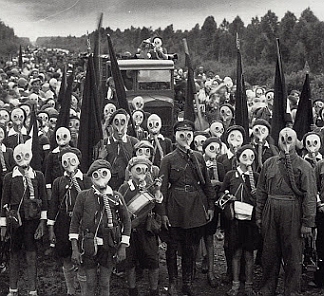
Of course, once in the QZ, there are more problems facing looters than the return trip. Trespassers must also contend with the Fellows, as the residents of the QZ now call themselves.

Society of Fellows

The new social order forged by the Freedom Fellowship has produced a conformist, deranged community. The Fellows have ritualized protocols put into place to ensure survival in a toxic environment. Chief among these protocols are the use of protective masks and the inviolability of New Dawn Combine bunkers.

Protective Masks

Use of protective masks is not necessary in most areas of the QZ. Certain underground areas may still contain toxic levels of airborne chemicals, but, overall, air quality in the QZ is adequate, if not better than in many urban areas. Nevertheless, no Fellow will permit himself to be seen in public without his protective mask. The taboo against this is analogous to a combination of prohibitions against public lewdness and spitting in people’s faces. Many Fellows refuse to go maskless in private much of the time. Forcibly unmasking a Fellow is akin to assault, and Fellows react negatively to those who go maskless in public.

Bunkers

Fellows believe that sealed bunkers must remain sealed. If the contents of these bunkers were vital, the founders of Fellow society would have unsealed them. Since they did not, it stands to reason that the contents must be such that it is in society’s best interest for them to remain undisturbed. The bunkers have acquired an almost mystical quality in Fellow society. They are taboo territory, and would-be trespassers must be dealt with in the most pointed manner possible.
The Bunker Tower

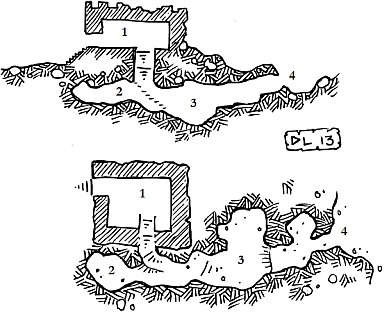
A militarized clan of Fellows live on and around this pre-revolution military bunker in a collection of sturdy buildings organized in an efficient grid pattern. The Fellows build most of these structures from the ruins of other buildings, carting brick, concrete, wood, et cetera from other locations. The clan maintains a high degree of alertness not only due to the bunker’s sacred proximity, but also because of the large number of predatory chemical worms in the area.

1. Superstructure: While the exterior of the superstructure shows signs of damage from the elements and battle, it remains solid and sealed tight. Inside the single-storey building are offices for administrative and security personnel, all long abandoned in haste. A cargo elevator leads down to the caves beneath the superstructure.

2. Munitions: This section of the caves was converted for munitions storage. Duraflex walls and ceilings form storage units in four rows. This particular facility stores mag pistols, mag rifles, ammunition, repair kits, and other firearms accessories. It also has a cache of grenades of various types.

3. Flooded Cave: The chemical pond’s high acid content eroded a narrow but passable tunnel through surfrace strata into the caves, flooding the lowest lying areas in the process. Chemical reactions have turned the air through the cave system into a toxic haze. The water itself is highly corrosive, and predatory chemical worms thrive in this environment.

4. Chemical Pond: A bomb crater to the rear of the superstructure has long since filled with water, and deadly toxins and acids in the soil have turned the resulting pond into a highly corrosive pool ideal for predatory chemical worms. During infrequent dry spells, much of the pond evaporates, leaving a thick, poisonous sludge.

Chemical Worm (for Stars Without Number):

Armor Class: 7
Hit Dice: 1
Attack Bonus: +2
Damage: 1d4 bite
No. Appearing: 10-40
Saving Throw: 15+
Movement: 15 ft., swim 15 ft.
Morale: 8

Chemical worms grow to about the length of a man, reaching a thickness approximate to a man’s thigh. They are sandy brown in color with bloodred heads and a quadripartite jaw sporting vicious fangs. They are invulnerable to almost all poisons and acids, and they can survive in anerobic environments for long periods of time. In addition to its bite, a chemical worm can spray a scalding fluid at its prey. The spray is produced by a reaction between two chemical compounds, hydroquinone and hydrogen peroxide, stored in separate reservoirs in the worm’s throat, and then mixed when needed in a third chamber with water and catalytic enzymes. Heat from the reaction brings the mixture to near the boiling point of water and produces gas that drives the ejection. The chemical worm’s spray inflicts 1d8 points of damage in a 15-foot wide fan.

February 17th, 2013  in RPG No Comments »

Sacred Ember of the Most High Altar

“Then one of the seraphim flew to me, holding an ember that he had taken with tongs from the altar. He touched my mouth with it, and said, ‘See, now that this has touched your lips, your wickedness is removed, your sin purged.'” Isaiah 6:6-7

Sacred Ember of the Most High Altar

Supernal powers gift only the holiest sites with sacred embers, which act as conduits for powerful Lawful magic. Only an appropriately blessed high priest of Lawful alignment may safely handle a sacred ember, and even then it may be touched only with sacred implements. Violating these strictures risks death (save versus death magic or die; suffer 10d10 points of damage even with a successful saving throw).

When pressed to the lips of a Lawful member of the faith which corresponds to the sacred ember‘s origin, the recipient is purged of negative effects, as per neutralize poison, remove curse, and restoration (with no incapacitating effect on the sacred ember‘s user). Purification from a sacred ember has additional effects based on the recipient’s class. The additional effects last for seven days:

* Cleric: When turning undead, the cleric uses the next highest “Clerical Level” column on the “Turning the Undead” table. When casting any cure spell, the cleric adds his level to the number of hit points healed.

* Fighter: When fighting creatures aligned with Chaos, the fighter adds +3 to his weapon damage rolls. Each day, the fighter has extra hit points equal to 1d10 plus his Constitution bonus (minimum +1 extra hit point). Damage is subtracted from these extra hit points first.

* Magic-User: When attacked by creatures aligned with Chaos, the magic-user enjoys a +1 bonus to Armor Class. Saving throws against his spells are made with a -1 penalty.

No one may benefit from the effects of a sacred ember more than once per year.

February 11th, 2013  in RPG No Comments »

River’s Bend Poets Inn

Here’s my second entry for The Grand Original Map Contest, this time for the “Best Trap, Treasure or Puzzle” category. I’m using Small Map B – Rose River for this one. I also have a feeling I’m stretching the intent of the contest a bit here, but that’s okay. I mean, worst-case scenario, I don’t win, which means I end up with what I started with.

River’s Bend Poets Inn

Everyone knows the quickest route through the Iseash Foothills is down the Orouns, that deep, fast-moving river that provides the Inundr Lowlands with so much of its water for irrigation. From the highland Alir Fortress to the sprawling rivertown Cadel, the trip downriver runs two or three days even for experienced river guides.

Meyr Alail, prophetess of Aelincar, the God of Poetry, received a vision in which she saw peoples from many faiths and nations gathered on a sandy river bank, peacefully enjoying wine and food and sharing poems. A single rose grew from the sand and blossomed. Within its petals rested a diamond shining with an inner light. Meyr set out on a pilgrimage down the Orouns and found that sandy bank halfway between the fortress and the town, just east of a wide, wooded valley. Following her vision, Meyr established the River’s Bend Poets Inn.

Over the subsequent years, the inn has grown into quite the regional attraction. Let’s take a tour!

As you wind down the Orouns nearing the inn, the first things you see are the wide, sandy East Bank and the sturdy stone arches supporting the high, stout bridge that spans the river from East Bank into the Sunrise Caves. Passing through these splendid natural chambers with their iridescent crystals, we enter the Hall. Meyr and her followers have carved pastoral bas reliefs into the walls. A short hall to the southwest leads to the soft grass banks at the entrance to the wide, wooded valley. The solid door at the end of this hallway is seldom locked. In the Hall, one also sees an L-shaped corridor leading away to the northwest. This is the Poet’s Passage, and it ends in another solid door, but this one is always locked. Indeed, it is held fast by magic, but it can be opened four times a year by the possessor of the Poet’s Key.

But What About the Trap, Treasure, or Puzzle?

Patience! I’m getting to it.

Remember Meyr’s vision? The part about the rose with the diamond? It turns out the vision was a tad more literal than most prophetic dreams. Four times a year — at each solistice and equinox — the East Bank is crowded with competitors, and spectators throng the bridge as well as the river in anchored boats. From dusk until the dawn, competitors compose original songs and poems in various styles and on numerous topics, doing so under the pious guidance of Meyr and her followers. When the sun starts to rise, a winner is declared, and if that winner’s efforts please Aelincar, then a single rose sprouts and blossoms. Within its petals rests the Poet’s Key. The winner may take the key, process across the bridge, through the Sunrise Caves and the Hall to the door at the end of the Poet’s Passage.

In the stunning caverns on the other side of the locked door awaits a reward chosen and provided by Aelincar himself. The nature of this treasure varies from contest to contest, but it always seems to be somehow related to the winner’s poems. Because of Aelincar’s interpretive whims, the treasure may be something of value, such as gold or gems, or it may instead be something personal, such as long-lost childhood toy restored by the God of Poetry.

That’s It? What Kind of Treasure Is That?

Well, it’s one earned by poetic prowess, so what were you expecting? Fabled riches? And, yes, this might be the sort of thing that hardened adventurers aren’t ever going to participate in.

Of course, there’s more going on each solstice and equinox than just the contest. The inn is crowded with visitors, and not all of them are there for the verse. In past years, the contest has served as a backdrop for intrigue, romance, and crime as well as the sort of hard partying that can lead to memory loss.

January 23rd, 2013  in RPG 2 Comments »

The Mountain Fastness of the Vermillion Coenobites

Over at Tenkar’s Tavern, some excellent people, including map guru Dyson Logos, are running a too-cool contest. Check out the details here. Of course, I have to throw my hat into the ring, so here’s my entry for the Best Creature. This entry uses Small Map C – Troll Chasm.

The Mountain Fastness of the Vermillion Coenobites

Last century, the Vermillion Coenobites labored to create a mountain retreat where they could sing their escatic psalms to bring about the end of one age and birth of the next. For a time, the community thrived, but eventually it collapsed from within, torn apart by internal jealousies and conflicts over obscure doctrinal points. Shortly after the last abbot died, poisoned by the hands of a rival monk according to persistent rumor, the order disintegrated. Many questions about the last days of the Vermillion Coenobites remain unanswered. Chief among these questions is this one: What happened to the order’s wealth? During the cult’s heyday, several wealthy donors gave generously to the monks to secure positions of importance in the next age that the order would supposedly bring about.

Unfortunately for treasure seekers, the order’s crumbling mountain fastness is abandoned no more. A band of earthwrights now live in the ancient monastery, and these creatures do not tolerate trespassers. To warn and frighten away the curious, the earthwrights have left would-be interlopers trapped in tombs of twisted stone in which the imprisoned have starved to death.

Earthwright (for Swords & Wizardry)

Hit Dice: 3+3
Armor Class: 2 [18]
Attacks: By weapon (1d8)
Saving Throw: 14
Special: rock jump, shape earth and stone
Move: 6
Alignment: Chaos (sometimes Neutrality)
Challenge Level/XP: 5/240

Earthwrights appear much like dwarves, but stand noticeably taller and wider. They shun armor, relying on their stony flesh for protection. If forced into melee, earthwrights fight with weapons, preferring cold steel that can hack muscle and bone. More formidable than axes and broad swords, however, is these creatures’ power over earth and stone. Once per day each, an earthwright can “cast” animate object (stone objects only), passwall, and transmute rock to mud. Earthwrights move slowly, but they can rock jump once per round. This ability enables an earthwright to teleport between any two points touching earth or rock that are within 60 feet. The destination must be within the earthwright’s line of sight. Once per round instead of making a normal attack or “casting” one of its spells, an earthwright can shape earth and stone out to a range of 60 feet. The target must make a saving throw to avoid being partially entombed as the earth and stone beneath him snake upward to grab and hold. A trapped target cannot move or attack unless he first succeeds on an open doors check. Earthwrights often layer earth and stone on a victim. Each successive saving throw an already trapped creature fails imposes a cumulative -1 penalty to his open doors checks to break free.

January 19th, 2013  in RPG 1 Comment »

Rory’s Story Cubes

I seldom need much encouragement to do two things: spend money on myself and be geeky. This explains how I ended up with a set each of Rory’s Story Cubes and Rory’s Story Cubes Actions.

It happened like this:

Christmas vacation had arrived. I had two weeks off, and I’d deliberately decided to not do any of my teacher work during the holiday. Instead, I would eat, drink, and be merry. Being merry involved living vicariously through people I follow on Google+, including Matt Jackson of Chubby Monster Games. Matt Google-plussed about using Story Cubes to flesh out an NPC for a game he was going to run.

I’d never heard of Story Cubes, so I surfed the Interwaves, and ended up watching several reviews and demos on YouTube. After this, I found myself one-click shopping at Amazon dot com. A few days later, the boxes of Story Cubes arrived, and they were mine. All mine!

Since then, I’ve played with them a bit. I demonstrated them to my family. I demonstrated them to my 5th graders. The demos weren’t hard. You (1) roll all nine dice, (2) look at the pictures, and then (3) make up a story that starts “Once upon a time…” using the pictures. That’s it. There aren’t any wrong answers. For added complexity and/or more options, toss the action dice as well. These have pictures of stick figures engaged in various activities. When you’re done making up your story, pass the dice to another player and enjoy them getting to be spontaneously creative.

The game components per set consist of nine sturdy six-sided dice with rounded corners. Each face of each die has a different picture for a total of 54 different pics per set. The dice come in a sturdy box a bit larger than a pack of playing cards. The box holds itself shut via a magnet. Both sets fit easily in the outer pocket of my laptop’s carrying case. I could fit either one in the front pocket of my jeans.

This game is a great idea for some silliness with your kids, as a teaching tool for students, as an ice-breaker at a party or meeting, or as inspiration for your own writing/gaming. In the latter mode, taking my cue from Matt Jackson, here’s a quick NPC to go along the dice results shown in the picture above and to the right:

NPC’s Name: Marlena

Occupation: Marlena is a dealer for high-stakes card games (hand) held in the private residences of the wealthy (building). She’s not above skewing the odds in favor of the house (scales).

Details: Marlena questions the morality of her occupation (question mark) and fears she’s living on borrowed time (clock). She is an avid reader (book).

Personality: Marlena hates to lose (the L). She loves fine and beautiful things, especially those that are fleeting (flower). Marlena has trouble managing her personal finances (credit card).

January 19th, 2013  in RPG 2 Comments »