Is Gratitude the Key to Happiness?
As I write this, I’m 50 years old and seriously under-employed. I left my teaching position largely due to health concerns. I’ve had one heart attack. That was seven years ago. I had a heart attack while driving me and the family home after church one fine Sunday morning. I still remember that next Monday morning, waking up in the hospital with tubes and monitors attached to me, and thinking, “Well, at least I woke up.”

A couple of days later, the day after having my femoral artery snaked to look for blockages and cardiac damage, I got to take an actual shower for the first time since the previous Sunday morning. A few hours later, I got to go home and lay on my couch, facing the television with the remote control within easy reach. That was Wednesday, if I recall correctly. I was back to work that week (against doctor’s orders).

That first week, I did something I’d not done in a while. I felt grateful for waking up. I felt grateful for a hot shower. I felt grateful for a comfortable couch and a remote control that works. I felt grateful for the large number of people in my life who care for me. For the first time in a long time, I truly appreciated G. K. Chesterton’s observation, “When it comes to life the critical thing is whether you take things for granted or take them with gratitude.”

I had been taking waking up in the morning for granted. I’d been taking couches, remote controls, and hot showers for granted. I’d even been taking my friends, family, students, and co-workers for granted. It’s perhaps a poor reflection on the quality of my character that it took a heart attack to shake the scales from my eyes so that I could see better the very many things I have in my life to be grateful for. I ought to be especially grateful for the things in my life that I’ve done nothing to earn but that I have regardless.

Which brings me to another of Chesterton’s observations: “I would maintain that thanks are the highest form of thought, and that gratitude is happiness doubled by wonder.”

There are so many things in my life that don’t have to be the way they are. They could be another way, but they’re not. How I cannot be struck by a sense of wonder by my good fortune? Sure, things aren’t perfect. Things will never be perfect. That’s not my point.

Consider food, for example. Why does it taste good? Is it inconceivable that the world would have arrived at an arrangement wherein food had no special flavor at all? Imagine that all food tasted like steamed asparagus. I like steamed asparagus, but I wouldn’t want all of my food to taste like it. But, if it did, I’d still eat. I’d have to still eat. Would I enjoy eating? Would anyone? I’m not sure about the answers to those questions.

But food does (or, at least, can) taste good, and I’m used to that, so I take it for granted rather than being filled with gratitude and wonder. That seems a shame because, if Chesterton is right (and he almost always is), gratitude and wonder are essential to happiness.

April 23rd, 2018  in RPG 1 Comment »

Need Some Movie Recommendations?

I’ve watched four movies recently, and I recommend all of them without reservation.

Wife Katrina, daughter Adrienne, and I watched Chasing 3000 Saturday evening. Here’s the trailer. This film stars Trevor Morgan and Rory Culkin as Mickey and Roger, two brothers from Pittsburgh who move to California when their mother (Lauren Holly) acts on doctor’s advice that the climate in the Golden State would help Roger’s muscular dystrophy related cardio-pulmonary problems. Mickey hates the move, mostly because he believes that he is asked to sacrifice too much for his younger brother, but also because the move takes him away from his grandfather (Seymour Cassel) and their beloved Pittsburgh Pirates and Roberto Clemente.

Like all the best baseball movies, Chasing 3000 is not really about baseball. It’s about family, sacrifice, growing up, and, most movingly, about the very real impact that a public figure worthy of admiration can have on the lives of his or her fans. Roberto Clemente was a class act in so many ways. For example, in August 1972, he was 30 hits away from 3,000 career hits. As the final week of the 1972 season approached, Clemente was well on his way to achieving this milestone. It was Thursday, 28 September 1972, playing against the Phillies, when Clemente got hit 2,999 off Steve Carlton. The next game was in Philadelphia, and the game after that was in Pittsburgh. Clemente had himself removed from the line-up so that he could get the magic 3,000th hit in front of his hometown fans. Clemente almost didn’t get it. He earned his 3,000th hit on his very last at-bat ever.

I also watched Imprint. Here’s its trailer. Starring Tonantzin Carmelo as a Lakota prosecuting attorney, Imprint seems a rare thing among movies focused on Native Americans in that the principal cast and the writer are Native Americans. This movie is a low-key supernatural thriller about a woman ashamed of her heritage coming to grips with her history, both as a Lakota as well as a member of a troubled family. The special effects aren’t great. None of the acting really shines. That said, Imprint is an effective, well-written ghost-themed mystery wrapped around family melodrama.

Radius, starring Diego Klattenhoff, Charlotte Sullivan, and Brett Donahue, is next. Of course, there’s a trailer. The film focuses on the growing, tense relationship between Liam (Klattenhoff) and Jane (Sullivan), two strangers who somehow ended up together in the cab of a truck before the truck leaves the road and rolls over in a field. Both emerge from the accident with no memories. Liam discovers that any living creature that comes within about 50 feet of him immediately dies. He and Jane together discover that not only is Jane immune to this effect, but that her presence near Liam prevents Liam’s deadly effects. Radius is a taut thriller that slowly reveals Liam and Jane’s connection through flashbacks leading to a final, chilling revelation.

And, lastly, son Christopher, daughter Adrienne, and I hit the theater to catch a matinee of A Quiet Place.

I won’t go too much into the plot of this film beyond this link for the trailer. There’s more than enough information out there on the Internet about A Quiet Place. Even Bishop Robert Barron, the Auxiliary Bishop of the Archdiocese of Los Angeles, praises the virtues of this film in a thoughtful review that includes some pretty major spoilers. Director and star John Krasinski has helped make a masterful film that, to paraphrase one review, links A-List performances with a B-Movie plot to craft a genuinely scary story. A Quiet Place ought to establish Krasinski as one of the new Hollywood heavyweights in both acting and directing, and, as good as he is, Emily Blunt and Millicent Simmonds are even better.

And that’s it for this post. Nothing game-related for today, but instead some recommendations for four good to astonishing motion pictures.

April 22nd, 2018  in RPG No Comments »

The Gappa

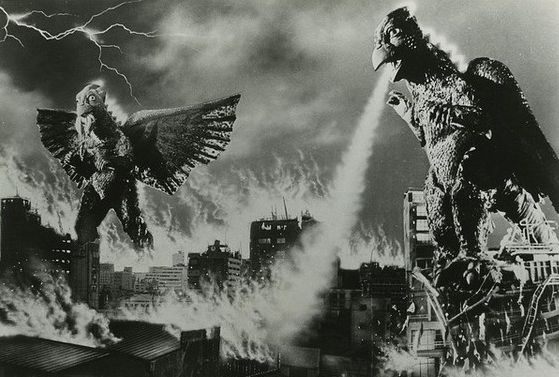
Yesterday, I watched Monster From a Prehistoric Planet via Amazon Prime. This one is boilerplate giant monster movie, complete with two distraught parent monsters on a destructive quest to retrieve their stolen offspring. The dubbing is pretty bad. The movie is preachy, maudlin, and sexist. Of course, the various toys and firecrackers deployed against the gappa fail to do anything other than make noise, smoke, and start fires. In other words, the movie is silly fun that took me back to the days of UHF and Saturday creature feature movies.

When writing up the gappa for Mutant Future, the scale of the monster presents some challenges. Most weapons are useless against the gappa. These beasts are more like natural disasters. To help me with the stats, I pulled my AD&D Oriental Adventures off the shelf to re-read the Gargantua monster entries.

Gappa
Alignment: Neutral
Movement: 120′ (40′), Fly: 480′ (160′), Swim: 180′ (60′)
Armor Class: 2
Hit Dice: 25
Attacks: 2 (stomp/stomp) or 3 (claw/claw/bite)
Damage: 5d10/5d10 or 3d10/3d10/6d10
Save: L25
Morale: 11
Hoard Class: None
XP: 10,000

Mutations: None.

The gappa appears as an enormous bipedal creature combining the features of reptiles and birds with a distinctive humanoid body shape. It can hold its breath for hours. An adult gappa stands nearly 100 feet tall and weighs in excess of 125 tons. Its thick hide is nearly impervious to harm. Primitive firearms, primitive melee weapons, and advanced melee weapons cannot damage the gappa. Other advanced personal weapons (pistols, rifles, and grenades) inflict one-half minimum damage (drop fractions). For example, a plasma rifle inflicts but 4 points of damage to a gappa with a successful attack. Nothing as weak as a stun baton or stun pistol could ever stun a gappa. A plasma grenade inflicts 6d6 points of damage to a gappa, and bombs and missiles inflict one-half normal damage. If wounded, a gappa regenerates 10 hit points per round.

Against targets on the ground, the gappa attacks by stomping its enormous feet. Each stomp affects a 15-foot radius, but the two radii cannot be more than 50 feet apart. Make a melee attack against each creature in the area. Success inflicts 5d10 points of damage; a failed attack inflicts half damage. Instead of stomping, the gappa may sweep its tail, affecting a 90-foot wide, 90-foot long cone. Each creature in the path of the tail must make a death save or suffer 8d10 points of damage. Against airborne or suitably large creatures, the gappa attacks with its claws and beak-like maw.

Each round of combat, there is a 1 in 6 chance that the gappa forgoes all melee attacks in favor of its fiery breath weapon that affects a 10-foot wide path along a 200-foot length. Against targets on the ground, this path need not be a straight line, but may sweep an area, making one 45-degree change of direction every 40 feet. The gappa’s breath inflicts 100 points of damage to everything caught in its path. Living creatures must also make a save versus radiation or suffer the effects of class 10 radiation. The gappa is immune to fire and radiation.

April 19th, 2018  in RPG No Comments »

Killer Mermaids

Well, it’s been a week and a half since I resigned from my teaching position. In that time, I’ve not had a single migraine, which is a great improvement from the almost daily pain. My blood pressure has also improved, and the tinnitus in my right ear is all but gone. My tutoring services have born fruit. I tutor an hour every day Monday through Friday, I’ve had another contact, and I have a meeting Friday with director of a home-schooling co-op about offering my expertise to families during the summer.

Best of all, I’m able to do stuff at home other than get home late and then fall asleep by 2000. For example, all by 0930, I dropped my son Christopher off at university, went to the grocery store, and played my wife Katrina in Words With Friends. Later today? I’m going to get some writing done.

Earlier this week, I watched Killer Mermaid via Amazon Prime. It’s kind of fun, mashing together a serial killer, a monster, and some beautiful locations. Of course, this also means I have to stat up the killer mermaid, once again using Mutant Future.

Killer Mermaid
Alignment: Chaotic
Movement: 30′ (10′); Swim: 120′ (40′)
Armor Class: 6
Hit Dice: 4
Attacks: 3 (claw/claw/bite) or 1 (tail)
Damage: 1d4/1d4/1d6 or 4d4
Save: L4
Morale: 8
Hoard Class: VI
XP: 300

Mutations: Echolocation, Increased Smell, Metamorph, Siren Song

Killer mermaids are Mutant Human females adapted to life underwater, but capable of breathing air as well. Killer mermaids have two forms: a monstrous one (shown in the picture above), and a secondary form in which they appear as beautiful women with the tails of fish. In this latter form, killer mermaids can only attack with their tails, which inflict 1d6 points of damage due to the lack of barbs and spikes. It takes a killer mermaid two full rounds of inactivity to change form. In either form, killer mermaids gather information about their surroundings via natural sonar to a range of 90 feet. Due to their sonar, killer mermaids receive a +2 to hit in combat. Killer mermaids also have an exceptional sense of smell, able to pick out and identify scents out to 180 feet. Creatures downwind or downstream can never surprise a killer mermaids.

In their beautiful woman form, killer mermaids may emit a hypnotic, ethereal song that affects a designated Mutant Human and Pure Human male within 180 feet. Roll 2d6+7 to determine a killer mermaid’s WIL. The killer mermaid makes a mental test against its target. Success renders the target incapable of violent action and with an irresistible desire to to embrace the killer mermaid. The effects last only until the start of the killer mermaid’s next turn, but the killer mermaid may re-target the victim each round it remains within range.

Killer mermaids speak their own language.

April 18th, 2018  in RPG No Comments »

The Creeping Terror

A week ago, I resigned from my teaching position. Starting tomorrow, I go from unemployed to semi-employed. I’ve started offering my services as a private tutor. You can read about me here.

Also, during my abundant spare time last week, I released Narvon’s Sinister Stair and The Bishop’s Secret, two short adventures for Swords & Wizardry and Swords & Wizardry: WhiteBox, respectively.

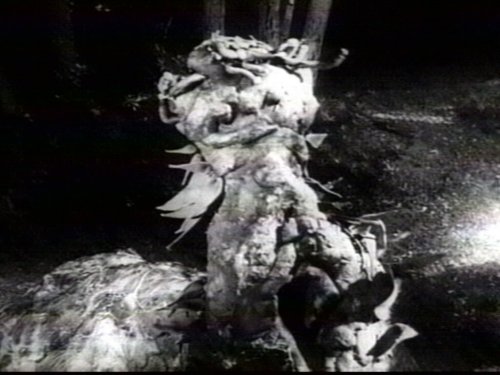
I also watched The Creeping Terror, one of the worst movies ever made, which explains what follows for use with Mutant Future.

Nearly 20 feet long, covered in both fur and some sort of chitin, multiple eyestalks bobbing about as it shuffled forward, emitting the most terrible noises, the creeping terror advanced through the hail of bullets and arrows, seemingly unconcerned about the damage it suffered.

Creeping Terror
Alignment: Neutral
Movement: 60′ (20′)
Armor Class: 5
Hit Dice: 10
Attacks: 1 (bite)
Damage: 3d8
Save: L5
Morale: 10
Hoard Class: None
XP: 2,400

Mutations: Alien Physiogomy, Digestive Analysis, Sonic Paralysis

Some alien civilization engineered creeping terrors as a means of testing the native fauna of distant worlds, perhaps to see if those worlds would be suitable for colonization. Due to their extraterrestrial origin and Alien Physiogomy, creeping terrors can withstand incredible punishment. They take half damage from physical attacks, and they are immune to poison and radiation. Creeping terrors move slowly, dragging themselves forward with two blunt feet and undulating their lengthy torsos in a series of motile contractions.

When they sense prey, creeping terrors emit a cacophony of shrieks and howls. Living creatures within 30 yards of the creeping terror must attempt a Stun Attacks saving throw. Failure induces sonic paralysis for 2d4 turns. Affected creatures stand motionless, perhaps screaming and gaping in fear, but otherwise unable to act. Creeping terrors attack with a powerful bite. On an attack roll of 19 or 20, the target is swallowed whole, and takes 3d8 points of damage per turn from the creeping terrors powerful digestive enzymes (see page 58, Mutant Future, for more details about paralysis and swallow attacks).

Within the digestive tract, creeping terrors have a variety of alien technological artifacts that analyze creatures swallowed whole. Powerful transmitters send collected data into space, presumably to be collated and studied by whatever alien creatures create creeping terrors.

April 15th, 2018  in RPG, Spes Magna News No Comments »