Savage Wednesday: The Anhkheg

Last week, I took the aerial servant from the AD&D Monster Manual and statted it up for Savage Worlds Deluxe Explorer’s Edition. If you missed that installment of Savage Wednesday, you can click here to make amends.

(Nota Bene: The first two links above are affiliate links.)

I kind of enjoyed writing the aerial servant post, and so I asked myself, “Self, why not do the same thing for the next monster?” I couldn’t think of a good reason to not do so. The AD&D Monster Manual remains a classic among the host of roleplaying game collections of monsters. Sure, some of the art is a bit uninspired. (I’m looking at you, Brachiosaurus.) Some of the monsters are perhaps a bit odd or even unnecessary. (Now I’m looking at you, Mule. You’re not a monster.)

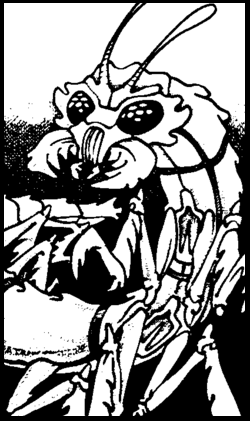
Other entries, however, are classics, and the anhkheg (note the correct spelling) is a classic. An giant burrowing arthropod that attacks by surprise and spits acid? What’s not to love?

Anhkheg

The anhkheg burrows through the earth like an earthworm, preferring soil rich in minerals and organic matter. Thus it will usually be found in forests and choice agricultural land. This causes farmers great consternation, since the anhkheg likes to supplement its earthly diet with a bit of fresh meat, human or otherwise. The anhkheg has a chitinous shell which is brownish in color. Its underside is pinkish. The creature’s eyes are glistening black.

Attributes: Agility d6, Smarts d4 (A), Spirit d6, Strength d12+4, Vigor d10
Skills: Fighting d8, Notice d8, Shooting d6, Stealth d8
Charisma:
Pace: 6
Parry: 6
Toughness: 14 (3)
Special Abilities:

Armor: +3.

Bite: STR+d10.

Burrowing: The anhkheg has a Burrowing Pace of 3. When burrowing, the anhkheg gains a +2 to Stealth rolls.

Spray Acid: The anhkheg sprays acid using the Cone Template. Every target within this cone must beat the anhkheg’s Shooting roll with Agility or suffer 4d8 points of damage. The anhkheg can spray acid once every 1d6 hours.

Size +4: The anhkheg reaches lengths of 20 feet.

Tremorsense: The anhkheg tends to lurk underground and attacks by ambush. The anhkheg detects vibrations within 6″, gaining a +2 to Notice rolls.

June 5th, 2019  in RPG No Comments »

Tuesday Terror: Rasties

Back when I was in high school, TSR published Star Frontiers. It wasn’t the first sci-fi game we played. That would be Gamma World. It wasn’t even the second, which would be Traveller. (N.B. That’s an affiliate link.)

But, man, did we play the heck out of Star Frontiers, and, as usual, our characters were a possee of shady mercenaries out to get rich and probably die young in the process. If memory serves, our characters’ last adventure involved trying to steal a prototype military robot in order to sell it on the black market. The mission did not succeed, and I’m pretty sure we moved on to another game.

Anyhoo, here’s a new monster adapted from the creature of the same name found in Crash on Volturnus:

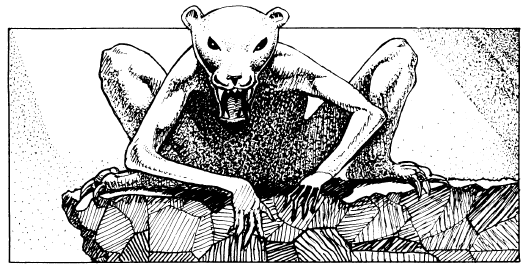
Rasties are vicious mammals of medium size that prey upon hapless shovelmouths and other gentle prey living in the caverns of Volturnus. [They] look like a cross between a rat and a small monkey. They have four legs, but can sit upright and use their forelimbs to grasp meat or small prey. Rasties are usually hungry, and will attack anything that looks edible to them.

Rasties
Small monstrosity, neutral evil

Armor Class 14 (natural armor)
Hit Points 27 (6d6+6)
Speed 30 ft.

STR 8 (-1), DEX 16 (+3), CON 13 (+1), INT 6 (-2), WIS 12 (+1), CHA 7 (-2)

Skills Perception +3, Stealth +5
Senses darkvision 60 ft., passive Perception 13
Languages Rasties
Challenge 1 (200 XP)

Blood Rampage. As a bonus action, the rasties can move up to half its speed toward a hostile creature that doesn’t have all its hit points and then make a bite attack against that creature. The rasties must be able to see the creature.

Keen Smell. The rasties has advantage on Wisdom (Perception) checks that rely on smell.

Pack Tactics. The rasties has advantage on an attack roll against a creature if at least one of the rasties’s allies is within 5 feet of the creature and the ally isn’t incapacitated.

Actions

Bite. Melee Weapon Attack: +5 to hit, reach 5 ft., one target. Hit: 4 (1d4+2) piercing damage, and the target is grappled (escape DC 13). Until the grapple ends, the target is restrained, and the rasties cannot bite another target.

June 4th, 2019  in RPG No Comments »

Savage Wednesday: Whoosh!

The Kids’ Game campaign using Savage Worlds Deluxe Explorer’s Edition is on a brief hiatus. Last Saturday would have been our next session, but folks were out of town or otherwise unavailable. This is probably a good thing. The next session looks to be a bit, well, busy. The kids in the forms of their pulp hero characters are holed up in Watusi, a small African town at the edge of Leopard Man territory. Pharaoh Doctor Mobius has a detachment of stormtroopers moving toward the fabled Temple of Tears, presumably to ambush the heroes when they show up with the Tiles bearing the secrets to finding the Chalice of Possibilities.

Realizing forewarned is forearmed, the heroes beat the streets and broke into some offices to gather intelligence. One of Mobius’s lieutenants, the inscrutable and deadly Wu Han, is en route via airship with more stormtroopers. Elements of the Resistance have allied themselves with the heroes while collaborators make ready to welcome Wu Han. In short, the heroes sit on a powder keg of potential insurrection. Hundreds of lives hang in the balance.

Like I said: busy. On the plus side, the next session presents a great opportunity to test out the Allies and Mass Battles rules, so I got that going for me.

And now, for no particular reason, the first monster in the AD&D Monster Manual. (Nota Bene: The links above are affiliate links.)

Aerial Servant

The aerial servant is a semi-intelligent form of an air elemental, typically encountered only due to conjuration by a cleric.

Attributes: Agility d10, Smarts d4, Spirit d8, Strength d12+2, Vigor d8
Skills: Fighting d10, Notice d10
Charisma:
Pace:
Parry: 7
Toughness: 9
Special Abilities:

Elemental: An aerial servant takes no additional damage from called shots. It is Fearless, and immune to disease and poison.

Flight: An aerial servant flies at a rate of 12″ with a Climb of 3. It may not run.

Ethereal: An aerial servant cannot be harmed by nonmagical attacks.

Invisibility: An aerial servant is naturally invisible. Its presence can be detected due to disturbances in the air. A character may detect an aerial servant with a Notice roll at -4. Once detected, an aerial servant may be attacked, but with a -4.

Size +3: An aerial servant is about 8 feet tall.

Slam: STR+d6.

May 29th, 2019  in RPG No Comments »

Tuesday Terror: Gravity

Gravity comes in five degrees: normal, low, high, zero, and relative.

Normal Gravity: This what probably everyone reading this is used to. (I guess it’s possible an astronaut might read this post.) Normal gravity is, well, normal. It neither grants any benefits nor does it impose any hindrances.

Low Gravity: Low gravity is gravity that is lower than normal. Of course, mass doesn’t change, but weight does. As a result, while in a low-gravity environment:

Attack rolls take a -2 penalty in a low-gravity environment unless the attacker is native to a low-gravity environment or has special training for fighting in low- or zero-gravity environments.

Carrying capacity is calculated as if the creature’s Strength score is 10 points higher than normal. For example, a character with a 11 Strength has a carrying capacity of 165 pounds. In a low-gravity environment, that character’s carrying capacity is 315 pounds.

Falling damage is reduced from 1d6 bludgeoning damage for every 10 feet fallen to 1d4 bludgeoning damage for every 10 feet fallen (to a maximum of 20d4).

Strength checks made in low-gravity environments are made with a +10 bonus.

Speed increases by 5 feet for all of a creature’s methods of movement.

Spending long periods of time in a low-gravity environment can cause problems when returning to normal or high gravity. For every 5 days spent in low gravity, a creature must make a DC 10 Constitution saving throw. Failure accrues 1 level of exhaustion that becomes noticeable upon returning to normal or high gravity.

High Gravity: This is gravity significantly greater than normal. Again, mass doesn’t change, but weight does.

Attack rolls take a -2 penalty in a high-gravity environment unless the attacker is native to a high-gravity environment.

Carrying capacity is calculated as if the creature’s Strength score is 5 points lower than normal. For example, a character with a 11 Strength has a carrying capacity of 165 pounds. In a high-gravity environment, that character’s carrying capacity is 90 pounds.

Falling damage is increased from 1d6 bludgeoning damage for every 10 feet fallen to 1d8 bludgeoning damage for every 10 feet fallen (to a maximum of 20d8).

Strength checks made in high-gravity environments are made with a -10 penalty.

Speed decreases by 5 feet for all of a creature’s methods of movement.

Spending long periods of time in a high-gravity environment can cause problems when returning to normal or low gravity. For every 5 days spent in low gravity, a creature must make a DC 10 Constitution saving throw. Failure accrues 1 level of exhaustion that becomes noticeable upon returning to normal or high gravity.

Zero Gravity: This is a no-gravity environment. Movement in zero gravity means grabbing onto and/or pushing away from a more massive object. As such, in many cases, Strength (Athletics) checks to climb or jump are not necessary.

Attack rolls take a -4 penalty in a zero-gravity environment unless the attacker is native to a zero-gravity environment or has special training for fighting in low- or zero-gravity environments.

Carrying capacity is 20 times higher than normal. For example, a character with a 11 Strength has a carrying capacity of 165 pounds. In a zero-gravity environment, that character’s carrying capacity is 3,300 pounds.

Shoving a creature in zero gravity can be attempted against a creature up to two sizes larger than the attacker. If the attacker wins the contested check, the defender is pushed 10 feet away, plus another 10 feet for every 5 points by which the attacker’s total exceeds the defender’s total.

Movement in zero gravity is much like flying. The creature gains a fly speed equal to its base speed. Flying is a bit of a misnomer, however. The creature’s flying movement is limited to straight lines only. A change in direction requires pushing away from larger object. A creature that can already fly retains its normal fly speed and is not limited to straight-line movement.

Initial exposure to zero gravity can be disorienting. The creature must make a DC 15 Constitution saving throw or become space sick. The space-sick creature gains the nauseated condition. If the DC 15 Constitution saving throw fails by 5 or more, the creature is also incapacitated. A new saving throw is permitted every 8 hours the creature remains in a zero-gravity environment. Creatures native to zero gravity or that have special training do not suffer from space sickness.

Spending long periods of time in a zero-gravity environment can cause problems when returning to normal or low gravity. For every 5 days spent in low gravity, a creature must make a DC 15 Constitution saving throw. Failure accrues 1 level of exhaustion that becomes noticeable upon returning to normal or high gravity.

Relative Gravity: Every creature has a native gravity. Most creatures are native to normal gravity, and the rules above assume as much. In other situations, apply these rules along with common sense. For example, a creature native to a zero-gravity environment treats low-gravity as normal gravity and normal and high gravity as high gravity. Specifics may need to be adjudicated on the fly.

May 28th, 2019  in RPG No Comments »

ThursdAD&D: Scaly Creatures

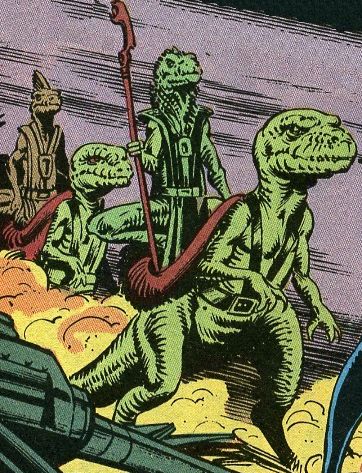
Way back in 1978, Ms. Marvel met a race of lizard people who had mutated from common desert reptiles into an intelligent society, all as a result of atomic bomb testing. I used to have that comic book. I’m pretty sure it was among the several comics from late 60s through the mid-80s that did survive the purge of my bedroom after I left for basic training in the summer of 1985.

Dinosaurs, lizardmen, et cetera have long been a staple of fantastic fiction and roleplaying games. From Lost Worlds to Lovecraftian serpent people to tragically mutated one-armed scientists, who doesn’t love scaly creatures? People who are wrong. That’s who.

Sollersaurus
Frequency: Rare
No. Appearing: 1-6 (4-24 in lair)
Armor Class: 4
Move: 15″ or 21″ (see below)
Hit Dice: 4+4
% in Lair: 20%
Treasure Type: D
No. of Attacks: 3
Damage/Attack: 1-4/1-4/2-8
Special Attacks: See below
Special Defenses: See below
Magic Resistance: Standard
Intelligence: Average
Alignment: Neutral
Size: L (6′ tall, 12′ long)
Psionic Ability: Nil
Attack/Defense Modes: Nil
Level/XP Value: IV/250 + 5/hp (Alphas: IV/290 + 5/hp)

The sollersaurus is an intelligent saurian carnivore. It is fast, and it has a whip-like tail, grasping forearms with hand-like appendages sporting sharp talons, a strong jaw full of fangs, and powerful hindlegs. The sollersaurus travels on either two legs or four (move 15″ or 21″, respectively). Its coloration is highly adaptable, much like that of a chameleon.

The sollersaurus has keen senses and infravision of the 90-foot variety. It is immune to illusions and is surprised only 1 in 8 times. The sollersaurus moves quickly and stealthily. It surprises its prey 4 in 6 times. On the first round of combat, the sollersaurus may leap up to 3″ and attack with the gutting talons on its hind legs. This attack enjoys a +2 to-hit bonus and inflicts 3-12 points of damage.

A pack of sollersauruses numbering at least 4 creatures will be coordinated by a mated pair of alphas. These alphas have at least 6 hit points per hit die and have a +1 to-hit bonus on attacks.

The sollersaurus speaks it own language of barks, trills, and hisses. It has a 25% chance to understand 1-2 other languages, although the sollersaurus lacks the vocal apparatus to speak most other tongues. Despite its intelligence, the sollersaurus seldom makes use of tools.


It’s been a while since I featured anything for The Four Color Hack, and a post that opens talking about a comic book seems an good time to remedy this omission.

The lizard people that Ms. Marvel met included some pretty tough customers. Some had psychic powers. One was a giant viper of sorts. Another threw a tank at Ms. Marvel. That takes some muscle.

Sca-Lor
Level 5 Villain

Quote: “Rraauwrrr!”
Real Name: H’stok
Identity: Secret
Place of Birth: Somewhere in the southwestern United States
Height: 7 ft. 6 in.
Weight: 390 lb.
Eyes: Yellow
Hair: None

Hit Points: 30 (4 Vigor)
Base Damage: d10
Powers: Desert Camouflage d10, Regeneration d10, Super-Strength d16 (d10+d16 damage), Thick Scales d12 (7 protection)

Background: Sca-Lor is the war-like champion and self-appointed guardian of the saurian people who live hidden in caves in the southwestern United States. Belligerent, xenophobic, and ambitious, Sca-Lor believes he should lead his people out of hiding in order to wage war on the “sssoft skinsss” that seem to be increasingly encroaching on saurian territory.

Powers: Sca-Lor’s powers are straightforward and quite exceptional for a saurian. He can lift 50 tons, and his thick scales are immune to most conventional weaponry. He heals rapidly, and he can even regenerate lost limbs and organs.

May 23rd, 2019  in RPG No Comments »