Revised PDF Available Virtually Near You

Got more done than anticipated. The revised Latina Facta & Versatile Performance Redux is now available at Paizo.com and DriveThruRPG. Revision I of this 14-page, printer-friendly PDF contains great game crunch:

* 15 feats inspired by Latin sayings. Stare down foes with Caro Putridas Es! or inspire your allies with Morituri Te Salutamus.

* 18 bardic arts divided into acting, music, and dancing categories. Boost an allied bard’s abilities with Chorus, get into character with Affective Memory, or stun an enemy with your Snake Arms.

* 7 new bard spells, one for each level 0 through 6. Bamboozle enemies with deceptive cadence and turn an ally into a whirlwind of pain via fouetté en tournant.

And all of these bombastic bard bonuses are still only $0.99.

Meow! Chirp! Ink!


I was surfing Interwaves recently and came across a couple of lengthy blogposts about some of the stupider monsters that have popped up in various versions of the world’s most popular roleplaying game. Some the stupidest have been monsters that combine normal animals. Since I don’t want to be left out of the stupid combo-animal carnival, I humbly submit the catbirdopus, which combines a domestic cat, a hawk, and an octopus.

Catbirdopus
CR 1/2; XP 200
N Small animal (aquatic)
Init +3; Senses low-light vision, scent; Perception +5

DEFENSE
AC 15, touch 14, flat-footed 12 (+3 Dex, +1 natural, +1 size)
hp 9 (2d8)
Fort +3, Ref +6, Will +1
Defensive Abilities ink cloud

OFFENSE
Speed 20 ft., fly 30 ft. (average), swim 15 ft., jet 100 ft.
Melee 2 talons +5 (1d3-2), bite +5 (1d3-2 plus poison), tentacles +3 (grab)
Special Attacks poison (Fort 11)

STATISTICS
Str 7, Dex 16, Con 11, Int 2, Wis 13, Cha 6
Base Atk +1; CMB -2; CMD +1 (cannot be tripped)
Feats Multiattack (B), Weapon Finesse
Skills Climb +5, Escape Artist +8, Fly +12, Perception +5, Stealth +13; Racial Modifiers +2 Climb, +5 Escape Artist, +4 Perception, +6 Stealth

SPECIAL ABILITIES
Ink Cloud (Ex): A catbirdopus can emit a 10-foot-radius sphere of ink once per minute as a free action. The ink provides total concealment in water, and persists for 1 minute.

Jet (Ex): A catbirdopus can jet backward once per round as a full-round action, at a speed of 100 feet. It must move in a straight line while jetting, and does not provoke attacks of opportunity when it does so.

Poison (Ex): Bite – injury; save Fort DC 11; frequency 1/round for 6 rounds; effect 1 Str; cure 1 save. The save DC is Constitution-based.

ECOLOGY
Environment temperate and hot water
Organization solitary or pair
Treasure none

Catbirdopus Companions
Starting Statistics: Size Small; AC +1 natural armor; Speed 20 ft., fly 30 ft. (average), swim 15 ft., jet 100 ft.; Attack 2 talons +5 (1d3-2), bite +5 (1d3), tentacles +3 (grab); Ability Scores Str 7, Dex 16, Con 11, Int 2, Wis 13, Cha 6; Special Qualities jet, low-light vision, ink cloud, scent.

4th-Level Advancement: Attack bite (1d3 plus poison [frequency 1 round (6), effect 1 Str damage, cure 1 save, Con-based DC]); Ability Scores Str +2, Con +2; Special Attacks poison.

June 7th, 2011  in RPG No Comments »

Lots of RPG Links

The 2011 One-Page Dungeon Contest is over. My The Lure of the Jade Throne didn’t win, but lots of better submissions did. You can check out the results by clicking this sentence.

With every one my Quid Novi? e-letters, I include some recommended reading from various places on the Interwebz. Here’s a round-up of several of recently recommended reading links.

For Awesome Campaigns Build A Player Campaign Book by Kit Reshawn

Ever noticed how what takes six months of real time to game might cover only a day or two of campaign time? I have, and the gap between real time and campaign time can make remembering important details difficult. Kit Reshawn offers some good advice about how to better organize campaign notes so that important details don’t get lost over real time.

New Stuff from Chaotic Shiny Productions

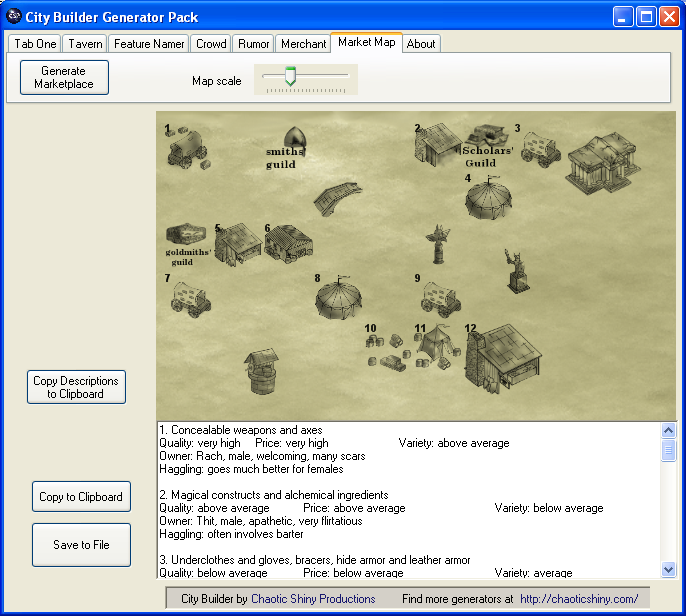
Need to brainstorm elements for some stage magic? Well, who doesn’t? The link above randomly generates elements for stage magic. For example, “This trick requires four tiny saws, one exotic coin, one large mirror and one small snake. It is often performed at bars.” Chaotic Shiny is also working on a “City Builder Generator Pack”. You can check out a sample of what it can do by clicking on this link.

How To Have An Epic Campaign In Three Acts by Patrick Benson
Part 1 | Part 2 | Part 3

Patrick Benson posts parts one and two of three articles that look at epic campaigning. In part one, he discusses defining “epic” for your group and establishing the campaign’s heroes, villains, and threat. Part two goes into more detail about your epic campaign’s set up. Part three of the series looks at how one wraps up your epic campaign with a legendary bang.

A Dyson Mapping 1-2-3 “Tutorial” by Dyson Logos

Old School cartographer offers a step-by-step look at how to create one of his great cross-section dungeon maps.

Weem’s DM Tips for RP Prompting and Immersion

This interesting thread is full of tips ranging from inspiring to silly about how to improve the roleplaying qualities of your game.

A Pathfinder Spell Card Generator! by Jefferson Jay Thacker

Tired of looking through books for spells? Like to have things printed on cards? Well, then check out this site. With a few clicks here and there, you can generate a page of spell cards for your favorite caster. Includes spells from the core rules, APG, and various Player’s Companions, adventure paths, and campaign setting guides. Good stuff!

Growing Up Gamers

This is a family blog, written by members of a gamer family for other gamers. It includes thoughts on gaming, reviews of games, and accounts of gaming with children. Makes me want to play more games with my family.

Driftwood: Hard and Soft Scenes by Walt Ciechanowski

Gnomestewer Walt Ciechanowski talks about the differences between vital (or hard) and nonvital (or soft) scenes in adventure design. He offers some thoughtful advice about how to incorporate both in your game.

Bringing Some Old-School Principles Into Pathfinder by Aplus

I’ve recommended this blog before. This time around the link leads to a post about how to take Pathfinder and use it for an old-school, sandbox campaign. The author makes good use of Pathfinder setting material blended with Old School Revival material for other publishers. Inspiring.

It’s a Kind of Magic by Alzrius

Alzrius talks about the science of magic, and how the way you explain the mechanics of magic can enrich your campaign world. Reminds me of the time I was inspired by Shankara’s Crest Jewel of Discrimination to explain how monster summoning spells worked.

May 15th, 2011  in Quid Novi?, RPG 1 Comment »

Birds of a Feather Kill Together

Here’s my piece written for the latest Game Geek.

Since the earliest days of RPGs, mythology has provided fertile soil for the gamer’s imagination. Recently, I started re-reading Samuel Butler’s prose translation of The Iliad. Somehow, this bizarre passage from the beginning of Book III had managed to slip under my oddness radar during previous readings:

“When the companies were thus arrayed, each under its own captain, the Trojans advanced as a flight of wild fowl or cranes that scream overhead when rain and winter drive them over the flowing waters of Oceanus to bring death and destruction on the Pygmies, and they wrangle in the air as they fly; but the Achaeans marched silently, in high heart, and minded to stand by one another.”

Yes, you read that correctly. Homer compares the Trojans to screaming flights of birds that kill and destroy Pygmy society every winter. Which got me to thinking: What would that look like in a game?

Step the First

Whenever I create a new creature, I look for an already made monster that I can reskin and refluff. In game terms, it’s obvious Homer describes some sort of swarm. I searched through d20pfsrd.com for swarms, looking for those that could fly.

After browsing through swarms of wasps, hellwasps, bats, botflies, locusts, and mosquitos, I decided that the bat swarm was the best place to start. Studying the bat swarm’s stat block revealed several areas that needed to be changed.

First off, the bats are too small. I don’t want a swarm of Diminutive birds. Perilous parakeets or bloodthirsty budgies aren’t what I’m looking. The largest creature that has swarm traits are Tiny. That’s roughly the size of a housecat, which seems right to me.

So, I slap the Giant creature simple template on the bat swarm. This bumps the individual animal’s size up to Tiny. I adjust ability scores and add a natural armor bonus. I don’t bump up the swarm’s damage, however. Swarm damage is linked to swarm Hit Dice rather than size. Next I remove the bat swarm’s wounding special ability. I don’t want it too obvious that my bird swarm is really just a bat swarm with some minor modifications.

Examining the altered stat block, I feel that I’m off to a good start, but my bird swarm doesn’t look like something that could “bring death and destruction” to an entire people. Civilization-threatening invasions of monsters should inspire a little more terror than what a slightly tweaked bat swarm delivers.

Since I like templates, I figured it wouldn’t hurt to browse through the rest of them. I hadn’t scrolled down far when I found what I was looking for: the Apocalypse Swarm template from Green Ronin’s Advanced Bestiary. More stat block adjustments ensued.

Adding the Giant Creature and Apocalypse Swarm templates to a bat swarm should give me a CR 6 monster. I need to compare the stat block to the parameters for that CR. Indeed it seems as if CR 6 is about right on target.

Step the Second

I’ve reskinned the stat block. Now it’s time to refluff the monster. I need some introductory descriptive text and to make sure my new stat block is complete and well-formatted. Here’s the final product:

The sky goes dark. A cacophony of squawks, caws, and shrieks competes with the thunderous flapping of a hundreds of wings. The birds! The birds have returned, and death comes with them!

Apocalpytic Flight of Wild Fowl
CR 6; XP 2,400
N Tiny animal (swarm)
Init +3; Senses low-light vision; Perception +17

DEFENSE
AC 19, touch 16, flat-footed 15 (+3 Dex, +1 Dodge, +3 natural, +2 size)
hp 68 (8d8+32); fast healing 10
Fort +9, Ref +11, Will +4
Defensive Abilities half damage from slashing and piercing weapons, swarm traits; SR 19

OFFENSE
Speed 20 ft., fly 120 ft. (average)
Melee swarm (3d6)
Space 10 ft.; Reach 0 ft.
Special Attacks fear (DC 12), greater distraction (DC 19)

STATISTICS
Str 7, Dex 17, Con 17, Int 2, Wis 14, Cha 7
Base Atk +6; CMB –; CMD
Feats Ability Focus (greater distraction) (B), Dodge, Lightning Reflexes, Mobility, Toughness
Skills Fly +14, Perception +17; Racial Modifiers +8 Perception
SQ swarm traits

SPECIAL ABILITIES
Fear (Su): Each creature within 100 feet of a flight of wild fowl that witnesses it bringing down another creature must succeed on a Will save (DC 10 + 1/2 flight’s HD + flight’s Cha modifier) or be frightened for 1 minute. Success leaves the creature shaken for 1 minute but does not negate the need to make a new saving throw for each such incident. Fear is a mind-affecting fear effect.

Greater Distraction (Ex): A creature that fails its save against a flight’s distraction special attack is nauseated for 1d4 rounds.

Splitting (Ex): When a flight of wild fowl takes more than 10 points of damage from a single attack, it splits into two identical flights, each with one-half the hit points that the original flight had when it split (rounded down). A flight of wild fowl with 1 hit point cannot be split, and one with 0 hit points is dispersed as normal. Each piece of a flight of wild fowl can heal damage normally, up to the number of hit points it had upon formation. Healing damage does not allow the flights to recombine. For example, a flight of wild fowl with 68 hit points that takes 15 points of damage would split into two flights with 26 hit points each (one-half of the original flight’s remaining 53 hp, rounded down). Each of these two flights of wild fowl can heal 10 points of damage per round with fast healing, but it cannot exceed 26 hit points.

ECOLOGY
Environment any temperate or tropical
Organization solitary, pair, flock (3-6 swarms), or apocalypse (11-20 swarms)
Treasure none

Step the Third

Now that I’ve got a scary swarm inspired by one of the enduring classics of Western literature, I need to unleash these monsters on my unsuspecting players. Fortunately, the next leg of my campaign takes the adventurers into a northern forest region where the PCs hope to thwart a dark elf plot to turn an annual winter festival into an orgy of death and terror. It ought not be hard to work at least one of my new swarms into the scenario.

May 3rd, 2011  in Greek Myth, RPG No Comments »

Wild Hunts & Degenerate Elves

I wrote this piece for Game Geek 16, now available at the previous link for free.

In Game Geek 10, I talked about the importance of tailoring adventure scenarios to the player character’s strengths. My starting point was the ranger’s favored enemy class feature. The basic claim: If a ranger has undead as a favored enemy, then that ranger needs to encounter undead monsters often.

In my current We’re Not in Arkansas Anymore! campaign, one of my players runs Rob Braden, a former baseball player turned ranger whose favored enemy is fey creatures. Rob’s player Wes expressed concern that whatever favored enemy he picked would turn into that type of creature Rob would never bump into again. I assured Wes that would not be the case, and fey enemies continue to play a major role in the campaign’s events.

Most recently, the PCs have been investigating a criminal gang’s attempts to fix the upcoming first annual baseball tournament in Harvest, the region’s primary agricultural community. As part of their investigations, Rob and his allies have discovered that the renegade elves of the Wild Hunt are involved. At the same time, I introduced the Dark Taint into the campaign lore.

The Wild Hunt

My campaign has a few god-like beings known as Entities. One of these entities is the Wild Hunt, a chaotic neutral being whose followers can be chaotic neutral, chaotic good, or chaotic evil. The Wild Hunt’s domains are Animal, Strength, Travel, and War, and the Wild Hunt is the main entity worshiped by elves in the region.

Most elves are closer to the chaotic neutral and chaotic good spectrum of alignments, and the Wild Hunt’s influence among them can be volatile but is seldom malevolent. My campaign’s elves aren’t sophisticated, effete tree dwellers. Instead, they are a warrior people of strong passions ruled by codes of personal honor and divided into dozens of competing clans, each led by their own elfking and elfqueen. These elves value strength of arms, the ability to stalk and catch prey, and the comraderie of their elfsovereigns’s drinking hall.

The chaotic evil aspect of the Wild Hunt is different. Those who follow this aspect revel in strong passions but reject personal codes of honor. Instead, they see all of life as a battle to survive. The strong prove their worthiness by hunting the weak. Whatever happens is the will of the Wild Hunt. Those destined to prevail survive. Those not destined to prevail die.

The consequences for surviving on the chaotic evil side of the Wild Hunt are more than just spiritual and moral depravity. The monstrous acts also warp the adherent’s flesh and mind. Elves that serve the Wild Hunt’s chaotic evil aspect often become subject to the Dark Taint.

The Dark Taint & Quick Templates

The changes associated with the Dark Taint eventually lead to one of two transformations. Either the elf becomes a dark elf, or else he becomes a grimlock. In my campaign, both dark elves and grimlocks are fey creatures and degenerate forms of the Wild Hunt’s chaotic evil elven followers. Unless noted otherwise, transformations are cumulative.

Initial Stage Dark Taint – Dark Elf Transformation
An elf on the road to becoming a dark elf first passes through a first stage transformation. The elf’s appearance changes slightly. His flesh darkens. His hair become lighter. His eye color fades. Elves in the first stage of the dark elf transformation have the following modifications:

* Ability Scores: -2 Int, +2 Cha.
* Senses: Lose low-light vision. Add darkvision 60 ft.
* Spell-Like Abilities: The elf can cast dancing lights once per day, using his total character level as his caster level.
* Special Attacks: The elf gains the Poison Use special ability. This lets the elf use of poison without risk accidentally poisoning himself.
* Weakness: The elf suffers from light sensitivity.

Final Stage Dark Taint – Dark Elf Transformation
An elf that survives with the Wild Hunt’s chaotic evil aspect long enough becomes a full-blow dark elf. Apply the following modifications:

* CR: Increase CR +1.
* Type: The elf’s type becomes fey (elf).
* Ability Scores: +2 Dex.
* Senses: Increase darkvision to 120 ft.
* Defensive Abilities: The elf gains DR 3/cold iron. He also gains Spell Resistance equal to 6 plus his class levels.
* Spell-Like Abilities: A dark elf can cast dancing lights, darkness, and faerie fire each once per day, using his total character level as his caster level.
* Weakness: The elf no longer has light sensitivity. Instead, he suffers from light blindness.
* Lost Racial Trait: The elf no longer has the Elven Magic racial trait.

Not all elves who acquire the Dark Taint become dark elves. Some become grimlocks. These two templates represent this gradual transformation.

Initial Stage Dark Taint – Grimlock Transformation
The elf becomes more muscular. His facial features become more bestial, and his eyelids grow thicker, turning his eyes into squinty slits. Apply these modifications:

* Ability Scores: +2 Str, +2 Con, -2 Cha.
* Senses: The elf loses low-light vision. He gains blindsense 40 ft. and scent.
* Tough Flesh: The elf gains a +2 natural armor bonus.
* Lost Racial Traits: The elf no longer has the Elven Magic and Keen Senses racial traits.

Final Stage Dark Taint – Grimlock Transformation
The elf’s transformation into bestial grimlock is complete. His eyelids have grown shut, and the eyes behind them have atrophied. He becomes strongly muscled and monstrous in both appearance and appetites.

* CR: Increase CR +1.
* Type: The elf’s type becomes fey (elf).
* Ability Scores: +2 Str, -2 Int, -2 Cha.
* Senses: The elf gains a grimlock’s heightened nonvisual senses. Lose blindsense 40 ft., and gain blindsight 40 ft.
* Defensive Abilities: The elf gains DR 3/cold iron. The elf also gains immunity to gaze attacks, visual effects, illusions, and other attack forms that rely on sight.
* Racial Hit Die: The elf gains one racial HD (1d6). He acquires skill points equal 6 + Int modifier. The following are class skills for the racial Hit Die: Acrobatics, Bluff, Climb, Escape Artist, Perception, Sense Motive, Stealth, and Swim. Also, add Will +2 to base saving throws.
* Tougher Flesh: Increase the natural armor bonus to +4.
* Lost Racial Traits: The elf loses the Elven Immunities racial trait.

April 7th, 2011  in Man-Day Adventures, RPG No Comments »