J Is for Jumping

In Pathfinder, the Acrobatics skill has several uses, among them determining how far a character can jump. Leaping out of the rules about jumping is this sentence: “No jump can allow you to exceed your maximum movement for the round.”

Which prompts me to ask, “Why?”

Consider a 1st-level human rogue with a 16 Dexterity wearing leather armor who has put one rank in Acrobatics. His base speed is 30 feet, or a maximum movement of 60 feet for the round. His total skill bonus is +7. Assume a roll of 20 and no surface modifiers affecting his DCs. Without a 10-foot running start, he jumps horizontally 13.5 feet or vertically 3.375 feet. With a 10-foot running start, those distances increase to 27 feet and 6.75 feet, respectively. This rogue consistently puts one skill point in Acrobatics each time he levels up, granting a steady improvement in his jumping distances. At both 4th and 8th levels, he bumps his Dexterity by one point. At 6th level, he acquires a stat booster item that bumps his Dexterity by +2. Let’s crunch some numbers (and continue assuming a roll of a 20). In each column, the first distances are without a 10-foot running start.

Level ~~~Horizontal Jump~~~ ~~~~Vertical Jump~~~~~
1st 13.5 ft./27 ft. 3.375 ft./6.75 ft.
2nd 14 ft./28 ft. 3.5 ft./7 ft.
3rd 14.5 ft./29 ft. 3.625 ft./7.25 ft.
4th 15 ft./30 ft. 3.75 ft./7.5 ft.
5th 15.5 ft./31 ft. 3.875 ft./7.75 ft.
6th 16.5 ft./33 ft. 4.125 ft./8.25 ft.
7th 17 ft./34 ft. 4.25 ft./8.5 ft.
8th 18 ft./36 ft. 4.5 ft./9 ft.
9th 18.5 ft./37 ft. 4.625 ft./9.25 ft.
10th 19 ft./38 ft. 4.75 ft./9.5 ft.

Since Acrobatics itself is not an action, but takes place during another action, it seems reasonable that a jumping character should have to declare whether he is going to make a single move action jump (normal 30-foot maximum in the case of our rogue’s base speed) or two move actions (normal 60-foot maximum in the case of our rogue’s base speed), and that this declaration should take place prior to the Acrobatics check. In the latter case, the rogue makes two Acrobatics checks and adds the distances together, getting more bang for his buck at the cost of both of his actions for the round.

This means, assuming a 10-foot running start with single move action, that our 1st-level rogue could potentially exceed his normal maximum speed by 17 feet with a maximum die roll (10-foot run up plus 27 feet on the jump). On average, he’ll travel 27.5 feet with the long jump, 17.5 feet of that being the actual jump. It isn’t until he reaches 4th-level that he’ll, on average, travel farther than his base speed with a single move action running jump. This is after putting four skill points into Acrobatics and an ability score bump into Dexterity, which seems to me a noteworthy investment toward being good at things acrobatical. If we allow the rogue to declare a double move as part of a single jump, we simply double the distances in the best case scenario, which assumes two d20 rolls that result in 20s. At 1st level, he travels 64 feet, including the 10-foot running start, barely more than his 60 feet maximum. By 10th level, he’s traveling 76 feet with the 10-foot running start.

None of this seems like a game breaker. Adding in other modifiers, such as for base speeds higher than 30 feet or feats such as Skill Focus (Acrobatics), obviously yield higher results, but still not to any great extent. If our rogue had a base speed of 40 feet and Skill Focus (Acrobatics), we’d add 7 feet to each running horizontal jump.

It would be possible for an Acrobatics-focused character to exceed his base speed with a jump check, at least some of the time. This would require a deliberate expenditure of limited resources (skill points and feats) to accomplish, and that seems a fair trade to me. If a character spends resources to be good at something, the character should get to be good at that something. In general, jumping isn’t a better way of moving than running. Jumping may get a character over rough terrain, for example, but it’s awfully hard to change direction once the character is airborne. Also, don’t forget that terrain modifiers affect Acrobatics checks. That 10-foot running start isn’t as easy on a frozen lake or the loose rocks of steep incline.

For added fun, let characters “rebound” from appropriate surfaces to change direction during a jump. Add +5 to the DC for each rebound. So, for instance, our exemplar 1st-level rogue could do a 27-foot running jump, or cover 22 feet with a direction-changing rebound from a wall. He could then jump over a pit in the corner of an L-shaped hallway, vaulting off the wall to effectively move along a right angle to the other side.

After all that, what’s my point? Simply this: Ignore the rule that says, “No jump can allow you to exceed your maximum movement for the round.” It won’t break your game, and it might even make it a tad bit more awesome.

April 11th, 2012  in RPG No Comments »

I Is for Ignorance

Way back in the early days of D&D, playing a monster as a character posed certain difficulties. Chief among these was that most monsters didn’t have any ability scores other than a general range for Intelligence. Monsters (as opposed to NPCs with class levels) and PCs weren’t built using the same rules. Indeed, there were few rules for building monsters at all. Sure, if a GM wanted to let you play a troll as a character, he could, but there really wasn’t any defined way to balance the troll’s abilities against those of regular PCs. If you wanted to build a new monster, you just sort of built it, maybe not quite willy-nilly but definitely without lots of hard-fast guidelines about Hit Dice, Armor Class, et cetera.

Enter 3E D&D. All of a sudden, monsters have the full range of ability scores (barring special cases such as undead — no Constitution — and vermin — no Intelligence). Monsters have types, which are sort of like character classes. The monster’s type determines Hit Dice, skill points, which skills count as class skills, and usually what can be viewed as racial abilities. Monsters also get feats pretty much the same way PCs do, and they choose those feats from pretty much the exact same list as the PCs. Monsters could be played as normal characters thanks the inclusion of Level Adjustments, a system almost universally panned as being, at best, deeply flawed. On the plus side, the conformation of monsters to basically the exact same rules used to create PCs was almost universally declared a Good Thing. I’m in agreement, but with one caveat.

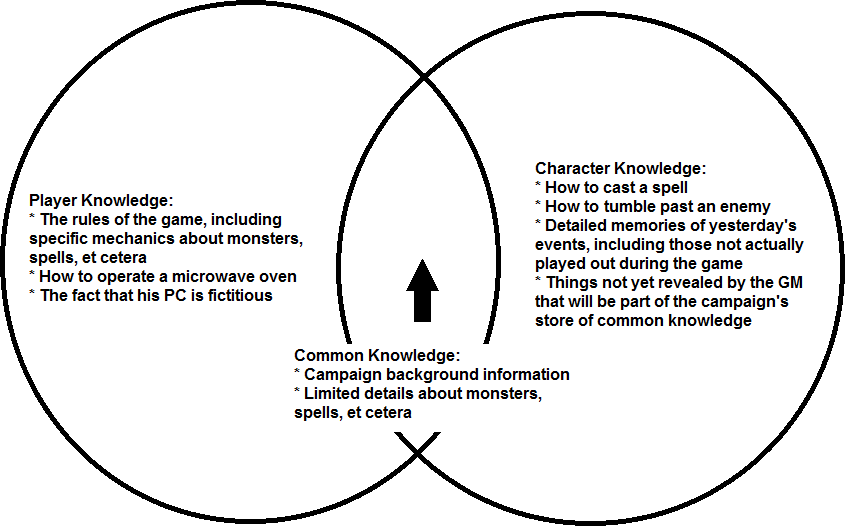
I’ve seen an increase in the amount of metagaming about monster abilities. The players (rather than the GM) have built their PCs, and they understand that the monsters are pretty much built using the same rules. Too many players then decide that this means that they can reverse engineer monsters during game play, and that those parts of a monster that don’t reverse engineer are somehow wrong.

I’ll toss out two examples to playfully tweak one of my players. Once upon a time, I ran an adventure where the PCs encountered some undead monstrous vermin. When it was painfully discovered that these zombie vermin were venomous, complaints ensued, such as, “But they don’t have Constitution scores. They can’t have poison.” Or, “That ability is lost when applying that template.” Another time the PCs met mummified hell hounds. The mummified hell hounds, much like non-mummified hell hounds, were immune to fire, which prompted complaints that “Mummies are vulnerable to fire. They shouldn’t be immune to fire if they’re mummies, because all mummies have that vulnerability.”

And thus we arrive at i being for ignorance.

What I want is a perfect game where the players (rather than the GM) are completely clueless about the rules that monsters follow. The players don’t know what a template is. They don’t know that a dragon’s breath weapon’s save DC is based on Constitution. Et cetera. Instead, they accept the game world as it is revealed to them, and have their characters react to that world, not the presumed rules violations embodied by a particular encounter.

Barring that, folks can just agree to stop the metagamey reverse engineering and work more on roleplaying their characters’ reactions.

“I hit the mummified hound thing with a scorching ray.”

“The searing flames of the spell have no apparent effect. The mummified hound charges to attack.”

“Ye gods! What manner of mummies are these, that they are immune to fire?”

Note the difference in the character’s reaction. It’s in-character. It also opens up the possibility for the character to learn the answer to his question, whether through something as simple as a Knowledge skill check or as involved as searching through musty tomes in the city library while consulting the sages.

“Huh, those mummified hounds were created from the corpses of hell hounds, which, even after the mummification process, retain their fiendish resistance to fire. They are, however, particularly vulnerable to cold. I must remember this…just in case.”

April 10th, 2012  in RPG No Comments »

H Is for Horror (for Free)

Mythopoetic Games “is dedicated to publishing a small number of free tabletop pencil-and-paper roleplaying games.” The site and the games are from the minds of Christopher Johnstone and Dean Suter. On the downloads page, Mythopoetic Games has five free tabletop RPGs. The one that we’re interested in today is Danse Macabre. Here’s the blurb:

A Roleplaying game of horror, intrigue and dark fantasy set in an alternative and dark Medieval Europe. Dark and monstrous things haunt the shadows of the forest and mountain. Old gods lurk mad and forsaken in their sacred pools. Wars between Heaven, Faerie and Hell have left all the mortal world bloodied and broken beneath the surface of things. A rot of destruction is spreading, and soon the final reckoning of creation itself may be at hand.

Five PDFs comprise this free horror RPG, and these aren’t piddly little documents typed up with large amounts of amateurishness. They are laid out in simple, readable two column format with evocative illustrations and printer-friendly goodness. The only downside to the PDFs is the lack of bookmarks, but this is really only a small complaint applicable to the Core Rules, the largest of the PDFs.

The Core Rules weigh in at about 140 pages divided into 10 chapters, including the introduction. The game uses a d6 dice pool action resolution system, and includes a nice little differentiation between subjective resolution (for things that don’t require dice rolls) and objective resolution (for things that do). Regarding the former: “The key to Subjective Resolution is acknowledging that clever ideas and well-narrated actions deserve rewards. Encouraging Subjective Resolution speeds the pace of a game considerably.”

Action resolution is by rolling the relevant number of d6 based on the appropriate trait and counting successes. Each 6 is one success, and “Easy” tasks require no roll to succeed. These traits tests can be simple (unopposed), opposed, or prolonged (for things like a foot race). Characters also have a pool of Effort points that can be spent to increase the success range for a die. For example, one Effort point makes rolls of 5 or 6 a success. Overall, this is a simple and quick action resolution mechanic, and the addition of Effort to increase success is at least close to inspired.

Character creation starts with a concept. Characters have a motivation (example: “I am an Irish wanderer, driven to seek out the mysteries of my ancient Celtic roots and beliefs.”) and an upbringing (such as noble or serf). The latter provides bonus skill points for certain skills.

In keeping with the medieval theme, characters also have “aspects of nature” that “define where you [sic] character falls in the endless wars between Heaven and Hell.” The player picks at least one but no more than three personality traits chosen from two lists: one for the Seven Heavenly Virtues and another for the Deadly Sins. Players earn Fate Points (used for character advancement and improvement) for roleplaying their PCs’ personality traits. Characters also have five background points that are spent buying Background traits that may affect skills. Skills are likewise purchased on a point system. Sorcery skills are accessed via appropriate background choices.

Further chapters detail character traits and background effects, the combat system, the magic system, the setting (which is chock full of win and sufficiently generic to fit a wide variety of game systems), an essay on roleplaying, various beasts and devils, and two short introductory scenarios.

Darkest Arts is a 10-page PDF that expands on two systems of magic, warlockry and necromancy. Another magic expansion, The Sacral and the Lost, talks about “white magic” such as angelic pacts. The wee people figure prominently in Danse Macabre, and another 10-page PDF, Faerie Lore, offers more detail about these mercurial creatures. Lastly, Tales Told by Shadows offers five short scenarios in 27 pages.

There is a wealth of good stuff in these documents. Even if you’re not inclined to play the game itself, the scenario, setting, and character background sections offer oodles of inspiration for anyone interested in running a dark fantasy game set in a horror-filled Middle Ages.

April 9th, 2012  in RPG 1 Comment »

G Is for Gröd the Gorilla

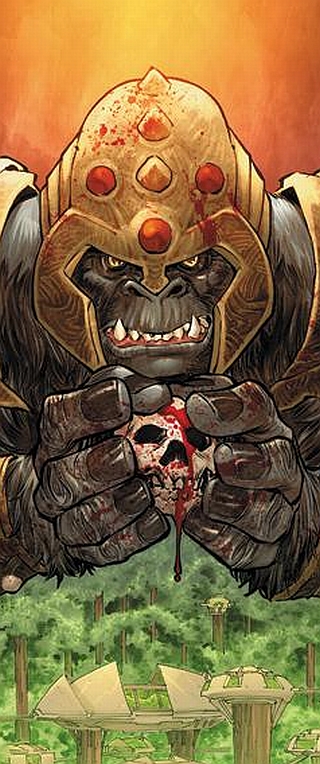
Gröd the Gorilla transformed from a common jungle ape into an evil, intelligent beast after exposure to the eldritch energies of a glowing hunk of starmetal that fell from the heavens. Those same energies unlocked wild psionic powers from the beast’s mind. With its newfound abilities, it took the name Gröd and began a terrible career as an evil adventurer. That was years ago. Since that fateful day, Gröd has grown in power and influence. He now rules a savage band of greenskin orcs augmented by a motley assortment of ogres and girallons. From his treetop fortresses, Gröd lives the life of a warlord, exacting tribute from those who travel through his domain as well as waging skirmishes against nearby rivals.

Gröd’s personality mixes a sort of superficial sophistication with bouts of intense savagery. He affects an informed taste for finery and higher cultural pursuits, but isn’t above eating a slain enemy uncooked, tearing flesh and snapping bones to suck marrow. Gröd evinces an irrational hatred of adventurers who move faster than he does.

Design Notes: Gröd was built by applying the awaken spell to a normal Pathfinder gorilla, but with the Strength score increased to a more appropriately gorilla-like level. I then adjusted the gorilla’s CR to 4 before adding 8 levels of wilder, counting those levels as a non-key class. This bumped Gröd’s CR to 8. The additional +1 CR results from giving Gröd equipment equal to that of an 8th-level PC instead of a 8th-level NPC. All psionic abilities, skills, feats, and equipment come from Psionics Unleashed by Dreamscarred Press. I highly recommend this book if you like both psionics and Pathfinder. You can check out its OGC at this link.

Gröd the Gorilla
Awakened Gorilla Warrior Wilder 8
CR 9; XP 6,400
NE Large magical beast (augmented animal, psionic)
Init +3; Senses low-light vision, scent; Perception +14

DEFENSE
AC 23, touch 14, flat-footed 15 (+6 armor, +3 Dex, +2 dodge, +3 natural, -1 size)
hp 121 (5d8+15 plus 8d8+24 plus 13 Toughness plus 8 Psionic Body)
Fort +11, Ref +9, Will +10
Defensive Abilities elude attack +2

OFFENSE
Speed 30 ft., climb 30 ft.
Melee 2 slams +17 (1d6+8 plus 1d6 electricity), or
Ranged +1 teleporting javelin +12 (1d8+9, range increment 30 ft.)
Space 10 ft.; Reach 10 ft.
Psionic Powers Known (68 pp/day, ML 8th; concentration +11, +15 defensively):
4th – empathic feedback (Will DC 18)
3rd – body adjustment
2nd – mental disruption (Will DC 16)
1st – energy ray, force screen

STATISTICS
Str 26, Dex 16, Con 16, Int 14, Wis 16, Cha 16 (14)
Base Atk +9; CMB +18; CMD 31
Feats Combat Manifestation, Great Fortitude, Mental Leap, Psionic Body, Psionic Meditation, Skill Focus (Perception), Skill Focus (Stealth), Toughness (B)
Skills Acrobatics +18 (+22 jumping), Autohypnosis +14, Climb +23, Intimidate +14, Knowledge (psionics) +13, Perception +14, Spellcraft +13, Stealth +9, Swim +15, Use Magic Device +14; Racial Modifier +8 Climb; Armor Check Penalty -1
Languages Common, Giant, Orc

SPECIAL ABILITIES
Hardened Body (Ex): Gröd’s deep and intense connection to his body means that when his mind surges with power, his body grows more powerful. Gröd gains 5 temporary hit points whenever he gain the benefits of surging euphoria. These temporary hit points last for the duration of Gröd’s surging euphoria.

Psychic Enervation (Ex): Pushing himself by invoking a wild surge is dangerous. Immediately following each wild surge, Gröd may be overcome by the strain of his effort. The chance of suffering psychic enervation is 15%. When overcome by psychic enervation, Gröd is staggered until the end of his next turn and loses a number of hit points equal to his normal manifester level (the increase in manifester level from his wild surge does not increase the number of hit points lost). Gröd may expend his psionic focus as a free action when he would suffer psychic enervation to convert this damage into power point loss, although he is still staggered as normal.

Surge Blast (Su): Gröd can channel his wild surge into a blast of uncontrolled phrenic energy. As a standard action and by expending psionic focus, Gröd can make a ranged touch attack (range 30 feet) that deals 3d6 points of force damage.

Surging Euphoria (Ex): When Gröd uses his wild surge ability, he gains a +1 morale bonus on attack rolls, damage rolls, and saving throws for 3 rounds. If Gröd is overcome by psychic enervation following his wild surge, he does not gain the morale bonus for this use of his wild surge ability.

Wild Surge (Su): Gröd can let his passion and emotion rise to the surface in a wild surge when he manifests a power. During a wild surge, Gröd gains phenomenal psionic strength, but may harm himself by the reckless use of his power (see psychic enervation).

Gröd can choose to invoke a wild surge whenever he manifests a power. When he does so, he gains +3 to his manifester level with that manifestation of the power. The manifester level boost gives him the ability to augment his powers to a higher degree than he otherwise could; however, he pays no extra power point for this wild surge. Instead, the additional 3 power points that would normally be required to augment the power is effectively supplied by the wild surge.

Level-dependent power effects are also improved, depending on the power Gröd manifests with his wild surge. This improvement in manifester level does not grant any other benefits outside of the manifestation (he gains no higher-level class abilities, for instance).

Gröd can expend his psionic focus to manifest a psionic power without expending any power points, powering the manifestation with only his wild surge. He manifests this power as if all power points were paid by his wild surge ability. This results in the power being manifested as if the base power point cost of the power was paid, along with augmentation equal to his wild surge amount, but he may not augment the power beyond the amount of his wild surge, and when checking for psychic enervation, the chance to be overcome doubles to 30%. Gröd must wait 10 minutes after wild surging in this fashion before he can do so again.

EQUIPMENT
+2 chain shirt of landing, +1 teleporting javelin, bracers of mighty shocking fists (as an amulet of mighty fists but occupying the wrist slot), headband of alluring charisma +2, potion of displacement, potion of greater magic fang +2, psionatrix of telepathy, ring of forcefangs, plus 2,550 gp of other stuff, some of which should be spent for various magical scrolls for use via Use Magic Device

April 7th, 2012  in RPG No Comments »

F Is for Folklore

Today’s letter inspired me to pull Kemp P. Battle’s compilation Great American Folklore from the history section of my library and flip through its pages for inspiration. Pages 41 and 42 list several superstitions about traveling, and I said to myself, “Self, this might work!” After all, adventurers travel, doing so in a world where the hazards attributed to superstition in our world can be real dangers. (Dramatic Aside: I know of one RPG product that’s expanded on the ideas of superstitions within the game world, the aptly titled Superstitions by Creative Mountain Games.) Let’s pull out a few of traveling superstitions compiled by Battle, and briefly muse about their game effects.

Superstition: “When you leave on a trip, toss an old shoe behind you for good luck.” Possible Game Effect: A character who performs this simple action gains a floating +1 luck bonus that can be used once at any time during the trip. If not used before the trip ends, the floating luck bonus goes away.

Superstition: “If you find a pin on the road, pick it up; it’s good luck.” Possible Game Effect: The bearer of the lucky pin gets to reroll the first failed roll he makes. He must abide by the results of this second roll.

Superstition: “If you see a spoon, let it be! Some folks are known to throw out a spoon when their luck is going badly, hoping that a passerby will pick it up and take the bad luck with him.” Possible Game Effect: This is the opposite of the lucky pin. The PC carrying the bad luck spoon must make two rolls and accept the worser of the pair. If the GM feel particularly grumpy, turn the spoon into a cursed object that the unlucky PC cannot easily rid himself of.

Superstition: “When you pass a crossroads, slap your right leg for good luck.” Possible Game Effect: After the leg slap, the superstitious PC gains a +1 luck bonus to saving throws and Perception checks for the remainder of the day.

Of course, it seems sensible to me that these little superstitions shouldn’t be universally or automatically effective. Not everyone who tosses a shoe behind them enjoys good luck on a trip, but some people do. I’m not sure about what means should be used to determine if a superstition has an effect. Perhaps I’ll ruminate on that and save it up for S?

April 6th, 2012  in RPG No Comments »