The Quid Novi? Collection

When I started Spes Magna Games back in 2009, I also started Quid Novi?, a twice-monthly e-mail newsletter of gaming goodness that eventually became a monthly PDF of gaming goodness which has now fallen by the wayside. The Quid Novi? Collection includes the 10 individual PDFs as originally published.

About 80% of the content in the Quid Novi? Collection is for the Pathfinder Roleplaying Game. You get two short adventures, and curses, diseases, magic items, haunts, monsters, giant lilypads, spells, and a Psionics domain for clerics. The other 20% of the collection was written for Old School gaming, and includes two short adventures as well as curses, magic items, prismatic mists, monsters, deadly mushrooms, and spells

Caveat emptor: If you were a Quid Novi? subscriber, you’ve got no reason to buy this collection. You already received all of these PDFs for free. The zipped file for sale includes 10 separate, bookmarked PDFs.

With this special discount code for DriveThruRPG, you can get The Quid Novi? Collection for $1.50, half off its regular price.

November 19th, 2013  in Quid Novi?, Spes Magna News No Comments »

Biderukic’s Dense Salamander

It’s been a while since I posted a new spell. As I’m going down a list of randomly generated Vancian spell names, here’s what’s next:

Biderukic’s Dense Salamander
Spell Level: Magic-User, 5th Level
Range: NA
Duration: 6 rounds

The caster summons 1d4 dense salamanders, who serve him until slain or until the duration of the spell expires. The dense salamanders do not appear immediately; there is a delay of 5 rounds before they appear.

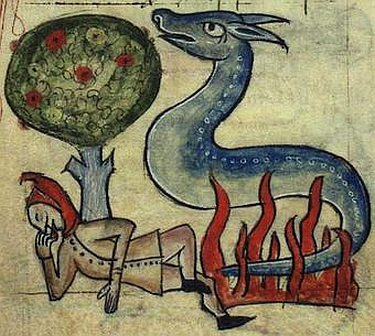
Dense salamanders are sluggish, somewhat intelligent creatures of the elemental planes of fire. They appear to be large snake-like beasts with tough scales that give off dangerous heat. The very touch of a dense salamander deals 1d4 hit points of fire damage, and they wrap their tails around foes to cause an additional 1d4 points of crushing damage per round as the victim writhes in the deadly heat of the serpentine coils.

Dense Salamander: HD 2+2; AC 4 [15]; Atk touch and constrict (1d4 + 1d4 heat); Move 9; Save 16; AL C; CL/XP 4/120; Special: constrict, immune to fire, heat.

November 17th, 2013  in RPG No Comments »

Elimungazi in Busara

The great city Busara, long a center of culture and learning, gleams like a precious jewel on the western shore of Donao, that vast salt lake of unfathomable depths. Centuries ago, Busara was little more than a fortified library built by the warrior-monks of Zazic*, the goddess of knowledge. Today, that library has grown to become a vertiable city within a city. Thousands of Zazic’s faithful investigate every field of human knowledge, and scholars from across the world make pilgrimages to Busara for a chance to study and learn.

Of course, mere mortal reason cannot sufficiently grasp all that there is to know. If Knowledge is a tower, then mortal efforts are a ladder that cannot reach the top. In her mercy, Zazic does not leave her faithful trapped by the limits of their own intellects. The scientist-prophet Isaija Paskal received a series of architectural visions from Zazic. He also received a compulsion to transform these visions into reality. Thus, Elimungazi was built.

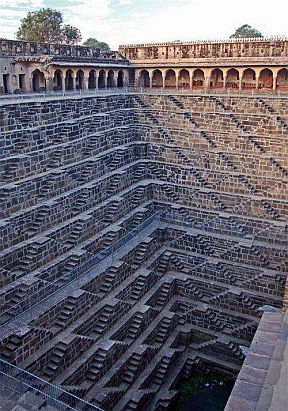
Workers excavated an enormous pit in Busara’s eastern park adjacent to the ancient library, and builders contructed a series of walkways and stairs running from the porticos above to the cobblestone floor below. When confronted with ineffable questions, Zazic’s faithful may receive permission from the hierarchy to meditate, ascending and descending the stairs according to Zazic’s prompts. Only the most spiritually attentive seekers can “hear” all of Zazic’s instructions during this meditative stair-walk. Success unlocks great secrets, and even failure may still yield partial knowledge.

*Zazic collects and collates everything that can be known. She reveals the patterns within disciplines and the relationships between fields of knowledge.

November 14th, 2013  in RPG No Comments »

The Mud Sprite

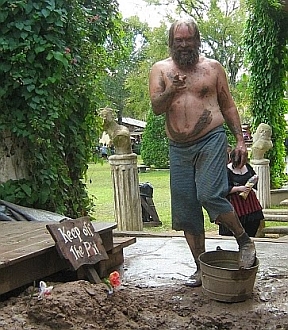
Last week, we teachers of 4th and 5th graders field tripped our students to the Texas Renaissance Festival. The highlight of the Texas Renaissance Festival for me is always the Mud Show. I especially adore Billy Billy VonBilly. How much do I adore him? Enough to turn him into a Swords & Wizardry monster:

The mud sprite, a creature of joy and mischief, dwells in muddy places such as a swamp or a pig-cote. They are often encountered in troupes that love to perform low-brow comedy acts for rewards of money, beer, and food. Mud sprites appear human, but they are diminutive, invariably filthy, and often quite hairy. These fey creatures can breathe water and can hide in mud or muddy areas (75% chance of success). When forced to defend themselves, they melee with daggers or throw balls of mud. A target struck by a mud ball must make a saving throw or be blinded for 1d4 rounds.

For Swords & Wizardry:

Hit Dice: 1d6 hit points
Armor Class: 5 [14]
Attacks: dagger (1d4)
Saving Throw: 18 (14 vs. elemental effects)
Special: Breathes water, hide in mud, mud ball
Move: 9 (Swim 12)
Alignment: Neutrality
Challenge Level/XP: 2/30

November 12th, 2013  in RPG No Comments »

Paying Respects at the Heretic’s Grave

The faithful of Renceth* have long shuddered at tales of the arch-heretic Galen Polegoas, who had been a well-respected and holy cleric instrumental in several saintly actions against the forces of chaos. Galen’s had a well-deserved reputation for erudition, generosity, and piety. Unknown to most, however, was the fact that gnawing doubts troubled Galen. Galen’s faith in Renceth’s providence was weakening, especially in light of myriad little sufferings people sought his advice about.

In face of so much disappointment, Galen could no longer accept the doctrines that explain how Renceth provides the faithful with what they need, but that the faithful must be alert and discerning enough to recognize these provisions. Instead of proper orthodoxy, Galen perceived Renceth’s conditional providence as being akin to the Tronsosian** commandment to take what they need.

And so Galen consolidated his power base and from the safety of his fortress-cathedral began to preach that Renceth and Tronsos were one and the same. Galen taught that it was true that Renceth provided his faithful with opportunities for success and happiness, and that often those opportunities belonged to other people and were kept behind locked doors. Is not Renceth the God of Keys? Are not keys to be used to open locks? Can one be truly happy without the experience of beauty?

“Those who selfishly hoard what Renceth wills to be yours for your happiness seek to thwart Renceth’s will,” taught Galen. “Therefore, Renceth, Opener of Ways, authorizes you to take what he wills to be yours. And, since it is yours not the other’s, taking it cannot be unlawful. No man can be condemned for taking what it is his by divine will, for protecting what is his by divine will.”

And so the forces of chaos gained a powerful ally, and Galen’s city plunged into violence. A council of bishops convened and demanded Galen appear before them to answer charges of heresy. Galen refused, denying the council had any true authority. Armies were gathered, and Renceth’s faithful marched on Galen’s city. The seige lasted for years. Great was the suffering, and many on both sides died. Eventually, right order prevailed. A loyal remnant within the city opened the gates, and the crusaders surged within, putting many heretics to the sword before Galen was captured.

As justice demanded, Galen was given a chance to defend his actions. He persisted in his errors, and the tribunal passed sentence. Galen was beheaded in the public square, and his body was burnt in a purifying fire. As required by canon law, the charred remains were placed on display as a stark reminder of heresy’s consequences. When the sun rose the day after Galen’s execution, his blackened bones had vanished.

Agents of Tronsos stole those bones, regarding them as sacred relics. These agents interred Galen’s bones in a secret location in a desolate region several miles outside the city. Thieves and murderers devoted to Tronsos guard the site to this day, jealously preventing trespassers from approaching Galen’s grave.

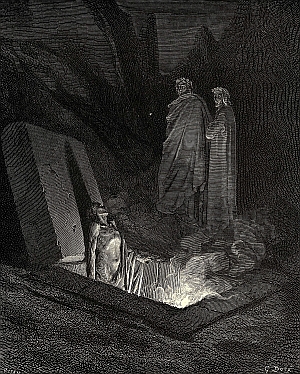
Any cleric of 5th-level or higher who manages to safely approach Galen’s grave and offers appropriate sacrifices of objets d’art (worth at least 3,000 gold pieces) can call forth Galen, who will rise from his grave veiled in fire. The visiting cleric may interrogate Galen, who will answer questions as if the cleric had cast Contact Other Plane. The visiting cleric decides the maximum number of questions and suffers any negative effects that would result.

*Renceth is the God of Prophecy, Friendship, and Keys. Renceth knows the future, but he does not freely share that knowledge. Instead, he puts into the paths of his faithful the people and the resources necessary to open the doors that will be encountered. Those who ignore Renceth’s gifts find their paths full of obstacles whereas the observant find their paths full of opportunities.

**Tronsos is the God of Thieves and Beauty. Tronsos doesn’t reward his faithful. Instead, his faithful take their rewards from those unable to keep them from being taken. Of all rewards, beauty is the most prized, and beauty must be possessed and hidden away, safe from covetous eyes.

November 2nd, 2013  in RPG No Comments »