H Is for Headaches That Pound

img

Musical Interlude

Today’s post is supposed to be about hero points, that third type of point that I forgot about when I said that there were two types of points in The Boogie Knights of the Round Table. Mea culpa maxima. Unfortunately, I have had quite the pounding headache all day long; hence, my choice of a musical interlude. Tomorrow, I shall tackle both hero points and initiative in a sort of two-for-one post.

Until then, don’t stop the music.

April 9th, 2015  in Product Development No Comments »

G Is for Genres

img

Musical Interlude

Arthur and Lance traveled the land, challenging different performers to battles of song, dance, and poetry. The disco duo defeated every opponent, but always with grace and good will. In the process, they united several clubs dedicated to various styles of performance. Thus, the Peace of Genres.

This dealt the Man a significant blow. The Man is all about control, and one of the Man’s most effective tools for maintaining that control is dividing people against each other. As a result, the Man encourages classism, racism, religious triumphalism, et cetera. Anything that some people can latch onto in order to rationalize feelings of superiority serves the Man’s purposes.

One of the Man’s early triumphs came about shortly after the birth of jazz and the blues. The Man planted seeds of suspicion among whites, especially in the South. Jazz and the blues weren’t music for respectable people, the Man hinted. It was fine for those people, but those people needed to keep themselves and their music in their place. As the blues evolved into rock, the seeds of suspicion were sown anew. The same happened when hip hop started to move from the streets to the airwaves.

In a seeming contradiction, the Man also lured artists into the mainstream. This way, those inclined to ignore or rebel against the Man’s insinuations could be lulled into thinking that these mainstream artists (frequently referred to as “sell-outs” by those in the know) somehow represented an authentic musical voice. Along with the mainstream came the merchandising, the carefully controlled messages, and further divisions.

Arthur and Lance achieved something important with the Peace of Genres. People still have their musical preferences. Arthur and Lance remain devoted disco darlings. The crowded clubs in the Land of Funk still thrum with groovy bass lines. Cowboys still two-step in honky tonks, and long-haired head bangers thrash in mosh pits.

But gone is much of the hostility. In its place is an appreciation for artistry and a common desire to get down. Tex Rhinestone, manager of the Texas Twister, still thinks disco sucks, but he also knows that “Disco sucks!” are words put into the people’s mouths by the Man.

“United we dance! Divided we fall!”

April 8th, 2015  in Product Development No Comments »

F Is for Feelings and Other Things That Get Hurt

img

Musical Interlude

Yesterday, I explained hit points. An earlier post talked about action resolution, which includes combat. It now seems like a good time to talk about damage. For an extended action, such as a fist fight or playing the dozens, a successful attack inflicts 1 point of damage to Kung-Fu, Brains, or Cool, depending on the nature of the attack, plus 1 more point of damage for every full 4 points by which the attacker won the challenge.

A hero might also take damage from failing an unopposed or simple action. Attempting to leap from one rooftop to the next, which would be an unopposed action, could result in an injury. So could attempting to catch that knife lobbed at you by that seven-foot-tall Chinese sorcerer, a feat that could be resolved as a simple action. In these cases, treat the opposing number, be it a Difficulty Number (DN) or dice total, as the attacker. Then, figure damage as normal.

As mentioned above, damage doesn’t always mean actual damage. A Trash Talking Gang Leader can beat a hero down with his fists, which will result in bruises and broken bones (a loss of Kung-Fu hit points), or he can beat a hero down with threats and insults while his gang stands around laughing, which will result in a bruised ego and a broken will (a loss of Cool hit points). In the former case, a trip the ER is in order; in the latter, a hug and a pep talk might suffice.

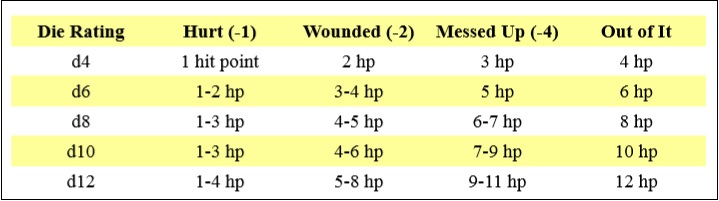
In addition to having three sets of hit points (Kung-Fu, Brains, and Cool), each ability score has four wound levels: Hurt, Wounded, Messed Up, and Out of It. The following table shows the wound levels and number of hit points each wound level encompasses. The first three wound levels impose a penalty to any action. The penalty is shown in parentheses in the table. When a hero is Out of It, he can take no further actions until healed to at least Messed Up.

Speaking of healing, The Boogie Knights of the Round Table has no standard rule for recovering hit points. How much a hero heals in any given amount of time is a subjective decision made by the GM based on the source of the damage and, more importantly, what makes the story more entertaining.

April 7th, 2015  in Product Development No Comments »

E Is for Experience and Other Points

img

Musical Interlude

The Boogie Knights of the Round Table (BKotRT) has two types of points: experience and hit. Earn enough of the former, and a player’s character improves. Lose enough of the latter and a player’s character ceases to improve, probably forever.

At the end of a successful adventure, a hero typically earns 1-3 experience points (XP). These XP are spent to increase the die ratings of ability scores and qualities, as well as to acquire new qualities. The XP cost to rise to the next highest die rating equals one-half the current rating’s maximum value. So, it would cost Gary’s Beau Mandy 2 XP to increase Rodeo Clown d4 to Rodeo Clown d6. It would cost 4 XP to increase Beau’s Cool from d8 to d10. A new quality costs 4 XP, and it starts with a d4 die rating. After this, the quality can be improved as normal. When an ability score or a quality reaches d12, it can still be improved, but it’s expensive. For 8 XP, a d12 ability score or quality increases to d12+4, or 6 XP for the d12 and 2 XP for the d4. After this, the additional d4 can be increased as normal.

A hero has three sets of hit points, one for each ability score. A hero’s hit points for each score are equal to the maximum possible for the ability score’s die. Let’s go back to Beau, whose ability scores are Kung-Fu d6, Brains d8, and Cool d8. Consequently, Beau’s hit points are Kung-Fu 6, Brains 8, and Cool 8. Different types of combat inflict different types of damage. In the last post, Beau engaged in social combat against his contact to convince him to reveal needed information. During this conflict, Beau would most likely suffer damage to his Brains and/or Cool.

April 6th, 2015  in Product Development No Comments »

D Is for Dice Pools

img

Musical Interlude

The Boogie Knights of the Round Table (BKotRT) uses a simple dice mechanic to resolve all actions. Before this post goes on to discuss the specifics, it’s important to understand two Super-Important Rules.

Super-Important Rule #1: In all cases, before dice are rolled, the action to be attempted should be described. What is the actor doing? How is he doing it? Then and only then are the applicable dice rolled.

Super-Important Rule #2: Whoever succeeds in an action gets to narrate the results of the action. This includes deciding the fate of the loser when applicable.

All actions are resolved by rolling the dice associated with the most appropriate ability score and most appropriate quality, based on the action’s description. BKotRT has three categories of actions: unopposed, simple, and extended. Let’s take a moment to recall Gary’s character from a previous post. We’ll use Beau in examples for each category of action.

Beau Mandy
Kung-Fu d6, Brains d8, Cool d8
Ex-Con Banjo Player d6, Rodeo Clown d4, Full of Homespun Wisdom d6

While on his way to Hillbilly’s, Beau gets a flat tire. He’s in a hurry. Beau’s contact won’t wait in the honky tonk for long if Beau is late. Mumbling about cheap tires, Beau slides from his pick-up’s cab and starts fishing tools from his tool box. Changing a flat is normally an unopposed action. The tire isn’t actively resisting Beau’s efforts. The GM decides that changing the flat in a timely manner is an easy action and assigns a difficulty number (DN) of 6. Gary describes how Beau’s had to change lots of flats over the years, what with all his time on the road as a Rodeo Clown. Because of these years of experience, Beau isn’t likely to get flustered by the inconvenient delay. The GM thinks this is reasonable, and so Gary rolls Cool plus Rodeo Clown, or d8+d4. If he gets at least a 6 total, Beau fixes the flat in plenty of time to reach Hillbilly’s before his contact spooks.

A few minutes later, Beau pulls into Hillbilly’s parking lot. He mosies up to the front door, but is stopped by the burly, towering doorman. The doorman glares down at Beau and growls, “I bet there’s rich folks eatin’ in a fancy dining car.”

Beau wasn’t expecting this challenge. Apparently Hillbilly’s management changed the password. This is another unopposed action with a 6 DN. Beau is an Ex-Con Banjo Player. This is child’s play for him. Gary rolls Brains plus Ex-Con Banjo Player, or d6+d8, and succeeds, and Beau drawls, “They’re probably drinkin’ coffee and smokin’ big cigars.”

Beau pays the cover charge and mosies inside. A few steps through the door, he’s confronted by a drunk cowgirl looking for a good time. Beau doesn’t have time for this. He’s a man with a mission, but the cowgirl is insistent, clinging to Beau and demanding he dance with her. Beau wants to let her down easy as well as not attract attention. This is a simple action. The cowgirl’s drunken insistence opposes Beau’s purposeful but gentle rejection. Gary describes how he turns on the charm and whispers some countrified sweet words. He then rolls Cool plus Full of Homespun Wisdom, or d8+d6. Gary’s total is compared to the cowgirl’s total. He wins the simple action. The cowgirl giggles and staggers off to paw another man.

Beau slides into the booth across from his contact. He orders an ice cold Lone Star. His contact his nervous and says he’s changed his mind, that he doesn’t want to have anything to do with the upcoming pirate radio broadcast. Beau must convince him otherwise. This is an extended action, one in which Beau must eventually wear down or otherwise defeat his opposition. In other words, Beau must engage in a form of social combat. A combination of Brains and Cool combined with Full of Homespun Wisdom is matched in round-by-round action against the contact’s dice totals. Pretty soon, Beau has calmed the contact down, and the contact hands over the frequency modulator’s location.

So, that’s the gist of using dice pools to resolve actions in BKotRT. There are a few other details, such as the range of DNs from easy to hardest, and how damage is figured, but we can leave those details for later.

April 4th, 2015  in Product Development 1 Comment »