Nazi Superscience!

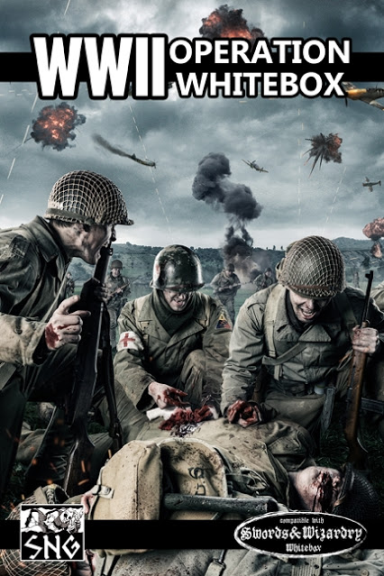
If you still haven’t purchased your copy of WWII: Operation WhiteBox by Pete C. Spahn, you need to hurry up. Seriously. Do you want the Axis to win? I think not!

Since I’m not a big fan of historical accuracy in games, even games based on history, I think the niftiest parts of OWB are the mini-settings. Why fight normal Nazis when you can match wits and trade bullets with Nazi cyborgs, occultists, and space aliens. When you purchase your copy of OWB, don’t read through the book in the order its words are written. Skip ahead to the mini-setting section and gape in astonished awe at Nazi superscience, Nazi occult, and Nazis in space.

Speaking of Nazi superscience…

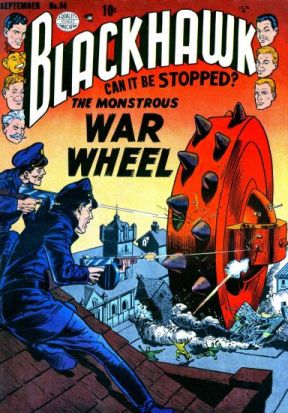
Nazi War Wheel

Armor Class: 2 [17]
Hit Points: 66 (HD 11)
Movement: 12
Attack: Flamethrower (x2), Heavy Tank Gun (x6)
Modifications: Communications, Firing Ports (x4), Reinforced Hull (x3)

The War Wheel was invented by Professor Merson, who defected to the Nazis, although it was widely believed he was abducted. The War Wheel went into action in May 1940. Its interior compartments remain level due to highly advanced gyroscopes.

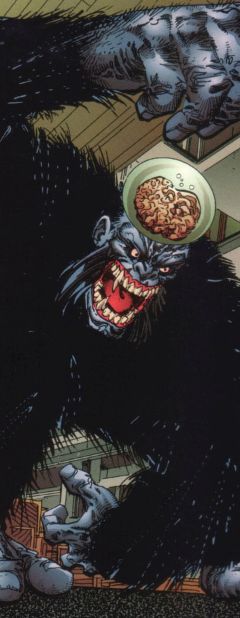
Brain Drain

Armor Class: 4 [15] (advanced materials and Dex)
Hit Dice: 4
Total Hit Bonus: +4
Attacks: Weapon or robot fist
Saving Throw: 15
Special: Mind control
Movement: 12
HDE/XP: 5/240

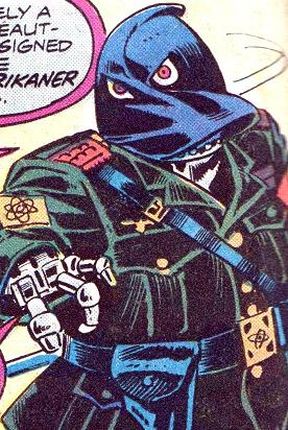
Brain Drain’s real name is Werner Schmidt. He is a Nazi scientist who was injured during the crash of an alien vessel. Unable to save his body, Nazi doctors transplanted Schmidt’s brain into a advanced robotic body based in part on alien technology. Free from the limitations of a human body, Schmidt developed the ability to telepathically control minds.

December 2nd, 2016  in RPG No Comments »

Drats! I’m Late Again!

Another excerpt from my draft one document for The Four Color, this time talking about the inclusion of hero-focused subplots.

Subplots

A Subplot is a story within a story. It occurs during an Issue, but a Subplot is not the main focus that the Issue. Subplots give the Writers and Editor a chance to explore the more mundane facets of a hero’s life. The use of Subplots puts the Writer in the driver’s seat for determining the elements of his hero’s Subplot.

The Writer’s Outline

Preparing a Subplot to present to the Editor requires answering a few questions.

What Is the Conflict? Subplots must have some sort of conflict, but those conflicts seldom involve actual combat. Instead, the conflicts tend to be personal or interpersonal. Diesel missed his last date with Irene because he was saving a busload of children, and Irene is displeased with being stood up yet again. Diesel has promised her that he’ll make it up to her. What sort of comedy of errors might ensue?

What Introduces the Conflict? Your hero becomes aware of the Subplot somehow. Does Diesel bring Irene flowers as an apology only to be roundly rebuked?

Who Else Is Involved? Are any other heroes part of the Subplot? If so, what do those heroes (and their Writers) know about the Subplot before it begins? Also, what non-hero characters are involved, and what roles do those non-hero characters play? Keep in mind that while a Subplot does shift the focus to a specific hero, it’s generally bad form to leave the other players sitting around with nothing to do for too long. More on this below under The Editor’s Outline.

How Might the Conflict Resolve? It helps to give the Editor an idea or three about expected possible outcomes for a Subplot. A Subplot with only one possible outcome is possible, of course, but a degree of uncertainty can increase dramatic tension and make for a more satisfying resolution.

The Editor’s Outline

Once the Editor has received a Subplot outline from a Writer, the Editor must review the proposed Subplot, keeping in mind questions such as these:

How Does the Subplot Fit? Perhaps the most important consideration for the Editor is how easily the Subplot can fit into the current Issue. Diesel trying to keep that important date with Irene might be a great idea for a Subplot, but if Diesel is currently trapped in the Dimension of Rage, it could be really difficult justifying shifting focus a bit toward his dating problems. If the Subplot does fit the current Issue, develop some idea about how the Subplot will interrupt or mesh with the main action of the story.

Will the Subplot Be Fun? The second most important question relates to fun, and that includes fun for everyone at the table, not just the Writer of the Subplot. As mentioned above, it’s bad form to expect the other Writers to be passive spectators to someone else’s fun. For example, years ago, I GMed a short-lived superhero campaign. One of the heroes was a surly, rebellious teenage girl with fabulous powers who skipped school and snuck out of the house to fight crime. We started one session with a Subplot about her parents staging an intervention. The other players took on the roles of the girl’s concerned parents, her pastor, and a professional psychologist. For about ten minutes, we played out our own episode of Dr. Phil, and fun was had by all.

Who Else Might Be Involved? The Writer should have already given the Editor some idea of which heroes and non-heroes might appear in the Subplot. Did the Writer forget anyone? Is there someone who ought to make an appearance that the Writer probably didn’t even consider? If so, add them.

What Do I Have to Prepare? Consider how much prep work needs to be done before the Subplot can be used in the current Issue. Plan accordingly.

December 2nd, 2016  in Product Development No Comments »

Wars of the Worlds

I recently received by copy of WWII: Operation WhiteBox by Peter C. Spahn. I read most of it last night before bed. Short review: It’s nearly perfect. Do you like the OSR and/or do you like historical roleplaying games? Then go purchase WWII: Operation WhiteBox as soon as possible if not sooner.

Best of all from my perspective is that WWII: Operation WhiteBox is fully compatible with the Swords & Wizardry WhiteBox fantasy RPG. Thus…

Worlds Wars, Too

Portals exist between two worlds torn by war. The mad sorcerer Amon-Gog commands armies of orcs, gargoyles, and giants. The mad ruler Adolf Hitler commands armies of soldiers, planes, and tanks. Both seek to purify their worlds with blood and fire in lunatic quests for imagined utopias. Against these rapacious hordes stand stalwart allies: the United States, the Lorian Confederation, France, Ironspyre, the United Kingdom, the Four Shires, the U.S.S.R., and the Buyan Steppes.

The Heroes

Make up a character using either Swords & Wizardry WhiteBox or WWII: Operation WhiteBox. Your character has a new ability, Link, which represents his connection to his native world. Link starts with a d6 rating.

You Got Your Fantasy in My History!

Magic does not work in the world of WWII: Operation WhiteBox except for in the proximity of a portal or significant relic/artifact. Similarly, no modern technology works in the world of Swords & Wizardry WhiteBox except in the proximity of a portal or significant relic/artifact. That magic wand in France? It’s just a stick. Those grenades in the Lorian Confederation? You can throw them, but they don’t explode.

A few exceptional individuals from both worlds can violate these restrictions, at least for a time. This is why your character has Link. When your character does something that violates the reality of the world he’s in, such as a Fighter using a magic sword in Poland, he must roll Link. When your character uses something that violates his own reality, such as a Combat Engineer using a magic sword in Ironspyre, he must roll Link. On a 1-2, his Link decreases by one die type. His action works regardless.

If your character’s Link decreases to less than a d4, your character has lost his Link. He’s become severed from his reality. He can no longer use forbidden items or abilities to his native world. (Yes, I’ve shamelessly taken the idea of Usage Dice from The Black Hack.)

Order of Dice: d4 < d6 < d8 < d10 < d12 < d16 < d20

Repairing and Improving the Link

When your character gets a chance to rest and recover, his Link repairs by one step (up to its normal die type). When your character reaches 2nd, 4th, 6th, 8th, and 10th levels, his maximum Link increases by one step.

December 1st, 2016  in RPG No Comments »

Initiative in The Four Color Hack

Action in The Four Color Hack doesn’t happen in rounds. Oh, no. It happens in Panels. Each Panel is a word picture that describes what happens right before the consequences of a hero’s decisions. What follows is an excerpt from the rough-draft rules about initiative in The Four Color Hack.

Whose Panel Is It?

When it’s necessary to determine what order heroes, villains, and whomever else act in, determine initiative using a normal deck of 54 playing cards (that’s 13 cards per suit plus two jokers). At the start of a scene, deal one card to each player. Deal one card for each villain or mob, plus a number of additional cards equal to half the heroes in the scene (drop fractions). Order of actions is determined by cards. Ace is the highest, two is the lowest. Ties are broken by suit, which are in descending order hearts, diamonds, clubs, and spades.

What If I Want a Different Order?

If you want your hero to go earlier or later then what your card indicates, you might be able to convince another Writer or the Editor to trade cards with you. If not, resign yourself to the card you received and make the most your hero’s action when its your Panel.

Why More Cards for the Editor?

The Editors is responsible for more of the story than any individual Writer. For example, each Writer has to make decisions about one hero, but the Editor has to make decisions about the villains, mobs, important supporting characters, and often the effects of Elements (described below under The Splash Page). Each important non-hero character or mob in a scene gets a card just as if that character or mob were played by a Writer. The additional cards represent the narrative advantage of the villain or crisis.

Check out the fight depicted at this link. The villain, front and center, throws down with two heavy hitters while four other heroes fight lesser villains or mobs in the background. If this were happening during game play, each hero would get a card. Each villain and mob would get a card. Those cards represent the specific actions of the heroes, villains, and mobs, played out in the order determined by the cards’ values. The Editor gets three other cards since there are six heroes in the scene. He uses these extra cards for additonal actions from the villains or mobs, or for introducing complications related to Elements.

About Those Jokers

If a joker is dealt to any player other than the Editor, return it to the deck and give that player a replacement card. Only the Editor gets to use jokers, and he can assign a joker to any villain, mob, et cetera, active in the current scene. What’s more, the joker is a wild card, meaning the Editor can interrupt the sequence of Panels any time he wants the character with the joker to act. The joker represents some unexpected development, sudden revelation, or other event detrimental to the heroes. Worst of all, no hero earns a Bonus Hero Die for the Editorial Control.

November 30th, 2016  in Product Development No Comments »

Diesel’s Running Strong

I’ve talked a little bit about The Four Color Hack on Facebook and G+, but not here. The Four Color Hack is a superhero game that rips the heart out of The Black Hack and transplants it into a Frankenstein’s monster game system. Below is a sample hero made up with the version 1 hero creation rules.

Diesel

Back & Fore: Alfredo Ortiz grew up in a large family in south Texas. His father Carlos worked as a high school coach, and his mother Maria was a nurse in a hospice ward. Alfredo was an unremarkable student except for his industrial arts classes where he showed a combination of interest and talent that resulted in high grades and summer job offers with local repair shops. Life was good, and Alfredo seemed to be on his way toward a bright future after high school graduation. During summer vacation in between his junior and senior years, Alfredo worked full-time at Anthony’s Garage. Anthony Enright was a good boss. He didn’t know as much about automobile repair as one would think he should, but he had a good head for business and a list of steady customers from all over the county. Anthony was quiet, hard-working, and took care of his employees. What only a handful of people in the state knew was that Anthony’s real name was Antonio Gabrielli, that he’d been an accountant for the Salvaggi crime family, and that he was currently in the Witness Security Program.

The hitmen showed up early in the morning. Alfredo was the only employee present when the shooting started. He’d been given the responsibility of opening the shop and prioritizing jobs. Anthony was dead by the time Alfredo made it to the front office. The hitmen shot Alfredo three times and left him for dead. Before they left, they poured gasoline on the floor and set the shop ablaze. Alfredo managed to drag himself through the fire into the back lot. Burned and bleeding, Alfredo was nearly dead by the time the fire trucks arrived. He was rushed to the hospital, and his family gathered, expecting the worst.

The worst never arrived. Instead, Alfredo made a startling recovery. His burns healed, and the new skin that grew was tough, flexible, and metallic. He packed on the pounds with muscle growth. Somehow, the trauma of that morning unlocked something hidden in the recesses of Alfredo’s genetic code. Just a week after he had been admitted to the hospital, Alfredo left very much changed.

Motivation: Alfredo’s not sure he wants to be a superhero, but his physical appearance and the publicity behind his transformation make it hard to imagine living a normal life. Also, Alfredo liked and respected Anthony, and it haunts Alfredo that he couldn’t save him. What’s more, Alfredo worries that the Salvaggi crime family might return to take out the only witness to Anthony’s murder. Leaving home for the big city to fight crime as Diesel just seems like the right thing to do for more than one reason.

Nota Bene: For the origin story, motivation, and picture, Wes received 3d12 Hero Dice.

Ability Scores: STR 16, DEX 15, CON 18, INT 11, WIS 9, CHA 13. Health: 55. Spirit: 39.

Skills: Mechanic.

Nota Bene: Diesel’s starting ability scores were STR 13, DEX 13, CON 13, INT 11, WIS 9, CHA 11. Wes exchanged 1d12 for 2d10. He rolled those 2d10 and scored 14 points to improve ability scores and purchase skills. He put 3 points in STR, 2 points in DEX, 5 points in CON, and 2 points in CHA. He purchased one skill for the other 2 points.

Powers & Abilities: Made of Steel (Metal Skin d10, Running d8, Super-Strength d12+d8).

Nota Bene: Wes had 2d12 Hero Dice remaining. Wes decides all of Diesel’s powers derive from being Made of Steel. Within this container are three powers. He exchanges another d12 for 2d10. He exchanged 1d10 for 2d8. This gives Wes a d12, a d10, and 2d8 Hero Dice. He really wants to pump up Super-Strength, so Wes assigns d12+d8 to that power. He assigns the d10 to Metal Skin. This leaves him with a d8, which Wes gives to a third power simply called Running. For the curious, Diesel can lift nearly 30 tons.

Weakness: Doubtful (roll with Disadvantage against effects that play on uncertainty and inexperience).

Idioms: New to the City, Uncertain Hero.

November 29th, 2016  in Product Development 12 Comments »