Archive for the ‘ RPG ’ Category

Mutant Cacti

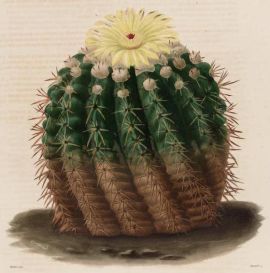
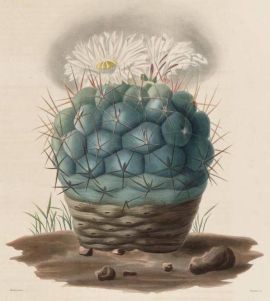
If you’ve never checked out The Public Domain Review, you should. It’s nifty. Keen, even. The two illustrations that accompany this post come from Iconographie descriptive des cactées, ou, Essais systématiques et raisonnés sur l’histoire naturelle, la classification et la culture des plantes de cette famille by French botanist Charles Lemaire (for more information, check this out).

Many dangers exist in the radioactive deserts of the mutant future.

Erinaceus
Alignment: Neutral
Movement: 30′ (10′)
Armor Class: 6
Hit Dice: 4
Attacks: 1
Damage: 1d4 (plus 3d6 poison)
Save: L2
Morale: 8
Hoard Class: None
XP: 245

Mutations: Projectile Thorns (Class 3 Poison), Unique Sense (“Smell” Water [60 feet])

An erinaceus is a roundish, predatory cactus with a thick, tough exterior. It rolls slowly by shifting water stored in its tissues toward the direction of travel. This plant senses water, to include the natural moisture stored in most creatures’ bodies, via an olfactory sense analogous to the sense of smell. An erinaceus brings down prey by means of its projectile thorns. These thorns have the same ranges as a thrown dagger, and each packs a powerful toxic punch (save for half damage permitted). Once its prey is down, an erinaceus rolls to it and uses its roots to extract the prey’s blood.

Hexadres
Alignment: Neutral
Movement: None
Armor Class: 8
Hit Dice: 6
Attacks:
Damage:
Save: L6
Morale: 7
Hoard Class: None
XP: 1,070

Mutations: Fragrance Development (Plants), Neural Telepathy, Teleport

A hexadres is an intelligent, telepathic cactus. Inoffensive and contemplative, a hexadres prefers to simply teleport away if molested. Of course, a hexadres is often protected by various creatures that have fallen victim to the plant’s enticing scent. A hexadres communicates via telepathy.

July 3rd, 2017  in RPG No Comments »

Evil Trees & Temptations

Now that I’ve finally finished The Four Color Hack, it’s time to finish The Grimm’s Fairy Hack, my second spin-off from The Black Hack. I’ve got one more section of essential rules related to the dark fairy-tale setting, and then the playtest rules are ready for upload to DriveThruRPG. This final section includes some special rules applicable to the fairy-tale world of TGFH along with some sample creatures, such as the Evil Tree below. After the Evil Tree comes rules for Temptations.

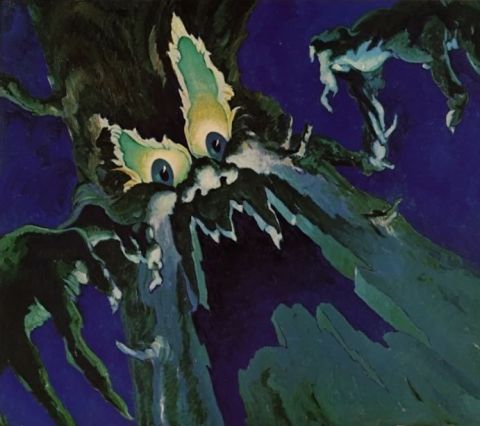
Evil Tree

The wild, wooded places between walled villages threaten travelers in a variety of ways. Even the trees themselves may seek to grab, tear, and crush.

Hit Dice: 7
Damage: 2d8
Special: An Evil Tree appears very much like a normal tree when it wants to (roll with Disadvantage to spot). It doesn’t move quickly, but its branches and roots have an extensive reach (attack anyone Nearby). An Evil Tree fears fire and axes (roll with Advantage when applicable). Some Evil Trees possess magical powers, such as the ability to animate normal trees or swallow a creature whole.

Temptations

Temptations abound in the fairy-tale world. Temptations exist to lure the unwary and thoughtless into danger. Temptations take a variety of forms, anything from delicious apples to piles of gold to beautiful ball gowns. No matter it’s form, a Temptation has four parts:

* A HD Equivalent: Temptations do not have HP, but they do impose a penalty on Stat checks to resist them.
* A Preferred Target: Temptations are often targeted against a specific type of character.
* A Preferred Stat: Temptations target a specific Stat that is used to resist the Temptation.
* An Effect: What happens if a character fails to resist the Temptation. This effect can range from something as simple as “The character opens the door” to powerful magical effects like “The character turns into a talking frog.”

For example, while traveling along the road, the characters sees stylish sunglasses resting on a fence post. The sunglasses are a Temptation.

Sunglasses (3 HD; Popular; Upbringing): The character takes the sunglasses and wears them all the time. The sunglasses allow the Goblin King to know the character’s whereabouts.

There is often a way to undo the effect of a Temptation. The method for undoing the Temptation may be simple or complex, easy or hard. In the case of the sunglasses, another character may take them away and break them, for example. On the other hand, perhaps a character transformed into a talking frog may regain his original shape only by receiving a willing kiss from a princess who holds a lilypad retrieved from the Marsh of Lost Heroes.

July 1st, 2017  in RPG No Comments »

The Dread Warrior

For I hear many whispering. Terror is on every side! “Denounce him! Let us denounce him!” say all my familiar friends, watching for my fall. “Perhaps he will be deceived, then we can overcome him, and take our revenge on him.” But the Lord is with me as a dread warrior; therefore my persecutors will stumble, they will not overcome me. (Jeremiah 20:10-11)

The Dread Warrior fights to defend holy causes against infidels, scoffers, blasphemers, and other evil-doers. He lacks the raw power and martial skill of the Warrior, but his righteous devotion grants him the ability to inspire dread in those he faces.

Dread Warrior
Starting HP: d8 + 4
HP Per Level/Resting: 1d8
Weapons & Armor: Any and All
Attack Damage: 1d8 / 1d4 Unarmed or Improvising

Special Features
Once per hour while in combat, a Dread Warrior can regain 1d6 lost HP.

When confronting evil-doers opposed to the Dread Warrior’s holy cause, the Dread Warrior inspires fear using his Dreadful Mien Usage Die, which starts at a d4 at 1st level. This fear affects a number of Hit Dice of enemies equal to the die’s roll plus the Dread Warrior’s level. For the next few minutes, the Dread Warrior rolls with Advantage against those foes.

The Dread Warrior rolls with Advantage when resisting effects that affect his emotions or loyalties.

Leveling Up
Roll to see if attributes increase. Roll twice for STR and CHA.

Every odd numbered level, step up the Dreadful Mien die.

June 26th, 2017  in RPG No Comments »

Bellatrix

In the picture, we see Thérèse of Lisieux in costume as Joan of Arc. The photograph dates from early 1895, about two years before Thérèse’s death from tuberculosis at the age of 24. Her sainthood was declared in May 1925 by Pius IX. Thérèse is the patron saint of aviators, florists, and those who suffer illnesses. Along with Francis Xavier, Thérèse is the patron of missions, and she and Joan are co-patrons of France. John Paul II declared Thérèse a Doctor of the Church in 1997, an honor Thérèse shares with three other women and about 30 men, an impressive accomplishment for such a young lady. Thérèse had a special fondness for Joan of Arc. You can read more about Thérèse at this site.

“But now,” [Jesus] said, “take your money and a traveler’s bag. And if you don’t have a sword, sell your cloak and buy one!” (The Gospel According to St. Luke 22:36)

Bellatrix

Background & Origin: Emmanuelle Paquet, orphan and raised in a convent school by Discalced Carmelites, received an exceptional education growing up, to include a most unusual course of rigorous training in swordsmanship by Sister Joaquina de Olot, who had been a skilled athlete before taking vows. Emmanuelle also embraced an ethos focused on the works of mercy. After completing her schooling, Emmanuelle left the convent, taking on a position as a music tutor and earning additional monies as a secretary for a law office. In the latter position, Emmanuelle saw first-hand the effects of crime and poverty on people, especially on women and children.

The plight of several families at the hands of Hugo Mesrine, an extortionist and racketeer, greatly disturbed Emmanuelle. The young lady donned a costume and armed herself with sword and shield. Over a period of several days, Emmanuelle brought the fight to Mesrine and his criminal cohorts. She protected those families, disrupted Mesrine’s operations, and gathered evidence against Mesrine. The Parisian press exploded with sensational stories of a mysterious female vigilante. One journalist, picking up on the religious motifs of Emmanuelle’s costume and exploits, dubbed her Bellatrix, and the name stuck. In the end, Mesrine’s operations were crippled, and Mesrine himself found himself facing a date with Madame Guillotine. The Parisian underworld was shaken to its roots, and the people of Paris largely embraced Bellatrix as their protectress.

Motivation: To serve God and fight evil!

Qualities: Master [+6] Swordswoman, Master [+6] Gadget: Shield, Expert [+4] Athlete, Good [+2] Classical Education, Good [+2] Contacts with the Press, Good [+2] Criminology, Good [+2] Devotion to St. Joan of Arc, Good [+2] Hero of the People, Good [+2] Polyglot, Poor [-2] Ability to Compromise

Powers: None

Stunts: Expert [+4] Ricochet Shield Throw (Gadget: Shield Spin-Off, 1 HP)

Hero Point Pool: 5/10

June 24th, 2017  in RPG No Comments »

The Search

A movie review I wrote way back in August 2013 (with some edits):

I watched The Bothersome Man, an unrated Norwegian film. The film’s protagonist, Andreas (Trond Fausa Aurvåg), finds himself in a clean, efficient city after being dropped off by a bus at a gas station in the middle of nowhere. He’s given a job as an accountant, and a clean and efficient apartment which comes fully furnished, to include a wardrobe full of clean, efficient suits. His co-workers are polite and well-groomed.

Andreas’s first clue that something is wrong with this new world happens when he finds himself in the men’s room of a nightclub. An unseen man in a stall laments loudly, sadly that no matter how he drinks he can’t get drunk. He complains that hot chocolate no longer tastes or smells good. Andreas, curious about this sad man, follows him home to where the man lives in a basement apartment.

The movie progresses, and Andreas moves from one scene to the next, becoming more aware that no one around him has any real passion for life. The most common adjective used to describe things is “nice”. Andreas’s girlfriend Anne (Petronella Barker) says he’s nice. He has nice conversations with nice people, usually about the nice things they can buy from nice catalogs. Andreas and his girlfriend have nice furniture. Their meals are nice. When Andreas starts an affair with a lady in his office, she also informs Andreas that he is nice. In fact, he’s just as nice as all her other boyfriends. Even in the most intimate of relationships, one person is just as nice as the next.

Driven to the point of despair, Andreas tries to commit suicide by jumping in front of a subway train. Not to give too much more of the movie away, but it doesn’t work. He limps out of the tunnel, is picked up by the ubiquitous jump-suited men who patrol the city, and is taken to Anne’s house. He stands there, broken and bleeding, and Anne informs him they have a date to go ride go-carts.

Andreas lives in a utilitarian world, where everyone’s happiness is maximized, but where there is no yearning for the true, the good, or the beautiful. Indeed, expressing such yearning is met with disapproval. Andreas confesses to his boss that he misses seeing children (for there are no children in a clean, efficient city). The only response Andreas gets is to be quickly ignored, as if he had just said something that no one would ever admit in polite company.

The real world — the world in which at least some things are genuinely and objectively true, good, and/or beautiful — is not a clean, efficient, polite place that can be described by so weak a word as nice. The real world is glorious and tragic and scary and awe-inspiring and depressing and wonderfully full of such a mess of thoughts, sights, sounds, and experiences. The classical liberal arts embrace this apparent chaos, and seek to find the order beneath the mess of contradictions.

I often remind myself, and I remind my students, the search isn’t without hope. Through the proper use of reason, we can discover the true, the good, and the beautiful, and we can at least begin to understand that those three qualities are not always a matter of mere opinion. Some things are truly true, truly good, truly beautiful, and to disagree about those things isn’t to express an opinion. To disagree is to be wrong.

The search for the true, the good, and the beautiful isn’t easy. Many people give up after one too many disappointments. But, I am reminded of the words of a wise man. To paraphrase, those that seek without surrender will eventually find what they’re looking for.

June 23rd, 2017  in RPG No Comments »