Archive for the ‘ RPG ’ Category

The Great Race of Yith

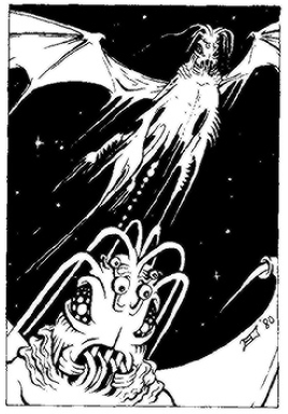
At this point during the conversion of the Cthulhu Mythos in the AD&D Deities & Demigods for use with 5E D&D to point out the one major flaw with this section of the book: It doesn’t really stay true to the source material. This becomes most obvious, I think, with our next creature.

In H. P. Lovecraft’s tales, the Great Race of Yith have highly developed mental powers, and the AD&D rules hit that point by giving the Great Race some potent psionic ability. What is missing from the Great Race’s description, however, is their most impressive ability, which is their ability to project their minds across time and space to forcibly inhabit the bodies of other creatures. During the time the Yithian’s mind inhabits, say, a human, that human’s mind occupies the alien body of the Yithian. In other words, the Great Race forcibly swaps bodies with another creature, doing so across both time and space, more or less at will.

These creatures populated the world eons ago and their cities still exist buried in deserts or other out of the way places. They had a highly advanced scientific civilization, with psionics rather than magic. (Deities & Demigods, page 45)

Great Race of Yith
Large aberration, lawful neutral

Armor Class 15 (natural armor)
Hit Points 84 (8d10+40)
Speed 45 ft.
Ability Scores STR 23 (+6), DEX 7 (-2), CON 20 (+5), INT 26 (+8), WIS 19 (+4), CHA 15 (+2)

Saving Throws CON +9, WIS +8
Skills Arcana +12, History +12, Insight +8, Investigate +12, Perception +8
Senses truesight 120 ft., passive Perception 18
Languages telepathy 240 ft.
Challenge 10 (5,900 XP)

Innate Spellcasting (Psionics). The Yithian’s innate spellcasting ability is Intelligence (spell save DC 20). It can cast the following spells, requiring no material components:

At will: dimension door
3/day: modify memory, telepathic bond
1/day: foresight (self only), mind blank (self only), time stop

Actions

Multiattack. The Yithian attacks twice with its pincers.

Pincers. Melee Weapon Attack: +10 to hit, one target. Hit: 10 (1d8+6) slashing damage.

Lightning Gun. The Yithian’s lightning gun fires a stroke of lightning forming a line 300 feet long and 5 feet wide from the Yithian in a direction it chooses. Each creature in the line must make a DC 13 Dexterity saving throw. A creature takes 14 (4d6) lightning damage on a failed save, or half as much on a successful one. The lightning ignites flammable objects in the area that aren’t being worned or carried. A lightning gun has 8 charges, after which it cannot fire until its power source is replaced.

Mind Swap. The Yithian projects its psyche through time and space, across any number of years or miles, but not from one plane to another. It picks a creature at its destination. The target must make a DC 20 Wisdom saving throw. On a failed save, the target and the Yithian swap minds. The Yithian retains its INT, WIS, and CHA, and it uses the target’s STR, DEX, and CON, but it makes Dexterity checks and saving throws at disadvantage. The Yithian retains its truesight, skills, telepathy, psionics, and Mind Swap. It gains the AC, hit points, senses, languages, and the physical abilities and characteristics of the target. The target retains its own INT, WIS, and CHA, and similarly gains the STR, DEX, CON, and other physical characteristics of the Yithian. The Yithian can communicate telepathically with the target. Once per long rest, the target can make a new Wisdom saving throw. If the saving throw succeeds, the Mind Swap is reversed.

Reactions

Quick Mind. If a target resists or overcomes the Yithian’s Mind Swap, the Yithian may choose a new creature to target with Mind Swap as a reaction.

September 1st, 2018  in RPG No Comments »

The Deep Ones

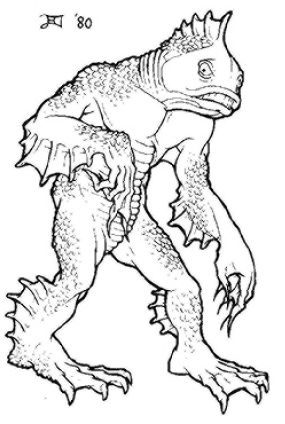
Mighty Cthulhu sends its Deep Ones from the AD&D Deities & Demigods into 5E D&D to establish new cult centers. Ph’nglui mglw’nafh Cthulhu R’lyeh wgah’nagl fhtagn!

The Deep Ones are humanoid, amphibious men-fish, cold-blooded creatures of great strength (18). … They live near the land on ocean shelves and are able to travel to the land at any time and for as long as they wish.

They have been known to interact with evil humans and interbreed with them. This results in human-appearing offspring who undergo a gradual transformation after the age of 21 that causes them to become as the Deep Ones who spawned them. Deep Ones are soulless and apparently immortal. (Deities & Demigods, page 45)

Deep One
Medium humanoid (Deep One), chaotic evil

Armor Class 17 (natural armor)
Hit Points 30 (4d8+12)
Speed 30 ft., swim 60 ft.
Ability Scores STR 18 (+4), DEX 14 (+2), CON 17 (+3), INT 12 (+1), WIS 12 (+1), CHA 11 (+0)

Senses darkvision 60 ft., passive Perception 11
Languages Common, Deep One
Challenge 3 (700 XP)

Amphibious. The Deep One can breathe air and water.

Regeneration. The Deep One regains 3 hit points at the start of its turn as long as it has more than 0 hit points. If the Deep One takes damage, this trait doesn’t function until the start of the Deep One’s next turn.

Soulless and Immortal.. The Deep One never suffers negative effects from aging. When subjected to an effect that causes necrotic or radiant damage, the Deep One takes only half damage, or no damage if a saving throw is permitted and successful. The Deep One cannot regain hit points from cure wounds or similar spells. A dead Deep One cannot be restored to life by means of raise dead or similar spells.

Actions

Multiattack. The Deep One attacks twice with its claws.

Claws. Melee Weapon Attack: +6 to hit, one target. Hit: 6 (1d4+4) slashing damage.

******

Deep One Warlock of the Great Old One
Medium humanoid (Deep One), chaotic evil

Armor Class 17 (natural armor)
Hit Points 75 (10d8+30)
Speed 30 ft., swim 60 ft.
Ability Scores STR 18 (+4), DEX 14 (+2), CON 17 (+3), INT 14 (+2), WIS 14 (+2), CHA 17 (+3)

Saving Throws WIS +5, CHA +6
Skills Arcana +5, Deception +6, History +5, Persuasion +6
Senses darkvision 60 ft., passive Perception 12
Languages Common, Deep One, telepathy 30 ft.
Challenge 5 (1,800 XP)

Amphibious. The Deep One warlock can breathe air and water.

Innate Spellcasting. The Deep One warlock’s innate spellcasting ability is Charisma (spell save DC 14). It can cast disguise self at will.

Regeneration. The Deep One regains 3 hit points at the start of its turn as long as it has more than 0 hit points. If the Deep One takes damage, this trait doesn’t function until the start of the Deep One’s next turn.

Soulless and Immortal.. The Deep One never suffers negative effects from aging. When subjected to an effect that causes necrotic or radiant damage, the Deep One takes only half damage, or no damage if a saving throw is permitted and successful. The Deep One cannot regain hit points from cure wounds or similar spells. A dead Deep One cannot be restored to life by means of raise dead or similar spells.

Spellcasting. The Deep One warlock is a 6th-level spellcaster. Its spellcasting ability is Charisma (spell save DC 14, +6 to hit with spell attacks). It regains expended spell slots when it finishes a short or long rest. It knows the following warlock spells:

Cantrips (at will): eldritch blast, friends, prestidigitation
1st-3rd level (2 3rd-level slots): arms of Hadar, detect thoughts, dissonant whispers, enthrall, hellish rebuke, major image, sending

Actions

Multiattack. The Deep One attacks twice with its claws or casts eldritch blasts to create two beams.

Claws. Melee Weapon Attack: +7 to hit, one target. Hit: 6 (1d4+4) slashing damage.

Eldritch Blast Beam. Ranged Spell Attack: +6 to hit, range 120 ft., one target. Hit: 8 (1d10+3) force damage.

Reactions

Entropic Ward (Recharges after a Short or Long Rest). When a creature makes an attack roll against the Deep One warlock, it can use impose disadvantage on that roll. If the attack misses the Deep One warlock, its next attack against the creature has advantage if the Deep One warlock makes the attack before the end of its next turn.

August 31st, 2018  in RPG No Comments »

Cthuga’s Flame Creatures

Yesterday it was the servants of He Who Must Not Be Named. Today’s trip into the AD&D Deities & Demigods brings us the fiery minions of Cthuga, the “master of the fire element”, statted for 5E D&D.

These creatures appear to be smaller versions of their master. This means a flame creature resembles a flaming amoeba with tentacles that appear to be flames emanating from its body. (Deities & Demigods, page 44)

Flame Creature of Cthuga
Huge elemental, chaotic evil

Armor Class 18 (natural armor)
Hit Points 184 (16d12+80)
Speed 60 ft.
Ability Scores STR 14 (+2), DEX 21 (+5), CON 20 (+5), INT 10 (+0), WIS 12 (+1), CHA 9 (-1)

Damage Resistances bludgeoning, piercing, and slashing from nonmagical attacks
Damage Immunities fire, poison
Condition Immunities exhaustion, paralyzed, petrified, poisoned, prone
Senses darkvision 60 ft., passive Perception 11
Languages Ignan
Challenge 10 (5,900 XP)

Amorphous. The flame creature can move through a space as narrow as 1 inch wide without squeezing.

Elemental Nature. The flame creature doesn’t require air, food, drink, or sleep.

Flame Aura. At the start of each of the flame creature’s turns, each creature within 60 feet of it takes 10 (3d6) fire damage, and flammable objects in the aura that aren’t being worn or carried ignite. A creature that touches the flame creature or hits it with a melee attack while within 5 feet of it takes 10 (3d6) fire damage.

Illumination. The fire creature sheds bright light in a 45-foot radius and dim light in an additional 45 feet.

Magic Resistance.. The flame creature has advantage on saving throws against spells and other magical effects.

Actions

Multiattack. The flame creature attacks twice with its tentacle and/or its heat ray.

Heat Ray. Ranged Weapon Attack: +5 to hit, range 30/90 ft., one target. Hit: 16 (2d10+5) fire damage. If the target is a creature or a flammable object, it ignites. Until a creature takes an action to douse the fire, the target takes 6 (1d12) fire damage at the start of each of its turns.

Tentacle. Melee Weapon Attack: +5 to hit, reach 10 ft., one target. Hit: 18 (3d8+5) bludgeoning damage plus 10 (3d6) fire damage. If the target is a creature or a flammable object, it ignites. Until a creature takes an action to douse the fire, the target takes 6 (1d12) fire damage at the start of each of its turns.

August 29th, 2018  in RPG No Comments »

“Yes, We Can!”

Some time next week, I’m relaunching my Patreon site as a support platform for The Four Color Hack. I’ll be writing up new villains, new heroes, new Elements, city details, situations that can be used for adventures for your game’s heroes, et cetera. All of this will revolve around Penance, Texas. What is Penance, Texas, you ask? Read on.

Welcome to Penance, Texas. Penance with its population of 455,000 sits on the Gulf Coast in the South Texas region. Penance’s history reaches back to the early 16th century, but long before the Spanish settled the area, the Kómaháyika lived in the area. Little is known of these people except that they had an evil reputation among both the Karankawa and the Spanish. Long-time residents of Penance say that whatever the Kómaháyika did must have cursed the ground the city stands on, for it seems as if Penance’s yesterday and today have always been caught in a struggle between evil and good….

As a setting, Penance, Texas, combines superheroics with elements from genres closer to true crime and Lovecraftian horror. Material released via Patreon will fall into the categories of The City, The Supers, The Scenarios, and The Rules. Patrons can choose from three tiers: $1 a month to be a Defender, $3 a month to be an Avenger, and $5 a month to be a League Member. Each tier includes Patron-only access to PDFs written specifically for the Patreon site. In short, Defenders get The Supers PDFs, Defenders get that and The Scenarios PDFs, and League Members get everything, plus other perks, such as getting me to write specially requested villains, et cetera.

Speaking of The Rules for TFCH, the ones for creating villains don’t have to be used for just villains. They can be used to create just about anyone or anything that the heroes may encounter, and that includes heroic allies.

The Builder
Level 3 Heroic Ally

Quote: “Can we fix it?”
Real Name: Bob (last name unknown)
Identity: Secret
Place of Birth: Somewhere in the United Kingdom
Height: 4 ft. 8 in.
Weight: 90 lb.
Eyes: Blue
Hair: Brown

Hit Points: 16 (3 Vigor)
Base Damage: d6
Powers: Machine Control d10, Telekinetic Drill d8, Tool Belt d8

Background: Little is known about Bob’s background. Based on his accent, he’s probably from somewhere in the United Kingdom, mostly likely from Birmingham, England. He’s been an active superhero for a few years, which is remarkable primarily because of his age. Bob can’t be much more than 10 or 11 years old. Who his parents are, where he goes to school, et cetera, are questions about which there is much speculation, but no definitive answers. The media took to calling Bob “The Builder” early on in his heroic career, and the name stuck. As the Builder, Bob does not operate as a traditional crime fighter, although he has tangled with criminals on more than one occasion. Most of the time, the Builder uses his powers to aid first responders in emergency situations.

Powers: The Builder’s main power is his ability to control machines. This ability appears to be psionic in nature, but it could be the effect of super-technology. With Machine Control, Bob can control the movement and operation of mechanical devices. He can even “program” a machine to operate semi-independently by splitting his Machine Control die to create a lasting effect, such as a Debris-Clearing Tractor d8. So far, the Builder has no shown the ability to change the form or function of a machine. He cannot, for example, make a pick-up truck fly like an airplane. The Builder uses a variety of tools, the most prominent being his Telekinetic Drill. With it, he can manipulate up to 5 tons of material within 80 feet. The Builder has used his Telekinetic Drill to repair damaged objects and to jury rig structures, as he did that the time he manipulated a load of PVC pipes to trap an aggressive dog in a PVC Cage d6. The Builder’s Tool Belt holds an assortment of high-tech devices, such as his Climbing Spike Screwdrivers d6 that he uses to scale buildings.

August 23rd, 2018  in RPG 1 Comment »

Q&A About TFCH

Earlier this week, J. Todd Scott emailed me with both praise and questions about The Four Color Hack. What follows is the bulk of my response to Todd, posted with his kind permission:

Question 1: So now that the villain is locked into the d12 bubble, what does that really mean?

Keep in mind that TFCH should always start and end with the narration. So, when the villain’s turn comes around, he’s trapped in a Positronic Bubble d12. That means, among other things, he’s not moving too far. He’s also not attacking through the bubble with effects that can be blocked by a Positronic Bubble. For the sake of clearer examples, let’s assume the villain is Chimera, and that Professor Positron is level 1.

Question 2: How does that d12 come into play?

In addition to the narrative effects, the Positronic Bubble d12 has 7 protection and 1d12 Hit Points. The player rolls 1d12, and gets a 6, so the Positronic Bubble d12 has 6 hit points. Effects blocked by a Positronic Bubble, such as Chimera’s claws, must get through the Positronic Bubble before Chimera can attack anyone else.

Question 3: Let’s say that villain now wants to attack Professor Positron, and Positron (the player) needs to defend and roll under his DEX of 10. Does that d12 affect that defense roll in anyway?

So, that means Chimera has to deal with the Positronic Bubble before he can attempt to tear apart Professor Positron. Since the Positronic Bubble is static, I’d rule it doesn’t get a defense roll unless Positron’s player can narrate something otherwise.

In the first case, Chimera would simply inflict damage against the Positronic Bubble. (And now I notice that Chimera’s base damage is missing from his stat block; grrr.) Most simply, this means Chimera inflicts 2d10 points of damage against the Positronic Bubble (1d10 base damage plus 1d10 Transmorphism). If Chimera does 13+ damage, he destroys the Positronic Bubble. If he does 7 or less damage, he failed to hurt the Bubble at all.

As GM, however, I’d more likely run the exchange like this:

GM: “Chimera’s arms transform into a monstrous crab claws, and he attacks the Positronic Bubble. How do you defend against this attack?”

Professor: “I focus on the Positronic Bubble, attempting to alter its shape so that Chimera’s attack is ineffective.”

GM: “That sounds like some clever quick-thinking. Roll against INT with a +3 because the level difference.”

If the player rolls under INT, Chimera’s attack fails; otherwise, Chimera damages the Bubble, possibly destroying it.

To further wrinkle the situation, Chimera can use his Power Dice pretty much just like a hero can, which brings me to the next question.

Question 4: Similarly, what about a character or villain with a Luck d8 ability or a Precognition d10 ability (like Chimera from TFCH) If Chimera can see effectively into the future, that’s something that could affect the TO HIT roll, rather than the amount of damage, right?

Here we have a six of one, a half dozen of another situation. I’d treat Precognition d10 as 6 points of protection in most situations. If this reduces damage to 0, then Chimera saw the attack in sufficient time to dodge it entirely. The GM could also rule that Chimera’s Precognition d10 enabled him to completely evade the attack. This would downgrade the die one step in terms of how many more times Chimera could just automatically succeed.

Question 5: If I’m the player and I’m rolling to dodge away from a villain with Combat Master d8, how does that die affect my defense roll? And if I’m rolling to hit that villain, how does his Combat Master d8 die affect my attack roll? Or is all this stuff just considered damage reduction?

In general, dice attached to powers don’t affect d20 rolls. The ability to use a Hero Die to achieve an automatic success takes this into account. My goal was to simulate that situation in a comic book where Spider-Man, for example, just can’t be hit. He uses his Amazing Agility against Doctor Octopus, dodging one attack after another, at least for a few panels. Eventually, however, Spider-Man’s luck runs out, and Doc Ock clouts him from behind with a tentacle.

August 22nd, 2018  in RPG No Comments »