Archive for the ‘ RPG ’ Category

ThursdAD&D: Arks & Badders

This last Sunday, I re-restarted an AD&D game. The characters all live on a flying island and serve as squires to Lady Mirelyn. For their first mission, the characters were dispatched to the sleepy town of Saltmarsh to investigate why the town has been consistently behind on its annual harvest taxes for the past several years.

Turns out, the root of the problem has something do with a haunted house….

Anyway, I’ve got a small group with only one player new to tabletop RPGs. Amusingly enough (to me), our new player is a former student of mine, whom I taught way back when he was in middle school. He’s all grown up now, older than my son. It’s funny as he struggles to address me as anything other than “Mr. Chance”.

But I digress.

Given that most of my players are D&D veterans, I want to change up things a bit to try to recreate that sense of wonder we first had when we started playing and hadn’t read the entire Monster Manual. This means new monsters. Well, sort of. Today’s offerings aren’t really new. They come the 1981 printing of TSR’s Gamma World, which remains one of the greatest RPGs of all time.

Ark
Frequency: Uncommon
No. Appearing: 20-200
Armor Class: 5
Move: 15″
Hit Dice: 2
% in Lair: 20%
Treasure Type: Individuals L, M; D, Q (x5), S in lair
No. of Attacks: 1
Damage/Attack: 2-8 or by weapon
Special Attacks: See below
Special Defenses: Nil
Magic Resistance: Standard
Intelligence: Low to average
Alignment: Chaotic evil
Size: L (9′ tall)
Psionic Ability:
Attack/Defense Modes: Nil
Level/XP Value: II/28 + 2/hp (Leader-type or guard: III/125 + 4/hp. Chieftan: IV/165 + 5/hp)

Climate/Terrain: Any non-desert/tropical to temperate
Organization: Band
Activity Cycle: Night
Diet: Carnivore
Morale: Steady (11)

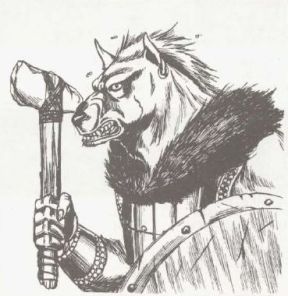
Arks are intelligent, brutal dog-men of great height but slender build. They live and travel in rapacious bands, wherein the largest and strongest dominate their smaller, weaker pack mates. Arks are generally on friendly terms with other evil races, such as badders. Arks are strong and fast. They have infravision. They speak their racial tongue, chaotic evil, and often (60%) badder and/or the common tongue.

For every 20 arks encountered, there will be a leader-type with 3+3 hit dice and 16 hit points. If 100 or more of these creatures are encountered, there will be a chieftan with 4+4 hit dice, 22 hit points, armor class 3, and +2 to damage. The chieftan has 2-12 guards with 3+3 hit dice, 16 hit points, armor class 4, and +1 to damage. If arks are encountered in their lair, there will always be a chieftan with 5-20 guards. The lair also contains females and young equal to 50% and 200% respectively the number of males present.

Arks are nomadic 80% of the time, but occasionally (20%) take up residence in an abandoned (or cleared) village, building, or cave. If nomadic, arks are quite likely (65%) to have 2-8 ark-hounds (treat as hyenas) or 1-6 ark-beasts (treat as hyaenodons) (80% and 20%, respectively). These beasts serve as pets and guards. If the arks have settled a location, double the number of beasts possible. Arks capture others for slaves and food, especially humans, as arks view human hands as a delicacy. Arks always have captives numbering 1 victim per 10 arks.

Arks are not dangerous only because of their numbers and their vicious natures. They also possess strange, magical powers. An ark who concentrates (treat the ark as motionless opponent as per DMG, p. 70) is capable of telekinesis with a range of 1″ per hit die, affecting 250 gold pieces of weight per hit die. Multiple arks can cooperate to increase the range and strength of their telekinesis, but the arks must be touching each other to do so.

Ark leader-types, chieftans, and guards can drain life energy from creatures of semi- or greater intelligence. This life leech ability can be used once per day. It affects a 3″ radius around the ark, and it affects all creatures in the radius (except the user). An affected creature loses 1-6 hit points (save versus death magic negates). The ark gains a number of hit points equal to the total damage inflicted (but this power cannot increase the ark’s hit points to more than twice normal value). Excess leeched hit points not destroyed in combat dissipate after 24 hours.

An ark chieftan can control weather as a druid once per week, but only after 1 turn of concentration. After the period of concentration, another 1-4 turns pass before the weather change is complete. This power weakens the chieftan, causing a loss of 3-10 hit points.

A peculiar aspect of ark psychology is their fear of large, winged creatures. Arks have -1 “to hit” and a -2 morale penalties against such creatures.

Badder
Frequency: Uncommon
No. Appearing: 40-400
Armor Class: 4
Move: 12″ (3″)
Hit Dice: 2-7 hit points
% in Lair: 40%
Treasure Type: Individuals K; C in lair
No. of Attacks: 1
Damage/Attack: 1-6 or by weapon
Special Attacks: Empathy
Special Defenses: Empathy
Magic Resistance: Standard
Intelligence: Low-average
Alignment: Lawful evil
Size: S-M (4′ to 5′ tall)
Psionic Ability: Nil
Attack/Defense Modes: Nil
Level/XP Value: I/5 + 1/hp (Leader or assistant: I/14 + 1/hp. Chief or bodyguard: II/40 + 3/hp.)

Climate/Terrain: Any land/any non-tropical
Organization: Tribe
Activity Cycle: Night
Diet: Omnivore
Morale: Average (10)

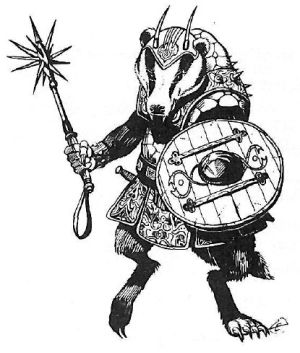
Badders are militaristic, humanoid badgers. They have a tribal society, the strongest ruling the rest, allowing fealty to the badder king. Badders enjoy dwelling in dismal surroundings, preferring subterranean habitats to others. Badders hate full daylight and attack at a -1 when in sunlight. They have normal infravision (60′ range). Badders are quick and agile, which in part accounts for their high armor class. These humanoids hate gnomes and dwarves, and will attack them in preference to other creatures. Badders are slave takers and are fond of torture. They speak their own tongue, lawful evil, and (80%) one or two other languages.

For every 40 badders encountered, there will be a leader and 4 assistants, all of whom have 1 hit die. If 200 or more badders are encountered, there will be the following additional figures: a sub-chief and 2-8 guards, each with 1+1 hit dice, armor class 5, and doing +1 damage. In their lair, there will be a badder chief and 2-8 bodyguards, each with 2+2 HD, armor class 4, and doing +2 damage. Also, there will be females and young equal to 60% and 100% respectively of the number of male badders encountered. Badders often have beasts in their lair, specifically 5-30 badgers (60%) or 3-18 giant badgers (40%), with these animals being present 60% of the time.

There is a 25% chance that any force of badders encountered will have 10% of its strength mounted on giant badgers. If this is the case, there will be an additional 10-40 giant badgers without riders.

Badders are fair miners, and they are able to detect passages which slope, unsafe areas, and approximate depth and direction between 50% to 80% of the time.

Exceptional badders (e.g. leaders, assistants, et cetera) have empathy. This allows them to detect the basic needs, drives, and/or emotioned generated by any unshielded mind within 1″ per hit die. This makes an alert badder difficult to surprise (1 in 6 chance). Badders can project emotions into the minds of creatures of semi-intelligence or less. This ability has a range of 3″ and affects a 1″ wide path. Creatures are permitted a saving throw versus spell to resist the effects, which last for 1-4 melee rounds per hit die of the badder. Exceptional badders use their empathic projection ability to frighten animals, entice prey, et cetera.

January 17th, 2019  in RPG No Comments »

Tuesday Terror: Sruthán

Check out this pic by clicking here. The artist is Nise Loftsteinn Below is what I think the creature in the picture could be as a D&D monster.

The sruthán are creatures of fire and earth, native to the Para-Elemental Plane of Magma. These genies, caught in the volcanic realm between Elemental Earth and Elemental Fire, live a precarious life with the greedy, malicious dao on one side and the haughty, cruel efreet on the other. The sruthán are deceitful and melancholy. They have little reason to trust other creatures.

Sruthán
Large elemental, chaotic neutral

Armor Class 15 (natural armor)
Hit Points 149 (13d10+78)
Speed 30 ft., burrow 30 ft., fly 30 ft.

STR 20 (+5), DEX 10 (+0), CON 22 (+6), INT 10 (+0), WIS 11 (+0), CHA 12 (+1)

Saving Throws INT +3, WIS +3, CHA +4
Skills Deception +4
Damage Resistances fire
Condition Immunities petrified
Senses darkvision 120 ft., passive Perception 10
Languages Ignan, Terran
Challenge 7 (2,900 XP)

Earth Glide. The sruthán can burrow through nonmagical, unworked earth and stone. While doing so, the sruthán doesn’t disturb the material it moves through.

Elemental Demise. If the sruthán dies, its body disintegrates into charred pebbles, leaving behind only equipment the sruthán was wearing or carrying.

Heated Body. A creature that touches the sruthán or hits it with a melee attack while within 5 feet of it takes 5 (1d10) fire damage.

Illumination The sruthán sheds dim light in a 10-foot radius.

Innate Spellcasting. The sruthán’s innate spellcasting ability is Charisma (spell save DC 12, +4 to hit with spell attacks). It can innately cast the following spells, requiring no material components:

At will: detect magic
3/day each: stinking cloud, tongues
1/day each: gaseous form, invisibility, plane shift

Actions

Multiattack. The sruthán makes two molten hair attacks.

Molten Hair. Melee Weapon Attack: +8 to hit, reach 10 ft., one target. Hit: 8 (1d6+5) bludgeoning damage plus 7 (2d6) fire damage.

Hurl Magma. Ranged Spell Attack: +4 to hit, range 60 ft., one target. Hit: 10 (3d6) fire damage.

January 15th, 2019  in RPG No Comments »

ThursdAD&D: Trained Hippogriffs

This Sunday, I’m re-restarting an AD&D game. I did this once before, several years ago. It didn’t last long. This time, I’m hoping for more longevity. I’ve got three players so far. We’re making up characters this Sunday.

All the characters work for Lady Mirelyn, a knight errant who occupies a fortress that sits atop and within a flying island called a skyrealm. I’m sticking reasonably close to first edition rules, including Unearthed Arcana, but I am incorporating some material drawn from second edition AD&D, a Dragon magazine or two, and my personal preferences.

Since the characters all live on a flying island, it seems reasonable that flying will be part of the campaign. Lady Mirelyn has a skyship, the Galerider. She and her knights ride hippogriffs, which brings me to today’s post.

Aerial Travel

Long distance travel on a hippogriff is quick. A rider travels one mile per hour for every 3″ of flying speed, and a hippogriff can bear a rider for up to nine hours before it must rest for at least that long. Also, a hippogriff needs an hour of rest for every three hours of flight. It is possible to push the hippogriff to ignore fatigue and hunger, but this is not without its risks.

Aerial Combat

Hippogriffs cannot hover. They are maneuverability class C without a rider, or maneuverability class D if carrying a rider. While flying, a hippogriff attacks with either its claws or its bite. If the hippogriff drives at least 30 feet, it can inflict double damage to a target that is not diving. As war-trained mounts, Lady Mirelyn’s hippogriffs fight on the second and succeeding rounds of melee, as long as their rider remains mounted.

A hippogriff cannot maintain flight if it sustains damage greater than 50% of its hit points. It must land as quickly as possible. If a hippogriff sustains more than 75% damage, it cannot control its descent, but instead plummets. Fortunately, as creatures with feathered wings, a hippogriff is treated as if its hit point maximum is 50% higher than it really is for purposes of determining whether flight can be maintained. This adjustment neither changes the amount of damage a hippogriff can sustain nor does it absorb damage from attacks.

Missile fire from the back of a flying hippogriff is tricky. Treat short range as medium (-2 “to hit”) and medium range as long (-5 “to hit”). Shots fired at ranges longer than medium will always miss.

Flight Saddles

Lady Mirelyn’s knights use specialized saddles. It takes two melee rounds to properly strap into the saddle, and this prevents the rider from falling or being knocked from his or her seat under most circumstances.

Weight Classes

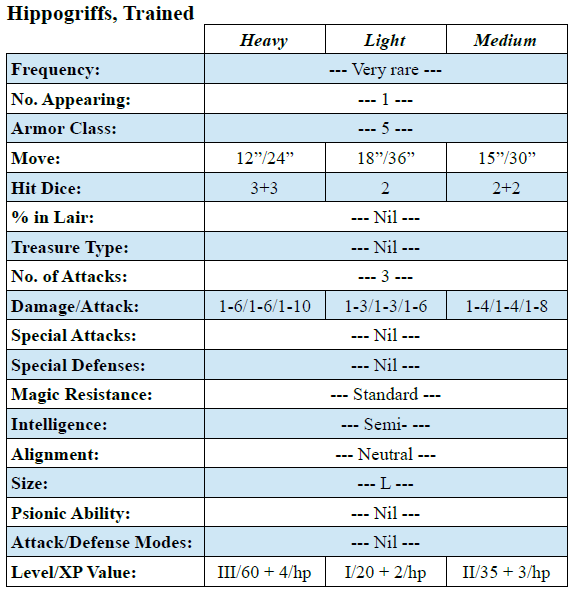
Lady Mirelyn’s hippogriffs come in three weight classes: heavy, light, and medium. They have the same loads as heavy, light, and medium warhorses, respectively. A hippogriff cannot fly if encumbered. The statistics for each type of hippogriff are shown on the table.

January 10th, 2019  in RPG No Comments »

Tuesday Terror: Kaempferi

“Mr–Jack” inspired today’s monster. Click on his name to see the picture. Mr–Jack’s piece is titled “Ultralisk II”. I have no idea what an ultralisk is. I’m guessing it’s a really big lisk. Here’s my take on the creature in the picture.

The kaempferi is an enormous crustacean usually found only in the deepest of oceans. There the kaempferi preys upon other monsters of the deep, such as giant sharks, whales, and giant octopuses. In shallower waters, the kaempferi attacks ships, devours coral reefs, and rarely ventures onto land to attack coastal communities.

Kaempferi
Gargantuan beast, unaligned

Armor Class 19 (natural armor)
Hit Points 351 (18d20+144)
Speed 50 ft., swim 50 ft.

STR 26 (+8), DEX 11 (+0), CON 26 (+8), INT 3 (-4), WIS 11 (+0), CHA 5 (-3)

Saving Throws CON +14, WIS +6, CHA +3
Skills Perception +6
Damage Resistances cold, fire, poison, thunder; bludgeoning, piercing, and slashing from weapons wielded by Large or smaller creatures
Condition Immunities poisoned
Senses blindsight 120 ft., passive Perception 16
Languages
Challenge 17 (18,000 XP)

Amphibious. The kaempferi can breathe air and water.

Echolocation. The kaempferi can’t use its blindsight while deafened.

Keen Hearing and Smell. The kaempferi has advantage on Wisdom (Perception) checks that rely on hearing or smell.

Siege Monster. The kaempferi deals double damage to objects and structures.

Trampling Charge. If the kaempferi moves at least 20 feet straight toward a creature and then hits it with a scythe attack on the same turn, that target must succeed on a DC 19 Strength saving throw or be knocked prone. If the target is prone, the kaempferi can make on stomp attack against it as a bonus action.

Actions

Multiattack. The kaempferi makes four scythe attacks.

Scythe. Melee Weapon Attack: +14 to hit, reach 15 ft., one target. Hit: 22 (4d6+8) bludgeoning damage.

Stomp. Melee Weapon Attack: +14 to hit, reach 10 ft., one prone target. Hit: 27 (3d12+8) bludgeoning damage.

Roar (Recharge 5-6). The kaempferi emits a thunderous roar in a 90-foot cone. Each creature in that area must make a DC 19 Dexterity saving throw. On a failed save, a creature takes 56 (16d6) thunder damage and is pushed and knocked prone 10 feet away from the kaempferi. On a successful save, the creature takes half as much damage and is not pushed or knocked prone. A creature underwater when subjected to the roar makes its saving throw with disadvantage.

January 8th, 2019  in RPG No Comments »

Gold, Frankincense, Myrrh

And entering into the house, they found the child with Mary his mother, and falling down they adored him; and opening their treasures, they offered him gifts: gold, frankincense, and myrrh. (Gospel According to St. Matthew 2:11)

Certain materials, specially prepared and blessed or enchanted, increase the potency of spells. Gold, frankincense, and myrrh are among these materials.

Gold Tola of Command
Wondrous item, uncommon (requires attunement by a spellcaster)

This small ingot of gold weighs 1 pound and has is worth 50 gold pieces considering the value of the metal alone. The ingot has 5 plus 1d4 charges. If the ingot is used as a material component when casting an enchantment spell, you expend a number of charges equal to the spell slot used to cast the spell. This lowers the monetary value of the ingot by 5 gold pieces. Saving throws made against the spell are made with disadvantage for the affected spell’s duration.

Frankincense of Meditation
Wondrous Item, rare (requires attunement by a cleric or paladin)

This small, rectangular block of frankincense aids in preparing and casting of spells. There is enough of it for one use. When you regain expended spell slots during a long rest while inhaling the fragrant smoke from the burning frankincense, choose a number of levels of spells equal to your spellcasting ability modifier. These spells are blessed. Saving throws against a blessed spell’s effects are made with disadvantage for the duration of the affected spell. For 1 minute after casting a blessed spell, when you make an attack roll or saving throw, roll 1d4 and add the number rolled to your attack roll or saving throw.

Myrrh of Shroudlands
Wondrous Item, very rare (requires attunement by a spellcaster)

The small box or vial that contains 1d4+1 uses of this fragrant resin. The resin has three uses:

Touch of Unlife. You expend a use of the resin as a material component when casting a necromancy spell. Saving throws against that necromancy spell are made with disadvantage. Starting at the end of your turn during which you cast the spell, you have resistance to cold and necrotic damage, and you are immune to poison damage and the poisoned condition, lasting for a number of rounds equal to twice the level of the spell.

Turn Undead. You use an action to apply a use of the resin to your holy symbol. When you present your holy symbol and speak a prayer censuring the undead, each undead that can see or hear you within 45 feet of you must makea Wisdom saving throw with disadvantage to avoid being turned. The applied resin lasts for one turn attempt.

Undead Bane. You use an action to apply a use of the resin to a piercing or slashing weapon. An undead creature damaged by the weapon must make a DC 15 Constitution saving throw, taking an extra 6d10 piercing or slashing damage on a failed save, or half as much extra damage on a successful one. The type of extra damage — piercing or slashing — matches the weapon’s type of damage. Once the weapon deals extra damage to an undead, the applied resin becomes inert.

January 7th, 2019  in RPG No Comments »