Archive for the ‘ RPG ’ Category

Bayou of Feathers 3: Unvary-by-Water

Since the settlement of refugees in the Bayou of Feathers needs a name and other information, I put off adding more detail to the region’s hexes and turn to page 27 in Atelier Clandestin‘s Sandbox Generator.

(Nota Bene: That product link is still an affiliate link. If you click and purchase, I get a small bit of pocket change.)

The refugees live in a hamlet, the smallest settlement type. I roll 1d30 to determine the pattern for the hamlet’s name, getting a 12. The name pattern is “D-by-sea”, where D is the component table on which I roll next, which means roll 1d24. I do, and I get a 20.

The refugees’ hamlet is Unvary-by-sea, but since they’re not by a sea, I tweak it a bit to Unvary-by-Water. Since I’ve said that Unvary-by-Water occupies “a few clustered islands”, I’ll also roll 1d3+2 to determine the number of islands. Unvary-by-Water is divided between four small islands.

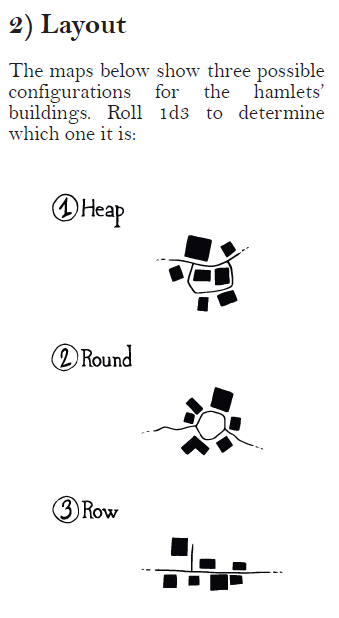
Next I turn to the section on hamlets. I roll 1d12 for the main building, 1d3 for layout, 2d6 for disposition, and 1d6 for a secret, doing so for each of the four islands. The results are as follows:

Island One: 12, 3, 7, 1
Island Two: 9, 2, 5, 5
Island Three: 2, 3, 9, 2
Island Four: 4, 3, 4, 6

This means:

Island One has a watchtower. The layout is a row. The residents’ disposition is neutral, and they are secretly cannibals.

Island Two has a tavern. The layout is round. The residents’ disposition is neutral, and they are secretly lycanthropes or vampires.

Island Three has a chapel. The layout is a row. The residents’ disposition is welcoming, and they are secretly cultists.

Island Four has a manor. The layout is a row. The residents’ disposition is hostile, and they are secretly murderers.

Since all four islands are really the same community, these results call for some interpretation. In general, the residents of Unvary-by-Water are neutral toward visitors. I’ve overlap between cannibal, lycanthrope or vampire, and murder. I don’t like the vampires choice, which leaves lycanthropes. But what kind of lycanthrope? Since they’ve relocated to a marsh, the obvious-to-me choice is the alligator. So, the community of refugees turn out to be a cult of were-alligators who fled into the Bayou of Feathers so that they could both practice the rituals of their alligator cult and occasionally devour travelers in relative peace.

Well, I did not expect the refugee community to end up like that!

This is the great virtue of relying on a combination of random tables and GM fiat. The tables suggest combinations of traits that I doubt I would have come up with on my own. This makes the unfolding hexcrawl world both a surprise to GM and player alike.

June 12th, 2025  in RPG No Comments »

Bayou of Feathers 2: Sandbox Generating

If you don’t have Atelier Clandestin‘s Sandbox Generator, you ought to check it out. I purchased the PDF and printed it, hole-punching the pages to fit in a three-brad folder. I used Sandbox Generator (SG hereafter) with my groups of student players last school year, and it was great fun for them and me.

(Nota Bene: The product link in the previous paragraph is an affiliate link. If you click and purchase, I get a small bit of pocket change.)

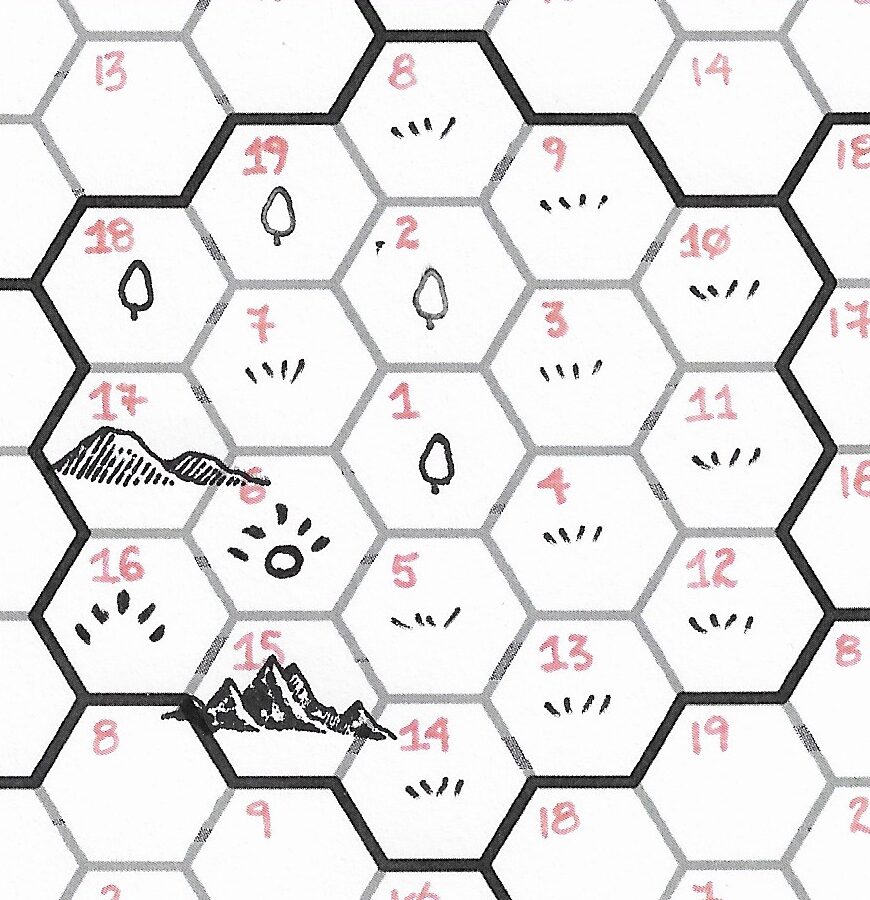
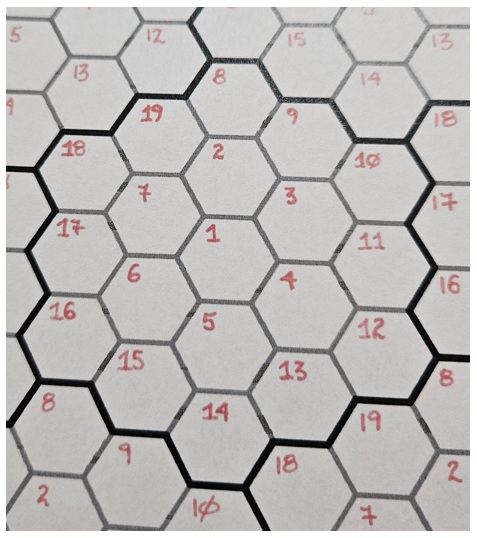
The centerpiece of SG is the hex map. With my students, I used the pictured hex map. Seven clusters of 19 hexes each make up the map, and each hex is two miles across. A section of the map template I used with my student groups can be seen right to the right. There are six clusters of hexes surrounding the 19 hexes of the center cluster.

The first step for a cluster? Determining the biome for each 2-mile hex. SG‘s biomes are determined by first rolling 1d10 for the starting hex. After this, I roll 1d10 on the “Next hexes” chart, which yields a 50% chance of repeating the previous hex’s biome.

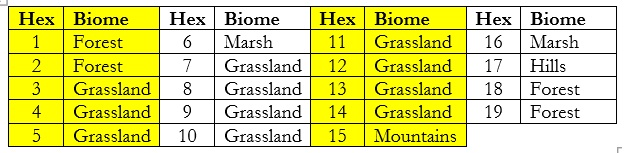
For example:

The table above shows the unedited results of 19d10 rolls. Most of the region is grassland surrounding a stretch of forest that starts in the center hex and extends to the north and northwest. There are more forests and some mountains in the southwest as well as hills in the west.

Linking this to my previous post about the Bayou of Feathers, the lack of marshlands becomes noticeable. This isn’t a problem. I can edit the biomes as I see fit. I change hexes 6 and 16 to marsh, sandwiching the biome between the mountains and the hills in hexes 15 and 17, respectively. Thus:

This puts last post’s community of refugees somewhere within about 21 square miles of marshland situated in the southwest of the center cluster of hexes on my sandbox map.

In the next post in this Bayou of Feathers series, I’ll randomly generator features for 18 of the 19 hexes in the center cluster. Either hex 6 or 16 will be location of the refugee community, which really does need a name.

June 11th, 2025  in RPG No Comments »

The Hodag for Shadowdark

The hodag is a creature of folklore and the subject of a famous hoax perpetrated by Wisconsinite Eugene Shepard in 1893. Here’s the hodag for Shadowdark. Enjoy!

Hodag

More than 10 feet long and at least four feet high at the shoulder. A visage that combines the features of a grinning man and a horned beast. Bony spikes down its spine. A hairless, rat-like tail. Sparse, brown hair covering its body. Powerful legs ending with clawed paws.

AC 14, HP 31, ATK 2 claws +3 (1d6) or gore +3 (1d8), MV double near, S +4, D +0, C +4, I -2, W +2, Ch -2, AL N, LV 6

Poor Climber. The hodag has disadvantage on climbing checks.

Charge. In place of attacks, move up to double near in a straight line and made one horn attack that inflicts 2d8 damage on up to two adjacent targets.

Tough Hide. Damage against a hodag from nonmagical slashing or piercing attacks is rolled with disadvantage.

Nota Bene: The first hodags — one male, the other female– were woodland carnivores incarnated from the pain and terror of abused animals. Their offspring, hatched from eggs, stalk forests to this day. It is wise to know that hodags are poor climbers.

April 1st, 2025  in RPG No Comments »

The Hissing Grassland?

So, I purchased Deck of Worlds from The Story Engine. It arrived in a sturdy box.

Inside the box, six unequally sized decks of cards rest in separate niches. Each deck came shrink-wrapped, which I understand why, but, man, do my old fingers have a hard time with shrink-wrapping. Each deck is one of six different types of cards: Regions, Landmarks, Namesakes, Origins, Attributes, and Advents.

The basic use of Deck of Worlds is to create microsettings. This is done by dealing out one card from each deck in the order listed above. Below are the six cards I ended up with.

Once the cards are dealt, cards two through five are “built” up around the Region card, making choices for each card as seems best. Landmarks and Advents come with two options. The other cards present four options. Once the choices were made, I ended up with this configuration of cards for my first Deck of Worlds microsetting.

Thus, I have the Hissing Grassland with its Village Built with Blood Money. The Region is subject to Seasonal Flooding. The Contents of an Important Archive Are Being Held Hostage in the Village.

I like it.

If you’re interested in more information, check out this ten-minute tutorial as well as the links in the first paragraph above.

March 22nd, 2025  in RPG No Comments »

St. Patrick’s Day Magic Items

How about two magic items for Shadowdark inspired by St. Patrick, Catholic bishop and missionary?

Bodhrán of St. Patrick

An aged goatskin stretched tight across a circular wooden frame about 15 inches in diameter and about 4 inches deep. The player beats the drum its wooden cipín, one end of which doubles as a hex key to tighten or loosen the skin.

Benefit. When played while casting turn undead, the bodhrán changes the target of the spell from undead creatures to reptilian creatures.

Curse. Only a Lawful priest may safely use the Bodhrán of St. Patrick. Others who attempt to use this relic suffer disadvantage on WIS checks for 24 hours.

Iron Bell of St. Patrick

A simple handbell about 8 inches high made of iron and bronze, carried within a decorative shrine composed of bronze, silver, gold, glass, and rock crystal.

Benefit. When rang while casting turn undead, the bell changes the target of the spell from undead creatures to infernal creatures.

Curse. Only a Lawful priest may safely use the Iron Bell of St. Patrick. Others who attempt to use this relic are struck deaf for 24 hours.

March 17th, 2025  in RPG No Comments »