Archive for the ‘ RPG ’ Category

I Is for Ichi

I adore the Ichi (more accurately, the Zatoichi) movies. Shintaro Katsu was amazing in the role as the blind swordsman. Takeshi Kitano’s take on this hero was also pretty spiffy. Since time really got the better of me today, I pillaged ancient content to come up with this build I did for second edition Mutants & Masterminds.

THE BLIND SWORDSMAN
Quote: “Those dice sound different. Are you sure you didn’t switch them?”
Power Level: 10
Concept: Blind swordsman
Occupation: Masseur, gambler, adventurer
Real Name: Ichi
Legal Status: Ichi has a good claim to Japanese citizenship, but being a character fictionally born in the 19th century makes this determination problematic.
Identity: Public
Place of Birth: Somewhere in Japan. His place of birth is identified in the ninth Zatoichi film, but I forget the name.
Marital Status: Single
Living Relatives: None that he knows of
Height: 5 ft. 8 in.
Weight: 180 lb.
Eyes: Dark brown
Hair: Dark brown, but graying
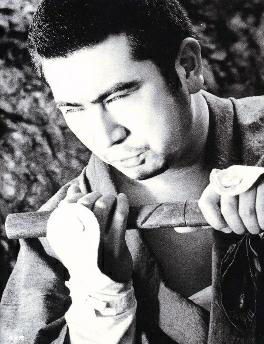
Notes: Here’s my riff on Shintaro Katsu’s Zatoichi. With sword in hand, he is deadly. I simulated his mastery of iaido via a Container power. When armed with any sword or sword-like weapon, the Blind Swordsman exhibits superhuman skill. He uses Deflect against slow projectiles as well as for melee blocks. A successful Deflect triggers his Defensive Attack. (Thus, he Quick Draws his sword, blocks the attack, and slices into one or more nearby targets.) Even when not consciously using his swordsmanship skills to block attacks, he is a slippery target (which explains the Shield power). His basic attack is the Rapid Attack, an Autofire Mighty Strike with a reach of 10 feet. The Blind Swordsman has two alternate powers to Rapid Strike: a Blindingly Fast Attack (Mighty, Subtle Strike) and a Powerful Attack (Mighty, Split Attack Penetrating Strike).

Despite his blindness, the Blind Swordsman is very hard to take by surprise. His other senses, especially his sense of hearing, are exceptionally sharp, and he has an almost preternatural intuition about impending danger.

The Blind Swordsman’s signature weapon is a shikomi-tzue (or cane sword). This piece of equipment has normal statistics for a sword.

STR 14 (+2); DEX 14 (+2); CON 14 (+2); INT 12 (+1); WIS 18 (+4); CHA 13 (+1)

TOU +5 (+2 without Defensive Roll); FORT +7; REF +7; WILL +9; INIT +10; KNOCKBACK -2 (-1 without Defensive Roll)

MELEE +4 (+10 with sword); RANGE +4; GRAPPLE +6; DAMAGE +2 unarmed; DEFENSE +8 (+10 with sword)

Skills (Ranks): Concentration +10 (6), Diplomacy +5 (4), Gather Information +5 (4), Intimidate +12 (11), Knowledge (theology & philosophy) +5 (4), Medicine +5 (1), Notice +15 (11), Profession (masseur) +5 (1), Sense Motive +8 (3), Stealth +5 (3)

Feats: Accurate Attack, Assessment, Attack Specialization (sword) 3, Blind-Fight, Defensive Roll 3, Distract (Intimidate), Elusive Target, Equipment 2, Fascinate (Intimidate), Improved Critical (sword), Improved Initiative 2, Improved Throw, Improved Trip, Move-By Action, Power Attack, Quick Draw 2, Startle, Takedown Attack, Weapon Break

Powers:
Iaido Mastery (Container 11) (Flaw: Must have sword or sword-like weapon [-1])
* Cutting the Arrow – Deflect 15 (Effect: Slow Projectiles; Power Feat: Interpose; Extra: Move Action [+1])
* Defensive Posture – Shield 2
* Defensive Attack – Strike 6 (Effect: Damage +8 (crit 18-20); Power Feats: Mighty, Split Attack 2, Triggered [by successful Deflect])
* Rapid Attack – Strike 4 (Effect: Damage +6 (crit 18-20); Power Feats: Extended Reach, Mighty; Extra: Autofire [+1])
* Blindingly Fast Attack – Strike 8 (Effect: Damage +10 (crit 18-20); Power Feats: Mighty, Subtle; Note: This is an AP of Rapid Attack.)
* Powerful Attack – Strike 4 (Effect: Damage +6 (crit 18-20); Power Feats: Mighty, Split Attack; Extra: Penetrating [+1]; Note: This is an AP of Rapid Attack.)

Super-Senses 5 (Effect: Accurate Hearing, Danger Sense, Extended Hearing 2)

Drawback: Blind (uncommon, moderate, 1 point)

Attack/Damage Tradeoff: -0/+0
Defense/Toughness Tradeoff: +5/-5

Abilities 25 + Skills 12 (48 ranks) + Feats 26 + Powers 49 + Combat 24 + Saves 15 – Drawback 1 = 150

April 10th, 2013  in RPG No Comments »

H Is for Hiawatha’s Friends

This week, after wheedling for more than a year, I’m finally getting to teach Henry Wadsworth Longfellow’s The Song of Hiawatha to my 5th graders. At the same time, as part of Latin class, we’re studying Penelope Lively’s In Search of a Homeland, a retelling of Virgil’s The Aeneid. We are so epic! Today I take a break from Tiamat’s Throne to provide quick Swords & Wizardry stats for two of Hiawatha’s friends.

Two good friends had Hiawatha,
Singled out from all the others,
Bound to him in closet union,
And to whom he gave the right hand
Of his heart, in joy and sorrow;
Chibiabos, the musician,
And the very strong man, Kwasind.

Chibiabos
Hit Dice: 7+7
Armor Class: 5 [14] (9 [10] unarmored)
Attacks: By weapon
Saving Throw: 9
Special: Amazing powers of song
Move: 12
Alignment: Law
Challenge Level/XP: 10/1,400

Chibiabos possesses amazing powers of song. When he sings, even normal animals — both domestic and wild — will stop what they’re doing in order to listen to his beautiful music. Of course, this desire to hear Chibiabos’s pleasing melodies won’t cause an animal to endanger itself or passively tolerate hostile action. With a happy song, Chibiabos can cause all humanoids who hear him to feel at peace. With a sad song, he causes the same to become sorrowful. Again, these feelings cannot cause anyone to endanger themselves or ignore obvious threats. As if these powers aren’t enough, Chibiabos can “cast” these spells, one at a time, once per day each, through his music: charm monster, charm plants, and mass charm.

Kwasind
Hit Dice: 8+14
Armor Class: 3 [16] (7 [12] unarmored)
Attacks: By weapon (double damage)
Saving Throw: 8
Special: Amazing strength
Move: 15
Alignment: Law
Challenge Level/XP: 10/1,400

Kwasind possesses amazing strength. His melee and thrown weapons inflict double normal damage, and even his unarmed attacks inflict 1d6 points of damage. He can hurl boulders as a stone giant (3d6 points of damage). Kwasind is powerful enough to tear apart stone structures with his bare hands as a half-strength earth elemental.

April 9th, 2013  in RPG 1 Comment »

G Is for the Grand Sweep of Time

Several posts about Tiamat’s Throne have made references to different ages, such as the Age of Ashes, Pre-Rage, et cetera. This brief timeline puts these and a few other events into a chronological context.

The Rage of Dragons
2665: Magical dimension irrupts, permitting supernatural creatures to enter our universe. The most destructive of these creatures were the dragons.

2675: The Rage of Dragons ends. Tiamat and her dukes emerge victorious.

The Age of Fire
2675-2800: Tiamat places the dragons Apophis, Illuyankas, and Níðhöggr over three different worlds, Whetu, Thurayya, and Ylli, respectively. Her Draconic Majesty takes a fourth world, Zvjezdana, for her own, renaming it Tiamat’s Throne. Then, she and her dukes set about subjugating the sector.

The Age of Ashes
2800-2950: Rebuiling and recolonization efforts are organized and started.

Early 3000s: Eugenics Commissars operations fully implemented. Tiamat establishes the first College of Wizardry on her throneworld.

The Age of the Phoenix
3275: Tiamat celebrates her sexcentennial and declares the new age has begun.

3292: Current year.

April 8th, 2013  in Product Development, RPG No Comments »

Bonus E! Welcome to Elanor

Elanor is an Earth-like world rich in metals. Pre-rage, Elanor was colonized as a research outpost by Stellae Zaibatsu, an industrial conglomerate focused on planetary mining and metallurgy. The colony was still in the early years of surveying when the Age of Fire erupted. Elanor itself was hardly touched by the dragons, but sector-wide chaos destroyed Stellae Zaibatsu, leaving the company’s colony isolated. Today, no one knows the eventual fate of the colonists. When recolonization of Elanor started during the Age of Ashes, the colony’s facilities remained, albeit abandoned and in a state of disrepair.

The Eugenics Commissars and Terra Prime Ring, the sector’s heavyweight in planetary mining, spearheaded the recolonization. The former organization gengineered the malgrandegulos to serve as the planet’s workforce, and the Commissars and Terra Prima Ring formed a corporate autocracy to oversee Elanor’s rebuilding and industries. These activities were focused on seven small urban centers spread in a ragged line across one of Elanor’s three continents, each located near major mineral and metal deposits. Between Terra Prime Ring’s ruthlessly efficient management and the malgrandegulos’ genetic predisposition to thriving in the sort of work environments planetary mining requires, Elanor’s recolonization was an early Imperial success.

Indeed, it so successful that Imperial control via proxies was relaxed, and the malgrandegulos were permitted self-government. The seven urban centers became independent, republican city-states, and the malgrandegulo citizens of each became increasingly competitive with each other. While this has increased exploitation of planetary resources, it has also increased conflict between the city-states, to include open war among shifting alliances.

Heavy pressure from the Empire encouraged the city-states to seek more diplomatic solutions to conflicts over land and the natural resources locked within that land. Each city-state established a diplomatic corps and exchanged ambassadors. The competing republics have since been locked in a tense cold war in which diplomacy and covert assets attempt to accomplish what conventional military action once attempted.

Adventurers and mercenaries can find ready work on Elanor, if they know who and how to ask. The city-states are eager to maintain plausible deniability and/or to be able to shift blame, and outsiders provide them the means to both ends. Spying, kidnapping, blackmail, extortion, theft, and sabotage are just a few of the activities available on Elanor for morally flexible visitors with the necessary skills.

Elanor at a Glance
Population: 91,600
Atmosphere: Breathable
Climate: Temperate
Government: Republic
Tech Level: 4*

* Yeah, I decided to go ahead and bump the randomly generated Tech Level originally generated for Elanor.

April 7th, 2013  in Product Development, RPG No Comments »

F Is for Fiddling with the Rules

In a couple of previous posts, I talk about giving players narrative control and using defense checks. Since those posts, I’ve acquired and read Dungeon World. It’s a nifty game, and I’m hankering to glom some of it for use in my upcoming Stars Without Number campaign. At the same time, Dungeon World has made me rethink the ideas I’ve had in those aforelinked posts.

How Dungeon World Does Combat

Whenever a character attempts anything in Dungeon World, the player rolls 2d6 and adds whatever ability score modifier applies. The basic outcomes are always these: 10+, you succeed; 7-9, you succeed, “but with complications or trouble”; and 6 or less, the “GM says what happens and you mark XP”.

The most common actions a character are likely to attempt are laid out in basic moves. For example, there is a basic move for melee combat called Hack and Slash. Here’s the text:

“When you attack an enemy in melee, roll+STR *One a 10+, you deal your damage to the enemy and avoid their attack. At your option, you may choose to do +1d6 damage but expose yourself to the enemy’s attack. *On a 7-9, you deal your damage to the enemy and the enemy makes an attack against you.”

Notice, please, that this combines the character’s attack roll, defense roll, and the enemy’s attack roll all in one.

Let the Glomming Begin!

Like Dungeon World, in Stars Without Number attack rolls have a uniform target number for success, namely any modified attack roll that equals or exceeds 20 is a hit. It’s not hard to adapt the former to the latter.

Ignoring ability score modifiers, a Hack and Slash move in Dungeon World has a 16.65% chance of being an outright success (the 10+ result) and a 41.65% chance of being a qualified success (the 7-9 result). The latter range is what I’m concerned with. Let’s round it down to 40% since that’ll fit a d20 better.

What we end with is this for Stars Without Number: A modified melee attack roll of 20+ is a hit, and the character deals damage. A modified melee attack roll in the 13-19 range is also a hit, but the enemy also makes a successful attack against that character.

So far, I’m liking this idea a lot, but it does require some further tweaking. It doesn’t take into account a monster’s attack bonus, but I’m not convinced that’s a problem. It doesn’t take into account the character’s Armor Class, and this is a problem. Dungeon World doesn’t have Armor Class; instead, armor soaks damage. This system also doesn’t account for multiple monster attacks, such as a xenobeast with a claw/claw/bite attack routine. I’m sure these issues can be compensated for with a few simple tweaks.

The same idea of full success on a 20+ and limited success on a 13-19 can be applied to any d20 roll, such as saving throws. Stars Without Number uses 2d6 plus ability score modifier for skill checks, which matches Dungeon World‘s dice conventions perfectly.

But, But!

Lastly, I know what some of you might be thinking: Why don’t I just play Dungeon World? Well, the basic answer is, “Just because.” I’m an admitted inveterate rules-tinkerer. I have been as long as I can remember. It’s worked for the past 30 or so years, and I don’t see why I should stop now.

April 7th, 2013  in Product Development, RPG 2 Comments »