Archive for the ‘ RPG ’ Category

D Is for Dandy

dandy: (adj.) excellent

The Baron Calogero, wealthy effete aristocrat, lives in an elegant chateau, surrounded by the finest luxuries money can buy and waited on by a platoon of the finest servants ever to grace a noble’s household. He is witty and stylish, and invitations to his parties are much sought after by aristocrats and successful merchants. His wife, the Baroness Lamya, possesses stunning beauty and all of the social graces. Nearly everyone admits that few men have life better than Calogero.

Unknown to most, Calogero, a master of disguise and swordsmanship, fights for justice against the forces of chaos under the nom de guerre of the Crimson Rose. Assisted by an elite team of trusted allies, the Crimson Rose engages in daring incursions, striking against those forces that would oppress and tyrannize.

Calogero is one of the most accomplished swordsmen in the land. He fights with a long sword, attacking up to three times per round. Calogero’s attack bonus and the damage he inflicts with his sword depend on how many attacks he makes.

If he makes three attacks in a round, he does so with a -1 penalty to attack rolls, and each attack inflicts 1d4+1 points of damage. If he makes two attacks in a round, his attack rolls are unmodified, and each attack inflicts 1d6+2 points of damage. With a single attack per round, Calogero has a +1 attack roll bonus and inflicts 1d8+3 points of damage.

Due to his enormous skill with a sword, Calogero can divide his attacks between multiple targets, moving as far a 5 feet between attacks. If the damage roll from a successful attack yields the minimum result (2 points with three attacks, 3 points with two attacks, 4 points with a single attack), Calogero not inflicts that damage, but also forces his foe to make a saving throw. If the saving throw fails, Calogero can disarm his foe, knock his foe prone, or leap 10 feet away from his foe (Calogero’s choice).

Due to his enormous wealth, Calogero seldom lacks whatever equipment he needs. He can easily afford the best weapons, armor, horses, et cetera. Among his most prized possessions is his magical quizzing glass.

Baron Calogero
Hit Dice: 5+5
Armor Class: 5 [14]
Attack: up to 3 sword attacks (damage varies)
Special: +2 AC against melee attacks, master swordsman
Move: 12
Saving Throw: 12
Alignment: Law
Number Encountered: Unique
Challenge Level/XP: 7/600

Magical Quizzing Glass: This normal seeming monocle on a stick has two useful magical powers. Once per round, the owner may look through the glass and either use Detect Evil or Detect Invisibility.

April 4th, 2014  in RPG 1 Comment »

C Is for Causal

causal: (adj.) of, relating to, or acting as a cause

The causality virus, designed by the Highbeam Multistellar’s most skilled engineers on Bellatrix, carries on the in the same weapon-of-mass-destruction tradition as the Bellatrixian plague fungus. Despite its name, the causality virus is not an organism of any sort. Instead, it is a nanotech weapon system built to infiltrate energy systems and disrupt the causality of energy transfer within those systems.

Like almost all nanotechnologies, the causality virus is self-replicating. The initial payloads are delivered to the target areas via conventional means, such as a missile. The virus then spreads, seeking out energy systems. It “infects” these systems, disrupting energy transfer by using that energy to fuel the nanotech’s self-replication. Once the “infection” within a system reaches the point at which no further energy transfer occurs within that system, the virus seeks out a new target.

The virus devastates target areas. Obviously, it shuts down all technology more sophisticated than simple machines such as waterwheels. Organisms also have energy systems, and the causality virus attacks biological processes as well. The effects on a human, for example, produce blindness and deafness almost immediately, rapidly followed by paralysis and then the complete cessation of all biological functions. Death is swift and almost painless.

After the causality virus has done its deadly work, coded broadcasts from orbital assets signal the nanotech to self-destruct by shutting down its own energy systems. This permits invading forces to move into the previously infected areas to clean up the dead and reactivate technologies affected by the virus.

April 3rd, 2014  in RPG No Comments »

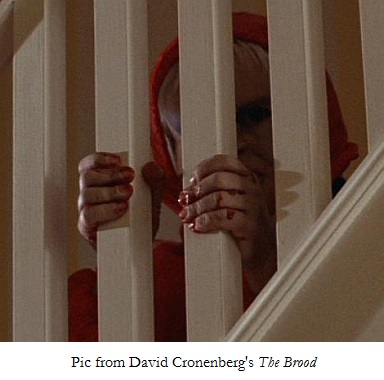
B Is for Brood

brood: (adj.) kept for breeding

A fumgaji (plural, wafumgaji) haunts the outskirts of civilization, lurking in shadowy places, emerging at night to hunt and breed. Wafumgaji practice a horrible form of brood parasitism in which a pregnant female fumgaji sneaks into the home of a sleeping, pregnant humanoid and magically swaps its gestating offspring for the humanoid’s unborn child.

The humanoid victim likely remains unaware of this monstrous switch for weeks, as pregnancy with a gestating fumgaji almost totally resembles a normal pregnancy. Eventually, the unborn fumgaji’s wicked intelligence awakens, and it starts to communicate with its host via telepathy (while she is awake) and vivid dreams (while she sleeps). During this time, the host usually grows increasingly insane. By the time she is ready to give birth to the fumgaji, the host has fallen completely under the monster’s psychic domination, and she will do whatever she must do to protect her “child” until it can return to its true family.

The stolen, unborn humanoid continues to develop within the fumgaji’s womb, and, barring unforeseen circumstances, he or she will be born. At that time, the newborn’s nightmare existence as a “domesticated pet” begins. Raised to amuse and serve evil masters, the child almost certainly grows to become evil as well due to years of physical and mental torture too horrible to speak of.

At first glance in dim light, a fumgaji might appear human, but a second glance likely reveals the truth. Wafumgaji have sickly, pale gray flesh. Anger, hatred, and disgust twist their facial features, sliding uncontrollably from one bestial expression to another. Razor sharp fangs fill their mouths, barely concealed by ragged, blood-red lips.

Wafumgaji attack with these fangs, preferably by surprise. All wafumgaji are telepathic; they have no spoken language (although they are capable of terrifying vocalizations). If a fumgaji does nothing else for the round, it can telepathically assault its victim. A saving throw is permitted against this psychic attack, modified by the fumgaji’s age (+2 for toddlers, +1 for children, +0 for adolescents, and -1 for adults). A failed saving throw causes the affected victim to be confused (as the spell) until the end of its next turn.

Fumgaji
Hit Dice: 1 (toddler), 2 (child), 3 (adolescent), 4 (adult)
Armor Class: 9 [10] (toddler), 7 [12] (child), 5 [14] (adolescent), 3 [16] (adult)
Attack: 1 bite (1d3, toddler); (1d4, child); (1d6, adolescent); (1d8, adult)
Special: surprise opponents on a 1-3 (1-4 for toddlers), telepathy
Move: 6 (toddler), 9 (child), 12 (adolescent), 15 (adult)
Saving Throw: 17 (toddler), 16 (child), 14 (adolescent), 13 (adult)
Alignment: Chaos
Number Encountered: 1d3 toddlers and/or children, 1d4 adolescents, 1d6+1 adults, plus a number of enslaved humanoids of various ages equal to one-half the number of non-adults present
Challenge Level/XP: 2/30 (toddler), 3/60 (child), 4/120 (adolescent), 5/240 (adult)

April 2nd, 2014  in RPG 2 Comments »

Another April’s Challenge

Another April is upon us, which means it’s time for another A to Z Blogging Challenge. (Nota Bene: Click on the pic to the right for more information about the challenge.) This will be the third year in a row I’ve picked up this particular gauntlet. If you’d like to review my previous efforts, please do so:

* A to Z 2012

* A to Z 2013

This year, I’m shooting for a theme. Since it’s April and the first letter is A, I’m going to build that theme around adjectives, with each blogpost featuring a different monster, villain, et cetera, each one characterized by a different adjective that starts with the day’s letter and focusing on OSR game systems, especially Swords & Wizardry and Stars Without Number. So, for example, if I weren’t copping out today with this introductory post, I might have instead written up some sort of atrocious villain.

Anyhoo, that’s it for today. See you tomorrow.

April 1st, 2014  in RPG 3 Comments »

Fiasco in the Classroom

If you’ve never played Fiasco, you owe it to yourself to try it. You might not like it; it’s not an RPG for everyone (but what is?). I won’t bother reviewing the game. It’s been reviewed bunches by better reviewers than me. Also, check out this, this, and this (in that order) to watch Wil Wheaton and friends play a complete demo of the game.

Last week, I decided to try using certain parts of the Fiasco Quest for the Golden Panda Playset for a lesson on story-writing. I pulled up the linked PDF on my laptop. I then asked a series of students to each provide me with a number between one and six, inclusive, dividing these numbers between the standard elements of a story: characters, setting, and problem. We ended up with these results:

Characters: Clandestine collaborators, and an old wise man and a curious child.

Setting: The vintage armor room.

Problem: To get the truth about the golden poppy flower that was left on the doorstep.

Students worked in pairs with the instructions that they had to:

1. Name the characters.
2. Take turns establishing a scene and working with their partners to determine what happens.
3. Compromise when they cannot agree.
4. Keep notes about each scene.
5. Work through two scenes per character, with each scene requiring a different character be present.

Students were also told to invent other characters and settings as needed.

The students worked for about an hour. Most of them seem genuinely engaged in the activity, but there were a couple of problems that popped up. First, one group had trouble compromising, and they required some redirection to get back on track. Also, the groups worked at wildly different speeds, a few completing a story in an hour while most hadn’t made it through half of their scenes. I should’ve been more explicit about the pacing for the scenes.

This week, we’re going to return to the assignment. Students will get to finish their collaboration, and then everyone can take the results and produce a rough draft short story. I can hardly wait to see what the results are.

March 30th, 2014  in RPG No Comments »