Archive for the ‘ RPG ’ Category

S Is for Splenetic

splenetic: (adj.) bad-tempered; spiteful

Everyone who has ever been in love has had this thought, but most reject it. They dismiss this thought as dangerous or wrong or unnecessary. A few, however, embrace this thought. They nurture it and let it grow until it takes on a life of its own.

“What is this thought?” you ask.

It is this: If I can’t have you, no one can.

And when this thought takes on a life of its down, a vishindo is born.

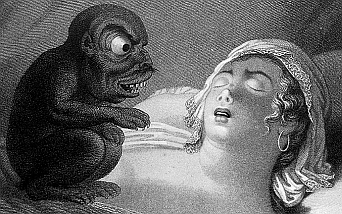
Vishindos serve Moannah*, the Goddess of Desire, and they exist to fulfill the twisted thought that creates them. These creatures appear as coal-black pudgy, diminutive humanoids with oversized heads, bulging eyes, and paw-like hands and feet. About the size of a human infant, a vishindo moves slowly but with great stealth. Furthermore, it crawls up walls and across ceilings as easily as it skulks along the ground.

In its natural form, a vishindo is hardly a physical threat. It can, however, become a 4-foot-diameter spider. In this form, gains a tough exoskeleton and a venomous bite. In its natural form, a vishindo has a dangerous magical ability. It sneaks into the presence of its sleeping victim, and then it haunts the victims dreams in an invisible, ethereal state. The victim suffers tormenting dreams that wreak havoc on the victim’s health. The victim loses 1d4 Constitution points upon waking.

Vishindo
Hit Dice: 2+2
Armor Class: 8 [11] (6 [13] in spider form)
Attacks: Bite (1d6 + poison) (in spider form only)
Special: Dream haunting (in vishindo form only), poison (+1 save or die), spider form, surprise opponents on a 1-5
Move: 6 (18 in spider form)
Saving Throw: 16
Alignment: Chaos
Number Encountered: 1
Challenge Level/XP: 7/600

* Moannah, the Goddess of Desire, she who gently kindles the embers of desire, nurturing the warmth of wanting. She adds fuel to the fire, stoking it with jealousy, greed, and obsession. She turns desire into an all-consuming fire.

April 22nd, 2014  in RPG No Comments »

R Is for Raffish

raffish: (adj.) unconventional and slightly disreputable, esp. in an attractive manner

Nota Bene: As promised, here’s an NPC for TSR’s original Top Secret from 1980. Back in the day, we played this, Marvel Super Heroes, and Gamma World more than D&D. I still fondly remember our long-running Top Secret campaign, wherein our agents quit working for the government and went freelance in the style of The A-Team. Ah, good times with friends who I’ve long since lost contact with, and two of whom have passed away. Requiescat in pace, Fred and Big Fred.

BEGIN MESSAGE

TO: All field operatives in the Middle East

BY AUTHORITY OF: Director of Administrations MR

PURPOSE: Dossier of Bradbury, John Alexander

MESSAGE: At the outbreak of the U.S. entry into World War II, Joshua Alexander Bradbury joined the National Guard and contacted Rep. John Sparkman of Alabama, who arranged a meeting with William “Wild Bill” Donovan. The two hit it off immediately, but Bradbury nonetheless was not recruited to Donovan’s Office of Strategic Services (OSS), and instead joined the Corps of Intelligence Police, which became the Counterintelligence Corps in January 1942. Bradbury was stationed in London. He reportedly gained the top-secret “Bigot” clearance and took part in discussions about Operation Overlord. After the conversion of the OSS into the Strategic Services Unit on 1 October 1945, Bradbury joined what would become part of the Central Intelligence Agency.

Among Bradbury’s first post-war postings was Damascus, Syria, starting in September 1947, thus beginning a long career in the Middle East. He played a role in supporting the March 1949 Syrian coup d’état, and was instrumental in arranging Operation Ajax, the 1953 technical coup d’état against the Prime Minister of Iran, Mohammed Mossadegh.[2]

Later in 1953, Bradbury returned to private life at the consulting firm Booz Allen Hamilton, but he remained a non-official cover operative for the CIA. He traveled to Cairo to meet Gamal Abdel Nasser, who had overthrown King Farouk and taken power in Egypt, advising Nasser on the development of the Mukhabarat and becoming Nasser’s closest Western advisor. In this role he offered U.S. economic development and technical military assistance.

In 1955, Bradbury officially returned to the CIA. During the Suez Crisis, the U.S. backed Egypt’s independence and control of the Suez Canal. The move is said to have been advocated by Bradbury with the goal of ending British control of the region’s oil resources, and forestalling the influence of the Soviet Union on regional governments by placing the U.S. behind their legitimate national interests. After the crisis, Nasser nevertheless moved closer to the USSR and accepted massive military technology and engineering assistance on the Aswan Dam. Bradbury worked to reverse this trend at the time, which included Bradbury’s involvement in schemes to assassinate Nassar.

In 1958, Syria merged with Egypt in the United Arab Republic and King Faisal II was deposed by Iraqi nationalists. Bradbury oversaw contacts with the Iraqi regime and with internal opponents, including Saddam Hussein and the Baath Party.

Shortly after these events, Bradbury faked his own death and went rogue. He currently works out of Beirut, where he owns several safehouses. From these locations, Bradbury sells his skills as an information broker. Bradbury is generally pro-Western, and even his former CIA bosses have had reason to contract with him for his services.

Bradbury has not been photographed in more than a decade. The photo to the right is one of the last known images of him before he went rogue. Presumably, Bradbury has retained his love of high fashion. Bradbury is dapper and charming, but this facade hides a core of cold steel. Approach with caution.

END MESSAGE
STOP
END PAGE

Primary Personal Traits
Physical Strength: 55
Charm: 90
Willpower: 80
Courage: 70
Knowledge: 95
Coordination: 60

Secondary Personal Traits
Offense: 65
Deception: 80
Evasion: 75
Deactivation: 78
Life Level: 14
Movement Value: 195

Tertiary Personal Traits
Hand-to-Hand Combat Value: 130
Surprise Value: 155

Languages: Arabic 65, English 90, French 80, Spanish 80

Areas of Knowledge: Architecture 75, Astronomy & Space Science 75, Biology & Biochemistry 65, Computer Science 105, Economics & Finance 90, Geography 85, Law 95, Military Science & Weaponry 75, Political Science & Ideology 90, Psychology 125

April 21st, 2014  in RPG No Comments »

Q Is for Querulous

querulous: (adj.) complaining in a petulant or whining manner

Nota Bene: Again a move away from Swords & Wizardry and Stars Without Number to focus briefly on a genuine Old School game. I’m back with Chaosium today for that esteemed company’s greatest game, Call of Cthulhu, using my 3rd edition hardback from 1986 for the first time in too long. The day after tomorrow I’m going to go way back again to TSR’s Top Secret.

Black-eyed children appear as preadolescents, but their eyes are solid black with no differentiation between sclera, pupil, or iris. Often, Black-eyed children can be seen playing games and singing the nursery songs in or near abandoned areas. Other reports claim these entities show up alone or in a pairs at people’s doors, usually at night. They avoid eye contact, looking down to hide their eyes. Black-eyed children tend to whine and sulk, and they have bad tempers.

Black-eyed children often attempt to talk a victim into allowing them entry into the home to use a telephone or to be safe from some unspecified danger. Other times, they approach strangers, asking for a place to stay or for an escort home. Victims cannot always refuse these requests, for black-eyed children seem to possess the power to compel obedience. When a black-eyed child attacks, it does so with savage ferocity and a strength that belies its size. At this time, the entity’s skin changes, becoming pallid and corpse-like.

Black-Eyed Child (Lesser Independent Race)

“Let us in,” came the whisper through mail slot, and despite the fearful chill down my back, I reached for the door’s lock.

Black-eyed children may attempt to compel nonviolent behavior through the semi-hypnotic power of their voices. A successful POW vs. POW roll resists the child’s words. It costs a child 1d4 magic points to use this ability.

Characteristics (Average)
STR 3d6+10 (20-21)
CON 2d6+6 (13)
SIZ 1d6+6 (9-10)
INT 3d6 (10-11)
POW 3d6+3 (13-14)
DEX 3d6+3 (13-14)
APP 3d6 (10-11)
Hit Pts 11-12
Move 8

Weapon (Attk%, Damage)
Fist/Punch (55%, 1d3+1d4)
Kick (45%, 1d6+1d4)
Weapon (30%, by weapon+1d4)

Armor: None
Spells: To determine spells known by a black-eyed child, roll 1d100. If the roll is higher than the child’s INT, it knows no spells. If the roll is equal to or lower than the child’s INT, it knows that many spells.
Skills: Climb 45%, Dodge DEX+10%, Hide 65%, Jump 45%, Listen 80%, Sneak 65%, Spot Hidden 50%
SAN: Meeting a black-eyed child’s gaze costs 1 SAN, but a successful SAN roll indicates no loss. Seeing a black-eyed child’s skin change costs 1d6 points of SAN, or no loss with a successful SAN roll.

April 19th, 2014  in RPG No Comments »

P Is for Pithikosophobic

pithikosophobic: (adj.) abnormally or persistently afraid of monkeys

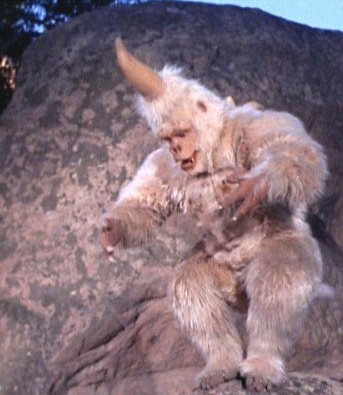
Mugatos are large, intimidating animals that can reach a height of six and one-half feet (not counting the cranial horn). Covered by a thick pelt of white fur all over their bodies with the exception of their faces and hands, they are similar to the great apes of Earth in their physical proportions and prehensile hands and feet. All of their teeth are sharp and serrated, and their fangs contained a strong venom that can be fatal within a matter of hours. Mugatos have large, thick horns projecting from the tops of their craniums as well as smaller spikes running down the spine.

Mugatos’ natural habitats cover tropical or subtropical forests covering a wide range of elevations from montane cloud forests (7,200–14,100 feet above sea level) to dense forests and lowland swamps and marshes as low as sea level. These creatures live in groups called troops. Troops tend to be made of one adult male and multiple adult females and their offspring. Mugato lifespan is normally between 35 and 40 years.

Mugato
Armor Class: 4
Hit Dice: 8
Attack Bonus: +10
Damage: 1d8 bite
No. Appearing: 1d4
Saving Throw: 11+
Movement: 30 ft.
Morale: 11

Mugato Venom: Toxicity 10, Interval 30 minutes, Virulence 3, Damage 1d6

April 18th, 2014  in RPG No Comments »

O Is for Oppressive

oppressive: (adj.) unjustly inflicting hardship and constraint

Ogres have long been a threat to civilized peoples. Strong, brutish, given to looting and pillaging, gangs of ogres are menaces that cannot be tolerated for long. Ogres revel in the misery of others. When smaller races aren’t available to crush between meaty fists or defile in blood-red lusts of violence, they turn to each other for entertainment. It takes a forceful leader to keep an ogre gang focused.

Within ogre tribes, few leaders prove more forceful than harridans. An ogre harridan rules by fear and violence, using her superior strength, intelligence, and magic powers to keep her underlings in line. Most especially it the harridan’s magic that elicits the most terror, for harridans practice gut magic.

Whenever a harridan succeeds with a bite attack against a living foe, she gains 2 gut-magic points. The harridan cannot have more than twice her Hit Dice in gut-magic points. She uses stored gut-magic points to cast spells from the lists that follow. Gut-magic points fade at a rate of 2 points per minute.

1 Gut-Point Spells: Charm Person, Magic Missile, Shield, Sleep

2 Gut-Point Spells: Darkness 15-Foot Radius, Levitate, Mirror Image, Pyrotechnics

4 Gut-Point Spells: Dispel Magic, Fly, Lightning Bolt, Slow

Harridan
Hit Dice: 8+2
Armor Class: 3 [16]
Attacks: 1 bite (1d6), 1 weapon (1d10+1)
Special: Gut-magic
Move: 9
Saving Throw: 8
Alignment: Chaos
Number Encountered: Up to 1 harridan per 15 ogres
Challenge Level/XP: 10/1,400

April 17th, 2014  in RPG No Comments »