In case you missed the announcements on G+ and Facebook, I’ve a few new, free PDFs of content for 1E AD&D ensconced in my Google Drive. Enjoy!
The Abbey of St. Martin: A short adventure.
AD&D Monsters: Alp to Xana: A dozen new monsters.
AD&D Monsters: Apsara to Zebez. Three dozen new monsters.
The Bard: Alternate class for 1E AD&D.
The Recondite Frontier: Campaign region.
Sveti Gardarkena: Another campaign region.
I’m starting a 1E AD&D campaign on 10 January. As part of character creation, I put together these house rules, and also purchased Beyond the Wall and Other Adventures (abbreviated BTW hereafter) and Further Afield by Flatland Games solely because I’d heard good things about that system’s character creation process.
Going Beyond the Wall
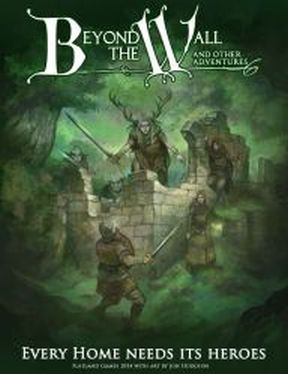
During this Christmas season, I hosted a dinner-and-gaming night featuring spaghetti and BTW. I’d prepped by printing out a blank village map, a spooky scenario pack (from the free Across the Veil addon), four character sheets, and a list of playbooks (click here for a sample playbook).
Nota Bene: As you explore BTW products, you’ll quickly notice that most of them are free. Flatland Games sells the rulebook and rulebook expansion (linked two paragraphs above), and then offers playbooks, scenario packs, et cetera, for free. Nifty!
BTW Character Creation
We started with character creation. Each player picked a playbook from the list, and then I printed only those playbooks. The soon-to-be created party of adventurers included a halfling outrider, a landless noble, an elven highborn, and a student of the dark arts. Next up, the players made up their PCs. Character creation was a snap. The only confusion came from players not reading their playbooks carefully.
Each playbook (and there are more than 30 published by Flatland Games) follows the same format. A playbook starts by giving some background information for the character being created. For example, the Assistant Beast Keeper playbook starts with, “The old witch in the village took a liking to you when you were still young, and you now keep her animals for her. While what you do may seem inconsequential, the witch seems to consider you to be vitally important, and favors you above all others. You dream of a more exciting life.” The playbook then tells the player what his character’s starting ability scores are. These ability scores are the very familiar Strength, Dexterity, Constitution, Intelligence, Wisdom, and Charisma.
After this, the player rolls the appropriate die on each chart to answer a question about this character. These questions cover childhood, known non-player characters, background events, and so forth. Each roll modifies ability scores, perhaps gives a skill or class ability, and so on. With a bit more than a half dozen rolls, the players end up with 1st- or 2nd-level characters (some playbooks lead to more experienced starting characters) complete with basic backgrounds, skills, spells (where applicable), starting equipment, et cetera. All of the characters know each other, and each has even shared some sort of life-changing experience with another character.
BTW offers three character classes: warrior, mage, and rogue. Each playbook feeds into a particular class or multi-class. For example, the Village Bear above creates a warrior-rogue. Three classes seem a bit limited, but the inclusion of multi-class options widens the field, and the playbooks do a good job and making sure no two warriors (for example) are the same. This really hits the Old-School groove well. In AD&D, what made two fighters different from each other wasn’t their class abilities, but instead was the backgrounds and personalities created by the players.
Based on my one game session, BTW’s best feature is character creation. Hands down. No contest. I fully intend on using BTW playbooks (with some minor tweaking) for character creation with my upcoming AD&D campaign.
Let’s Make a Village
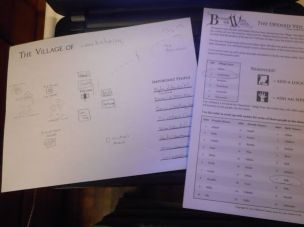
After this, we put together a quick map for the Village of Lambsheim. Character creation includes village creation. Playbook prompt players to add elements to the village map. These elements focus on both non-player characters and locations. With our table of four players, Lambsheim started as a mostly blank piece of paper and grew into a village with eight important locations and eight important non-player characters.
All-in-all, character and village creation took about an hour. We ended up with four developed heroes and a pretty good idea about the heroes’ village, to include some village history that was at least implied by the results from the playbooks.
The Call to Adventure
While the players did their thing, I perused The Opened Veil Scenario Pack. BTW bills itself as offering something other OSR games do not, namely the “tools to play the game almost immediately and with little prep” (to quote the main rulebook). The books elaborates, “Using special Character Playbooks and Scenario Packs, a group of players with a single gamemaster should be able to play the game with absolutely zero prep in about three to five hours, from making characters to tasting a glorious success or a bitter defeat.” Our game session found this to be accurate, but with a caveat about the Scenario Pack. BTW requires little prep so long as someone else has done the prep required for a Scenario Pack.
Nota Bene: Even if the gamemaster does have to put together his own Scenario Pack, the format for such is less work intensive than, say, writing a standard adventure. (For example.) A Scenario Pack also requires far less reading than a standard adventure, and each Scenario Pack lends itself well to a more improv style of play that has built in hooks to get the players motivated.
Back to our session. As necessary details, such as nonplayer character names, emerged from the use of playbooks, I filled in the blanks in the Scenario Pack. Once my tables were completed, a few rolls of the dice generated the specifics of the adventure we would play. I had the hook, the source of the problem, the nature of the problem, and hints about complications and solutions. The Scenario Pack even included some player-generated recent events. Ready to go, we started the game in the inn (of course!).
The scenario played out as a combination of undead street fighting, a haunted jail mystery, a town drunk with looted coins, a betrayal between noble families going back two generations, several watchful spirits, a pack of zombies in the barrows, and a short but brutal fight against an ambitious wight.
The Short of It
All in all, the players had a good time. Everyone agreed that the character generation system was the highlight of the game. Kerry, who played the student of the dark arts, complimented the magic system’s distinction between spells, cantrips, and rituals (although rituals did not come up during play). The game’s systems for combat, skills, and saving throws are easy to grasp and should be at least almost instantly familiar to anyone who has played OSR-style games (or the original games that inspired them).
BTW’s system for cantrips, which work as regular spells but require an ability score check to avoid negative consequences, has found its way into my AD&D house rules. So too has the skill system. The rules expansion, Further Afield, includes rules for starting a “player-driven campaign” that is a “shared sandbox.” I’ve skimmed these rules. I like them, and they too will find their way into my AD&D campaign.
In short, the campaign creation rules are like a larger-scale version of the village creation process, but with the added wrinkle that elements added by the players to the world function as bits of character knowledge subject to degrees of inaccuracy. Just because a player’s gifted dilettante rogue-mage thinks there is a ghost-haunted tower near the foothills a few days to the north doesn’t mean that character’s knowledge about the tower or its location is entirely accurate. Degree of accuracy is determined by an ability score check using either Intelligence, Wisdom, or Charisma (depending on how the character acquired the knowledge).
Beyond the Wall and Other Adventures is a great game. Our playtest included good times, good food, and I spent more time cooking than I did prepping for the game.
Tags: AD&D, Beyond the Wall, game play