Posts Tagged ‘ Stars Without Number ’

The Fombui

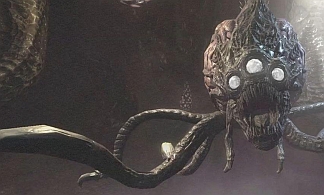
The Fombu (pl. Fombui) is a strange crystalline creature that dwells in the dark and muck of lake bottoms and sea floors. They are seldom encountered as the Fombui have little reason to leave their aquatic abodes. A Fombu appears to be a five stems growing from a central clump. Frail-seeming projections grow upward from these stems, creating a sort of comb-like structure. The longer, more mature projections end in sensory nodules. No one is quite sure how large Fombui grow. Individuals with stems reaching lengths of six feet have been reported. Fombui are filter feeders, sucking water into their bodies and straining out tiny shrimp, algae, and so on. They move slowly by crawling about on stubby feet. Once every 1d6 rounds, a fombui can generate a powerful jolt of electricity. Creatures within 5 feet of the fombui suffer 4d8 points of electricity damage and are stunned for 1d6 rounds. Those within 10 feet suffer 2d8 points of electricity damage and are stunned for 1d3 rounds. Creatures no farther away than 15 feet suffer 1d8 points of electricity damage and are stunned for 1 round. A successful save halves this damage and negates stunning. Fombui cannot be harmed by electrical attacks.

Fombui are remarkably intelligent. They communicate with each other via targeted electrical impulses, doing so over distances as great as two or three miles. While the Fombui lack most trappings of civilization, they have eidetic memories and a rich, complex oral history.

Swords & Wizardry

Hit Dice: 4
Armor Class: 6 [13]
Attacks: electrical jolt
Saving Throw: 13
Special: immune to electricity
Move: 3
Alignment: Lawful
Challenge Level/XP: 6/400

Stars Without Number

Armor Class: 6
Hit Dice: 4
Attack Bonus: NA
Damage: electrical jolt
No. Appearing: 1d6
Saving Throw: 13
Movement: 10 ft.
Morale: 7

June 17th, 2013  in RPG No Comments »

The Konstruaĵo

Centuries ago, when we moved into Stelo Sector to explore and colonize, settlers discovered the first Konstruaĵo sites, which, by that time, were already hundreds of centuries old. To this date, no one can say with certainty what happened to the Konstruaĵo or even what the Konstruaĵo looked like.

What is known? Well, this:

* Konstruaĵo architecture was designed to blend into the natural environment. Many Konstruaĵo structures extend into subterranean spaces.

* No stairs or ladders have been discovered in Konstruaĵo sites. The Konstruaĵo did make use of ramps, some of them quite steep.

* Most curiously perhaps, no depictions of Konstruaĵo life have ever been found. Likewise, xenoarchaeologists have uncovered very few Konstruaĵo artifacts. Those artifacts that have been found are invariably simple tools or utensils, most of them broken.

* It is believed the Konstruaĵo had a highly mystical culture. After the discovery of the Traduko Codex, which led xenocryptologists to reconstruct portions of the Konstruaĵo language, translations of rare Konstruaĵo literary fragments were completed.

* It appears as if Konstruaĵo religion centered on the idea that “enlightened ones” could manipulate reality via “purified senses”. It is almost certain that at least some Konstruaĵo were psychics.

* Inferences drawn from Konstruaĵo texts indicate that the Konstruaĵo were not bipedal humanoids. It is likely that the Konstruaĵo did not consume solid foods, but rather they had a system of externalized digestion, using enzymes to liquefy food before consumption.

The Traduko Codex

Among the many mysteries associated with the Konstruaĵo is the origin of the Traduko Codex, discovered accidentally by construction workers on Ryloth when the ground beneath an earth mover caved in, uncovering an ancient Konstruaĵo cave dwelling. Quite improbably, the fragmentary Traduko Codex included text in both the Konstruaĵo’s language as well as eme-ĝir, the standard dialect of ancient Sumeria, a Terran culture that dates back to the beginnings of recorded history on the human motherworld.

This Konstruaĵo-Terra connection has fueled speculation for decades. It must be that the Konstruaĵo visited Terra during the earliest periods of Terran history. What purpose these visits may have had, when the visits began, when they ended, et cetera, are questions that have yet to be answered.

June 14th, 2013  in RPG No Comments »

Shenzi Chaser

The Shenzi chaser hunts the veldt of the Shenz Highland. These carnivorous flightless birds stand taller than a man, and a full grown adult male can weigh more than 350 pounds. What makes these predators dangerous isn’t their size, speed, and powerful kicks. Rather, it is the Shenzi chaser’s piercing screech, a sonic attack that the bird uses to disable fleeing prey. This screech has a range of 60 feet and requires an attack roll with a +2 bonus to hit. A living creature struck by the screech takes 2d4+2 points of damage and must make a saving throw or be stunned helpless for 1d6 rounds. If the screech misses by 4 or less, the sonic waves strike the ground near the target, causing an explosion in a 5-foot radius that inflicts 1d6+1 points of damage. Those caught in the blast must make a Dexterity check or be knocked prone.

Swords & Wizardry Stats

Hit Dice: 2+2
Armor Class: 7 [12]
Attacks: 2 kicks (1d4+1)
Saving Throw: 16
Special: screech
Move: 15
Alignment: Neutrality
Challenge Level/XP: 3/60

Stars Without Number Stats

Armor Class: 7
Hit Dice: 2+2
Attack Bonus: +3/+3
Damage: 1d4+1/1d4+1 kicks
No. Appearing: 2d4
Saving Throw: 14
Movement: 45 ft.
Morale: 8

June 10th, 2013  in RPG No Comments »

On-the-Fly Gaming

This past week hasn’t been a good week for getting game stuff done. I was out of town much of the week visiting Ridgeview Classical Schools in Fort Collins, Colorado. Their mission, philosophy, et cetera, are very similar to ours where I teach in Katy, Texas, so my school sent me and two other teachers there to kick down doors and loot ideas.

So, about game stuff: A couple of weeks ago, Man Day Adventures kicked off the first session of our new Stars Without Number campaign, meta-titled Amazing Future Tales. As the GM, I’ve decided to pummel the heck out SWN with rules stolen from other games. You can read about the first session here. You can check out the wacky house rules here.

Assuming you read the first session, you noticed one of the characters issuing assignments to the other characters. I didn’t plan that. The players, especially Terry, made all of that up on the spot. I liked that. It made the story more theirs and less mine. It also keeps me from having do prep work as a GM. I’ve got a bare-bones plot for the adventure. I’m ad-libbing the rest with the help of the players. How can that be a bad thing?

A few weeks ago, I played a session of InSpectres. In that game, players have wide-ranging ability to determine specific plot elements, in effect making up the plot as the game progresses. It was a hoot and a half.

To explain simply, characters have a certain number of dice divided between four broad areas of competence. The characters interact with the game environment, the player rolls the applicable number of dice, and the highest result (most of the time) determines how much of the narrative is controlled by whom. A really great die roll means the player has almost carte blanche to determine the result of the roll. Lesser results impose specific restrictions, and the least results give the GM the carte blanche.

I’m mulling using a modified version of the InSpectres narrative resolution mechanic with Amazing Future Tales. At the moment, I’m not quite sure what that’d look like. My initial instinct is for each player to have a pool of “story dice” that they can use to determine results. The player decides how many “story dice” to use for a given situation. The more dice rolled, the greater the chance the player gets to dictate the results. Once “story dice” are used, they are deducted from the player’s pool.

For example, let’s say that the players have just uncovered something mysterious (such as the man who attacked A.J. in our first session). As the GM, I don’t know who this man is. Wes said he wanted to see how combat worked, so I had his character get ambushed. Maybe one of the players, however, has a good idea about who this man is. Let’s say this player is Gary.

Gary decides to spend a couple of “story dice”. He rolls and gets a good result. Gary can then make his idea about the man’s identity, circumstances, et cetera, an official part of the story.

Gary could say, “Well, after we get him cleaned up, I recognize him as a researcher from a different station closer to the coast. He’s weak and feverish from exposure and sickness, but he could provide important information about what’s really going on the jungle.”

Could I have come up with that on my own? Obviously, since I just did, but that’s not the point. The point is that one of my players gets to help shape the narrative-in-progress to make the story more like what he wants it to be.

Again, how can that be a bad thing?

May 18th, 2013  in Man-Day Adventures 1 Comment »

Amazing Future Tales

Man Day Adventures kicked off our new campaign yesterday. You can read the growing amount of campaign information here. We’re using Stars Without Number with some story-telling roleplaying game tweaks. (Check out my house rules to find examples.)

You may notice that Amazing Future Tales doesn’t have anything to do with my under-development Tiamat’s Throne. My players vetoed science fantasy as a genre, preferring more straightfoward science fiction. That’s cool. It’s not like I can’t use a lot of what’ll get developed for the new campaign in Tiamat’s Throne.

Anyway, the first session was a short one. We were missing two players, and another had to leave early. Even still, we got characters created. Specifically, each player created four 0-level characters. Our first adventure is “The Jungle That Hates”, a character-funnel scenario.

Gary ended up with one of his characters, Jack Owen, being the supervisor at Camp Goodall. I handed him the personnel roster and told him to conduct the morning agenda. Gary got a bit flummoxed by the sudden responsibility of spinning out story elements, so Jack Owen passed the buck to Vanessa Amaro (played by Terry).

Vanessa assigned jobs for the day, dividing up the 16 characters into four teams (except for Wes’s Dave Thomas, who stayed in camp). We then jumped to the first group investigating Mandolarian shag ferns so that we could see how the skill check mechanic works. Wes wanted to see how the combat mechanic works, so we shifted to the second team at the henhouse habitat to have Terry’s A.J. Johnson get jumped by a haggard lunatic.

After that, we had to break for the day. Next session is 18 May. If our missing players make it that day, we’ll add eight more 0-level characters to the character roster, and then unleash the ravening hellbeasts.

Characters that survive the funnel get to advance to first level, and then become the core crew of the campaign’s official focus.

May 5th, 2013  in Man-Day Adventures, RPG No Comments »