
Texicon Goeth

Well, Texicon 2012 has come and gone, and Giant Boy and I rest comfortably at home once more. So, you wonder, how was the convention? Well, let me tell you, breaking things down in Leone-esque categories. Feel free to play this music in the background while you read.

The Good

I’ve never been to Fort Worth, Texas, even though I’ve been nearby Dallas several times. I enjoy visiting new places. Norris Center, the convention’s downtown venue, was easy to find, close to free parking, and there were at least a half dozen eateries within easy walking distance. With an hour break between each gaming event, that gave me and Giant Boy plenty of time to chow down, relax a bit, and then dive back into the convention scene.

Texicon is a small convention, all of the gaming crammed into two rooms, one for board and roleplaying games, and the other for miniature battles. A few seminars were held in another rooms. Everything was on the second floor of the Norris Center, so getting from event to event was not difficult. Contrast this with OwlCon, for example, which last year was spread across Rice University over an area roughly three city blocks square sometimes without clear instructions about what was where.

A wide variety of board games were in play. As I type this paragraph, it’s session 2 of day two. I count nine tables for board games. Two aren’t being used. The other seven have seven different board games going on. The miniature battles room was similiarly well-attended, although I spent little time therein.

As small as Texicon was, I was pleased to see a number of children — preteen and teen — in attendance. Again, glancing around the board/roleplaying game room, I see four kids, not counting Giant Boy. The gaming torch is being passed to a new generation.

Saturday morning, with no one signed up for my “Metro Gnomes” game, Giant Boy and I both played in Stan Shinn‘s excellent Savage Worlds sci-fi adventure. I was the brave ship’s captain, and Giant Boy was “Phase”, our crew’s resident hacker and tech-jockey. The crew also included Corey, my faithful firstmate; Bryce, our face-man; and “Stitch”, the ship’s doctor and molecular knife enthusiast. We were hired by a wealthy political pariah to liberate his abducted daughter from the clutches of a ruthless warlord. We completed this daunting task with much aplomb, saving the damsel, capturing her father’s traitorous employee, and sending the warlord and several of his goons hurtling from the warlord’s stolen spaceship into the rugged landscape passing below at many kilometers per hour.

After this game, Giant Boy and I popped across the street to Five Guys for a burger each, and then visited the small vendors’ room. About eight vendors were on hand, selling used books, back issues of comics and gaming magazines, et cetera. I chatted bit with The Game Closet (purveyor of fine games), The Tangled Web (purveyor of lovely handmade dice bags), and Roll2Play (purveyor of fine dice). I plopped down some money with the latter on some more dice since Giant Boy’s half-orc falchion monster needed more d4s, and I never seem to have sufficient d6s to fireball people. I’d’ve bought a crocheted dice bag, but they were a little too gamergrrl to fit in at Man Day. I did, however, purchase my daughter Adrienne a zipper pouch with a lovely, hand-embroidered bunny rabbit on it.

Since no one other than Giant Boy was signed up for the day 2/session 2 Pathfinder event, the lad played in a Rifts adventure while I wrote parts of this blogpost and took some pictures. I watched much of this event from afar. The GM was animated and personable, and appeared to be good at keeping both experienced and novice Rifts players engrossed in the game (and with two of those novices being younger than 16). Giant Boy played some sort of power-armored samurai.

Near the end of Giant Boy’s Rifts game, I started a delightful conversation with Paul Cardwell of the Committee for the Advancement of Role-Playing Games. Mr. Cardwell is a fine, elder scholar and gentleman who is passionate about gaming and history. What’s not to like? Our amiable, rambling discourse covered topics such as old-school gaming, kids today, the influence of Charles Dickens on the latest Batman movie, Glenn Miller, ostrich-riding knights, Vatican II, and the moral failings of dystopian gaming.

I also must applaud Texicon’s staff, the vendors, and the players for how genuinely friendly everyone was. (Well, not the T-shirt vendor guy; he was churlish.) Texicon was small, but it had a mighty heart.

While it’s not game related, I must mention St. Joseph Catholic Church in Cleburne, Texas. Giant Boy and I attended services there Sunday morning. The crucifix in the jay-peg collage hangs above the tabernacle there. Strictly speaking, we didn’t attend Mass since the parish priest was out of town. A deacon conducted a communion service, and he movingly spoke about the monstrous shooting spree in Aurora, Colorado.

After church, we ate yummy breakfasts at Susannah’s Homestyle Cooking and then went and saw The Dark Knight Rises. It was adequate. I won’t toss out any spoilers here, but will say that the storyline was muddled, Bruce Wayne was whiny, and Bane’s voice often unintelligible. At one point in the film, I swear Bane threatened to reduce Gotham City to “asses”. The Dark Knight Rises is in no danger of being lauded as the Nolans’ best movie.

The Bad

Roleplaying game offerings were sparser and less well-attended. For example, no one other than Giant Boy signed up for my “Metro Gnomes” game. I had three people signed up for my Go Fer Yer Gun! game. By start time, the sign-up list had one name scratched off, and by about 20 minutes after start time, I only had one player (Giant Boy). On the roleplaying game sign-up sheets, blank spaces outnumbered claimed player slots by a substantial margin. Most RPG rounds did not have sufficient players for them to run.

Friday evening, since my “Metro Gnomes” game couldn’t run with just one player, Giant Boy and I jumped in on a 2E D&D game. It was just about thoroughly blah, in part because of the environment (more on this below), which complicated the fact that the DM was hard of hearing. The scenario, such as it was, had a lot of potential. Giant Boy, some other guy, and I played military recruits of sorts on maneuvers in a Bad Lands of the Dakotas sort of place. What was meant to be a simple training run for a search-and-rescue mission turned into a life-and-death struggle against orcs and ogres. Like I said: potential. Unfortunately, even factoring out environmental issues, the scenario seemed to be entirely and clumsily ad-libbed. It often felt more like a showcase for the DM’s meticulously conceived homebrew campaign than a convention event.

Now, about those environmental issues. Above, I noted that it was a good thing everything at the convention was in a single location and easy to get to. This good thing was also a bad thing. As I glance up from the keyboard to guesstimate, the board/roleplaying game room looks to about 900 square feet of floor space with 20 tables set for at least six people each. That’s crowded. It’s also loud, and lots of background noise really bugs me. It hampers communication, and it can be a mood killer for a game. If I had my druthers, the space used for seminars — about which I have zero interest — could have been better used for gaming to cut down on the hubbub.

The Ugly

When I first started typing this while Giant Boy played Rifts, I counted five people I saw last night. Three of them were wearing the same clothes, and one of the three had probably not bathed judging by his bedhead hairdo. I mean, seriously, people. I’ve written in this space before about how the stereotype of gamers being hygiene-challenged, socially awkward basement-dwellers is unfair. Unfortunately, it’s not always unfair.

Here’s my public service announcement.

My fellow gamers, personal hygiene is not optional. It is a basic requirement for participating in civil society and for your own physical health. Except in extremis, put on clean clothes every day. Bathe everyday. Brush your teeth. That logo, cartoon, or slogan on your T-shirt isn’t so awesome, funny, or witty that it somehow makes personal hygiene optional.

Much in the same vein, the men’s room was a disaster. To start with, the sign adjacent to the entrance read “Mens Room”. That makes no sense. How much extra money would an apostrophe have cost? Every time I had to avail myself of the facilities, wadded up paper towels littered the floor. I mean, seriously, men. Put trash in a trash can. You want to be a pig and toss trash on a bathroom floor, go do it in the privacy of your home. Likewise, if you feel compelled to urinate near a urinal, do that at home also. Along the wall to which the urinals were attached, there was a foot-wide smear of moisture that looked like it had both depth and resilience (as well as hair).

To be fair, that level of build up couldn’t have taken place solely within the scope of the convention. I’m willing to go on the record and state that much of the urinal wall zone of gag-reflex-triggering horror was present Friday morning before Texicon began. Norris Center staff: Buy a mop and some extra strength floor cleaner, and use them zealously.
July 23rd, 2012  in RPG, Spes Magna News 1 Comment »

Texicon Cometh

Well, Texicon 2012 is almost here. Giant Boy and I are heading up to the Dallas/Fort Worth area this Friday. At the convention, I’m running Dyson Logos’s Geodesic Gnomes and a Go Fer Yer Gun!/Call of Cthulhu mash-up. The former adventure, Metro Gnomes, is going to be made available via the regular sources for Spes Magna PDFs by the end of this month (in theory). I’d like to publish the other adventure, but I need to contact GFYG!‘s author Simon Washbourne. I’d like to note that my adventure, BR&ND, is compatible with GFYG!, but I won’t use someone else’s product identity like that without their permission.
I’m also behind the curve on getting the metric system version of Dodeca Weather done. Once I get caught up, it’ll be made available as well. Those of you who’ve already purchased Dodeca Weather will receive the metric system version for free when I update the files.

Brain Fiends!

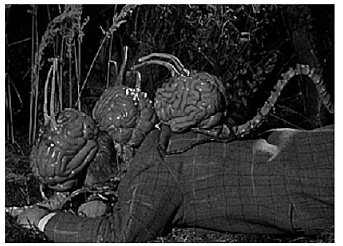
Several grotesque monsters swarm over the body. Each appears to be an oversized brain with a single tentacle and snail-like eyestalks. They scurry about on spindly, insect-like legs.
Brain Fiend
CR 2; XP 600
LE Small aberration (aquatic, psionic)
Init +2; Senses darkvision 60 ft., detect hostile intent; Perception +8

DEFENSE
AC 13, touch 13, flat-footed 11 (+2 Dex, +1 size)
hp 13 (3d8)
Fort +1, Ref +3, Will +6

OFFENSE
Speed 30 ft., climb 20 ft., swim 30 ft.
Melee tentacle +5 (1d4 plus grab)
Special Attacks constrict (1d4 plus strangle), powerful tentacle
Psi-Like Abilities (ML 3rd; concentration +6)
Constant – detect hostile intent
At will – detect psionics, read thoughts (Will 15)
3/day – cloud mind (Will 15)
1/day – brain lock (Will 15), inertial armor (+5 armor)

TACTICS
A brain fiend prefers to attack by surprise against a lone victim. It uses a combination of cloud mind and Stealth to avoid detection. When ready to attack, it opens with brain lock since this power has the potential to make a fight against a solitary target a rather short conflict. Against a victim who can fight back, a brain fiend protects itself with inertial armor, and then it tries to constrict its foe to death.

STATISTICS
Str 6, Dex 15, Con 11, Int 16, Wis 15, Cha 16
Base Atk +2; CMB -1 (+5 grapple); CMD 11
Feats Mental Leap, Stealthy, Weapon Finesse (B)
Skills Acrobatics +8 (+10 to jump with Mental Leap), Autohypnosis +8, Climb +16, Escape Artist +10, Knowledge (any one) +9, Perception +8, Stealth +14, Swim +11; Racial Modifiers +8 Climb, +4 Stealth, +8 Swim
Languages telepathy (100 ft.)
SQ amphibious, compression, water dependency

SPECIAL ABILITIES
Powerful Tentacle (Ex): A brain fiend’s tentacle is remarkably strong. Its Strength modifier for damage and grapple attacks enjoys a +2 racial bonus.

Skills: Brain fiends use their Dexterity modifier for Climb and Swim checks.

ECOLOGY
Environment any swamps or underground
Organization solitary, pair, or cortex (3-9)
Treasure standard

Brain fiends are amphibious monsters that resemble disembodied brains with snail-like eyestalks. These creatures scurry about on four insectile legs. Their bulbous, soft bodies terminate in a powerful, bony tentacle that it uses for combat, swimming, and manipulation of simple tools. All brain fiends possess impressive telepathic powers. These monsters are carnivorous, and they prefer to feast on the soft organs of their victims. They feel as if an organ’s flavorfulness increases as does the intelligence of the creature from which the organ is taken. The average brain fiend is about a foot in diameter with a two-foot-long tail, and it weighs about 30 pounds.

Brain fiend cortexes function as a cohesive, disciplined unit. The creatures’ constant detect hostile intent and ability to read thoughts make it so that dishonesty and treachery within the brain fiends’ collectivist society is almost unknown.

June 20th, 2012  in RPG 1 Comment »

The Infected

Before I continue, let’s toss out a table of contents of sorts:

Post 1: Zombie Brainstorming
Post 2: More Zombie Brainstorming!
Post 3: Of Zombies & Exploding Dice
Post 4: The History of the Plague

Next, let’s repost the rundown of infected traits:

Trait 1: The host’s lymph nodes swell into buboes. These buboes fill with a mixture of blood, pus, and live virus. Not only can they pop if roughly handled, the virus changes the host’s body so that the host can vent its buboes’ contents via the mouth and nose.

Trait 2: The infected do not respirate the way humans do. Their lungs do not serve any particular purpose. More physiological changes, however, give an infected the ability to voluntarily control its thoracic diaphragm. By contracting or relaxing this muscle, an infected can inhale or exhale, permitting it produce limited vocalizations. The infected cannot speak, except perhaps single syllable words that would be more hissed than articulated, but they can growl, moan, et cetera.

Trait 3: Further physiological changes alter bone structure and density. The proximal and distal phalanges fuse, and the fused bones grows into something very much like spikes. Since the bones are denser as a whole, the infected is more durable and less suspectible to injury.

Trait 4: The infected’s brain changes as well. It enters a hyper-adrenaline state which constantly floods the infected’s body with this powerful hormone. At the same time, the nervous system is less sensitive to pain and fatigue.

Trait 5: The infected kill and eat the non-infected because uninfected human tissues contain a variety of hormones which nourish the virus. Chief among the hormones that the infected crave are arenaline and cortisol, the hormones that trigger the flight-or-fight response.

Now with all that done, it’s time to tackle the stats of the infected. For this part of the brainstorming, I’m borrowing the idea of templates from the d20 System. For those of you not familiar with this little gem of game design, a template is a set of rules that change a base creature into a different sort of creature. The Pathfinder Roleplaying Game, for example, has a number of simple templates, such as the Giant Creature template that tells the GM how to quickly adjust a creature’s stats reflect it being bumped up in size by one category.

The Infected Template is applicable to any human. In GYFG!, there are two types of people: Folk and NPCs. The former are generic characters. They are 0-level people with average stats and maybe a special ability or two at most. NPCs are more fleshed out. They have a class, level, all six attributes, et cetera. Since NPCs are the more complicated, I’m going to start with template designed based on them.

Infected Template

The Infected Template is applied to any person who has contracted the plague and become a cannibalistic, raging psychopath.

Class & Level: The infected retain their level, Hit Dice, bonus to hit, bonus to defense, and class abilities.

Attributes: The infected gain a +4 bonus to Strength and Constitution, and a +2 bonus to Dexterity. They suffer a -4 penalty to Intelligence, Wisdom, and Charisma. No attribute may be higher than 21 or lower than 5 once these modifiers are applied. Regardless of class, Strength and Constitution are primary attributes. Dexterity is the infected’s only secondary attribute. Mental attributes are all treated as tertiary.

Hit Points: The infected’s hit points likely change due to the increase in Constitution. The infected are not rendered unconscious when their hit points are reduced to 0 or lower. An infected whose hit points are -1 or lower still loses 1 hit point per combat round from blood loss. The amount of negative hit points an infected has been reduced to is applied as a modifier to all d20 rolls the infected makes. For example, an infected reduced to -5 hit points can still move, fight, et cetera, but it suffers a -5 penalty to d20 rolls. An infected dies when reduced to -10 hit points.

Abilities: The infected often have impaired class abilities due to their adjusted attributes. They also don’t use tools, so abilities such as a gunslinger’s fast draw are almost always irrelevant. Defence Class likely changes due to the increase in Dexterity.

Languages & Literacy: The infected cannot speak properly, but they retain the ability to understand whatever languages they knew prior to infection.

Special Abilities: All infected have the following special abilities.

* Bite: The infected can bite a grappled victim with a successful attack roll. The bite inflicts 1d2 points of damage (modified by Strength), and the victim may be exposed to the virus. The victim is allowed a Dexterity saving throw to avoid exposure. Those that fail this saving throw must make a Constitution saving throw to avoid infection. Both of these saving throws are made with a +2 bonus.

* Cannot Drown: The infected do not respirate the way humans do. They cannot drown in water since they can extract needed oxygen from the water.

* Claws: The infected attack with their claws. They get two claw attacks per round that inflict 1d4 points of damage each, modified by Strength as normal.

* Vent Buboes: As an attack usable a number of times per day equal to Constitution modifier, the infected may vent their buboes via their mouths and noses. This attack has a range of 10 feet. The chosen target must make a Dexterity saving throw to avoid being sprayed. If this saving throw fails, the victim must make a Constitution saving throw to avoid infection. If this fails, the victim is almost certainly doomed.

Special Hazard: An infected reduced to -1 or few hit points presents a special hazard. Anyone adjacent (within 5 feet) of such an injured infected when that infected suffers further damage may be splashed, sprayed, et cetera, by virus-laden fluids. Those who might be sprayed must make a Dexterity saving throw to avoid being hit by bodily fluids. Those that fail this saving throw must make a Constitution saving throw to avoid infection. Both of these saving throws are made with a +2 bonus.

XP: Increase the XP value of the base creature by adding the appropriate special ability modifier twice. For example, a rowdy is normally worth 65 XP. Once infected, he is worth 105 XP.

When applying the template to a Folk, the process is simpler:

* +2 bonus to Strength and Constitution checks, and a +1 bonus to Dexterity checks.
* +2 Strength-based damage.
* +2 hit points per Hit Die.
* +1 Defence Class.
* -2 to Intelligence, Wisdom, and Charisma checks.
* Two prime attributes: Strength and Constitution.
* Apply special abilities and special hazard as normal.

Becoming Infected

Eventually, a PC or important NPC is going to get infected. Both the Dexterity and Constitution saving throws are going to fail. At this point, there is nothing to do but kill the victim before he fully succumbs to the virus. Once per combat round for the next 1d4+4 rounds after being infected, the victim may make a Wisdom saving throw. If he succeeds, he can act normally that combat round. Otherwise, he simply screams, flails about, et cetera, as the virus mutates his body and mind with horrifying rapidity. After the 1d4+4 combat rounds, the victim is fully transformed. On the plus side, he’s likely already injured, so at least killing him will be a bit easier.

June 19th, 2012  in RPG No Comments »

The History of the Plague

Enough game mechanics about horror suvival in GFYG!. Well, at least for now. I need to look at background information. Just like a tell my students, “When you do history, start with the five double-yous and the aitch.” Works for 5th graders. I don’t see why it won’t work here.

When?

To start with, I need a time for when the plague first started to spread. In keeping with the apocalyptic theme, I’m going to pick 1860, the year Abraham Lincoln was elected President of the United States, and the final links in the chain of events leading to the U.S. Civil War were forged. For many Americans, Lincoln’s election was seen as the beginning of the end: the end of the Union, the end of states rights, the end of slavery, et cetera. Well, in our survival horror game, the first outbreak of the infection took place in late November 1860.

What?

The plague isn’t like anything ever seen before. It makes smallpox and the bubonic plague look like the common cold. This deadly bloodborne pathogen spreads quickly, has no known cure, and mutates its hosts into monstrous killing machines.

Where?

In 1860, travel was pretty limited. Most people still walked or road in wagons. The railroads were around, but they were mainly used for shipping freight, not transporting people. Travel via water was still widely used. In modern pandemic apocalypse stories (such as the film Contagion), the disease spread globally quickly because modern folks travel globally quickly. In 1860, this wasn’t the case. In order for a mid-19th century plague to gain purchase and spread rapidly, it needs to hit a major population center that is also a hub for transport and travel.

In 1860, that means New York City.

About half of the cargo and people entering or leaving the U.S. via the Atlantic passed through New York City in 1860. The Big Apple is about 190 miles from Boston, 250 miles from Philadelphia, about 300 miles to Washington, D.C., and about 750 miles to Charleston, South Carolina. Those are overland distances. All four cities were also on major waterways as well as on rail lines.

Not to leave the south and west out of the picture, let’s have an outbreak in New Orleans, Louisiana, in the early days of December 1860. From New Orleans, it’s a short hop to Galveston and Jefferson, Texas, both important ports (the latter being a steamboat port). New Orleans also opens up the possibility of international problems as it is relatively close to many Carribean islands and Mexico.

How?

Well, obviously, the plague spread because the infected bit people who then escaped being eaten long enough to become infected themselves. Then they bit people, et cetera, et cetera. In New York City and New Orleans, the plague spread quickly. Communications and travel were slow enough that by the time militia and/or U.S. military personnel arrived to restore order, the battle was already lost in those cities.

Efforts were made to quarantine both cities. Once it became clear the infected could not be safely treated, a shoot-on-sight policy was implemented. People whose loved ones were infected often disagreed with this policy, and at great risk to themselves, smuggled bound and gagged infected out of quarantine zones to seek treatment in other towns. This, of course, didn’t result in any cures, but instead facilitated the spread of the plague outside the quarantine zones.

By the end of January 1861, the infected were rampaging along the Atlantic and Gulf Coasts. Fortunately, the cold winter months helped slow the spread, especially across the Appalachian Mountains into states like Tennessee and Kentucky. Also, the swamps and bayous in southern Louisiana inhibited the travel of the infected westward into Texas, and the Ozark Mountains had the same effect going to northern Arkansas and southern Missouri.

By March 1861, when Lincoln was inaugurated, the U.S. was in the throes of a pandemic the likes of which the world had never seen. States with low rates of infection spoke of secession, and President Lincoln tried to preserve the Union from within the battlements of the White House.

Who?

This one’s easy. The infection doesn’t discriminate. Rich, poor, slave, free, white, black, native, or immigrant. It doesn’t matter to the plague. Among the hardest hit initially were doctors, nurses, and others who treat the sick, such as members of the clergy and religious communities. Those who keep the peace, such as police and the military, have also been widely affected.

Why?

Here’s where some ambiguity gets injected into the setting. No one knows why the plague started. There are a variety of competing hypotheses, any one of which might be true. Or, maybe none of them are true.

The Democrats: The plague was released somehow by Democrats upset at the election of a known abolitionist to the Oval Office. Unfortunately, the Democrats couldn’t control the disease’s spread and have plunged the entire nation into blood-drenched chaos.

Divine Judgement: The plague is God’s judgement on America for so long tolerating the evil institution of slavery. Or, maybe, it’s God’s judgement on America for so long tolerating the abolitionists. It all depends on which group is making the claim.

Foreigners: The plague was brought to the U.S. by foreign immigrants and/or travelers. This hypothesis dovetails nicely with divine judgement (“America for Americans!”), the Jesuits (“Servants of a foreign power!”), and Mexico (“Revenge for Texas!”).

The Jesuits: Conspiracy theories about the Jesuits go all the way back to just about when the order was formed. Given the widespread anti-Catholic sentiments popular with many Americans in the 19th century, who’s to say those black-robed Papists haven’t finally launched their plan to crush democracy and subjugate the land of the free to the Pope?

Mexico: Mexico is still stinging after its embarrassing defeat at the hands of the U.S. in the Mexican-American War. Mexico lost thousands and thousands of square miles of territory under the provisions of the Treaty of Guadalupe Hidalgo. The plague was unleashed in the U.S. by Mexico as revenge for its defeat. This theory fits in nicely with the foreigners and Jesuits hypotheses.

The Republicans: The plague was released somehow by Republicans to punish the Southern states for slavery. Unfortunately, the Republicans couldn’t control the disease’s spread and have plunged the entire nation into blood-drenched chaos.

Voodoo: Slaves started the plague with their devilish voodoo practices.

Right now, I lean toward avoiding any particular origin to the plague. In survival horror films, the victims very often don’t have a clue why things have gone horribly wrong. They don’t know who’s to blame, and that’s part of the horror. Can the government be trusted? Are those doctors really trying help? If you don’t who’s guilty, you don’t know who’s innocent either. After a while, maybe everyone becomes a suspect.

In a similar vein, I’m not worried about going into much socio-political detail. Survival horror isn’t about the big picture. It’s about small groups of people cut off from conventional sources of help trying to stay alive from one day to the next. Before Tex McGraw was eaten in the saloon, he didn’t care what President Lincoln was doing in D.C. He wasn’t waiting for the federal marshal to come riding in to save the day. He was trying to get a bottle of whiskey and that shotgun from under the bar.

In other words, survival horror is a style of game that almost requires the start small and gradually develop the big picture style of play.

Giant Boy just asked, “What’s the current year?” Not sure. I’d be inclined to start a GFYG! surival horror campaign circa late spring 1861. The mountain passes would be thawed up nicely by then. Perhaps a good starting point for such a campaign would be with a small group of survivors trying to keep the infected from swarming through the Cumberland Gap.

June 18th, 2012  in RPG No Comments »