Archive for the ‘ RPG ’ Category

The Obedience of Faith

Also from September 2012, represented here with a few edits.

In his Epistle to the Romans, Paul of Tarsus writes about “the obedience of faith” (Romans 1:5, to be specific). In the original Greek, that phrase has the same structure as the English phrase “the city of Houston.” In other words, faith is another name for obedience. Obedience and faith are synonymous.

The theological implications of this synonymous relationship are beyond the scope of this modest blog. I’m not a preacher or a theologian. I’m just a teacher in a small, classical education charter school. Nevertheless, the equivalence between obedience and faith drawn by Paul is instructive.

One of a teacher’s more challenging tasks is keeping a room full of kids on-task, relatively quiet, and exhibiting an acceptable level of politeness. With a score children in a too-small room, each student with his or her own wonderful personality and foibles, this is often easier typed than done. Youthful enthusiasm doesn’t seem to easily tolerate the expectations of public education, which often must seem more like a full-time job than a wonder-filled journey of discovery. My students’ school day runs from about 8:00 a.m. to about 3:15 p.m., Monday through Friday, with about an hour-long break for recess and/or lunch. That’s almost eight hours a day, five days a week, mostly spent in classrooms with the same 19 other people.

Is it any wonder nerves can get a bit frazzled?

In my experience, discipline problems are more prevalent in the earlier weeks of school. I’ve often wondered why, and recently I think I’ve hit on at least part of the answer, which brings us back to the equivalence between obedience and faith. I ask my students to do a variety of things all day long. Many of those things can seem daunting. Write a paragraph about how Latin adjectives and Latin nouns must agree in terms of gender. Sit still and be quiet while I rave about D. H. Lawrence’s use of alliteration. Read the next chapter of Don Quixote. Et cetera.

When a student fails to follow these sorts of instructions, that lack of obedience may indicate a lack of faith. But a lack of faith in what? Well, most likely, the lack of faith is in me as a teacher. If I’ve not earned a student’s trust, it only makes sense that that student may be more inclined to disobey my instructions. The disobedience could also point out that the student lacks faith in his or her own abilities.

If I am to expect obedience from my students (which I do expect), I must earn my students’ faith, their trust. I must respect them while demanding excellence and while encouraging them to demand the same from themselves.

May 16th, 2017  in RPG No Comments »

Jake Kiboko, Private Eye

Every now and then, I hit these annoying funks during which I manage to accomplish little other than go to work, do family stuff, and eat and sleep. I certainly can’t seem to muster the energy and ethusiasm for my writing projects, which is my lame excuse for not having finished The Four Color Hack, releasing another Dangerous Place, et cetera. I’d love to say I’m getting back on track, but I’m not sure that’s accurate. Of course, I can just take Dietrich Bonhoeffer’s advice, modified a bit. Bonhoeffer’s words were something to the effect of, “Those who believe, do; those who do, believe.” In other words, stop sitting around wallowing in whatever it is I’m wallowing in and do something. From action comes conviction.

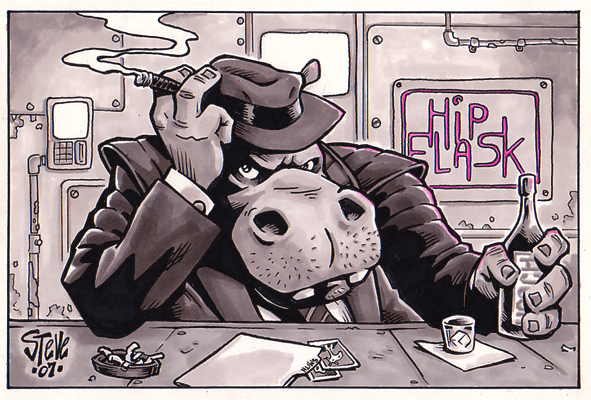
The other day, I was doing some image searches and came across pics of Hip Flask, a comic book character of which I’d not heard before. Check him out. Of course, I thought that his look would make a great character for Atomic Sock Monkey‘s Trust & Justice.

Here’s Jake Kiboko, another hero made using T&J:

Background & Origin: Jacob Kiboko, university student and emigrant from Embu, Kenya, now a naturalized U.S. citizen, worked as a safari guide during his summers, showing tourists the wildlife of his native country. During one such safari, a chemical spill at a plant upstream from Kiboko’s campsite dumped mutagenic substances into the river. A pod of hippos caught in the effluence became enraged and charged through the campsite. Kiboko was gored by a hippo while pushing a tourist out of the angry beast’s path. Kiboko was seriously injured and nearly died. After his lengthy recovery, Kiboko returned to the U.S., intending to resume his studies. Gradually, however, he noticed changes. He put on weight. He grew in height. His very bone and muscle structure changed from day to day, accelerating as the process became more advanced. In short, Kiboko transformed into a humanoid hippo. He has since taken some time off from being a student in order to figure out how to live his life in his new form.

Motivation: The city is my territory, and I’m territorial.

Qualities: Expert [+4] Private Detective, Good [+2] Almost a Zoologist, Good [+2] Boxing, Good [+2] Jovial Personality, Poor [-2] 8-Feet Tall & 1,500 Pounds

Powers: Good [+2] Semi-Aquatic, Good [+2] Super-Strength, Good [+2] Thick Skin

Stunts: Expert [+4] Block the Way (Thick Skin Spin-Off, 4 Hero Points); Average [+0] Charge! (Super-Strength Spin-Off, 1 Hero Point)

Vulnerability: Intense solar radiation

Hero Point Pool: 5/10

May 2nd, 2017  in RPG 2 Comments »

Holy Disguise

And behold, two of them went, the same day, to a town which was sixty furlongs from Jerusalem, named Emmaus. And they talked together of all these things which had happened. And it came to pass, that while they talked and reasoned with themselves, Jesus himself also drawing near, went with them. But their eyes were held, that they should not know him. (The Gospel According to St. Luke 24:13-16)

Holy Disguise
Spell Level: Cleric, 1st Level
Range: Touch
Duration: 12 hours

By means of this spell, the Cleric appears to be a normal sort of resident or traveler native to a particular region. Those who see the Cleric do not notice any special vestments, holy symbols, et cetera. Furthermore, abilities that detect alignment show the Cleric to be of the same alignment as the detector. Even those who personally know the Cleric do not recognize him unless he performs a certain action or says a certain phrase, the nature of which is determined when the spell is cast. This spell in now way disguises the Cleric’s actions or grants any knowledge of languages or customs.

April 30th, 2017  in RPG No Comments »

The Blindness of Love?

From September 2012:

Last Friday, 21 September, we had our weekly Socratic discussion. Often, these class discussions are the high point of my week as a teacher. Best of all, the students enjoy them. They get a chance to talk about some important topics in a safe environment where the expectation is that everyone will be listened to and respected. For each discussion, I select a topic relevant in some way to the literature we’ve read that week. Our topic for 21 September was this: “Love is blind.”

This expression has been floating around the English language for a few centuries. Often, I pointed out to my students, expressions take on the appearance of truth after they’ve been used for a long time by a lot of people. Part of what we try to do with classical education is examine ideas that perhaps too often go unquestioned. With this in mind, I asked my students, “What does it mean to say, ‘Love is blind’?”

Hands shot up, and most of my students did a great job abiding by our class rules for discussions: only one person gets to talk at a time, everyone listens to every speaker, we get to speak in the order in which our names enter the queue, et cetera. The students not only offered their individual answers, but also responded to each other. After several minutes (and a few detours chasing off-topic rabbits), a few recurring ideas became evident. Among these ideas, the students reached a consensus that when one is genuinely in love with another person, then one sees good qualities in that person that others might not be aware of.

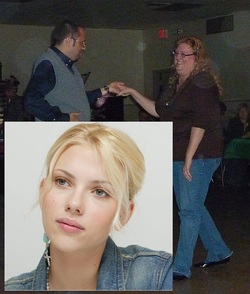
Next, I posed a hypothetical question to my students: If I went to downtown Houston during lunch hour with two pictures, one of my wife Katrina and one of Scarlett Johansson, and showed the pictures to strangers, who would most people say was the more beautiful? The students admitted (somewhat cautiously perhaps) that most strangers would pick Ms. Johansson.

“But,” I said, “in my opinion my wife is the more beautiful. Mrs. Chance is more beautiful than Scarlett Johansson. Why would I think this?”

More conversation ensued, and the students determined that I’d answer that way because I love my wife, and I see more than just what she looks like. I see my wife’s heart, as one student put it.

“So,” I said, “with all that we’ve said in mind, is it true that love is blind?”

None of the students agreed that the expression was true. Through their own examination of the expression, my students concluded that the opposite is true. They concluded that love isn’t blind, but rather that love sees with better vision.

April 25th, 2017  in RPG No Comments »

Virtuous Education

From August of 2012, now with some minor edits:

The purpose of a classical education is to teach children those things they need to know and to do in order to be both free and responsible. In the classical tradition, this focuses on the virtues of justice, temperance, courage, and, most importantly, prudence. The Christian tradition, when it adopted and baptized the classical tradition, added the virtues of faith, hope, and, most importantly, charity.

Once upon a time, there was an additional component to the education in virtue, namely the education in manners. Children were expected to learn and demonstrate the correct ways to behave in polite society. At Aristoi Classical Academy, we want to recapture this lost component of education. To help students learn how to behave in polite society, I cannot strongly enough recommend Ron Clark’s humorous, thoughtful The Essential 55.

Among the essential fifty-five is this rule:

“When responding to any adult, you must answer by saying, ‘Yes ma’am,’ or ‘No sir’. Just nodding your head or saying any other form of yes or no is not acceptable.”

I try to model this with my students in my interactions with both them and with adults. Often I’ve encountered people who object to me addressing them as “sir” or “ma’am”. I remember one lady in particular who attended the same church I did at the time. She bristled at being addressed as “ma’am”. I tried to explain to her why I did so. I’m not sure she ever bought into my explanation, but I think those reasons bear repeating here.

I try to address people as “sir” or “ma’am” as a sign of respect. This seems rather obvious, I think. Those two words are verbal clues, so to speak, that I view the person I’m speaking to as worthy of being taken seriously, of being appreciated. It doesn’t matter who the person is: a cashier at a fast food joint, a panhandler at an intersection, a door-to-door salesman, et cetera. Everyone deserves at least this modicum of respect.

“But not everyone,” I’ve heard people respond. “People have to earn respect, after all.”

Well, maybe they do, but there’s more to this rule. “Sir” or “ma’am” aren’t just signs of respect for that other person. They’re also signs of self-respect. I ought to value the quality of my character too much to speak to other people in a disrespectful manner, even if (or especially if) they seem to deserve it.

The trick is communicating this distinction to my students. When I answer a 5th grader with “Yes sir”, it’s not just a sign of respect for that student. It’s a message to others and myself that I am trying to be the kind of person who gives others respect as a matter of habit.

And that’s what a virtue is: a habitual tendency to behave in a manner that is aimed at the good.

April 11th, 2017  in RPG No Comments »