Archive for the ‘ RPG ’ Category

How My Ranger Stopped Encountering Undead

(First published in Game Geek 10)

Let’s eavesdrop on a depressingly common Internet conversation:

First DM: My player’s PC has such-and-such class feature that is broken. What should I do?
Second DM: Just design your scenarios so that he can’t use the class feature. Problem solved.

Sound familiar? If so, and you’re a player, pass this article to the offending DM. If you are the offending DM, then pay careful attention, because the advice below might just keep your players from killing you and taking your stuff.

Favored Enemy, or How to Avoid Encountering Certain Creatures Ever Again

Let’s focus on one specific class feature: the ranger’s favored enemy. This class feature is frequently maligned because its bonuses are situational. Either you’re facing your ranger’s favored enemy and get the bonuses, or else you aren’t and you don’t. The DM gets to decide when your ranger gets to benefit from one of his defining class features.

Too often, a ranger’s favored enemies are much more like a list of creatures that the party won’t ever encounter. Take favored enemy (undead) at 1st-level, and you’ll never encounter an undead monster. Instead, orcs regularly mob the adventurers. Your ranger reaches 5th level and takes favored enemy (orc). From that point on, orcs are scarcer than hen’s teeth. Et cetera, ad nauseum.

“Well,” says the DM, “orcs and undead just aren’t challenging because you get so many bonuses against them. My job as DM is make sure the adventures are challenging.”

The best initial response to this is a sneer. As William Paley asked, “Who can refute a sneer?” After that, you can point out a few uncomfortable truths, starting with the one immediately below.

Class Features Aren’t Broken; You’re DMing Skills Are

This applies almost no matter what the class features. There is almost always no good reason to nix characters’ abilities. If you’re running a murder investigation, it’s bad form to rule that divination spells don’t work. Yes, that single speak with dead could very well bring the investigation to a quick end. So be it. In a similar vein, when the party tracks down the evil murderer, it’d be equally bad form for the paladin’s smite evil power to not work against him.

Characters’ abilities, feats, class features, et cetera, are the tools the players get to use to overcome the challenges the DM presents. Your players chose to play the characters they’re playing because they want to use those tools. That means that you’re not allowed to take those tools away without a very good and rare reason.

Most of the time, your players should count on getting to use those tools. Back to our ranger whose favored enemies are orcs and the undead. If that ranger isn’t encountering orcs and/or undead at least 50% of the time, then you need to stop and examine the adventures your running. Your ranger’s player deserves the opportunity to roleplay his ranger’s orc/undead-hate and to enjoy the bonuses the character gets against orcs and undead.

Letting the Characters Shine

Next time you’re prepping for your game, take stock of your players’ characters. What are those characters’ strengths in terms of feats, class features, skills, and so forth? Jot down at least one strength per character. Then, include some way for each character to revel in their respective strengths during the adventure. Pretend you’ve done what I just advised you to do, and this is what you came up with:

The Ranger: Favored enemy (undead).
The Wizard: Maxed out ranks in Linguistics.
The Cleric: Maxed out ranks in Knowledge (religion).
The Rogue: Just acquired slippers of spider climbing.

Here’re some sample challenges:

The Ranger: The BBEG is protected by a platoon of plague zombies.
The Wizard: The BBEG and its minions communicate via an ancient dialect of the Dark Tongue.
The Cleric: The BBEG and its minions are engaged in a complicated demon-summoning ritual.
The Rogue: The BBEG occupies a floating dais closer to the ceiling than the floor.

During the final battle against the BBEG, the ranger gets to have a field day mowing through the plague zombies. The wizard gets to make Linguistic checks to accurately understand the BBEG’s orders to its minions. The cleric not only gets to channel positive energy, but her keen insights provide the best way to disrupt the demon-summoning ritual. The rogue can most easily get to the floating dais. Everyone gets to use a character feature to contribute to the BBEG’s demise.

But Shouldn’t I Negate Characters’ Abilities at Least Some Time?

Yes, especially when dealing with intelligent enemies who’re expecting the sort of trouble the characters provide. The trick is to make the negation both reasonable and a challenge in itself.

For example, an undead BBEG who knows it’s being hunted by an undead-slaying ranger might recruit non-undead minions. If it’s sufficiently powerful, it might also be worried about enemies who can scry and teleport. There are reasonable defenses against both of these capabilities as well.

What is bad form, however, is to design adventures that negate character abilities in such a way as to railroad the players. Negating character abilities should paradoxically lead to greater variety in player tactics as those players seek ways to overcome the challenges presented by not being able to rely on their full arsenal.

Consider the undead BBEG again. It knows that it’s likely to face adventurers capable of teleporting. Not wanting enemies to show up at will in its lair, it employs an 11th-level cleric to ward key areas with forbiddance. Discovering the area is warded isn’t too difficult. Adventurers just need to try (and fail) to teleport into the lair. After this discovery, what choices do the characters have?

Well, they can just lump it and fight their way in the hard way. Or, better yet, they can discover that the BBEG’s cleric spends time away from the lair. This gives the characters the chance to nab the cleric and discover the password that permits them to enter the warded area without damage. Also, the characters might coerce the cleric into revealing that there is an area not warded against teleport within the lair proper. The BBEG uses this secret area for its own movement via planar means. Thus, after a side adventure, the characters have not only earned more experience, they’ve defeated one of the BBEG’s key minions and discovered a possible means of taking the BBEG by surprise.

Best of all, the ranger still gets to unleash his undead-slaying prowess.
January 9th, 2011  in RPG No Comments »

Lumusi the Crawling Horde

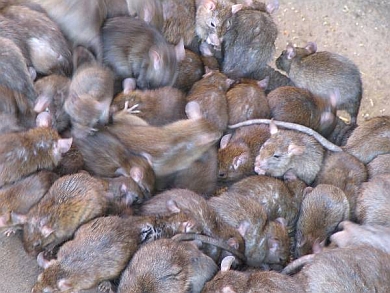
Mystery obscures Lumusi’s origins. Through some ancient ritual, an entire rat swarm became awakened. This in itself wouldn’t necessarily be a problem, but Lumusi possesses an evil disposition and a desire to inflict loss on others. It lurks in the hidden places of urban areas and farming communities. From its lair, it stealths out under cover of night to wreak havoc. It uses its spells to charm animals and vermin (thanks to its Vermin Heart feat), damage crops and property, and cause sickness and death.

Lumusi the Crawling Horde
Awakened rat swarm blight druid 9
CR 10; XP 9,600
NE Tiny magical beast (augmented animal, swarm)
Init +9; Senses low-light vision, scent; Perception +20
Aura forgetfulness (30-ft. radius, Will DC 19, 9 rounds/day)

DEFENSE
AC 15, touch 15, flat-footed 12 (+3 Dex, +2 size)
hp 94 (14d8+28)
Fort +12, Ref +10, Will +12
Defensive Abilities swarm traits (as a swarm of tiny creatures, a rat swarm takes only half damage from piercing and slashing attacks); Immune disease, nauseated condition, sickened condition

OFFENSE
Speed 15 ft., climb 15 ft., swim 15 ft.
Melee swarm (1d6 plus disease)
Space 10 ft.; Reach 0 ft.
Special Attacks disease (Fort DC 16), distraction (Fort DC 16), miasma (Fort DC 19)
Druid Spells Prepared (CL 9th):
5th (2+1)- cure critical wounds, enervation*, flame strike (Elemental Spell, Heighten Spell) (Ref DC 20)
4th (3+1)- cure serious wounds, dispel magic, hurricane blast (Heighten Spell) (Ref DC 20), shadow conjuration*
3rd (4+1)- burning gaze (Elemental Spell, Heighten Spell) (Fort DC 18), cure moderate wounds, deeper darkness*, protection from energy, sleet storm
2nd (5+1)- barkskin, blindness/deafness* (Fort DC 17) (blindness only), elemental speech, glide, pox pustules (Fort DC 17), wood shape
1st (6+1)- charm animal (Will DC 16), cure light wounds (x2), entangle (Ref DC 16), longstrider, obscuring mist*, touch of the sea
0 (4)- create water, detect magic, read magic, resistance
*Domain Spells
Nature Bond Subdomain Loss

STATISTICS
Str 2, Dex 17, Con 15, Int 8, Wis 20, Cha 9
Base Atk +9; CMB –; CMD
Feats Ability Focus (disease, distraction), Aspect of the Beast (wild instinct), Blind-Fight (B), Elemental Spell (cold), Heighten Spell, Improved Initiative, Natural Spell, Skill Focus (Perception), Vermin Heart
Skills Acrobatics +7, Climb +24, Knowledge (nature) +5, Perception +20, Stealth +15, Survival +21, Swim +16 (+24 to perform a special action or avoid a hazard); Racial Modifiers +8 Climb, +8 on Swim checks to perform a special action or avoid a hazard, uses Dex to modify Climb and Swim
Languages Common, Druidic
SQ nature sense, vermin empathy +8, wild shape 3/day, woodland stride

SPECIAL ABILITIES
Aura of Forgetfulness (Su): Lumusi can emit a 30-foot aura of forgetfulness for 9 rounds per day. These rounds do not need to be consecutive. Creatures you target in this area must make a DC 19 Will save or have no memory of any time spent inside the area. In addition, spellcasters in the area lose one prepared spell or available spell slot per round spent in the area, starting with 1st-level spells and going up through higher-level spells. Spellcasters are allowed a save each round to negate this loss (this save is separate from the memory loss save).

Disease (Ex): Filth fever; injury; save Fort DC 16; onset 1d3 days; frequency 1/day; effect 1d3 Dex damage and 1d3 Con damage; cure 2 consecutive saves. The save DC is Constitution-based.

Distraction (Ex): Lumusi can nauseate the creatures that it damages. Any living creature that takes damage from a creature with the distraction ability is nauseated for 1 round; a Fortitude save negates the effect.

Miasma (Ex): If Lumusi is adjacent to a creature at the beginning of its turn, the creature must succeed at a DC 19 Fortitude save become sickened for 1 round. A creature of the animal, fey, or plant type that fails its save is nauseated for 1 round and sickened for 1 minute thereafter. If the creature makes its save, it is immune to this effect for 24 hours, as are creatures immune to disease.

Touch of Darkness (Sp): As a melee touch attack, Lumusi can cause a creature’s vision to be fraught with shadows and darkness. The creature touched treats all other creatures as if they had concealment, suffering a 20% miss chance on all attack rolls. This effect lasts for 5 rounds. Lumusi can use this ability 8 times per day equal.

Vermin Empathy (Su): Lumusi can improve the attitude of vermin as a normal druid can with animals. Vermin have a starting attitude of unfriendly. Lumusi can also improve the attitude of animals and mindless undead creatures that were formerly animals, but it takes a -4 penalty on the check unless the animal or undead has a disease special attack.

Wild Shape (Su): Lumusi has the ability to turn itself into any Diminutive, Tiny, Small, Medium, Large, or Huge animal and back again. This ability functions like the beast shape III spell, except as noted here. Lumusi can also assume the form of a Small or Medium elemental as if using elemental body II. Furthermore, it can take the form of a Small or Medium plant creature as if using plant shape I.

Lumusi loses its ability to speak while in animal form because it is limited to the sounds that a normal, untrained animal can make, but it can communicate normally with other animals of the same general grouping as its new form. (The normal sound a wild parrot makes is a squawk, so changing to this form does not permit speech.) The effect lasts for 9 hours, or until Lumusi changes back. Changing form is a standard action and doesn’t provoke an attack of opportunity.

NOTE
Due to Lumusi’s unusual nature, it has no equipment. As a result, its CR is 1 lower than expected.

December 31st, 2010  in RPG No Comments »

Masters of Disguise

Since A Medieval Holiday is done and selling well at Paizo.com and at DriveThruRPG, I’ve been working my next PDF: Masters of Disguise. This new PDF’s main feature is the masque, a base class focused on deceit and disguise with four levels of spells. I’ve sent version 2 to my playtesters and received even more insightful feedback. I’m certain the masque is going to be an excellent base class once all the fine-tuning is completed.

But the masque isn’t all there will be. Masters of Disguise will also include useful crunch such as:

* Expanded uses for Diplomacy, Disguise, Linguistics, and Use Magic Device.
* More feats.
* More rogue talents.
* Equipment, both mundane and magic.
* A shapechanger bloodline for sorcerers.
* A disguise subdomain for clerics.
* And more!

Here’s an excerpt of the expanded rules for Diplomacy:

Diplomacy
Diplomacy serves many functions. A diplomatic character can help disarm conflicts and schmooze his way through potentially tricky situations. He can also keep abreast of the what’s going, using his gift of gab to gather useful information. But what if the character wants to put out bogus intelligence in order to mislead others?

Check: If you want to mislead those who trying to gather information about you, your Diplomacy check is opposed by your foe’s Diplomacy check. If you succeed, you misdirect your foe’s inquiries. This is typically an ongoing process with new opposed checks required each day.

You can also use Diplomacy for rumor-mongering in order to spread false information. This can make it more difficult for someone to interact favorably with other NPCs, applying penalties to their Charisma checks or other social skills. In order to rumor-monger, make a Diplomacy check opposed by the NPC’s Sense Motive check. If you succeed, the target of your rumor-mongering suffers a -2 penalty on interaction checks with that NPC for the next week.

Action: Using Diplomacy to mislead an information gatherer requires 1d4 hours of work, sowing bogus intelligence to informers. Rumor-mongering requires 1 minute of continuous interaction.

Try Again: You can retry Diplomacy checks made to spread false information and rumor-monger.

Special: Feats, spells, et cetera that modify Diplomacy apply to misleading and rumor-mongering attempts.

Masters of Disguise should be available in January 2011.

In Media Res Gaming

A column I wrote for Game Geek 9:

Have you watched TV lately? If so, you’ve undoubtedly noticed that in media res is all the rage. For example, check out any episode of The Good Guys on Hulu. The beginning of each episode isn’t necessarily the beginning of the story. It’s usually nearer the end of the plot, and most of the episode takes you back to the events as they unfolded leading up to the opening scene.

In media res hooks the viewer right away. It sets up an exciting situation to generate interest in what led up to that point in time. I am compelled to watch the entire episode of The Good Guys because I want to find out how Jack and Dan are going to survive the exploding dynamite while pinned down by enemy gunfire inside the storage container.

Just as in media res hooks the viewer, it can also hook the player when used in an adventure. Care must be exercised, however. The type of in media res used in many television shows, for example, often won’t work in an RPG scenario. This is because most of the episode is an extended flashback, and flashbacks in an adventure can be railroad tracks that rob players of meaningful choices.

For an example of in media res that would work in an adventure, consider the classic Thundarr the Barbarian episode “The Prophecy of Peril”. At the beginning of this episode, Thundarr, Ariel, and Ookla engage in a pitched battle against the wizard Vashtar’s hench-robots. Our heroes have stolen a magical gem from Vashtar and are trying to escape his citadel. Thanks to some timely exposition from Vashtar, we learn that the gem holds the secret to defeating him, and that this is why Thundarr and company have taken the gem. Thundarr, Ariel, and Ookla escape Vashtar, and then the trio spend the rest of the episode acting on the plot hook the gem represents.

This is a type of in media res that can work in an RPG scenario. Let’s break the idea down into some necessary components.

The Ultimate Goal

Every adventure has some sort of terminal objective. The PCs have a goal they wish to reach. They want to reveal the prince as a traitor. They seek the fabled tome of knowledge. The stars are ready to align and unleash the Old Ones unless the Elder Sign is affixed to some dread portal. When designing an in media res adventure, determine the ultimate goal and at least one step crucial to meeting it that can be combined with an action scene. Here’re some examples expanding on the previous three sample ultimate goals.

Reveal the Traitor: The PCs start the adventure in shackles in the rolling brig of a galley bound for an infamous slave port. Fortunately, one PC has a handy means of escape, such as a hidden lockpick. The PCs must free themselves, overcome the villains on the galley, and return to civilization.

Find the Tome of Knowledge: The PCs have just recovered a piece of an ancient map leading to the lost ruins in which the tome lies hidden. Unfortunately, their exit has just been detected by the feral man-apes that guard the map’s location.

Stop the Old Ones: The PCs sit in a stately study about to meet a famed scholar who can help them learn the location of the Elder Sign. The scholar enters the study when deranged cultists burst in through the skylights.

Exposition

After the initial conflict is resolved, it’s time to fill in the players. The exposition portion is the PC background material that happened “off-camera” and led up to the opening conflict. It should include all of the information the PCs would have reasonably had that led them to the precarious position in which they just found themselves. For example:

Reveal the Traitor: The PCs had been on their way to meet a lady-in-waiting believed to have evidence of the prince’s perfidy. When the PCs arrived at the rendezvous in the upstairs private room of an inn, they found not the lady, but an ambush by a press gang. The PCs were overpowered and woke up in the hold of a slave galley. The PCs must act quickly. The lady said she had evidence that the prince planned to imprison his recently deceased brother’s heirs as the first step to seizing the throne.

Find the Tome of Knowledge: The PCs were hired by the Golden Key Scholars to retrieve the tome of knowledge. A fell plague sweeps the land, caused by some evil sorcery. The tome of knowledge holds the secrets to stopping the plague. The PCs were given one piece of an ancient map that led them to a ruined library deep in feral man-ape territory. Now with the second map piece, the PCs have learned the last known resting place of the tome.

Stop the Old Ones: The PCs recently rescued a maiden from the clutches of sinister cultists. Evidence on site revealed that the cultists were part of a larger group seeking to unleash an unspeakable evil. One of the PCs knew the famed scholar by reputation, and the heroes sought his advice. Once the PCs defeat the attackers, the meeting with the famed scholar can go on as planned, assuming the scholar lives.

Conflict & Resolution

Here’s where you run the bulk of the adventure just like you normally would. The PCs already have their plot hook and adventure background. Build on the events, villains, and hints contained in the opening scene and the exposition.

This sort of in media res technique works with nearly any type of campaign. Whether you’re running an epic adventure path, a one-shot module, or the ultimate sandbox, you can adjust your scenarios so that they start with an action scene.

December 21st, 2010  in RPG No Comments »

Beware the Quicklings!

Here’s an old classic I restatted for Pathfinder:

These small, slender, extremely fast-moving creatures are said to be a race of brownies who dabbled in magic and mysteries better left alone. Thus, legend relates, the little folk were changed into evil creatures of great maliciousness towards humans, demihumans, and other little people. They dwell in dark woodlands and wild, evil areas.

Quicklings speak several languages, although at a high pitch and too quickly to be easily understood. The quickling race is short-lived because of their accelerated rate of motion. Mature at about 1 or 2 years of age, quicklings die between 12 and 15 years of age.

Quickling
CR 2; XP 600
CE Small fey
Init +8; Senses low-light vision; Perception +1

DEFENSE
AC 15, touch 15, flat-footed 10 (+4 Dex, +1 dodge); Mobility
hp 11 (2d6+4)
Fort +2, Ref +7, Will +4; +8 racial bonus vs. spells and spell-like abilities
DR 3/cold iron

OFFENSE
Speed 80 ft.
Melee dagger +6 (1d3-1/19-20), or
Ranged dart +6 (1d3-1, 20 ft. range increment)
Special Attacks really fast
Spell-Like Abilities (CL 3rd)
At will – animal trance (DC 13), daze monster (DC 13), levitate, shatter (DC 13), soften earth and stone, ventriloquism (DC 12)

STATISTICS
Str 8, Dex 18, Con 14, Int 15, Wis 12, Cha 13
Base Atk +1; CMB -1; CMD 14
Feats Dodge (B), Improved Initiative (B), Mobility (B), Weapon Finesse
Skills Acrobatics +9 (+29 when jumping), Bluff +6, Escape Artist +9, Knowledge (nature) +7, Perception +6, Sleight of Hand +9, Stealth +13, Use Magic Device +6
Languages Aklo, Common, Sylvan
SQ magic resistance, natural invisibility, quicker than the eye

SPECIAL ABILITIES
Magic Resistance (Su): Quicklings are notoriously difficult to affect with spells and spell-like abilities. They enjoy a +8 racial bonus on saving throws against such effects.

Natural Invisibility (Su): When taking no more than a 5-foot step in natural terrain, a quickling enjoys invisibility (as the spell).

Quicker Than the Eye (Su): When moving, a quickling appears to be little more than a blur. Foes suffer a 20% miss chance to strike a quickling any round that is moves more than a 5-foot step.

Really Fast (Su): A quickling can take an extra standard or move action each round, even when surprised.

ECOLOGY
Environment any forest
Organization solitary, pair, or group (4-16 plus 1 1st-level quickling or 1 3rd-level quickling and 2 2nd-level quicklings if 11+)
Treasure standard

December 18th, 2010  in Man-Day Adventures, RPG No Comments »