Archive for the ‘ RPG ’ Category

S Is for Snakes

Animals are amazing. They often have abilities that seem as if they’ve been lifted out of some science fiction story. Game stats for animals often (usually?) give the short shrift to some of the remarkable things animals can do. For example, a tiger’s roar can stun its prey via infrasound frequencies. Check out Pathfinder‘s tiger stats. There’s no stunning sonic roar attack there (and, in my opinion, there should be).

Let’s look at snakes, since today is all about the S. Pathfinder snakes have the scent extraordinary ability, which makes sense. Snakes track prey through scent. The receptors on the snake’s tongue provide a sort of directional sense of smell and taste at range. Yes, that snake can sort of taste you without actually having to lick you. Snakes can also detect movement by picking up faint vibrations transmitted through the ground and the air. It’s not impossible to sneak up on a snake, but it isn’t that easy either. Many types of snakes — and not just pit vipers — also exhibit sensitivity to the infrared portion of the spectrum.

If I were going to feature snakes as a regular foe for my players’ characters, I’d consider beefing them up just a bit. All snakes should have a racial bonus to Perception checks and/or Skill Focus (Perception) as a feat or bonus feat. This bonus would account for the snake’s superior olfactory senses and its ability to detect vibrations. Tremorsense might seem like a good fit, but this ability is too good for the average snake since tremorsense permits the ability to automatically pinpoint a creature’s location. As mentioned above, it is possible to sneak up on a snake if one is sufficiently stealthy.

But what about that infrared sensitivity? The game doesn’t have a good equivalent. Darkvision doesn’t fit because darkvision is sort of magical. The easiest thing to do is to ignore penalties for Perception checks related to darkness that a snake would otherwise suffer so long as the snake is sensing a warm-blooded creature. (Or, in the case of creatures without blood, those that otherwise generate their own body heat, such as fire elementals, although what a snake would be doing preying on a fire elemental, I don’t know.)

Snakes also tend to be ambush predators, many of which stalk their prey. Racial bonuses to Escape Artist (to squeeze into lairs) and Stealth are appropriate. (Most snake game stats include the latter.)

When a snake constricts its prey, unconsciousness or death by asphyxiation is a real risk. The constrictor is sensitive enough to detect when its prey exhales, and it tightens its grip at that time, putting more pressure on the lungs and reducing the capacity of those organs to inhale. The rules enable a constrictor to inflict additional damage with every successful grapple check, but they don’t reflect the risk of asphyxiation.

I’d like to playtest a variation of the suffocation rules to reflect the asphyxiation hazard associated with constriction. A character being constricted has enough air to last 2 rounds per point of Constitution plus 1 additional round per point of Strength. If a character takes a standard or full-round action, the remaining air duration for the character is reduced by 1 round. Also, remaining air duration is reduced by 1 round per point of damage the character suffers due to constriction. Once a character has no more air left, he must make a DC 10 Constitution check in order to avoid suffocation. The check must be repeated each round, with the DC increasing by +1 for each previous success. When the character fails one of these Constitution checks, he begins to suffocate. In the first round, he falls unconscious (0 hit points). In the following round, he drops to –1 hit points and is dying. In the third round, he suffocates.
April 21st, 2012  in RPG No Comments »

R Is for Reflex Saves

Okay, so here’s the scenario. The adventurers are in the middle of a 40-foot-square chamber. Other than a bit of debris here and there, the room is empty and devoid of cover for the adventurers to, well, take cover behind. Suddenly, an up-until-then invisible sorcerer appears, lobbing a fireball at the adventurers. The wizard and the cleric fail their Reflex saves and take full damage. The fighter makes his and takes half damage. The rogue also makes his saving throw and, thanks to his evasion class feature, takes no damage at all.

Why does the fighter take half damage? Why does the rogue take none?

Well, we could say that the fighter hunkered down behind his shield, avoiding a lot of the direct heat. That is, if the fighter has a shield. The rogue, however, evaded the entire attack. Without moving. When the flames clear, he’s still in the exact same square, unharmed.

Again, why?

It seems as if making a Reflex save implies some sort of movement. Some sort of reflex action. But, as noted, when all is said and done, no one’s positions on the battlefield actually change due to a Reflex save. This bugs me. It didn’t bug me back in 1E or 2E days because there were no Reflex saves. Instead, you saved versus spells, or death magic, or rods and staves and wands, et cetera. These categories really didn’t have much in the way of descriptive power. They really don’t even imply anything about how the character resisted whatever it was he just resisted. Fortitude, Reflex, and Will, however, are descriptive. How did you resist the poison? Through Fortitude! Why didn’t that vampire dominate you? Because of my Will! Wow, that fireball barely hurt you! How come? My Reflex! But you didn’t move. Uh….

So here’s my quick thought before I head off to bed after a long week of molding young minds: Whenever a character makes a Reflex save, he gets an immediate move action.

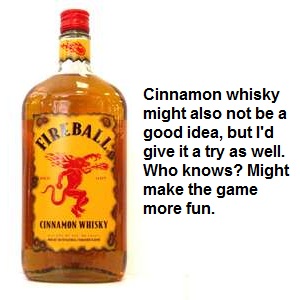
That’s it. It’s not a big idea. It might not even be a good idea, but I’d be willing to give a try. Who knows? Could make the game more fun, and, if it did, that’d make it a winner idea in my book.

April 20th, 2012  in RPG 2 Comments »

Q Is for Quit Whining & Play!

I read many threads on Paizo’s Pathfinder messageboards. I don’t respond to most of what I read, in large part because I simply cannot relate to the topics. Chief among these topics are the threads about the lack of rule clarity (usually accompanied by demands that one of Paizo’s developers respond with an official ruling), complaints about changes to the rules (often accompanied by demands that Paizo rescind the change), and complaints that certain rules ought to be changed (some even accompanied by demands that official changes be made).

As I said, I just can’t relate to these sorts of topics. Almost always, my response would be, “Quit whining and play the game.” Since that sort of response isn’t terribly helpful and isn’t likely to be well received, I leave the thread without the questionable benefit of my wisdom, feeling for a time somewhat sad that it seems as if so many RPGers spend so much time arguing about these sorts of issues instead of playing the game.

What I especially cannot relate to are the widespread demands that the game’s developers take time out of their days to personally respond with Official Rulings. Now, to be sure, this attitude isn’t new. Way back in the day, before there was an Internet or messageboards, Dragon magazine, for example, regularly featured “Sage Advice”, a Q&A column wherein AD&D‘s experts answered questions from readers about the rules. Then, a few issues later, other writers would complain in the letters column about those answers. So, it was sort of like Paizo’s messageboards, only a lot slower and with better grammar and spelling.

Also, to be fair, there is one segment of the Paizo on-line “community” that gets riled about these sorts of issues, and with cause, these folks being those involved in organized play. These sorts of game require a uniform understanding of the rules to help ensure that characters are indeed portable from one GM to the next without those characters’ abilities, spells, magic items, et cetera, changing due to varying GM interpretations.

So, organized play players, I’m not talking about or to you. Instead I’m talking to/about all the other gamers who are more like me, playing in nonorganized play games in someone’s home on a more or less regular schedule with more or less the same people each time.

Let’s say your situation is like mine. You play with the same GM most of the time in the same campaign. One of your players runs a Zen archer monk, and he’s read about the recent clarifications from Paizo about the monk’s flurry of blows ability. He expresses concern about how this rule change will affect his character, especially after reading all the posts about how Zen archer monks are now unplayable and that the change definitively “nerfs” the archetype’s primary ability. What’s the GM’s best response?

“I don’t care what Paizo changed. Keep running your Zen archer monk just like before,” the GM responds bestly.

This same principle applies to questions about vague rules, rules that should be changed, et cetera. The players of the game in that particular campaign get together and come up with a solution that works for that group. That solution then becomes the only official ruling that particular gaming group needs.

I’m sure the Paizo staff are nice people. I’ve corresponded with a few of them here and there, and I’ve always found them professional and personable via email. But regardless of how nice, professional, and personable Vic Wertz, Liz Courts, James Jacobs, and other Paizoans are, they don’t run my game. Instead, I run their game, and my players and I change what they’ve published to better suit our preferences.

April 19th, 2012  in RPG 2 Comments »

P Is for Poem for Mr. Birsinger

At the school wherein I teach young students
There’s a teacher named Mister Birsinger.
In ignorance’s hide he puts new dents.
As a teacher he’s a real humdinger!

When Birsinger nobly strides through the halls,
Order and discipline from his mouth ring,
Echoing invisibily from the walls.
We cannot but help his praises to sing!

Look at his erudite brow! His keen gaze!
Witness how stately his ponytail swings!
O! How I envy his students their days
In his classroom, learning so many things.

Birsinger is a tower of learning
Built by years of selfless, tireless striving,
Guided by a vision like fire burning
To see all kids become wise and thriving.

The level of envy of him is scary.
O my! His upper lip is quite hairy.

N.B. I made a small edit to the first quatrain to improve the rhyme.

April 18th, 2012  in RPG No Comments »

O Is for Ocelot Atlatl

O nearly had me stumped. I don’t know why, but I just couldn’t think of anything good for O. Orcs were too obvious. Old School? Too ubiquitous. Ovaltine wasn’t really game-related. Then I remembered growing up that my mother wanted an ocelot. She thought they were very pretty animals, and they are, and that it would be cool and adventurous to own one, and I’m imagining it would’ve been at least adventurous. But what to write about ocelots? Game stats? Nah. I could just use the lynx with a few mods.

So, I thought some more. Ocelot…ocelot…ocelot. The “ocel” part of the word started to stick out. Also protruding was the T at the end of the word. From there it was a short mental walk to atlatl. Well, short at least for the way my brain works. At that point, I had two words: ocelot and atlatl. That didn’t seem to accomplish much. After all, I was supposed to be figuring out what to write about ocelots, and instead I end up with a stick-throwing stick.

By this time, I was tired of thinking. Tired of trying. I mean, seriously, this whole A to Z thing was starting to smack of effort. I didn’t really do a good job with N, and for O I’m staring down ocelot and atlatl. Then, it hit me. Why not combine the two?

Thus was born the ocelot atlatl, a weapon used by a Large jungle humanoids that aren’t particularly concerned about developing a reputation for cruelty to animals.

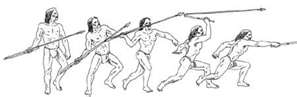
Ocelot Atlatl

The ocelot atlatl is a throwing device consisting of a stick fitted with a socket to steady the butt of an ocelot and extend the velocity and distance it travels when thrown. The Large jungle humanoid places an ocelot in the socket and then propels the frightened, angry feline at an enemy.

Both the ocelot and the victim suffer 2d6 points of damage if the Large jungle humanoid’s attack succeeds. The ocelot falls prone in a randomly determined square adjacent to the victim after impact unless the ocelot succeeds with a DC 15 Acrobatics check, in which case it isn’t prone. If the Large jungle humanoid’s attack fails, the ocelot takes the same damage as it bounces off the ground, et cetera. (Generous GMs can let the ocelot attempt a separate DC 20 Acrobatics check to reduce its damage by 1d6.) The angry, frightened, freshly injured ocelot must attempt a DC 15 Will save upon impact. If it fails, it attempts to flee. Otherwise, it blames the nearest creature for its plight and attacks on its next turn.

Without the ocelot atlatl, a thrown ocelot is an improvised weapon with a range increment of 10 feet. The ocelot atlatl is an exotic weapon. With it, the thrown ocelot is not an improvised weapon and has a range increment of 30 feet. Loading an ocelot in an ocelot atlatl socket is a move-equivalent action.

An ocelot atlatl is a one-handed weapon for a Large creature. It weighs 8 pounds and costs 5 gp.

April 17th, 2012  in RPG 2 Comments »