“If You Have Telekinesis, Raise My Hand.”
Telekinetic Monk Archetype
The telekinetic monk combines martial arts with psychokinetic power. He can launch flurries of telekinetic blows at range and develops an array of psionic and psi-like abilities as he gains experience.
Skills: A telekinetic monk gains Autohypnosis and Knowledge (psionics) as class skills.
Psionic: At 1st level, a telekinetic monk gains the Wild Talent feat as a bonus feat. If monk already has levels in a psionic class, he instead gains the Psionic Talent feat.
This ability replaces the monk’s 1st-level bonus feat choice.

Bonus Feats: At 2nd level, and every 4 levels thereafter, a telekinetic monk may select a bonus feat. These feats must be taken from the following lists. A telekinetic monk replaces the normal monk bonus feats with the following: Autonomous*, Deflect Arrows, Mental Leap*, Psionic Body*, Psionic Fist*, Psionic Meditation*, and Up the Walls*
At 6th level, the following feats are added to the list: Aligned Attack*, Focused Sunder*, Ghost Attack*, Improved Disarm, Improved Trip, Return Shot*, and Unavoidable Strike*
A monk need not have any of the prerequisites normally required for these feats to select them. Feats marked with an asterisk are found among these psionic feats.
Telekinetic Flurry (Su): Starting at 1st level, a monk can make a telekinetic flurry as a full-attack action. A telekinetic flurry does not use weapons. Instead, the telekinetic monk punishes his foes with mental force. When doing so he may make one additional ranged attack out to a maximum range of 25 feet plus 5 feet per 2 telekinetic monk levels (with no range increment).
These attacks inflict lethal or nonlethal damage, as the telekinetic monk wishes. All attacks suffer a -2 penalty on attack rolls. For the purpose of these attacks, the monk’s base attack bonus from his monk class levels is equal to his monk level. For all other purposes, such as qualifying for a feat or a prestige class, the monk uses his normal base attack bonus.
Telekinetic flurry attacks inflict the monk’s normal unarmed strike damage, but damage is not modified by Strength.
At 8th level, the telekinetic monk may substitute disarm, sunder, and trip combat maneuvers for ranged attacks as part of a telekinetic flurry. The telekinetic monk’s Combat Maneuver Bonus for purposes of these attacks is adjusted by Charisma modifier instead of Strength. Since these combat maneuvers occur at range, the telekinetic monk does not provoke attacks of opportunity for using the maneuver. The penalty to the monk’s telekinetic flurry attack rolls decreases to -1.
At 15th level, the penalty to the monk’s telekinetic flurry attack rolls decreases to -0.
This ability replaces flurry of blows.
Psychokinesis (Psi): As a telekinetic monk gains levels, his psychokinetic powers improve. He can manifest the following powers as psi-like abilities at the indicated levels.
1st Level: far hand. This ability replaces stunning fist.
3rd level: concussion blast. This ability replaces maneuver training.
5th Level: telekinetic force. This ability replaces high jump.
7th Level: telekinetic maneuver. This ability replaces wholeness of body.
A telekinetic monk uses a psi-like ability as a standard action. The psi-like ability manifests at the telekinetic monk’s class level as if he had spent a number of power points equal to his class level. The DC of a saving throw (if applicable) against a creature’s psi-like ability is 10 + the level of the power + the telekinetic monk’s Charisma modifier. Each manifestation of one of these psi-like abilities costs the telekinetic monk 1 ki point.
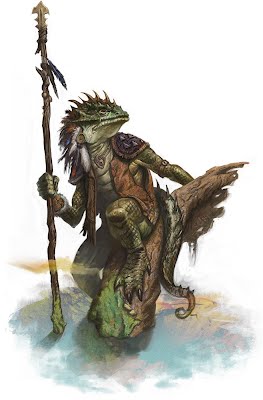 Recreating monsters is one of my favorite parts of being a GM. The black dragonfolk is a retooled normal dragonfolk. I changed its type to dragon, respent skill points, and added the advanced template’s modifiers to natural AC and stats. A full-blown breath weapon seemed a bit much, so instead the new monster gets to spit gobs of acid. I topped it off with some acid resistance.
 Over on the Paizo boards, there’s a thread wherein people wonder why
  Stereotypes are just oh so convenient, being a sort of shorthand generalization that encompasses so much in so little space. Work as a television writer? Need to instantly identify a throwaway character as a bad guy? Toss in the shaven-headed, tattooed Hispanic male wearing a white undershirt and baggy pants. Instant identification from the audience. “He looks like a bad guy; therefore, he’s a bad guy.” Next, spice up the dialogue with a few Spanish words, especially if they’re delivered with a noticeable accent and bad grammar. Example when addressing a female detective: “I ain’t gonna talk, chica.” More instant identification from the audience. “Ooh, he speaks a foreign language, and he’s disrespectful to both authority and women; therefore, he’s a bad guy.”
