Archive for the ‘ RPG ’ Category

Atanasija’s Lyre

Dunwick Rossignols sang like an angel, but he had the heart of a devil. He used his charm and music to ingratiate himself into the life of Nafasi, a prosperous village situated near an important crossroad. Dunwick prospered. He also systematically seduced many of the village’s maidens and wives. The wicked bard delighted in the strife caused by his many conquests. He deliberately sowed seeds of jealousy and false hope, plucking on people’s emotions as deftly as his finger plucked his lyre’s strings.

Dunwick played his cruel games too long. His machinations provoked the widow Atanasija into a cold fury. She lured Dunwick to her home with carnal promises. As soon as he entered her home, Atanasija struck him a stunning blow to the head with a bronze candlestick holder. Her cold fury blazed white hot then, and she strangled Dunwick to death, crushing his windpipe with the candlestick holder. Horrified by her crime, Atanasija fled into the night, vanishing into Mabonde, the nearby forested valley. Dunwick was buried, and the villagers made a half-hearted and failed attempt to apprehend Atanasija. Little by little, life in Nafasi resumed something resembling what it was before Dunwick.

Months after Dunwick’s brutal murder, Atanasija, now mad, crept into the village’s cemetary. With ragged fingernails, she clawed Dunwick’s remains free from their grave and stole the bard’s skull. Back in her cave in Mabonde, Atanasija fashioned Dunwick’s skull into a macabre lyre. The mad widow played and sang her most beloved songs by Dunwick. Before the last echoes of her tortured voice faded in the darkness of her cave, Atanasija took her own life.

Decades went by as the widow’s corpse rotted away before a group of adventurers pursuing goblin raiders stumbled into the cave and discovered the Atanasija’s lyre.

Barbarians of Lemuria

A minstrel can play Atanasija’s Lyre and make a tough (-4) mind check modified by minstrel ranks. If the minstrel succeeds, 1d6 corpses within earshot of the lyre’s morbid notes rise up and attack the nearest living creatures, continuing to do so as long as the minstrel plays. If the minstrel’s check results in a natural 12, double the number of corpses that animate. If the minstrel’s check results in a natural 2, one or more of the lyre’s strings break and must be replaced before the lyre functions again.

Dungeon World

Whenever you play Atanasija’s Lyre near one or more corpses, roll+CHA. *On a 10+, several corpses animate as zombies under your musical control. *On a 7-9, several corpses animate as zombies.

Swords & Wizardry

Atanasija’s Lyre is a magical item usable by any non-Lawful character. As long as the holder plays this musical instrument, up to 2d6 nearby corpses animate as skeletons or zombies. Each round this lyre is played, there is a 10% chance the undead slip the musicians’s control and attack the nearest living creatures. In this latter case, the zombies and skeletons remain animated until destroyed.

July 2nd, 2014  in RPG No Comments »

Maps for Heroes

Matt Jackson does some great maps. Seriously. If you don’t believe, check them out on his site. I’ve narrowed the search for you right here.

Matt’s currently putting his maps to good use by supporting the Wounded Warrior Project. You can read more about it at Matt’s site by clicking here. If you want to donate, you can do so via his site or by clicking on the picture to the right of these words.

Hooah!

July 1st, 2014  in RPG No Comments »

Jabalitika

The windswept, arid heights of Mlima-Wa-Moto support little life. The plants that grow there are small and tough. An aggressive, burrowing species of large wingless wasp crawls around, its mottled hair-like covering allowing it blend in with the terrain, providing camoflauge against the shaggy-furred rock badgers that feed almost exclusively on the insects. As for the wasps themselves, they survive on sticky umande, the jabalitika’s dewy excretion.

The jabalitika grows lichen-like on rocks. This strange plant has a rapid growth cycle. Spores take root in a rock’s tiny fissures and quickly mature, spreading over several square feet in just a few days. A mature jabalitika has a thickness of about one-quarter inch (or 0.635 centimeters). Via enzymes, the jabalitika converts minute quanities of the rock’s surface into a micro-stew of minerals and water that the plant uses to survive. Of course, being a plant, the jabalitika also engages in photosynthesis. The aforementioned dew-like excretion, or umande, is a waste product of the jabalitika.

Umande is highly nutritious but slightly punguent. A half-pint (about a quarter of a liter) provides sufficient nutrition for an adult human for a full day. Umande also increases the efficiency of respiratory systems in animals, making it easier to breathe Mlima-Wa-Moto’s thin, high-altitude air. A square foot (a bit more than 900 square centimeters) of jabalitika produces about a half-pint of umande under optimal conditions.

The rugged mountain people of Mlima-Wa-Moto cultivate jabalitika to harvest umande. They domestic rock badgers to help keep their jabalitika fields as free of wingless wasps as possible. While those insects are not especially dangerous, their stings are extremely painful, capable of incapacitating a grown man for several minutes.

June 24th, 2014  in RPG No Comments »

Cruaum’s Codex

Who can understand the mind of Shimaus Cruaum? A man of wealth and sophistication, he moved with ease within upper classes, among whom he was widely admired for his erudition and talents as a healer. He also murdered prostitutes, those women Cruaum both desired and hated.

Now that Cruaum is dead, rumors abound about his earlier life. Many say he was no stranger to murder before arriving in the city. He poisoned his first wife, whom he’d gotten pregnant and was forced to marry. A female patient was found dead in the shed behind his clinic. He narrowly avoided imprisonment when two of his patients died under mysterious circumstances, the second one having been poisoned.

Rumors aside, this much is true: After moving to the city, Cruaum established himself as a respected healer and began to murder. His modus operandi was simple. He would solicit a prostitute, introducing himself as a man of medicine. They would take an evening stroll or some such activity. Cruaum would offer medicine, feigning kindness, suggesting that the prostitute appeared ill. He would then depart, and prostitutes who took Cruaum’s medicines would die a painful death by poisoning.

Cruaum murdered nearly a dozen women before he was caught. One of his victims survived, agreeing to take the offered medicine but later approaching a city official with her suspicions and the unconsumed poison. Cruaum met his fate at the business end of the executioner’s axe.

Cruaum’s wealth and property were seized by the city. Many of his moveables were auctioned off, but one lot disappeared before it could be brought up for sale. Cruaum had what appeared to be a thick book that, when opened, revealed an icon of death and several drawers in which he kept deadly ingredients. Tales of Cruaum’s Codex persist to this day. The infamous poisoner’s book reportedly holds insidious magic and also carries a curse.

Barbarians of Lemuria

An alchemist can use Cruaum’s Codex to make poisons, which can be Common, Uncommon, or Rare Preparations. The book counts as having access to the proper laboratory or shop and having the necessary raw materials. Cruaum’s Codex never need be restocked. An alchemist who fails a roll when using the book to make a poison must make a tough (-4) mind check. If the alchemist fails this check, the wicked spirit of Shimaus Cruaum will possess him for several hours the next time he falls asleep.

Dungeon World

Whenever you have time to use Cruaum’s Codex in a safe place, you can make three uses of a deadly applied poison. Each time you use the book, roll+WIS. *On a 10+, you suffer no ill effects. *On a 7-9, disturbingly pleasurable dreams about killing women haunt your sleep. *On a miss, the wicked spirit of Shimaus Cruaum possesses you for several hours the next time you fall asleep.

Swords & Wizardry

Cruaum’s Codex is a magical item usable by Assassins, Chaotic Clerics, and Thieves. Given a few uninterrupted hours once per day, the book’s user can concoct a single dose of deadly poison (save or die). This dose may take the form of a pill or a liquid (either of which must be consumed to be effective). Each time this item is used, there is a 5% cumulative chance that the wicked spirit of Shimaus Cruaum will possess the user for several hours the next time he falls asleep.

June 21st, 2014  in RPG No Comments »

Agmundr

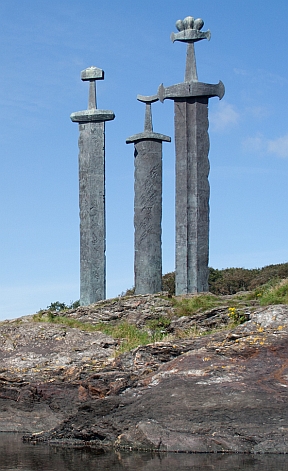
The giant stone swords of Agmundr stand on a rocky outcropping along Sverdsfjord, one of the southernmost bays in that rugged, northland known locally as Izotz. Centuries ago, two kings vied for control of Izotz. Ecgberht and Hildebrand waged war against each other, and the conflict grew increasingly bitter and lawless as both kings sought the advantage over the other. Villages were burned, and their citizens put to the sword. Sacred places were defiled. The blood of innocents cried out for justice, but ambition and malice deafened both Ecgberht and Hildebrand. Into this chaos from out of the ice-locked north strode Guđbrandr.

Haunted by visions of those innocents caught in the conflict between the two kings, Guđbrandr swept into the borderlands between the kingdoms. The opposing armies broke against Guđbrandr’s righteous fury. Others, war-weary, flocked to Guđbrandr’s banner. Before long, Ecgberht and Hildebrand found themselves on the defensive. When winter came and the polar bears arrived to support Guđbrandr, the warring kings decided that perhaps peace was a better option.

In the dead of winter, Guđbrandr met with Ecgberht and Hildebrand at Agmundr by the frozen Sverdsfjord. Guđbrandr took the kings’ swords and thrust them into the rocks. Then he took his own blade and did the same with it. The two kings knelt and swore fealty to Guđbrandr and amity between themselves. The witnesses to this agreement stood awed as the three swords turned to stone and grew to enormous size. The largest sword belonged to the victorious Guđbrandr, and the two smaller swords to the defeated kings Ecgberht and Hildebrand.

Since that day, those northern lands are ruled by a triumvirate of kings descended from Guđbrandr, Ecgberht, and Hildebrand. Each king’s coronation takes place at Agmundr, and the ancient oaths of fealty and amity are repeated in that god-touched place.

Anyone who dedicates himself to a cause or quest may journey to Agmundr and swear an oath on the power of those stone swords.

Barbarians of Lemuria

Upon swearing an oath on the power of Agmundr to accomplish some task, a hero gains 1d6 Fate Points. The hero can use these Fate Points to grant himself a one-off boon, just as if he were a priest.

Dungeon World

When you bolster yourself prior to swearing an oath on the power of Agmundr, you gain preparation as normal, plus you gain hold equal to preparation+2. If you violate your oath, the power of Agmundr will make its displeasure known. As long as you act to fulfill your oath, you may spend hold, 1 for 1, to choose an option:

• Defy danger as if you rolled a 10+ instead of rolling the dice.
• Heal damage equal to half your max HP.
• Inflict maximum damage with an attack.
• Use an advanced move appropriate to your class one time as if you were one level higher.

Swords & Wizardry

A character who swears an oath on the power Agmundr to accomplish some task gains a +1 bonus to attack rolls and saving throws until that task is fulfilled. If the character does not diligently work at performing the task, a deadly weakness sets in (50% reduction in Strength), and an attempt to entirely abandon the quest incurs a curse.

June 19th, 2014  in RPG No Comments »